
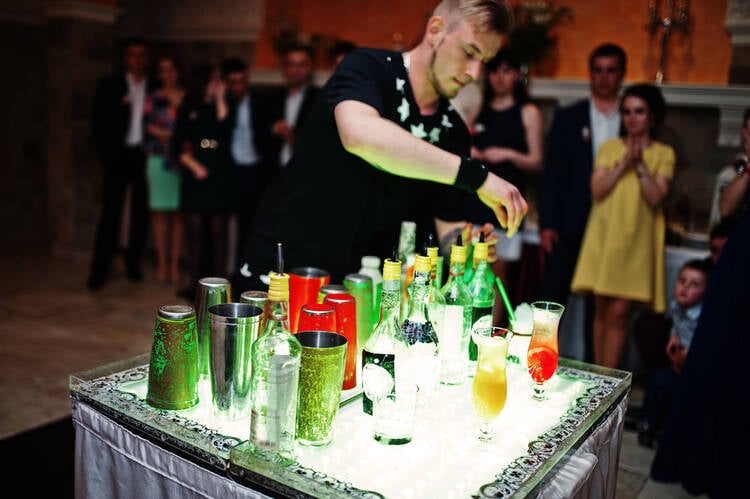
A mobile bartending business provides professional bartenders, portable bars, beverage equipment, mixers, garnishes, ice, glassware, cocktail preparation, and related beverage services at locations chosen by clients.
Unlike a traditional bar, the business is not tied to one permanent customer-facing location.
Mobile bartenders travel to weddings, corporate events, birthdays, private parties, festivals, fundraisers, product launches, and other events.
Depending on state alcohol laws and the company’s licensing arrangements, the client or venue may purchase and provide the alcohol while the mobile bartending company supplies everything needed to serve it.
The business benefits from the size of the wider events industry. More than 2 million weddings took place in the United States in 2025, generating approximately $66.16 billion in wedding spending alone.
Demand for professional bartenders also remains healthy. The U.S. Bureau of Labor Statistics reported about 762,600 bartender jobs in 2025 and projects employment to grow by 5 percent between 2025 and 2035.
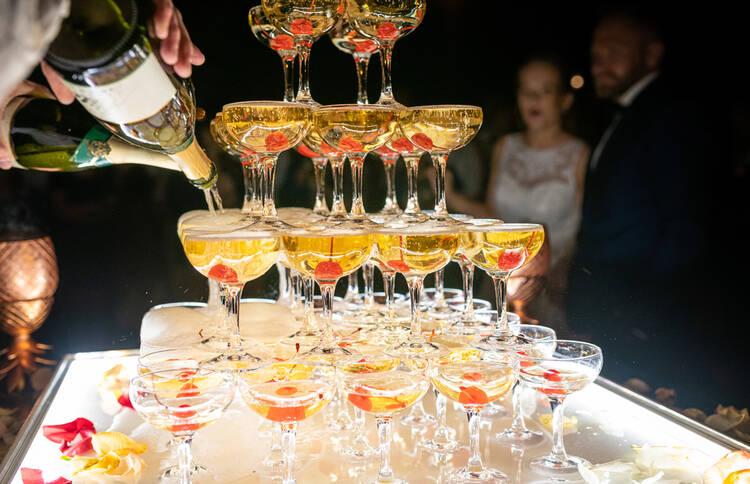
Mobile bartending businesses can generate additional income from mobile bar trailer rentals, mocktail packages, signature cocktail design, glassware rentals, beverage stations, event staffing, champagne service, and branded corporate activation.
Steps on How to Write a Mobile Bartending Business Plan
-
Executive Summary
Blue Ember® Mobile Bartending, LLC, based in Austin, Texas, is an event beverage and hospitality company focused on providing professional mobile bartending services for weddings, corporate events, private parties, birthdays, festivals, brand activations, and special occasions.
Our company will operate primarily as a dry-hire mobile bartending service.
Clients or appropriately licensed venues will purchase the alcoholic beverages, while Blue Ember® Mobile Bartending will provide professional bartenders, mobile bars, mixers, ice, cups, garnishes, cocktail ingredients, equipment, menu planning, setup, service, and cleanup.
This operating model is particularly important in Texas because TABC alcohol permits are generally issued to permanent physical addresses rather than a roaming mobile bar or food truck.
Blue Ember® Mobile Bartending will operate a professionally converted mobile bar trailer supported by portable satellite bars that allow us to handle everything from intimate backyard celebrations to large weddings and corporate events.
Our goal is to build Blue Ember® Mobile Bartending into one of the most recognized mobile beverage-service brands in Austin and Central Texas before expanding into other high-growth event markets.
-
Company Profile
a. Our Products and Services
Mobile Bartending Services:
- Bartender-Only Service: Professional bartenders, bar tools, setup, service, and cleanup while customers supply beverages and consumables.
- Mobile Bar Packages: Portable bar or mobile trailer, professional bartenders, mixers, ice, cups, garnishes, napkins, straws, bar equipment, and beverage planning.
- Wedding Bartending: Cocktail-hour service, champagne toasts, beer and wine service, signature cocktails, reception bartending, and bar coordination.
- Corporate Event Bartending: Beverage service for company parties, conferences, brand activations, client events, networking events, and product launches.
- Private Party Bartending: Birthdays, anniversaries, graduation parties, house parties, engagement parties, reunions, and holiday celebrations.
- Mocktail Bar Packages: Alcohol-free beverage experiences featuring premium mocktails, fresh juices, syrups, garnishes, and specialty drinks.
- Mobile Bar Trailer Rental: Rental of our professionally converted bar trailer with or without bartending staff where permitted.
Other Services:
- Custom signature cocktail development
- Alcohol quantity and shopping-list preparation
- Mixers and garnish packages
- Glassware rental
- Portable bar rental
- Champagne toast service
- Hydration stations
- Coffee and non-alcoholic beverage stations
- Waitstaff and barback services
- Event beverage consultation
- Custom cocktail menus and signage
- Branded corporate beverage stations
- Setup and breakdown services.
b. Nature of the Business
Our mobile bartending company will operate using both the business-to-consumer and business-to-business models.
Individual clients will hire us for weddings, birthdays, anniversaries, graduation parties, engagement parties, and private celebrations.
Business customers will include event planners, wedding coordinators, corporations, venues, caterers, hotels, marketing agencies, production companies, nonprofit organizations, and festival organizers.
c. The Industry
Blue Ember® Mobile Bartending, LLC will operate within the hospitality and event-services industry, specifically the mobile bartending and beverage catering segment.
d. Mission Statement
“At Blue Ember® Mobile Bartending, LLC, our mission is to make professional bar service available wherever our clients choose to celebrate.
We are committed to delivering creative drinks, professional service, responsible alcohol service, attractive bar presentations, and memorable guest experiences while allowing event hosts to relax and enjoy their celebrations.”
e. Vision Statement
“Blue Ember® Mobile Bartending, LLC envisions becoming one of America’s most respected mobile bartending brands, known for exceptional service, creative beverage experiences, responsible bartending, beautiful mobile bars, and outstanding event execution.
We aspire to build a scalable hospitality brand capable of serving weddings, private events, corporate clients, and large celebrations across multiple U.S. markets.”
f. Our Tagline (Slogan)
“Blue Ember® Mobile Bartending – We Bring the Bar to You!”
g. Legal Structure of the Business (LLC, C Corp, S Corp, LLP)
Blue Ember® Mobile Bartending, LLC will be formed as a Limited Liability Company (LLC).
An LLC will provide flexibility in managing the company while helping separate business liabilities from the personal assets of its owners.
Because alcohol service can create significant liability exposure, the company will also carry appropriate general liability, liquor liability where applicable, commercial automobile, workers’ compensation, and equipment insurance.
h. Our Organizational Structure
- Chief Executive Officer (Owner)
- Operations and Event Manager
- Sales and Marketing Manager
- Accountant/Bookkeeper
- Lead Bartenders
- Mobile Bartenders
- Barbacks/Event Assistants
- Driver/Equipment Coordinator
- Part-Time Event Staff.
i. Ownership/Shareholder Structure and Board Members
- Olivia Bennett – Owner and Chairman/Chief Executive Officer – 52 Percent Shares
- Michael Bennett – Board Member – 18 Percent Shares
- Marcus Coleman – Board Member – 10 Percent Shares
- Rachel Wallace – Board Member – 10 Percent Shares
- Amanda Foster – Board Member and Secretary – 10 Percent Shares.
-
SWOT Analysis
a. Strength
- Low Fixed Overhead: The company does not require an expensive permanent bar or restaurant location.
- Mobility: We can serve customers at homes, wedding venues, ranches, offices, event centers, hotels, and outdoor locations.
- Diversified Events: Weddings, corporate functions, private parties, and branded events provide several revenue streams.
- Premium Presentation: Our mobile bar trailer provides a visually attractive centerpiece that can justify premium pricing.
- Dry-Hire Business Model: Having clients purchase the alcohol can reduce inventory requirements and some regulatory complications.
- Custom Cocktail Capability: Signature drinks allow us to differentiate our company from simple bartender-for-hire services.
- Scalable Staffing: Freelance and part-time bartenders can be added according to event demand.
b. Weakness
- Most events take place on weekends and evenings.
- Bookings may be seasonal.
- The business depends heavily on positive online reviews and referrals.
- Transporting equipment increases vehicle and maintenance expenses.
- Quality may decline if poorly trained temporary bartenders are hired.
- Bad weather can affect outdoor events.
- Alcohol-related incidents can create substantial liability.
- A mobile trailer limits the number of events one physical unit can serve simultaneously.
c. Opportunities
- Growing demand for customized wedding experiences.
- Corporate brand activations and experiential marketing events.
- Increasing demand for premium mocktails and alcohol-free bars.
- Partnerships with wedding venues and event planners.
- Mobile bar trailer rentals.
- Luxury cocktail packages.
- Seasonal holiday parties.
- Festival and community event beverage service.
- Expansion into several mobile units.
- Event staffing services.
- Franchise or licensing opportunities.
i. How Big is the Industry?
Mobile bartending is a fragmented segment of the wider hospitality, catering, wedding, and events industries, and there is no single federal statistical category that cleanly measures only U.S. mobile bartending businesses.
However, the markets supporting mobile bartenders are substantial. The United States hosted approximately 2.01 million weddings in 2025, representing around $66.16 billion in total wedding expenditure.
Professional bartending itself is also a large occupation. The Bureau of Labor Statistics estimated approximately 762,600 bartender jobs in 2025.
Private market-research estimates for mobile bartending vary considerably depending on how the category is defined.
One 2026 research estimate valued the worldwide mobile bartender-services market at about $1.8 billion in 2025, but such estimates should be considered directional rather than equivalent to official government industry statistics.
These figures nevertheless demonstrate a sizeable addressable market supported by weddings, private events, festivals, corporate hospitality, and celebrations.
ii. Is the Industry Growing or Declining?
The outlook for professional bartending and event beverage services is positive.
The U.S. Bureau of Labor Statistics projects bartender employment to increase by approximately 5 percent from 2025 to 2035, faster than the projected average for all occupations.
Approximately 121,200 bartender job openings are expected annually during that period.
Mobile bartending should continue benefiting from demand for flexible event vendors, weddings held at nontraditional venues, corporate events, personalized cocktail experiences, and private celebrations.
iii. What are the Future Trends in the Industry?
Future trends in mobile bartending include:
- Mocktails and Zero-Proof Cocktails: Customers increasingly want sophisticated alcohol-free beverages alongside traditional cocktails.
- Signature Drinks: Couples and corporate clients want custom beverages that match the theme, brand, color palette, or personality of their events.
- Photo-Worthy Mobile Bars: Vintage trailers, horse trailers, tap trucks, carts, converted vans, and stylish portable bars are becoming part of the event décor.
- Corporate Brand Activations: Companies are increasingly using branded cocktails and beverage installations for marketing events.
- Digital Booking: Online quoting, contracts, electronic deposits, scheduling, automated reminders, and digital questionnaires will simplify booking.
- Premium Ingredients: Fresh juices, house syrups, elaborate garnishes, herbs, specialty ice, and premium mixers will support higher-priced packages.
- Dry-Hire Models: Businesses operating in jurisdictions where alcohol sales require specialized licensing may focus on service, equipment, and mixers while clients purchase the alcohol.
- Responsible Service: Certification, age verification, liquor liability insurance, and staff training will become increasingly important competitive advantages.
- Multiple Revenue Streams: Mobile bartenders will increasingly add rentals, staffing, mocktail bars, coffee carts, beverage stations, and event coordination.
iv. Are There Existing Niches in the Industry?
Yes, there are several niches in the mobile bartending industry. They include:
- Wedding bartending
- Corporate bartending
- Luxury mixology
- Mobile bar trailer rental
- Mocktail bars
- Craft cocktail bars
- Beer and wine service
- Mobile tap bars
- Festival bartending
- Private party bartending
- Brand activation bartending
- Champagne carts
- Destination wedding bartending
- Event staffing.
v. Can You Sell a Franchise of your Business in the Future?
Yes.
Mobile bartending can be franchised once a company develops recognizable branding, standardized packages, operating procedures, staffing systems, training programs, technology, and marketing processes.
There are already franchise concepts operating in this space. For example, With A Twist markets a mobile bartending and event-services franchise that provides bartending, event staff, portable bar equipment, drink design, mixers, ice, and related services.
Other mobile beverage franchise and licensing concepts also exist, including Tapville Mobile and mobile-bar licensing systems.
Blue Ember® Mobile Bartending does not intend to franchise during its first few years of operation.
d. Threats
- Alcohol-related liability claims
- Changing state or local alcohol regulations
- Competition from inexpensive freelance bartenders
- Economic downturns reducing discretionary event spending
- Cancellation of outdoor events because of weather
- Vehicle accidents or trailer damage
- Rising insurance premiums
- Negative reviews
- Difficulty finding dependable bartenders
- Venue restrictions on outside alcohol vendors
- Customers attempting to serve intoxicated or underage guests
- Increasing fuel and transportation costs.
i. Who are the Major Competitors?
Mobile bartending is highly fragmented, with most competitors operating locally or regionally.
Companies competing within Texas and the wider mobile bartending market include:
- Austin Private Bartending
- The Mobile Bar Austin
- Uphill Taps
- Social Butterfly ATX
- Shaken Not Stirred Bartending
- DTR Bartending – Drink to Remember
- Secret Lime Bar Co.
- Kickstand – The Mobile Mule
- Spirito Bar Co.
- Mobile Bar TX
- The Vintage Texan Mobile Bar
- Toddy For Body
- Charmed Spirits
- EvesBar
- Stirrup Saloon
- Liquid on Wheels
- Tasty Tilly’s Bartending
- With A Twist Bartending Service
- Bartenders On Demand
- Hire A Mixologist.
Austin currently has several active competitors offering professional mobile bartending, custom cocktails, weddings, corporate events, portable bars, and dry-hire services, demonstrating both healthy demand and meaningful competition within the market.
ii. Is There a Franchise for Mobile Bartending Business?
Yes. With A Twist offers mobile bartending franchise opportunities and promotes a home-based, relatively low-overhead model supported by technology, staff scheduling systems, marketing, equipment ownership, and protected territories.
Tapville also offers a mobile taproom franchise concept, while other companies use licensing rather than traditional franchise arrangements.
iii. Are There Policies, Regulations, or Zoning Laws Affecting Mobile Bartending Businesses in the United States of America?
Yes. Mobile bartending companies must pay close attention to state and local alcohol laws.
Requirements vary considerably according to where the business operates, whether alcohol is sold, who purchases the alcohol, whether customers pay individually for drinks, and where each event takes place.
Because Blue Ember® Mobile Bartending will operate in Texas, the company must comply with Texas Alcoholic Beverage Commission requirements.
TABC specifically states that alcohol permits are issued to permanent physical addresses.
A roaming mobile bar or food truck generally cannot obtain an alcohol permit merely for the mobile vehicle.
Therefore, Blue Ember® Mobile Bartending will initially operate primarily as a dry-hire service.
The client will purchase the alcohol, while Blue Ember provides professional bartenders and related services.
If alcohol is being sold at an event, the arrangement must comply with applicable licensing requirements.
TABC also states that temporary event authorizations are generally available to qualifying licensed retailers and eligible nonprofit organizations rather than simply any unlicensed mobile bartender wishing to sell alcohol at an event. Other requirements may include:
- Business registration
- Employer identification number
- State and local tax registrations
- Responsible beverage-service training
- TABC seller/server certification for staff
- General liability insurance
- Liquor liability insurance where applicable
- Commercial vehicle insurance
- Workers’ compensation coverage where required
- Trailer registration
- Food-handling permits when required for certain ingredients
- Venue insurance certificates
- Written contracts
- Age verification policies
- Local permits for festivals and public events.
Legal requirements should always be confirmed for each state and event location before serving or selling alcoholic beverages.
-
Marketing Plan
a. Who is Your Target Audience?
i. Age Range: Primarily adults aged 25 to 55 who organize weddings, parties, corporate events, and celebrations.
ii. Level of Education: No specific educational requirement. Marketing will focus on individuals and businesses capable of planning and paying for professional event services.
iii. Income Level: Primarily middle-income and upper-middle-income households, together with corporate clients and higher-income customers purchasing premium event experiences.
iv. Ethnicity: No specific ethnicity. Blue Ember® Mobile Bartending will serve customers from diverse backgrounds.
v. Language: English will be the primary language, although hiring bilingual bartenders will allow us to serve more of the diverse Central Texas population.
vi. Geographical Location: Initially Austin, Round Rock, Georgetown, Cedar Park, Lakeway, Dripping Springs, San Marcos, Fredericksburg, and surrounding Central Texas communities.
vii. Lifestyle: Couples planning weddings, professionals organizing corporate events, families celebrating milestones, party hosts, event planners, marketing agencies, venue operators, and individuals who value attractive, convenient, professionally managed beverage service.
b. Advertising and Promotion Strategies
- Build relationships with wedding planners.
- Partner with wedding venues.
- Develop referral relationships with photographers, DJs, florists, caterers, and rental companies.
- Attend wedding fairs and bridal shows.
- Develop preferred-vendor arrangements with event venues.
- Create an attractive mobile bar trailer that generates social-media exposure.
- Collect Google reviews after successful events.
- Partner with corporate event planners.
- Offer referral incentives.
- Create styled wedding shoots with other vendors.
- Develop seasonal packages.
- Target businesses planning holiday and employee events.
i. Traditional Marketing Strategies
- Wedding expos
- Bridal fairs
- Business networking events
- Referral partnerships
- Printed brochures
- Venue marketing materials
- Business cards
- Direct mail
- Event-industry trade shows
- Vehicle and trailer branding.
ii. Digital Marketing Strategies
- Search Engine Optimization
- Google Ads
- Google Business Profile
- Instagram marketing
- TikTok marketing
- Facebook advertising
- Pinterest marketing
- Email marketing
- Wedding directory listings
- Content marketing
- Influencer partnerships
- Retargeting advertisements.
iii. Social Media Marketing Plan
- Post videos showing the mobile bar being transformed from trailer to event bar.
- Publish signature cocktail videos.
- Post before-and-after event setups.
- Feature wedding décor and custom cocktail menus.
- Publish bartender tips and drink recipes.
- Share customer testimonials.
- Create behind-the-scenes event content.
- Collaborate with wedding photographers.
- Tag event venues and planners.
- Create Instagram Reels and TikTok videos.
- Promote mocktail and seasonal drink ideas.
- Use customer-generated content with permission.
c. Pricing Strategy
Blue Ember® Mobile Bartending will adopt package-based pricing supplemented by hourly charges and optional upgrades. Current Austin competitors demonstrate the range available in the market.
Austin Private Bartending advertises bartender service at approximately $80 per hour per bartender, with a four-hour event starting around $320.
Secret Lime Bar Co. advertises service beginning around $75 per hour per bartender.
Other Austin providers offer complete packages beginning around $350 for bartender-only service, while more elaborate private-party and wedding packages can cost $1,000 or considerably more.
Blue Ember® Mobile Bartending will therefore avoid competing solely on low prices.
We will position ourselves as a mid-market to premium service based on professional staff, strong presentation, responsive communication, custom drinks, and dependable execution.
-
Sales and Distribution Plan
a. Sales Channels
Blue Ember® Mobile Bartending will generate sales through several channels. Our website will serve as the company’s primary direct-booking platform.
Prospective customers will complete an event questionnaire providing their date, location, guest count, event type, desired service hours, and drink preferences.
The company will then prepare a customized quotation. Additional sales channels will include:
- Wedding planners
- Event planners
- Wedding venues
- Corporate event managers
- Google searches
- TikTok
- Wedding directories
- Vendor referrals
- Corporate partnerships
- Repeat customers
- Word-of-mouth referrals.
b. Inventory Strategy
Because Blue Ember® Mobile Bartending will initially operate primarily as a dry-hire service, we will not maintain large inventories of alcoholic beverages. Instead, inventory will include:
- Mixers
- Syrups
- Juices
- Garnishes
- Disposable cups
- Napkins
- Straws
- Cocktail picks
- Bar tools
- Glassware
- Coolers
- Ice containers
- Portable bars
- Cleaning supplies
- Uniforms
- Signage.
Consumable supplies will be purchased according to confirmed event bookings to minimize spoilage and unnecessary inventory.
Equipment will be labelled, counted, inspected, and stored after every event.
c. Payment Options for Customers
Blue Ember® Mobile Bartending will make the following payment options available:
- Credit cards
- Debit cards
- Bank transfers
- ACH payments
- Approved digital wallets
- Checks from approved corporate customers
- Electronic invoices.
d. Return Policy, Incentives and Guarantees
Return/Cancellation Policy:
Blue Ember® Mobile Bartending will require customers to pay a non-refundable booking retainer to reserve an event date.
The remaining balance will be due before the event according to the terms contained in the service agreement.
Customers cancelling sufficiently in advance may be permitted to transfer part of their payment to another available date.
Cancellations occurring close to an event may result in forfeiture of deposits or additional amounts because staffing, equipment, and the date have already been reserved.
Special rules will apply when government restrictions, severe weather, mandatory evacuation orders, or other circumstances beyond either party’s control make an event impossible.
Incentives:
- Wedding planner referral discounts
- Repeat-customer discounts
- Corporate account pricing
- Off-season discounts
- Weekday event discounts
- Referral credits
- Early-booking incentives
- Package upgrades during promotional periods.
Guarantees:
Blue Ember® Mobile Bartending guarantees that contracted staff and equipment will arrive according to the agreed event schedule except in circumstances beyond our reasonable control.
We guarantee professional service, clean equipment, appropriately trained bartenders, and fulfillment of the services specified in the customer’s contract.
e. Customer Support Strategy
Blue Ember® Mobile Bartending will provide customer support throughout the planning and event process.
After booking, each client will receive an event questionnaire and planning consultation.
The company will confirm guest count, service hours, drink menu, equipment, venue access, ice requirements, glassware, mixers, staffing, and setup before the event.
Customers will be able to communicate with us through telephone, email, website forms, SMS, and social media.
After every event, customers will receive a follow-up message requesting feedback and, where appropriate, an online review.
-
Operational Plan
Blue Ember® Mobile Bartending will operate primarily from a small administrative office and secure storage facility in Austin, Texas.
Our mobile bar trailer, portable bars, glassware, coolers, tables, beverage equipment, decorations, and supplies will be stored at the facility when not being used.
Bookings will be managed using event-management and customer relationship software.
Each event will have an event sheet describing the client, venue, guest count, bartender requirements, service hours, beverage menu, equipment, supplies, arrival time, dress code, and special instructions.
Bartenders will be assigned several days or weeks before each event. All equipment will be inspected before loading.
Following the event, equipment will be returned, cleaned, sanitized, counted, repaired where necessary, and prepared for the next booking.
a. What Happens During a Typical Day at a Mobile Bartending Business?
A typical event day starts with management reviewing the day’s event schedule.
Staff confirm the venue, customer contact details, weather conditions, parking arrangements, load-in instructions, guest count, bar menu, and required equipment.
Bartenders and event assistants gather supplies and load the mobile bar vehicle.
The team arrives at the venue ahead of guest service time. The mobile bar is positioned and prepared.
Ice, mixers, garnishes, cups, tools, menus, and other supplies are arranged.
If the customer is supplying alcohol, staff verify that the requested alcohol has been delivered without taking ownership contrary to applicable law.
During the event, bartenders prepare beverages, monitor guests, maintain the bar area, restock supplies, check identification where appropriate, and follow responsible-service procedures.
After last call, bartenders clean the bar, pack equipment, remove company supplies, and leave the venue according to the contract. Upon returning to storage, equipment is unloaded and cleaned.
b. Production Process
There is no traditional manufacturing process. However, preparing each event involves:
- Receiving the booking.
- Conducting customer consultation.
- Designing the beverage menu.
- Preparing the customer’s alcohol shopping list.
- Determining staffing requirements.
- Purchasing mixers and consumables.
- Preparing syrups and garnishes.
- Packing equipment.
- Transporting equipment to the venue.
- Setting up the mobile bar.
- Serving customers.
- Breaking down the bar.
- Cleaning and sanitizing equipment.
- Returning everything to storage.
c. Service Procedure
Customers will begin by requesting a quotation online or contacting our office. The customer provides information about the event.
Blue Ember® Mobile Bartending will recommend a package and calculate staffing based on guest count, service style, event duration, location, and menu complexity.
After the customer approves the proposal, a contract is signed and the booking retainer is paid.
Approximately two to four weeks before the event, the final guest count and beverage menu will be confirmed.
The customer receives an alcohol purchasing guide where applicable. Staff arrive before service time to complete setup.
During the event, bartenders provide beverage service according to the contract. Following the event, Blue Ember cleans and removes its equipment.
d. The Supply Chain
Blue Ember® Mobile Bartending will maintain supplier relationships with:
- Ice suppliers
- Wholesale food-service suppliers
- Glassware suppliers
- Beverage-equipment suppliers
- Grocery and produce suppliers
- Cup and disposable-product wholesalers
- Uniform suppliers
- Mobile bar builders
- Trailer-maintenance providers
- Automobile repair companies
- Commercial insurance companies
- Printing companies
- Event-rental companies
- Software providers.
Using multiple suppliers will help protect the company from shortages and last-minute event disruptions.
e. Sources of Income
Blue Ember® Mobile Bartending will generate revenue from:
- Bartender service fees
- Wedding bartending packages
- Corporate event packages
- Private party packages
- Mobile bar trailer rentals
- Portable bar rentals
- Glassware rentals
- Mixers and garnish packages
- Mocktail packages
- Signature cocktail design
- Champagne service
- Hydration stations
- Additional bartender fees
- Additional service hours
- Travel charges
- Barback and waitstaff services
- Corporate branding upgrades.
-
Financial Plan
a. Amount Needed to Start your Mobile Bartending Company?
Blue Ember® Mobile Bartending, LLC will require an estimated $90,000 to successfully establish a professional mobile bartending company in Austin, Texas.
A very small bartender-only operation could start with considerably less money.
Our higher startup budget is based on launching with a professionally converted mobile bar trailer, transportation capability, multiple portable bar stations, event equipment, insurance, technology, marketing, and sufficient working capital.
b. What are the Costs Involved?
Our estimated startup budget is:
- Custom Mobile Bar Trailer: $28,000
- Tow Vehicle/Vehicle Deposit or Acquisition: $15,000
- Portable Bars, Bar Tools and Equipment: $8,000
- Insurance, Legal Setup, Permits and Certifications: $7,000
- Glassware, Coolers and Event Equipment: $8,000
- Website, CRM and Booking Software: $5,000
- Branding and Launch Marketing: $4,000
- Working Capital: $10,000
- Opening Mixers, Supplies and Consumables: $5,000.
Total Estimated Startup Cost: $90,000.
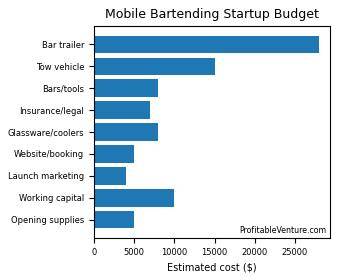
These figures are planning assumptions and actual startup expenses will vary according to the trailer, vehicle, equipment quality, service model, staffing plan, and location.
c. Do You Need to Build a Facility? If YES, How Much will it cost?
Blue Ember® Mobile Bartending will not build a permanent customer-facing facility during the startup stage.
We will lease a small commercial storage and administrative space for our mobile bar trailer, portable bars, glassware, equipment, supplies, and office operations.
This reduces the financial burden associated with constructing or leasing a traditional bar or restaurant.
d. What are the Ongoing Expenses for Running a Mobile Bartending Business?
- Bartender wages
- Event staff wages
- Payroll taxes
- Vehicle fuel
- Vehicle maintenance
- Trailer maintenance
- Vehicle and trailer insurance
- General liability insurance
- Liquor liability insurance where applicable
- Workers’ compensation
- Storage facility rent
- Mixers and garnishes
- Ice
- Cups and napkins
- Glassware replacement
- Cleaning supplies
- Laundry
- Booking software
- Website hosting
- Advertising
- Credit-card processing fees
- Professional services
- Uniforms
- Equipment replacement.
e. What is the Average Salary of your Staff?
Our projected compensation structure is:
- Chief Executive Officer – $65,000 Per Year
- Operations and Event Manager – $52,000 Per Year
- Sales and Marketing Manager – $48,000 Per Year
- Accountant/Bookkeeper – $38,000 Per Year
- Lead Bartenders – $25 to $40 Per Hour
- Event Bartenders – $20 to $35 Per Hour
- Barbacks/Event Assistants – $16 to $24 Per Hour
- Driver/Equipment Coordinator – $20 to $28 Per Hour.
For comparison, the U.S. Bureau of Labor Statistics reported a median bartender wage of approximately $16.51 per hour in May 2025, excluding the potential impact of tips and differences between regular bar employment and specialized event work.
f. How Do You Get Funding to Start a Mobile Bartending Business?
- Personal savings
- Loans from family members and friends
- Bank loans
- SBA-backed loans where eligible
- Equipment financing
- Vehicle financing
- Private investors
- Business partners
- Business credit
- Small-business grants where available
- Crowdfunding.
-
Financial Projection
a. How Much Should You Charge for Your Product/Service?
Current Austin-area market pricing shows considerable flexibility. Some providers charge around $75 to $80 per hour per bartender, while packaged services begin around $350 and can reach several thousand dollars for larger weddings and premium mobile bar experiences. Blue Ember® Mobile Bartending will use the following approximate prices:
Bartender-Only Package
- One bartender, up to four hours: $400 – $500
- Additional bartender: $75 – $100 per hour
- Additional service hour: $100 – $150
Private Party Mobile Bar Package
- Up to 50 guests: $750 – $1,200
- 50 to 100 guests: $1,200 – $2,000
Wedding Bartending Package
- Small Wedding: $1,200 – $1,800
- Medium Wedding: $1,800 – $3,000
- Large/Premium Wedding: $3,000 – $5,000+
Corporate Event Packages
- Small Corporate Event: $800 – $1,500
- Medium Corporate Event: $1,500 – $3,000
- Large Brand Activation: $3,000 – $8,000+
Mobile Bar Trailer Rental
- Trailer Only: $600 – $900 per event
- Trailer With Staff and Service Package: $1,500 – $4,000+
Add-Ons
- Signature Cocktail Development: $75 – $150
- Champagne Toast: $2 – $5 per guest
- Custom Menu Signage: $50 – $150
- Mocktail Upgrade: $150 – $500+
- Additional Portable Bar: $200 – $400
- Travel Outside Standard Service Area: Mileage or flat-rate fee.
b. Sales Forecast?
Based on gradual growth in bookings, increased referrals, additional bartending teams, wedding venue partnerships, corporate clients, and premium packages, Blue Ember® Mobile Bartending projects:
- First Fiscal Year (FY1): $180,000
- Second Fiscal Year (FY2): $300,000
- Third Fiscal Year (FY3): $450,000
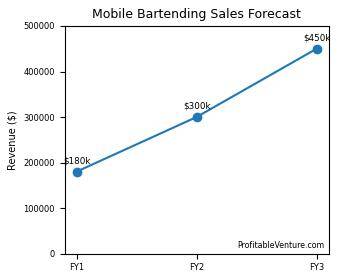
The first year will focus primarily on building reviews and venue partnerships.
During the second year, the company expects to add additional bartending teams so multiple events can be served simultaneously.
By the third year, Blue Ember plans to operate several portable bar setups in addition to the main trailer.
c. Estimated Profit You Will Make a Year?
Our projected profit after tax is:
- First Fiscal Year (FY1): 15 Percent
- Second Fiscal Year (FY2): 20 Percent
- Third Fiscal Year (FY3): 25 Percent
At the projected revenue levels, this represents approximately:
- FY1: $27,000
- FY2: $60,000
- FY3: $112,500.
d. Profit Margin of a Mobile Bartending Business
The ideal net profit margin we hope to achieve at Blue Ember® Mobile Bartending will be between 15 and 25 percent after the company reaches stable booking levels.
Mobile bartending can achieve attractive margins because the business does not carry the same rent, kitchen, utilities, and permanent staffing expenses associated with operating a traditional bar.
However, profitability depends heavily on pricing events correctly. Transportation time, setup, cleanup, staff hours, supplies, insurance, equipment depreciation, credit-card fees, and marketing must be included when calculating the true cost of every event.
-
Growth Plan
a. How do you intend to grow and expand? By opening more retail outlets/offices or selling a Franchise?
Blue Ember® Mobile Bartending will initially grow by increasing the number of events we can serve rather than opening permanent retail locations.
The first expansion will involve purchasing additional portable bars and hiring additional bartending teams.
This will allow us to service several weddings and private events on the same Saturday rather than being limited to a single booking.
The next phase will involve purchasing additional mobile bar trailers for major markets.
Once the company has developed standardized training, contracts, pricing, operating procedures, marketing systems, booking software, and several profitable company-owned territories, management may consider franchising.
b. Where do you intend to expand to and why? (Geographical Locations)
Blue Ember® Mobile Bartending plans to consider expansion into:
- Dallas, Texas
- Houston, Texas
- San Antonio, Texas
- Fort Worth, Texas
- Nashville, Tennessee
- Atlanta, Georgia
- Charlotte, North Carolina
- Orlando, Florida
- Phoenix, Arizona
- Denver, Colorado.
These cities offer sizable populations, active wedding and corporate event markets, tourism, nightlife, convention activity, and strong demand for private events.
Expansion will depend on local alcohol regulations. Because alcohol laws differ significantly from state to state, Blue Ember® Mobile Bartending will develop each territory only after confirming licensing requirements, permitted service models, insurance requirements, and local competition.
-
Exit Plan
Blue Ember® Mobile Bartending, LLC intends to build a scalable mobile hospitality business that can eventually be sold, franchised, licensed, or acquired.
Our preferred long-term exit strategy will be a strategic acquisition by a larger event-services, catering, hospitality, wedding-services, or mobile beverage company.
To increase the company’s eventual value, management will focus on developing a recognizable brand, recurring corporate accounts, venue partnerships, strong customer reviews, standardized operating procedures, documented training systems, dependable staff, and multiple profitable territories.
Another potential exit strategy will involve establishing a franchise network.
Under this arrangement, the founders could gradually reduce their involvement in day-to-day event operations while receiving income from franchise fees, royalties, technology fees, training, or other approved franchise revenue streams.
The company may also attract a private investor or event-services group interested in acquiring a controlling interest while retaining existing management.
Regardless of the eventual exit method, Blue Ember® Mobile Bartending will be built from the beginning as an organized business rather than simply a self-employed bartending job.
This approach should make the company easier to scale, finance, franchise, transfer, or sell in the future.