
A car title loan business lends money to consumers using a vehicle title as collateral.
The borrower normally keeps possession of the vehicle while your company records or holds the appropriate security interest in the title.
Once the borrower repays the loan according to the agreement, your company releases its lien or other title interest.

If the borrower defaults, the lender may eventually have the legal right to repossess and sell the vehicle, but only after following all applicable state and federal requirements.
This sounds like a straightforward secured-lending business. It is not. Vehicle title lending is one of the more heavily scrutinized areas of consumer finance.
Depending on the state, title lending may be:
- Expressly permitted
- Permitted only under particular consumer-lending statutes
- Restricted by interest-rate or APR caps
- Restricted by loan-size limits
- Restricted by minimum or maximum loan terms
- Restricted in the number of renewals
- Effectively uneconomical because of rate caps
- Prohibited entirely.
This means you should not form the company, lease an office, develop loan documents, and then ask whether title loans are legal in the state.
Determine the legal lending model first.
You are also dealing with customers who may be under serious financial pressure. Your business therefore needs strong controls around:
- Affordability
- Transparent pricing
- APR disclosures
- Loan documentation
- Vehicle valuation
- Consumer privacy
- Payment processing
- Collections
- Complaints
- Repossession
- Military borrower protections
- State licensing.
Your long-term goal should be to make money because borrowers successfully repay properly underwritten loans—not because customers repeatedly refinance unaffordable debt or lose their vehicles.
If you already know that you want to enter this industry, you can also review our Car Title Loan Business Plan.
Steps on How to Start a Car Title Loan Business
-
Conduct Market Research
Start with regulation rather than demand. A city may contain thousands of consumers who would potentially use short-term credit, but that does not mean your proposed loan structure is legal there.
Choose several possible states and ask specialist consumer-finance counsel to prepare a regulatory matrix covering:
- Whether vehicle title lending is permitted
- Required lender license
- Maximum interest rate or APR
- Permitted fees
- Maximum loan amount
- Minimum and maximum term
- Renewal/refinancing restrictions
- Ability-to-repay requirements
- Title and lien procedures
- Repossession requirements
- Surplus and deficiency rules
- Advertising requirements
- Surety bonds
- Minimum net worth
- Branch licensing
- Recordkeeping
- Regulatory examinations.
Only after you know what product you can legally offer should you estimate demand.
a. Who is the Target Market?
The typical market consists of consumers who:
- Own a qualifying vehicle
- Have substantial equity in the vehicle
- Need relatively small short-term or installment credit
- May not qualify for conventional unsecured financing
- Can demonstrate a reasonable repayment source.
Potential customers may need money for:
- Emergency household expenses
- Medical bills
- Vehicle repairs
- Utility bills
- Temporary income gaps
- Other unexpected expenses.
Do not define your market simply as “people with cars who need cash.” Your actual addressable market consists of people to whom your company can legally and responsibly extend the specific credit product you are licensed to offer.
b. Is a Car Title Loan Business Profitable?
It can be profitable, but lending revenue should never be confused with profit.
Suppose your loan portfolio generates $500,000 in annual interest and permitted fee income. You still need to subtract:
- Credit losses
- Cost of capital
- Employee payroll
- Compliance
- Legal expenses
- Licensing
- Loan software
- Payment processing
- Fraud losses
- Vehicle recovery expenses
- Office costs
- Marketing
- Insurance.
The biggest financial mistake is assuming that collateral eliminates credit risk. It does not. A repossessed vehicle may:
- Sell for less than expected
- Require towing
- Require storage
- Need auction fees
- Contain damage
- Take time to liquidate
- Generate legal or compliance costs.
The best loan is normally one the borrower repays according to the agreement.
c. What Determines Profitability?
- Average outstanding loan portfolio
- Permitted interest and fee structure
- Portfolio turnover
- Cost of funding
- Delinquency rate
- Charge-off rate
- Fraud losses
- Recovery rate
- Operating cost per loan
- Customer acquisition cost
- Compliance cost.
d. What Niches Exist?
Depending on what state law permits, a company might specialize in:
- Short-term title-secured loans
- Longer-term title-secured installment loans
- Small-dollar secured lending
- Online application with in-person title verification
- Fully digital servicing where legally permitted
- Single-state storefront lending
- Multi-branch lending.
Do not assume that a product legal in one state can simply be copied into another.
e. Who are the Major Competitors?
Your competitors may include:
- Title lenders
- Small installment lenders
- Credit unions
- Community banks
- Online personal lenders
- Pawn lenders
- Other alternative-credit providers.
Customers may also compare your loan against:
- Credit cards
- Employer advances
- Family loans
- Bank overdraft products
- Payment plans
- Personal loans.
f. What Federal Rules Should You Consider?
State law will determine much of your title-lending product, but federal consumer-finance laws can also apply. Your compliance review should consider requirements involving:
- Truth in Lending
- Regulation Z
- Equal Credit Opportunity
- Fair credit reporting where consumer reports are used
- Consumer financial privacy and data security
- Electronic payments
- Unfair, deceptive, or abusive practices
- Applicable small-dollar and vehicle-title lending rules
- Servicemember protections.
Your loan documents should clearly disclose the legally required credit terms. Consumers should understand:
- Amount financed
- Finance charge
- APR
- Payment amount
- Payment dates
- Total payments
- Late-payment consequences
- Collateral
- Default provisions.
g. Pay Particular Attention to Military Borrowers
Do not treat active-duty military customers like ordinary title-loan applicants.
The Military Lending Act creates special protections for covered servicemembers and dependents.
A title-secured product that might be legal for another consumer can be prohibited or restricted for a covered military borrower.
Your application process should therefore include a legally compliant system for determining MLA-covered borrower status before consummating covered loans.
Your compliance attorney should also address Servicemembers Civil Relief Act requirements for pre-service obligations.
h. What Do You Need to Start?
- Substantial lending capital
- Consumer-lending attorney
- State lending license
- Surety bond where required
- Compliance management system
- Loan management software
- Secure customer portal
- Identity-verification system
- Vehicle valuation system
- Title/lien verification
- Payment processing
- Cybersecurity
- Trained loan personnel
- Complaint-management process
- Collections procedures
- Approved repossession vendors
- Liquidity reserve
- Loan-loss reserve.
i. How Does the Loan Process Work?
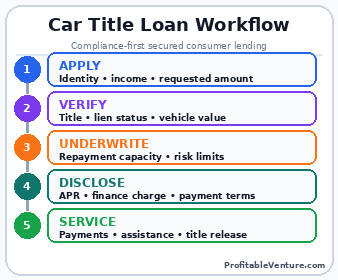
Step 1 – Application
The applicant provides the required personal, financial, vehicle, and contact information.
Step 2 – Identity Verification
Confirm the applicant’s identity using legally appropriate procedures.
Step 3 – Verify the Vehicle and Title
Confirm:
- VIN
- Ownership
- Title status
- Existing liens
- Vehicle condition
- Estimated value.
Step 4 – Underwrite the Loan
Do not simply ask whether the vehicle is worth more than the loan.
Evaluate whether the proposed loan complies with your underwriting standards and whether the borrower has a realistic repayment source.
Collateral should support the credit decision rather than replace responsible underwriting.
Step 5 – Generate Required Disclosures
Present the borrower with complete loan terms before signing.
Step 6 – Execute the Loan
Complete the agreement and establish the lender’s legal security interest according to applicable state requirements.
Step 7 – Disburse Funds
Disburse money only after all approval, identity, title, disclosure, and compliance checks are completed.
Step 8 – Service the Loan
Track payments, statements, notices, customer inquiries, and account status.
Step 9 – Release the Title Interest After Payoff
When the borrower fulfills the obligation, release your lien or security interest promptly according to applicable law.
-
Choose a Memorable Business Name
A financial-services brand should sound trustworthy rather than desperate or aggressive. Some ideas include:
- ClearRoad Title Finance, LLC
- DriveBridge Financial, LLC
- AutoEquity Finance, LLC
- RoadValue Lending, LLC
- ClearTitle Finance, LLC
- Vehicle Equity Partners, LLC
- DrivePoint Financial, LLC
- RoadBridge Lending, LLC
- AutoTrust Finance, LLC
- EquityDrive Lending, LLC
- MotorBridge Finance, LLC
- TitlePath Financial, LLC
- Roadway Consumer Finance, LLC
- DriveCapital Lending, LLC
- ClearPath Auto Finance, LLC
- Vehicle Value Finance, LLC
- RoadTrust Lending, LLC
- AutoBridge Financial, LLC
- TitleWorks Finance, LLC
- ClearLane Lending, LLC.
Check business-name availability, regulatory naming requirements, and trademarks before selecting your final name.
-
Register and License the Business
a. What Business Structure is Best?
An LLC or corporation may be appropriate depending on ownership and capital structure.
However, title lending is a regulated activity. Forming an LLC does not give you authority to make loans.
The entity may need a separate consumer-lending or title-lending license before it may legally originate loans.
b. Typical Formation Steps
- Select your state and legal lending model
- Engage consumer-finance counsel
- Form the legal entity
- Obtain an EIN
- Open business banking accounts
- Capitalise the company
- Apply for required lending licenses
- Obtain surety bonds where required
- Purchase insurance
- Implement the compliance management system
- Approve loan documents
- Test systems before originating loans.
c. What Licenses May Be Required?
Depending on jurisdiction:
- Consumer lender license
- Title lender license
- Small-loan license
- Installment lender license
- Branch licenses
- General business license
- Debt collection license where applicable
- Repossession-related registrations for in-house activity, if permitted and applicable.
Many financial licenses also require some combination of:
- Background checks
- Financial statements
- Minimum net worth
- Surety bonds
- Ownership disclosures
- Qualified managers
- Regulatory examinations.
d. What Documents Do You Need?
- Formation documents
- EIN
- Lending licenses
- Surety bonds
- Insurance policies
- Loan agreement
- Federal and state disclosures
- Privacy notice
- Credit policy
- Underwriting policy
- Fair-lending policy
- MLA/SCRA procedures
- Collections policy
- Repossession policy
- Complaint policy
- Information-security program
- Incident-response plan
- Vendor-management policy
- Advertising policy
- Employee training records.
e. What Insurance Should You Carry?
Potential coverage includes:
- General liability
- Professional liability/errors and omissions
- Cyber liability
- Commercial property
- Workers’ compensation
- Crime/fidelity coverage
- Directors and officers coverage where appropriate
- Umbrella liability.
f. Build a Compliance Management System Before Launch
Your compliance system should cover the entire loan lifecycle:
- Advertising
- Applications
- Underwriting
- Disclosures
- Funding
- Payments
- Late accounts
- Customer complaints
- Collections
- Repossession
- Vehicle sales
- Title release
- Data retention.
Train every employee on the procedures that apply to his or her job. Do not allow loan officers to invent terms or fees at the counter.
-
Cost Analysis and Budgeting
a. How Much Does It Cost to Start a Car Title Loan Business?
This is fundamentally a capital business. Your main asset is not the office. It is the loan portfolio. For planning purposes:
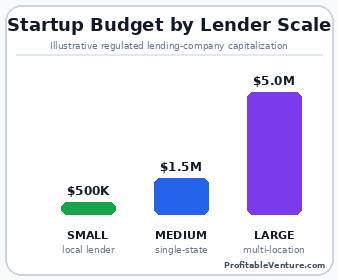
- Small local lender: approximately $300,000 – $750,000
- Professional single-state lender: approximately $1 million – $3 million
- Larger multi-location lender: approximately $4 million – $15 million+.
For this guide, we will model:
- Small: $500,000
- Medium: $1.5 million
- Large: $5 million
b. Small Local Lender – Approximately $500,000
- Loan portfolio capital – $325,000
- Liquidity and loss reserve – $60,000
- Legal, licensing, and compliance – $40,000
- Loan-management software and cybersecurity – $20,000
- Office, security, and equipment – $15,000
- Payroll reserve – $15,000
- Marketing – $10,000
- Insurance and professional fees – $15,000
- Total – $500,000.
c. Medium Single-State Lender – Approximately $1.5 Million
- Loan portfolio capital – $1,050,000
- Liquidity and loan-loss reserve – $150,000
- Legal, licensing, and compliance – $90,000
- Loan software, cybersecurity, and data services – $55,000
- Office, security, and equipment – $45,000
- Payroll reserve and recruiting – $45,000
- Launch marketing – $35,000
- Insurance and professional fees – $30,000
- Total – $1,500,000.
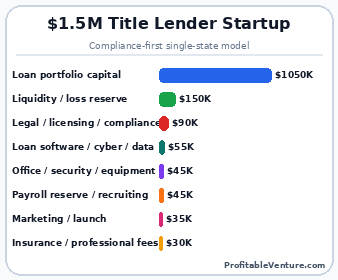
This is the financial model used below.
d. Large Multi-Location Lender – Approximately $5 Million
- Lending capital – $3,650,000
- Liquidity and loan-loss reserves – $450,000
- Legal, licensing, and compliance – $250,000
- Technology and cybersecurity – $175,000
- Branches, security, and equipment – $150,000
- Payroll reserve – $120,000
- Marketing – $100,000
- Insurance and professional fees – $105,000
- Total – $5,000,000.
e. Why is the Loan Reserve So Important?
Suppose the company approves $80,000 of new loans this week. You need actual money available to fund those loans. At the same time, you need sufficient liquidity for:
- Payroll
- Operating expenses
- Unexpected credit losses
- Legal costs
- Customer refunds where required
- Regulatory obligations.
Do not lend every available dollar.
f. What are the Ongoing Expenses?
- Cost of lending capital
- Credit losses
- Payroll
- Licensing
- Legal counsel
- Compliance
- Loan software
- Credit and identity data
- Cybersecurity
- Payment processing
- Office occupancy
- Insurance
- Marketing
- Collections
- Vehicle recovery expenses
- Storage and auction expenses.
g. What Staff Do You Need?
A medium operation may employ:
- Chief Executive/General Manager
- Compliance Officer
- Underwriter/Credit Manager
- Loan Officers
- Loan Servicing Representatives
- Collections Specialists
- Customer Service Representatives
- Finance/Accounting Staff
- IT/Cybersecurity Support.
h. How Do You Fund the Company?
- Founder equity
- Private investors
- Bank financing where available
- Specialty lending facilities
- Business partners
- Retained earnings.
Your lenders and investors will usually care about:
- Portfolio performance
- Delinquencies
- Charge-offs
- Compliance history
- Liquidity
- Net worth
- Management experience.
-
Write a Business Plan
You can use our Car Title Loan Business Plan as an additional planning reference.
a. Executive Summary
ClearRoad Title Finance, LLC is a proposed licensed consumer-finance company that will originate vehicle-title-secured loans only in a jurisdiction where its proposed product is expressly permitted.
The company will not launch lending operations until all applicable licenses, surety bonds, disclosures, lending policies, servicing systems, and compliance controls have been approved. ClearRoad will launch with approximately $1.5 million in capital.
Approximately $1.05 million will initially be allocated to lending capital, while the remaining funds will support liquidity, credit-loss reserves, licensing, compliance, technology, employees, insurance, and operations.
The company’s lending philosophy will emphasize:
- Transparent disclosures
- Lawful pricing
- Documented underwriting
- Affordable payment structures
- Fair servicing
- Early borrower communication
- Repossession only as a last-resort recovery tool.
b. Mission Statement
“At ClearRoad Title Finance, LLC, our mission is to provide lawful, transparent vehicle-secured credit through responsible underwriting, understandable loan terms, respectful customer service, secure technology, and disciplined regulatory compliance.”
c. Vision Statement
“Our vision is to build a trusted specialty consumer lender recognized for regulatory discipline, fair treatment of borrowers, transparent pricing, strong portfolio management, and sustainable financial performance.”
d. Goals and Objectives
Management will monitor:
- Outstanding principal
- Originations
- Average loan balance
- Delinquency rate
- Charge-off rate
- Net credit losses
- Recovery rate
- Cost per originated loan
- Portfolio yield
- Cost of capital
- Complaints
- Regulatory exceptions
- Repeat borrower concentration.
e. Organizational Structure
- Chief Executive Officer
- Chief Compliance Officer
- Credit/Underwriting Manager
- Loan Officers
- Servicing Manager
- Customer Service Representatives
- Collections Team
- Finance/Accounting
- IT/Cybersecurity
- External Legal Counsel.
Marketing Plan
a. SWOT Analysis
Strengths
Vehicle collateral can reduce some credit exposure compared with completely unsecured lending.
A well-capitalized lender can also process approved transactions relatively quickly.
Weaknesses
The industry faces substantial regulatory, legal, reputational, and credit risk. The business also requires significant lending capital.
Opportunities
Opportunities may exist in jurisdictions where consumers lack access to mainstream small-dollar credit and title-secured lending is expressly permitted under responsible terms.
Threats
- State rate-cap changes
- New consumer-protection laws
- License suspension
- Credit losses
- Fraud
- Regulatory enforcement
- Class-action litigation
- Cybersecurity incidents
- Reputational damage
- Cost-of-capital increases.
b. How Does the Company Make Money?
The company earns primarily from:
- Lawful interest income
- Permitted origination or administrative fees where legally allowed
- Other expressly permitted loan charges.
Do not build your business plan around:
- Repeated rollovers
- Hidden add-ons
- Unnecessary insurance products
- Excessive late fees
- Repossession proceeds.
Repossession should be treated as credit-loss recovery, not a core revenue stream.
c. How Should You Price Loans?
Do not decide that you want to earn a particular APR and then look for a state that allows it.
Start with the law. Your pricing matrix should be approved by consumer-finance counsel and identify:
- Permitted interest rate
- APR requirements
- Permitted origination fees
- Late fees
- Returned-payment fees
- Loan term
- Renewal rules
- Prepayment rules.
Your compliance system should also ensure that fees legally treated as finance charges are included correctly when calculating required disclosures.
d. Marketing Strategies
Potential channels include:
- Local search advertising
- Search-engine optimization
- Storefront visibility where permitted
- Direct response advertising
- Online applications
- Community advertising
- Existing-customer referrals where legally permitted.
e. Keep Advertising Transparent
Avoid statements such as:
- “Guaranteed approval”
- “Everybody qualifies”
- “No risk”
- “Keep your car no matter what”
- “Instant free money.”
If you advertise a particular rate, payment, or credit term, make sure the advertised term is genuinely available and presented with all disclosures required by applicable law.
Financial Projection
a. Revenue Assumptions
The projection below assumes ClearRoad gradually grows its properly licensed loan portfolio while maintaining meaningful loss reserves and conservative liquidity.
Revenue means interest and legally permitted fee income.
Vehicle sale proceeds used to recover defaulted balances are not treated as ordinary operating revenue in this simplified model.
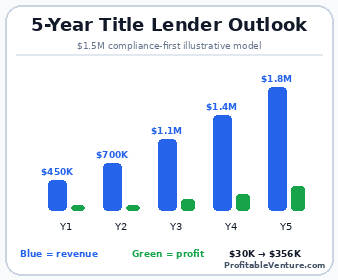
b. Five-Year Revenue and Profit Projection
| Fiscal Year | Interest & Fee Revenue | Operating Expenses | Net Profit | Net Margin |
|---|---|---|---|---|
| Year 1 | $450,000 | $420,000 | $30,000 | 6.7% |
| Year 2 | $700,000 | $630,000 | $70,000 | 10.0% |
| Year 3 | $1,050,000 | $885,000 | $165,000 | 15.7% |
| Year 4 | $1,400,000 | $1,155,000 | $245,000 | 17.5% |
| Year 5 | $1,800,000 | $1,444,000 | $356,000 | 19.8% |
Under this illustrative model, cumulative five-year revenue would be approximately $5.3 million. Cumulative projected net profit would be approximately $866,000.
c. Sample Five-Year Profit and Loss Projection
| Item | Year 1 | Year 2 | Year 3 | Year 4 | Year 5 |
|---|---|---|---|---|---|
| Interest & Permitted Fee Revenue | $450,000 | $700,000 | $1,050,000 | $1,400,000 | $1,800,000 |
| Credit Losses and Charge-Offs | $100,000 | $150,000 | $220,000 | $290,000 | $370,000 |
| Cost of Lending Capital | $50,000 | $80,000 | $120,000 | $165,000 | $210,000 |
| Payroll and Benefits | $100,000 | $145,000 | $205,000 | $265,000 | $330,000 |
| Legal, Compliance and Licensing | $35,000 | $45,000 | $55,000 | $65,000 | $75,000 |
| Technology, Data and Cybersecurity | $25,000 | $35,000 | $45,000 | $55,000 | $70,000 |
| Marketing | $25,000 | $35,000 | $50,000 | $65,000 | $80,000 |
| Office, Security and Occupancy | $30,000 | $35,000 | $40,000 | $45,000 | $50,000 |
| Loan Servicing and Payment Processing | $15,000 | $25,000 | $40,000 | $55,000 | $70,000 |
| Collateral Recovery and Auction Expenses | $10,000 | $15,000 | $20,000 | $25,000 | $30,000 |
| Insurance, Administration and Other Costs | $30,000 | $65,000 | $90,000 | $125,000 | $159,000 |
| Total Operating Expenses | $420,000 | $630,000 | $885,000 | $1,155,000 | $1,444,000 |
| Projected Net Profit | $30,000 | $70,000 | $165,000 | $245,000 | $356,000 |
d. What Determines Profit?
- Size of the loan portfolio
- Lawful portfolio yield
- Credit-loss rate
- Cost of capital
- Operating efficiency
- Customer acquisition cost
- Fraud prevention
- Delinquency
- Recovery rates
- Regulatory cost.
e. What is the Profit Margin?
The illustrative model begins at approximately 6.7% net margin and rises toward approximately 19.8%.
This assumes the lender grows its performing portfolio, improves operating efficiency, maintains controlled credit losses, and does not experience significant regulatory or litigation costs.
Actual results can differ dramatically.
-
Set Up Your Office and Lending Technology
You do not need an extravagant office. You need a secure one. Your operation may require:
- Customer service area
- Private loan interview space
- Secure document storage
- Computers
- Security cameras
- Alarm system
- Loan-management software
- Secure internet/networking
- Payment-processing systems.
a. Protect Customer Data
You may hold highly sensitive information such as:
- Social Security numbers
- Driver’s license information
- Income information
- Bank-account details
- Vehicle titles
- Payment information.
Cybersecurity should therefore be part of your startup budget rather than something you add after a breach.
b. Use a Real Loan Management System
Your software should be able to track:
- Applications
- Approvals
- Loan balances
- Payment schedules
- Interest
- Fees
- Delinquencies
- Notices
- Titles/liens
- Complaints
- Collections
- Payoffs.
-
Hire and Train Employees
Do not train loan officers simply to close as many loans as possible. They should understand:
- Eligibility
- Required disclosures
- State loan limits
- Permitted fees
- Fair lending
- Privacy
- MLA screening
- Complaint escalation
- Title procedures
- Prohibited practices.
a. Give Compliance Real Authority
Your compliance officer should be able to stop a loan product, advertisement, fee, or process that creates legal risk.
Compliance should not report to a sales manager whose compensation depends entirely on originations.
b. Audit Loan Files
Review samples regularly for:
- Correct disclosures
- Correct APR
- Proper fees
- Title verification
- Required notices
- Underwriting documentation
- Military-status checks
- Payment accuracy.
-
Launch and Manage the Company Properly
Do not open five branches immediately. Launch one controlled operation and verify that the entire credit lifecycle works. Track the first portfolio carefully.
Watch:
- Early delinquencies
- Payment failures
- Fraud attempts
- Borrower complaints
- Documentation errors
- Unexpected loss patterns.
a. Build a Responsible Delinquency Process
When a borrower misses a payment, early communication may be more effective than immediately escalating toward repossession. Where legally permitted, your policies may include appropriate:
- Payment reminders
- Written delinquency notices
- Hardship review
- Lawful payment arrangements
- Voluntary payoff discussions.
Any modification must comply with state and federal law.
b. Treat Repossession as a Last Resort
If repossession becomes legally appropriate:
- Confirm default
- Confirm required notices
- Check bankruptcy or legal holds
- Use properly qualified vendors
- Require lawful, non-confrontational recovery
- Protect personal property left in the vehicle
- Send required post-repossession notices
- Conduct the sale according to applicable law
- Account properly for surplus or deficiency.
Never encourage a recovery agent to use force, threats, or other conduct that could constitute a breach of the peace.
c. What Makes a Car Title Loan Business Successful?
- Strong compliance – One regulatory failure can be extremely expensive.
- Responsible underwriting – Collateral should not replace repayment analysis.
- Accurate disclosures – Borrowers should understand what the loan costs.
- Portfolio discipline – Monitor losses constantly.
- Liquidity – Do not lend away every dollar.
- Fraud controls – Verify titles and identities carefully.
- Secure technology – Consumer financial data requires protection.
- Fair servicing – Accurate payments and balances matter.
- Complaint management – Complaints can reveal problems before regulators do.
- Careful collections – Recovery practices must remain lawful and documented.
d. What Happens During a Typical Day?
The compliance manager begins the morning reviewing regulatory alerts and any customer complaints.
A loan officer receives an application from a vehicle owner seeking a $1,500 loan.
- Identity is Verified
- Terms and condition are confirmed.
The underwriting team evaluates the proposed loan under the company’s approved credit policy.
- Another application is declined because it falls outside policy.
- The applicant receives the required notice.
- A servicing employee processes payments and reconciles accounts.
- Another customer contacts the company because a payment appears incorrect.
The account is investigated and corrected where necessary. The finance team reviews:
- Cash available for lending
- Outstanding portfolio
- Daily collections
- Past-due balances
- Charge-offs.
A weekly credit meeting reviews whether recent originations are performing as expected. Before closing, management checks:
- Loans originated
- Loans declined
- Cash disbursed
- Payments received
- Delinquencies
- Complaints
- Exceptions
- Available liquidity.
e. What Skills and Experience Do You Need?
- Consumer finance
- Credit underwriting
- Compliance
- Portfolio management
- Financial accounting
- Collections management
- Information security
- Customer service
- Risk management.
You do not need to have previously owned a lending company. But this is not a business where you should learn consumer-finance law through expensive mistakes.
- Hire experienced counsel.
- Hire a serious compliance professional.
- Choose the state before designing the product.
- Determine the legal APR and fee structure before writing the financial plan.
- Build strong underwriting.
- Maintain liquidity.
- Protect consumer data.
- Audit loan files.
- Monitor complaints.
And measure success by the performance of loans that borrowers repay—not by how many vehicles you repossess.
If you can combine sufficient lending capital, responsible underwriting, transparent disclosures, secure technology, disciplined credit management, lawful collections, strong liquidity, and rigorous regulatory compliance, you can build a sustainable car title loan business without relying on practices that create unnecessary consumer harm or regulatory risk.