

A CNC machine shop is a manufacturing business that uses computer numerical control equipment to cut, drill, mill, turn, bore, thread, and shape raw materials into precise components according to engineering drawings or digital models.
Your customers may send you a drawing for a stainless-steel shaft, aluminum housing, mounting bracket, medical-device component, machine replacement part, robotics component, tooling fixture, or prototype.
Your shop then determines:
- What material is required
- Which CNC machine should make the part
- How the part will be held
- What cutting tools are needed
- How long programming and setup will take
- How many machining operations are required
- How the part will be inspected
- How much the job should cost.
You may machine:
- Aluminum
- Carbon steel
- Stainless steel
- Brass
- Bronze
- Copper
- Titanium
- Engineering plastics
- Other machinable materials.
Your customers can come from industries such as:
- Automotive
- Aerospace
- Robotics
- Medical devices
- Industrial machinery
- Energy
- Agriculture
- Construction equipment
- Food-processing machinery
- Packaging equipment
- Defense supply chains
- Electronics manufacturing.
The business can become very profitable because customers are not simply buying metal.
They are paying you to convert an inexpensive piece of raw material into an accurate component that may be worth many times the cost of the material. However, CNC machining is capital intensive.
A beginner can easily spend hundreds of thousands of dollars on machines, tooling, inspection equipment, software, electrical upgrades, material, and employees before the shop has enough recurring work to keep those machines busy.
This is why your first question should not be: “Which CNC machine should I buy?” Your first question should be: “Who will pay me to run it?”
A $100,000 machine with no work is an expensive object occupying floor space.
A properly tooled machine running profitable repeat production 30 to 50 hours per week can become one of the strongest revenue-producing assets in your company. That distinction is the foundation of a successful machine shop.
Steps on How to Start a CNC Machine Shop in Your Garage
-
Conduct Market Research
Your market research should begin with manufacturers in your region. Make a list of companies within approximately 50 to 150 miles that manufacture equipment or regularly purchase machined components.
Potential customers may include:
- Machine builders
- Automation companies
- Robotics businesses
- Packaging-equipment manufacturers
- Agricultural-equipment companies
- Auto-parts manufacturers
- Medical-device companies
- Industrial maintenance companies
- Engineering firms
- Food-processing-equipment manufacturers
- Energy companies
- Research laboratories.
Then find out what these businesses are currently outsourcing. You are looking for problems such as:
- Local machine shops have six-week lead times
- Existing suppliers do not want small prototype jobs
- Customers struggle to source complex turned parts
- Manufacturers need emergency replacement parts
- A company needs a second approved supplier
- A customer needs tighter inspection documentation
- Local shops do not have the required machine capacity.
Those problems represent opportunities.
a. Who is the Target Market?
Your customers can include:
- Manufacturing companies
- Machine builders
- Engineering firms
- Automotive suppliers
- Aerospace suppliers
- Medical-device manufacturers
- Industrial equipment companies
- Robotics companies
- Energy companies
- Maintenance departments
- Research institutions
- Inventors and product developers
- Other machine shops needing overflow capacity.
Do not overlook other machine shops. They can become excellent customers. A shop specializing in CNC turning may send milling work to you.
A five-axis shop may subcontract simple three-axis work because it does not want to occupy expensive machines with low-complexity parts.
A busy shop may also send you work simply because it has more orders than capacity.
b. Is a CNC Machine Shop Profitable?
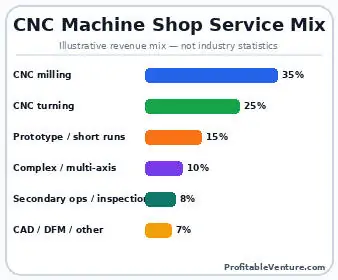
Yes, but profitability depends much more on machine utilization and quoting than on owning expensive equipment. Consider a simplified example.
Suppose a machining center produces billable work for 30 hours per week at an effective shop rate of $130 per hour. That represents:
30 hours × $130 × 50 weeks = $195,000 in annual billable machine revenue.
If the same machine produces only 10 billable hours per week:
10 × $130 × 50 = $65,000.
The purchase payment, insurance, floor space, and depreciation do not disappear because utilization fell. This is why you should closely monitor:
- Machine utilization
- Spindle hours
- Setup hours
- Cycle time
- Scrap
- Rework
- Tool consumption
- Revenue per machine hour
- Gross margin per job
- On-time delivery.
c. What Niches Exist in CNC Machining?
You can specialize in:
- CNC milling
- CNC turning
- Prototype machining
- Short-run production
- High-volume production
- Five-axis machining
- Swiss machining
- Large-part machining
- Micro machining
- Medical components
- Aerospace components
- Automotive components
- Plastic machining
- Tooling and fixtures
- Replacement machine parts
- Emergency repair machining.
A new shop may be better off choosing a manageable niche instead of trying to purchase every machine type immediately. For example, you might start with:
- One vertical machining center
- Aluminum and mild-steel parts
- Prototype and short-run work
- Jobs fitting within a specific work envelope.
Once customers begin asking for turned parts frequently enough to justify the investment, you can add a CNC lathe.
d. Who are the Major Competitors?
Your main competition will generally come from:
- Independent machine shops
- Large contract manufacturers
- Specialized aerospace shops
- Medical machining companies
- Online manufacturing marketplaces
- Foreign manufacturers
- Customers with in-house machining departments.
You do not necessarily need to beat the largest shop on price. You can compete on:
- Fast quoting
- Short lead times
- Small minimum quantities
- Emergency work
- Engineering support
- Quality
- Inspection documentation
- Communication
- Reliable delivery.
A customer whose production line is shut down may happily pay more for a replacement shaft delivered tomorrow than for one that costs 20% less but arrives in three weeks.
e. What Regulations Apply?
A CNC machine shop is primarily regulated as an industrial workplace. Requirements can include:
- Business registration
- Industrial zoning
- Certificate of occupancy
- Fire-code compliance
- Workplace safety requirements
- Machine guarding
- Lockout/tagout procedures
- Hazard communication
- Personal protective equipment
- Noise controls
- Forklift safety
- Waste-management requirements.
Machining operations can generate:
- Metal chips
- Used coolant
- Cutting oils
- Solvent waste
- Oily absorbents
- Used filters
- Scrap metal.
You should determine how every waste stream will be recycled, managed, or disposed of legally. Metal chips can often be separated by alloy and sold to scrap recyclers.
Coolants, solvents, and contaminated materials require more careful management.
f. What Certifications Can Help You Win Better Customers?
A general commercial machine shop may operate without specialized quality certification.
However, certifications can become increasingly valuable as you pursue larger customers. Examples include:
- ISO 9001 quality-management certification
- AS9100 for aerospace supply-chain work
- ISO 13485 where appropriate for medical-device manufacturing
- Customer-specific approved supplier certifications.
Certification does not automatically make your machining better. It demonstrates that your company operates documented and controlled quality systems.
g. What Do You Need to Start?
- Suitable industrial facility
- CNC milling machine
- CNC turning equipment where required
- Toolholders
- Cutting tools
- Vises
- Chucks
- Fixtures
- Probing equipment
- Air compressor
- Coolant systems
- Material storage
- Inspection equipment
- CAD software
- CAM software
- Computers
- Machinists
- Programmers
- Working capital.
h. How Does the CNC Machining Process Work?
A normal job may follow these steps:
Step 1 – Receive the RFQ
The customer sends a drawing, 3D model, specifications, material requirements, quantity, and requested delivery date.
Step 2 – Review Manufacturability
You determine whether the tolerances, geometry, surface finish, material, and quantity fit your capabilities.
Step 3 – Estimate the Job
Calculate:
- Material
- Programming
- Setup
- Cycle time
- Tooling
- Inspection
- Secondary operations
- Packaging
- Profit margin.
Step 4 – Program the CNC Machine
The programmer uses CAM software or control programming to create toolpaths.
Step 5 – Set Up the Machine
Install workholding, cutting tools, raw stock, offsets, and programs.
Step 6 – Produce a First Article
The first completed part should be measured carefully before continuing production.
Step 7 – Run Production
Once the process is verified, produce the remaining quantity.
Step 8 – Inspect
Measure critical dimensions and record results where required.
Step 9 – Complete Secondary Operations
These may include:
- Deburring
- Grinding
- Heat treatment
- Anodizing
- Plating
- Painting
- Laser marking.
Step 10 – Ship
Package parts properly and send the required inspection or certification documentation.
-
Choose a Memorable Business Name
Some CNC machine shop business name ideas include:
- Precision Axis Manufacturing, LLC
- IronPeak CNC Works, LLC
- Vertex Precision Machining, LLC
- TrueCut CNC Manufacturing, LLC
- AxisPoint Machine Works, LLC
- Precision Forge CNC, LLC
- BlueSteel Machining, LLC
- NextAxis Manufacturing, LLC
- PrimeCut CNC Works, LLC
- Vector Precision Manufacturing, LLC
- ExactPoint Machine Works, LLC
- CoreAxis CNC, LLC
- PrecisionPath Manufacturing, LLC
- IronEdge CNC, LLC
- NorthStar Machine Works, LLC
- ExactForm Machining, LLC
- AxisCraft Manufacturing, LLC
- Summit Precision Works, LLC
- TrueAxis Machine Company, LLC
- Advanced Precision Components, LLC.
Check state business records and potential trademark conflicts before selecting the final name.
-
Register Your Business
a. What Business Structure is Best?
An LLC can work well for a privately owned CNC machine shop. A corporation may become preferable if you expect outside investors, multiple owners, acquisitions, or substantial expansion.
The business also needs adequate insurance because CNC machining involves expensive machinery, employees, customer parts, industrial facilities, and product-liability risks.
b. Steps to Form an LLC
- Choose an available business name
- File Articles of Organization
- Select a registered agent
- Create an operating agreement
- Obtain an EIN
- Register for applicable taxes
- Open a business bank account
- Secure the industrial facility
- Obtain insurance
- Maintain required state filings.
c. What Licenses and Permits are Needed?
Depending on your location and operations:
- General business license
- Industrial zoning approval
- Certificate of occupancy
- Fire inspection
- Environmental registrations where applicable
- Air or discharge permits where particular processes require them
- Waste-management registrations where applicable
- Employer registrations.
d. What Certifications are Needed?
You generally do not need a professional license simply to own an ordinary CNC machine shop.
However, employees should receive appropriate training for their jobs. Useful training can include:
- CNC programming
- Machine setup
- Blueprint reading
- Geometric dimensioning and tolerancing
- Quality inspection
- Forklift operation
- Lockout/tagout
- Hazard communication
- Workplace safety.
e. What Documents Do You Need?
- Business formation documents
- EIN
- Lease agreement
- Insurance policies
- Customer purchase orders
- Customer drawings
- Supplier records
- Material certifications
- Inspection records
- First-article reports where required
- Calibration records
- Training records
- Machine maintenance logs
- Safety procedures
- Quality procedures
- Nonconformance records
- Corrective-action records.
f. What Insurance Should You Carry?
Potential coverage includes:
- General liability
- Commercial property
- Product liability
- Workers’ compensation
- Equipment breakdown
- Commercial auto
- Business interruption
- Cyber insurance where appropriate.
-
Cost Analysis and Budgeting
a. How Much Does It Cost to Start a CNC Machine Shop?
Startup costs vary enormously. A skilled machinist can begin with one used machine in a small industrial unit.
A serious production shop with several new machines, metrology equipment, automation, tooling, and payroll reserves can require millions.
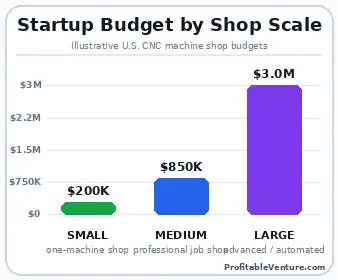
For planning purposes:
- Small one-machine shop: approximately $125,000 – $300,000
- Professional CNC job shop: approximately $500,000 – $1.5 million
- Advanced automated machine shop: approximately $2 million – $8 million+.
For this guide, we will use:
- Small: $200,000
- Medium: $850,000
- Large: $3 million.
You can also compare this guide with our CNC machine shop business plan.
b. Small One-Machine Shop – Approximately $200,000
- CNC vertical machining center – $80,000
- Tooling and workholding – $30,000
- Inspection equipment – $15,000
- Lease deposit, electrical work, and basic buildout – $25,000
- CAD/CAM and computers – $10,000
- Air, coolant, chip, and shop-support equipment – $10,000
- Initial raw material – $10,000
- Insurance, registration, and professional expenses – $5,000
- Working capital – $15,000
- Estimated Total – $200,000.
c. Medium Professional Job Shop – Approximately $850,000
- Two CNC vertical machining centers – $180,000
- CNC turning center – $120,000
- Tooling, fixtures, workholding, and probing – $90,000
- Inspection and metrology equipment – $55,000
- CAD/CAM, computers, networking, and software – $30,000
- Air compressor, coolant/chip equipment, and material handling – $45,000
- Lease deposit, buildout, rigging, and electrical upgrades – $110,000
- Initial raw-material inventory – $50,000
- Insurance, legal, permits, and professional setup – $25,000
- Working capital and payroll reserve – $145,000
- Estimated Total – $850,000.
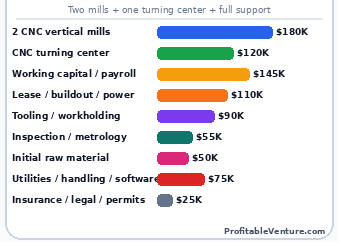
This is the financial model used later in the article.
d. Large Advanced CNC Shop – Approximately $3 Million
- CNC machines and automation – $1,550,000
- Facility buildout and electrical infrastructure – $350,000
- Inspection laboratory and metrology – $180,000
- Tooling, fixtures, and workholding – $250,000
- Compressors, chip systems, coolant systems, and material handling – $150,000
- CAD/CAM, ERP, networking, and technology – $80,000
- Initial raw-material inventory – $120,000
- Insurance, quality certification, legal, and professional fees – $70,000
- Working capital – $250,000
- Estimated Total – $3,000,000.
e. What Determines Startup Cost?
- New versus used machines
- Three-axis versus five-axis capability
- Machine size
- Automation
- Number of machines
- Inspection requirements
- Facility power
- Rigging
- Tooling
- Software
- Quality certification
- Working capital.
f. Do You Need to Build a Facility?
No. Leasing industrial space is normally more practical for a startup. Your facility needs to accommodate:
- Machine weight
- Electrical demand
- Three-phase power where required
- Compressed air
- Material deliveries
- Forklift movement
- Chip handling
- Coolant handling
- Loading and shipping.
Do not sign the lease before a qualified electrician, machine representative, and rigging company confirm that the facility can support the equipment.
g. What are the Ongoing Expenses?
- Raw material
- Machinist payroll
- Rent
- Electricity
- Cutting tools
- Toolholders
- Coolant
- Maintenance
- Machine repairs
- Software subscriptions
- Insurance
- Inspection calibration
- Scrap
- Shipping
- Sales
- Accounting
- Loan payments.
h. What Staff Do You Need?
A professional shop may employ:
- Owner/General Manager
- Production Manager
- CNC Programmer
- Setup Machinists
- CNC Operators
- Quality Inspector
- Estimator
- Shipping/Receiving Employee
- Sales Representative
- Bookkeeper.
Illustrative salary-planning ranges may include:
- Experienced CNC Machinist: $50,000 – $80,000+
- CNC Programmer: $65,000 – $100,000+
- Setup Machinist: $55,000 – $85,000
- Quality Inspector: $45,000 – $70,000
- Production Manager: $75,000 – $120,000+
- Estimator/Sales Engineer: $60,000 – $100,000+.
i. How Do You Fund a CNC Machine Shop?
- Personal investment
- SBA-backed loan
- Commercial bank financing
- Equipment financing
- Equipment leasing
- Business line of credit
- Private investors
- Business partners
- Starting with used equipment
- Reinvesting profits.
Equipment financing can be particularly useful because the machine itself may help secure the financing.
However, avoid financing machines simply because a dealer says the monthly payment is affordable. The real question is whether you have enough profitable work to cover:
- Machine payment
- Operator
- Tooling
- Electricity
- Maintenance
- Floor space
- Profit.
-
Write a Business Plan
a. Executive Summary
Precision Axis Manufacturing, LLC is a proposed CNC machining company located in Columbus, Ohio.
The company will provide precision machining services to industrial equipment manufacturers, automation companies, robotics businesses, automotive suppliers, and other regional manufacturers.
The initial shop will operate:
- Two CNC vertical machining centers
- One CNC turning center
- A full inspection area
- CAD/CAM programming systems.
Services will include CNC milling, CNC turning, prototype machining, short-run production, repeat production, fixtures, tooling components, and selected secondary operations. The company will launch with approximately $850,000 in capital.
Management’s strategy will focus on rapid quoting, dependable lead times, accurate parts, good customer communication, strong inspection controls, and repeat production contracts.
b. Products and Services
Precision Axis Manufacturing will offer:
- Three-axis CNC milling
- CNC turning
- Prototype machining
- Short production runs
- Repeat production
- Fixtures
- Tooling components
- Replacement machine parts
- Engineering-support machining
- Inspection documentation
- Deburring
- Outsourced finishing coordination.
c. Mission Statement
“At Precision Axis Manufacturing, LLC, our mission is to help manufacturers keep production moving by delivering accurate machined components, dependable lead times, responsive communication, disciplined quality control, and practical manufacturing support.”
Vision Statement
“Our vision is to build Precision Axis Manufacturing into a trusted regional CNC machining partner recognized for technical capability, reliable delivery, strong quality systems, and long-term customer relationships.”
d. Goals and Objectives
The first objective is to increase productive spindle utilization. Management will track:
- Available machine hours
- Setup hours
- Production hours
- Downtime
- Revenue per machine hour
- Scrap
- Rework
- On-time delivery.
The second objective is to convert one-time customers into repeat production accounts.
Repeat work is attractive because programming, tooling decisions, workholding, setup procedures, and inspection plans have already been developed.
This can substantially reduce nonproductive time.
e. Organizational Structure
- Owner/General Manager
- Production Manager
- CNC Programmer
- Setup Machinists
- CNC Operators
- Quality Manager/Inspector
- Estimator/Sales Engineer
- Shipping and Receiving
- Administrative/Accounting Support.
Marketing Plan
a. SWOT Analysis
Strengths
CNC machining serves many industrial markets and produces high-value components from relatively inexpensive raw material. Good repeat customers can also provide predictable production work.
Weaknesses
Machinery is expensive. Skilled machinists and programmers can also be difficult to recruit. Machines that are not producing billable parts still consume capital.
Opportunities
Opportunities include:
- Reshoring
- Robotics
- Automation
- Aerospace supply chains
- Medical components
- Emergency replacement parts
- Prototype manufacturing
- Five-axis machining
- Lights-out automation.
Threats
Threats include:
- Foreign competition
- Material-price increases
- Skilled-labor shortages
- Machine breakdowns
- Customer concentration
- Quality claims
- Economic downturns
- Technology obsolescence.
b. How Does a CNC Machine Shop Make Money?
Revenue may come from:
- CNC milling
- CNC turning
- Prototype work
- Production machining
- Engineering and manufacturability assistance
- Fixture manufacturing
- Inspection services
- Secondary operations
- Rush work.
c. How Should You Price CNC Machining?
Do not quote jobs by guessing. A useful starting formula is:
Quoted Price = Material + Programming + Setup + Machining Time + Tooling + Inspection + Outside Processing + Packaging + Overhead + Profit.
For example, suppose a customer needs 100 aluminum components. Your estimate might include:
- Material – $900
- Programming – $300
- Setup – $350
- Machine time – $3,000
- Cutting tools – $250
- Inspection – $250
- Deburring/packaging – $200
- Overhead/profit – $1,250.
Total quotation:
$6,500 or $65 per part.
If your actual cycle time turns out to be twice your estimate, much of your expected profit can disappear. This is why experienced estimating becomes extremely valuable.
d. Sales and Marketing Strategies
- Build a professional capability website
- Show machine work envelopes
- List materials you machine
- Publish quality capabilities
- Contact local manufacturers
- Visit industrial parks
- Register as a supplier with larger manufacturers
- Build relationships with engineering firms
- Approach maintenance departments
- Partner with fabrication and welding companies
- Offer overflow work to other machine shops
- Respond quickly to RFQs.
Welding and fabrication companies can become useful partners because their customers frequently need machined components. We also have a welding and fabrication business plan if you are considering combining both capabilities.
Respond to RFQs Quickly
Industrial buyers may request quotes from five machine shops. If you take two weeks to respond, the job may already be awarded.
A well-run shop should develop a quoting process that quickly identifies:
- Material
- Machine
- Setup
- Cycle time
- Outside services
- Delivery date
- Price.
Financial Projection
a. How Much Should You Charge?
There is no universal CNC shop rate. Your effective hourly requirement depends on:
- Machine cost
- Labor
- Building cost
- Machine utilization
- Tooling
- Maintenance
- Electricity
- Financing
- Required margin.
A smaller three-axis machining center may need a much lower effective shop rate than a highly automated five-axis machine.
For planning purposes, a commercial CNC shop might model effective machine rates of roughly $90 to $200+ per productive machine hour, depending on equipment and work complexity.
The correct rate is the one supported by your actual cost structure and market.
b. How Much Revenue Can a CNC Machine Shop Generate?
For planning purposes:
- Small one-machine operation: approximately $150,000 – $400,000 annually
- Professional multi-machine job shop: approximately $600,000 – $2 million+
- Large production machine shop: several million dollars annually.
The financial model below assumes the $850,000 shop generates approximately $900,000 in first-year revenue.
c. Five-Year Revenue and Profit Projection
| Fiscal Year | Revenue | Operating Expenses | Net Profit | Net Margin |
|---|---|---|---|---|
| Year 1 | $900,000 | $830,000 | $70,000 | 7.8% |
| Year 2 | $1,250,000 | $1,130,000 | $120,000 | 9.6% |
| Year 3 | $1,650,000 | $1,460,000 | $190,000 | 11.5% |
| Year 4 | $2,100,000 | $1,820,000 | $280,000 | 13.3% |
| Year 5 | $2,600,000 | $2,220,000 | $380,000 | 14.6% |
Under this model, cumulative five-year revenue would be approximately $8.5 million. Cumulative projected net profit would be approximately $1.04 million.
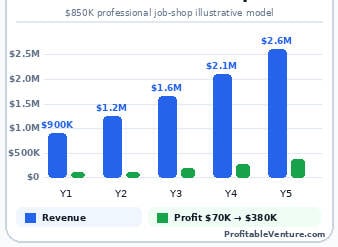
d. Sample Five-Year Profit and Loss Projection
| Item | Year 1 | Year 2 | Year 3 | Year 4 | Year 5 |
|---|---|---|---|---|---|
| Revenue | $900,000 | $1,250,000 | $1,650,000 | $2,100,000 | $2,600,000 |
| Raw Material | $220,000 | $310,000 | $410,000 | $520,000 | $650,000 |
| Production Payroll | $250,000 | $335,000 | $430,000 | $535,000 | $650,000 |
| Rent and Occupancy | $78,000 | $82,000 | $86,000 | $90,000 | $95,000 |
| Electricity, Air and Utilities | $55,000 | $70,000 | $88,000 | $105,000 | $125,000 |
| Tooling, Coolant and Consumables | $60,000 | $78,000 | $100,000 | $125,000 | $150,000 |
| Machine Maintenance and Repairs | $35,000 | $48,000 | $63,000 | $80,000 | $100,000 |
| CAD/CAM, ERP and IT | $18,000 | $22,000 | $26,000 | $31,000 | $36,000 |
| Insurance, Quality and Compliance | $20,000 | $23,000 | $27,000 | $31,000 | $35,000 |
| Sales, Administration and Shipping | $45,000 | $60,000 | $80,000 | $100,000 | $125,000 |
| Depreciation, Financing and Other Costs | $49,000 | $102,000 | $150,000 | $203,000 | $254,000 |
| Total Expenses | $830,000 | $1,130,000 | $1,460,000 | $1,820,000 | $2,220,000 |
| Projected Net Profit | $70,000 | $120,000 | $190,000 | $280,000 | $380,000 |
E. How Much Profit Can a CNC Machine Shop Make?
There is no fixed amount. A one-machine owner-operator may effectively earn both machinist compensation and company profit.
A larger shop can generate millions of dollars but employ programmers, machinists, operators, inspectors, managers, and sales staff.
Under the medium model used here, annual projected profit increases from approximately $70,000 in Year 1 to approximately $380,000 in Year 5.
f. What Factors Determine Profit?
- Machine utilization
- Billable machine rate
- Cycle time
- Setup time
- Material cost
- Scrap
- Tooling cost
- Labor productivity
- Machine downtime
- Repeat orders
- Customer concentration
- Pricing accuracy.
g. What is the Profit Margin?
Use:
Net Profit Margin = Net Profit ÷ Revenue × 100.
The illustrative business begins at approximately 7.8% net margin and improves toward approximately 14.6%.
Higher-value specialized work may generate better margins, while commodity production work may operate on thinner margins but higher volume.
h. What is the Sales Forecast?
- Year 1: $900,000
- Year 2: $1,250,000
- Year 3: $1,650,000
- Year 4: $2,100,000
- Year 5: $2,600,000.
-
Set Up Your CNC Machine Shop
a. How Do You Choose the Right Location?
You do not need an expensive retail location. You need industrial infrastructure. Look for:
- Industrial zoning
- Three-phase electrical service
- Sufficient amperage
- Concrete floors capable of supporting machines
- Loading access
- Forklift access
- Ceiling clearance
- Compressed-air capability
- Material storage
- Truck access
- Expansion space.
Location near manufacturing customers can also reduce shipping time and support emergency work.
b. How Much Space Do You Need?
A medium three-machine operation might reasonably use approximately 5,000 to 10,000 square feet, depending on machine sizes, office requirements, material storage, and future expansion.
Your shop may include:
- CNC machining area
- Inspection room
- Programming office
- Tool crib
- Raw-material storage
- Finished-goods area
- Shipping/receiving
- Maintenance area
- Coolant/chip handling
- Administrative office.
c. What Equipment Do You Need?
- Vertical machining centers
- CNC turning center
- Band saw
- Toolholders
- End mills
- Drills
- Inserts
- Vises
- Chucks
- Fixtures
- Probes
- Surface plate
- Micrometers
- Calipers
- Height gauges
- Gauge pins
- Coordinate measuring equipment where required
- Air compressor
- Forklift
- Pallet jack
- Chip bins
- Coolant equipment
- CAD/CAM software
- Shop-management software.
d. Buy Machines for Work You Expect to Win
A common mistake is purchasing equipment based on what the owner would like to make rather than what customers actually need.
If 80% of your RFQs are rectangular milled aluminum components, buying an expensive large-bore turning center first may make little sense. Track lost quotes.
If customers repeatedly ask for jobs you cannot manufacture because you lack one particular capability, that data can help justify the next machine purchase.
-
Hire and Train Employees
Experienced CNC employees are valuable because machining mistakes can become expensive very quickly. When hiring machinists, evaluate:
- Blueprint reading
- GD&T knowledge
- Setup ability
- Workholding knowledge
- Cutting-tool knowledge
- Inspection skills
- Problem-solving
- Safety habits.
A machinist who can independently take a drawing, develop the setup, select tooling, troubleshoot chatter, adjust offsets, and produce a good first article is much more valuable than someone who can only load parts and press cycle start.
Build a Strong Safety Culture
Your safety program should address:
- Machine guarding
- Door interlocks
- Lockout/tagout
- Rotating machinery
- Sharp chips
- Eye protection
- Noise
- Coolant exposure
- Forklift traffic
- Material lifting
- Housekeeping
- Compressed air.
Never encourage employees to defeat a machine safety interlock simply to save cycle time. A few seconds of productivity is not worth a serious injury.
-
Launch and Manage the Shop Properly
Do not fill the building with machines before proving you can sell machine time.
- Start by winning work.
- Create a target-customer list.
- Send capability information.
- Visit manufacturers.
- Quote aggressively but intelligently.
Once the first orders arrive, measure the difference between what you estimated and what actually happened.
Suppose you estimated:
- Programming – 2 hours
- Setup – 3 hours
- Cycle time – 12 minutes per part
- Scrap – 2%.
The actual job takes:
- Programming – 5 hours
- Setup – 7 hours
- Cycle time – 19 minutes
- Scrap – 6%.
That job may not have been profitable. But you now have data. Use that information when quoting the next order.
a. What Makes a CNC Machine Shop Successful?
- High machine utilization – Machines need productive spindle time.
- Accurate estimating – Bad quotes destroy margins.
- Fast setups – Setup is often nonproductive machine time.
- Low scrap – Material and machine time are both lost when parts are scrapped.
- Preventive maintenance – Unexpected downtime is expensive.
- Good machinists – Skills drive productivity.
- Quality systems – Customers need confidence in your parts.
- On-time delivery – Manufacturing customers plan around your promise.
- Repeat customers – Repeat jobs are usually easier to produce profitably.
- Customer diversification – One customer should not control your survival.
b. What Happens During a Typical Day?
The production manager arrives and reviews every machine.
- Machine One is finishing a 250-piece aluminum bracket order.
- Machine Two needs a new setup for a prototype fixture.
- The turning center is producing stainless-steel shafts.
The first shift checks:
- Coolant
- Tool condition
- Offsets
- Workholding
- Scheduled maintenance.
A machinist measures the first parts produced overnight.
- The quality inspector checks critical dimensions.
- A customer sends a request for quotation for 500 components.
The estimator reviews the drawing and determines that the job requires:
- Two milling operations
- Custom soft jaws
- Several drilled holes
- Anodizing by an outside supplier
- Final inspection documentation.
The purchasing employee orders aluminum stock.
- At noon, a cutting tool breaks unexpectedly.
- The operator notices the sound change and stops the machine before additional parts are damaged.
Later, finished components are inspected, packaged, and prepared for shipment. At the end of the shift, management reviews:
- Machine hours
- Parts produced
- Scrap
- Downtime
- Jobs completed
- Late orders
- Tomorrow’s setups.
c. What Skills and Experience Do You Need?
- CNC machining knowledge – Someone needs to understand how parts are actually produced.
- Programming – Efficient toolpaths affect cycle time.
- Blueprint reading – Customer drawings define the job.
- GD&T – Precision work depends on understanding tolerances.
- Estimating – Quoting determines profitability.
- Quality control – Parts must conform to specifications.
- Sales – Machines cannot sell their own capacity.
- Financial management – Capital equipment creates significant fixed costs.
- Employee management – Skilled machinists are valuable employees.
- Production planning – Jobs need to move through the shop efficiently.
You do not personally have to be the best CNC programmer in your state to own a machine shop.
But if you have no machining experience, you need people around you who do.
This is not a good business for learning every technical detail by trial and error after investing $850,000.
Before buying machines, spend time inside working machine shops. Hire an experienced production manager or lead machinist.
- Learn how quoting works.
- Learn tooling.
- Learn workholding.
- Learn inspection.
- Learn machine utilization.
Learn why one 30-minute setup is profitable while another eight-hour setup destroys your margin.
Most importantly, build the business around customers rather than equipment.
Machines are tools. Your real business is solving manufacturing problems accurately, reliably, and profitably.
If you can combine dependable customers, skilled machinists, accurate quoting, good machines, efficient setups, strong inspection, preventive maintenance, low scrap, and disciplined capital investment, you can build a successful CNC machine shop even if you started with no previous business ownership experience.