
A dollar store is a discount retail business that sells a broad selection of everyday products at low price points.
Your store may carry cleaning supplies, snacks, canned foods, beverages, toiletries, cosmetics, kitchen utensils, storage containers, party supplies, school supplies, toys, basic hardware, pet products, seasonal decorations, greeting cards, batteries, socks, and hundreds or thousands of other inexpensive items.
Despite the name, you do not have to sell everything for exactly one dollar.
In fact, building a modern independent dollar store around one fixed price can make the business unnecessarily difficult.
Wholesale costs, freight, wages, rent, insurance, and merchandise costs change over time.
A better approach for many independent operators is to build a value store with several easy-to-understand price points.
You might have substantial merchandise at $1.25, $2, $3, $5, $7, and $10 while maintaining the customer’s expectation that almost everything in the store represents a bargain.
This also gives you access to products you could never profitably sell for one dollar.
The business sounds simple because individual products are inexpensive, but discount retail is actually a game of pennies.
If you sell a product for $2 and pay $1.20 for it, the remaining 80 cents is not your profit. That money still has to help pay for:
- Employees
- Rent
- Electricity
- Credit-card fees
- Insurance
- Damaged merchandise
- Shoplifting
- Freight
- Advertising
- Technology
- Accounting
- Store supplies.
This means the owner needs to understand purchasing and inventory almost as well as selling.
You make money by buying merchandise correctly, turning that merchandise quickly, controlling shrink, keeping payroll efficient, and encouraging customers to purchase several items during every visit.
A customer who walks into your store for dishwashing liquid and leaves with paper plates, cookies, batteries, shampoo, balloons, and cleaning wipes is exactly how the model begins to work.
The advantage is that many products are everyday necessities. Customers may visit repeatedly rather than purchasing only once or twice per year.
The challenge is that you will compete with some of the largest and most efficient retailers in America. Your opportunity is not necessarily to beat them on every SKU.
An independent operator can compete through location, convenience, carefully selected merchandise, local preferences, unusual closeout deals, clean shelves, fast checkout, and products that customers in that specific neighborhood actually want.
Steps on How to Start a Dollar Store Business
-
Conduct Market Research
Start with the neighborhood rather than the merchandise catalog. A dollar store is primarily a convenience-and-value business, which means the success of the store can depend heavily on what households live within a relatively short driving or walking distance.
- Visit the neighborhood several times.
- Do not look at it only at noon on a Tuesday.
- Visit before work, after school, in the evening, and on Saturday.
Pay attention to:
- Apartment complexes
- Family neighborhoods
- Schools
- Bus stops
- Senior housing
- Office workers
- Pedestrian traffic
- Parking
- Nearby supermarkets
- Convenience stores
- Pharmacies
- Discount stores.
Then study the competing stores. Visit Dollar Tree, Dollar General, Five Below, independent discount stores, convenience stores, ethnic grocery stores, closeout retailers, supermarkets, and pharmacies.
Take notes on what they do well.
- How large is the store?
- Which aisles are busiest?
- What is located near checkout?
- What price points appear repeatedly?
- Which products are constantly being restocked?
- How much shelf space is devoted to cleaning supplies?
- How much goes to food?
- Are customers buying party supplies?
- Are there refrigerated drinks?
- What seasonal products are displayed at the entrance?
Then visit independent discount stores. They may reveal opportunities the national chains ignore. You may find strong demand for:
- Hair products used heavily in the neighborhood
- Ethnic food products
- Phone accessories
- Specific school supplies
- Religious items
- Party decorations
- Kitchenware
- Work gloves
- Inexpensive home organization products.
Your independent store can adapt much faster than a national chain if you listen to customers.
If customers ask for the same product five times in one week, write it down. That information is more useful than guessing what people might want.
a. Who is the Target Market for a Dollar Store?
Your customer base can include:
- Families looking to reduce household expenses
- Working-class households
- Middle-income bargain shoppers
- Students
- College students
- Parents buying school supplies
- Teachers
- Older adults
- Apartment residents
- Office workers
- Party planners
- Small businesses
- Restaurants needing inexpensive consumables
- People buying cleaning supplies
- Holiday shoppers
- Impulse shoppers
- Customers purchasing everyday convenience items.
Do not make the mistake of assuming a dollar store serves only low-income households. Many customers simply enjoy finding a bargain.
The psychology of the store is partly about saving money and partly about discovery.
A customer may come in looking for toothpaste and discover an unexpectedly good storage container, seasonal decoration, branded snack, or kitchen gadget at a low price.
b. Is a Dollar Store Business Profitable?
Yes, an independent dollar store can be profitable, but profit margins are generally much thinner than beginners expect. This is a volume business.
You may earn only a relatively small amount on an individual product, so the store needs enough transactions and enough items in each basket to generate meaningful profit.
Suppose your store averages 250 customer transactions per day. If the average basket is $8, daily sales would be approximately:
250 × $8 = $2,000.
If the store operates 360 days per year, that would represent approximately:
$2,000 × 360 = $720,000 in annual sales.
Now suppose you increase the average basket from $8 to $9.50 without increasing customer count. Annual sales would become approximately:
250 × $9.50 × 360 = $855,000.
That is an additional $135,000 in annual revenue simply from increasing average basket size. This is why merchandising matters.
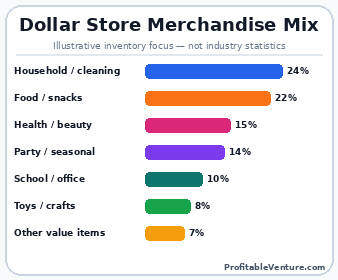
Checkout candy, batteries, phone cables, greeting cards, inexpensive toys, and seasonal products can increase the value of each transaction. Profitability depends heavily on:
- Merchandise cost
- Average basket size
- Transactions per day
- Rent
- Payroll
- Shoplifting
- Damaged inventory
- Freight
- Supplier terms
- Inventory turnover.
c. Are There Existing Niches in the Dollar Store Industry?
Yes. You can operate a general dollar store or specialize. Possible niches include:
- General household dollar store
- Party-supply discount store
- Beauty and personal-care discount store
- School and office discount store
- Household cleaning discount store
- Closeout merchandise store
- Discount grocery and household store
- Neighborhood convenience dollar store
- Seasonal merchandise discount store
- Craft and party value store
- Dollar-plus store
- Import value store
- Discount general merchandise store.
The most practical beginner model is usually broad enough to generate frequent visits while remaining disciplined about categories. You do not need to sell everything.
A 4,500-square-foot store filled with productive merchandise is better than a 10,000-square-foot store containing thousands of slow-moving products.
d. Who are the Major Competitors?
Major competitors and comparable value retailers include:
- Dollar General
- Dollar Tree
- Five Below
- Walmart
- Family-oriented discount retailers
- Convenience stores
- Drug stores
- Independent dollar stores
- Closeout stores
- Discount grocery stores
- Online marketplaces.
One lesson worth learning from the major chains is that modern value retail no longer has to mean one rigid price point.
Even businesses built around the “dollar store” concept increasingly use multiple price points to offer larger pack sizes, branded goods, refrigerated products, and higher-quality discretionary merchandise.
For an independent operator, this gives you more freedom. You might create a store where most products remain below $5 while allowing certain products to sell for $7, $10, or $15 when customers still perceive them as excellent value.
e. Are There County, State, or Federal Regulations for a Dollar Store?
Yes, although ordinary discount retail is generally regulated more heavily at the state and local level than by one specific federal dollar-store license. You may need:
- General business license
- Retail sales license
- Seller’s permit
- Sales-tax registration
- Resale certificate
- Zoning approval
- Certificate of occupancy
- Fire inspection
- Sign permit
- Employer registrations.
The exact requirements depend on your state, county, city, and merchandise. Some product categories introduce additional regulations.
For example, selling tobacco, alcohol, lottery tickets, certain medications, or other regulated products can require separate licenses and age-verification procedures.
A beginner may find it easier to launch without those categories and add them later only after understanding the applicable rules.
If you sell refrigerated or frozen food, local requirements may differ depending on what products you carry.
If you only sell sealed commercially packaged goods, the compliance burden can be different from operating a deli or preparing food onsite.
You also need procedures to prevent recalled, counterfeit, unsafe, or illegally labeled products from reaching your shelves.
Cheap merchandise is not automatically safe merchandise. This becomes particularly important when purchasing liquidation pallets, closeouts, or imported goods from unfamiliar suppliers.
f. Is There a Franchise for a Dollar Store Business?
Some discount-store franchise or licensing concepts may exist, but many of the best-known national dollar-store chains operate primarily through company-owned stores rather than selling ordinary franchises to individual operators.
You do not need a famous dollar-store name to enter the business. An independent operation gives you control over:
- Suppliers
- Product assortment
- Price points
- Store size
- Branding
- Neighborhood selection
- Seasonal products
- Local merchandise.
The disadvantage is that you do not have the enormous purchasing power of a national chain. Your supplier strategy therefore becomes extremely important.
g. What Do You Need to Start a Dollar Store?
- Retail location
- Business registration
- Sales-tax registration
- Resale certificate where applicable
- Store shelving
- Checkout counter
- POS system
- Barcode scanners
- Receipt printers
- Security cameras
- Anti-theft systems where appropriate
- Shopping baskets or carts
- Opening inventory
- Wholesale suppliers
- Closeout suppliers
- Stockroom
- Store insurance
- Employees
- Working capital.
h. Where Can You Buy Merchandise for a Dollar Store?
Your purchasing network may eventually become one of the most valuable parts of the business. Possible sources include:
- General merchandise wholesalers
- Dollar-store wholesalers
- Closeout suppliers
- Liquidators
- Manufacturer overstocks
- Discontinued merchandise suppliers
- Importers
- Regional food distributors
- Cash-and-carry wholesalers
- Direct manufacturers
- Seasonal merchandise wholesalers.
Do not buy solely because an item appears cheap. You need to ask:
“Can I sell this quickly at a price that creates an acceptable gross margin?”
A case of merchandise sitting in your stockroom for 14 months is not a bargain. Your cash is trapped inside it. When evaluating a new product, calculate:
Gross Margin = (Selling Price − Product Cost) ÷ Selling Price × 100.
If a product costs you $1.50 and sells for $2.50:
($2.50 − $1.50) ÷ $2.50 = 40% gross margin.
That 40% still needs to pay rent, payroll, utilities, shrink, processing fees, and other overhead.
-
Choose a Memorable Business Name
Your name should suggest value without making customers assume every single product costs exactly one dollar unless that is genuinely your pricing policy.
Some dollar store business name ideas are:
- Value Corner Discount Store, LLC
- Everyday Dollar Market, LLC
- Smart Saver Value Store, LLC
- Budget Basket Discount Store, LLC
- Neighborhood Value Mart, LLC
- Dollar Lane Discount Store, LLC
- Easy Value Market, LLC
- SaveMore Dollar Store, LLC
- Value Spot Discount Store, LLC
- Budget Box Market, LLC
- Smart Dollar Value Store, LLC
- Value Town Discount Store, LLC
- Daily Deals Market, LLC
- Bargain Basket Store, LLC
- Dollar & More Market, LLC
- Everyday Bargain Store, LLC
- Value Depot Discount Store, LLC
- Neighborhood Bargains, LLC
- QuickSave Value Store, LLC
- Price Point Discount Market, LLC.
Check state business records and potential trademark conflicts before ordering signs, shopping bags, uniforms, or advertising materials.
-
Register Your Business
a. What Type of Business Structure is Best for a Dollar Store?
An LLC is commonly suitable for an independent dollar store. It can separate the owner’s personal and business affairs while remaining relatively straightforward to operate. Retail creates several potential liabilities.
- A customer can slip and fall.
- An employee may be injured.
- A defective product may generate a complaint.
- A delivery can damage property.
Your business structure should therefore be combined with adequate insurance and good store procedures.
b. Steps to Form an LLC
- Choose an available business name
- File Articles of Organization
- Select a registered agent
- Create an operating agreement
- Obtain an EIN
- Register for state and local taxes
- Obtain your seller’s permit where required
- Obtain a resale certificate where applicable
- Open a business bank account
- Purchase insurance
- Maintain required annual filings.
c. What Licenses are Needed?
Depending on your location and merchandise, you may need:
- General business license
- Retail establishment license
- Sales-tax permit
- Seller’s permit
- Resale certificate
- Certificate of occupancy
- Fire inspection approval
- Sign permit
- Food retail permit where applicable
- Tobacco license if applicable
- Alcohol retail license if applicable
- Lottery retailer approval if applicable.
d. What Certifications are Needed?
You usually do not need a professional certification simply to operate a general dollar store. Useful training includes:
- Retail management
- Loss prevention
- Inventory control
- POS training
- Workplace safety
- First aid and CPR
- Food handling where applicable
- Age-restricted product compliance where applicable.
e. What Documents are Needed?
- Business registration documents
- EIN
- Business license
- Seller’s permit
- Sales-tax registration
- Resale certificate
- Lease agreement
- Certificate of occupancy
- Insurance policies
- Supplier agreements
- Wholesale invoices
- Employee records
- Inventory records
- Safety procedures
- Security procedures
- Product recall procedures.
f. Do You Need a Trademark, Copyright, or Patent?
You normally do not need a patent. A trademark can protect your store name, logo, slogan, and private-label products.
Copyright can protect original website content, advertising materials, product photography, promotional graphics, and printed material.
If you later create your own private-label household or personal-care products, trademark protection may become particularly valuable.
-
Cost Analysis and Budgeting
a. How Much Does It Cost to Start a Dollar Store?
Startup cost depends on store size, location, inventory depth, fixtures, and whether the premises already function as retail space.
For planning purposes:
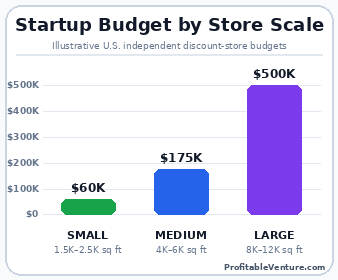
- Small 1,500- to 2,500-square-foot store: approximately $35,000 to $90,000
- Medium 4,000- to 6,000-square-foot store: approximately $120,000 to $250,000
- Large 8,000- to 12,000-square-foot store: approximately $350,000 to $750,000 or more.
For this guide, we will use:
- Small dollar store: $60,000
- Medium dollar store: $175,000
- Large dollar store: $500,000.
b. What are the Costs Involved in Starting a Dollar Store?
Small Dollar Store – Approximately $60,000
- Opening inventory – $22,000
- Lease deposit and basic improvements – $10,000
- Shelving and fixtures – $8,000
- POS and security equipment – $4,000
- Signage and branding – $3,000
- Licensing and insurance – $3,000
- Opening marketing – $2,000
- Working capital – $8,000
- Estimated Total – $60,000.
Medium Dollar Store – Approximately $175,000
- Opening inventory – $60,000
- Lease deposit and store buildout – $30,000
- Shelving, checkout counters, displays, and fixtures – $25,000
- Working capital – $30,000
- POS, barcode equipment, and security – $10,000
- Storefront signage and branding – $8,000
- Licenses, insurance, and professional expenses – $7,000
- Grand-opening marketing – $5,000
- Estimated Total – $175,000.
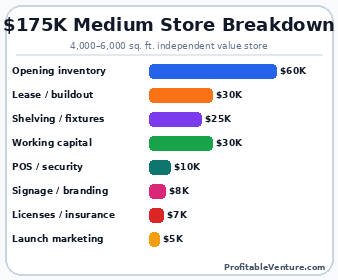
This is the financial model used later in this guide.
Large Dollar Store – Approximately $500,000
- Opening inventory – $180,000
- Leasehold improvements and buildout – $90,000
- Shelving, fixtures, and checkout equipment – $65,000
- Refrigeration and freezer equipment – $35,000
- POS, security, technology, and inventory systems – $25,000
- Signage and store branding – $15,000
- Licensing, insurance, and professional expenses – $10,000
- Opening marketing – $10,000
- Working capital and payroll reserve – $70,000
- Estimated Total – $500,000.
c. What Factors Determine Startup Cost?
- Store square footage
- Location
- Rent
- Opening inventory
- Number of SKUs
- Shelving requirements
- Refrigeration
- POS system
- Security equipment
- Number of employees
- Store buildout
- Freight
- Working capital.
d. Do You Need to Build a Facility?
No. Leasing an existing retail location is normally far more practical.
A former pharmacy, small grocery store, discount retailer, or neighborhood retail space can sometimes reduce buildout costs because it may already have:
- Retail lighting
- Checkout area
- Stockroom
- Public entrance
- Parking
- Restrooms
- Appropriate electrical service.
Do not sign the lease based only on low rent. A cheap store with poor visibility, difficult parking, or almost no customer traffic can become very expensive once you realize why the previous tenant failed.
e. What are the Ongoing Expenses?
- Merchandise purchases
- Freight
- Employee wages
- Payroll taxes
- Rent
- Electricity
- Water
- Insurance
- Card-processing fees
- POS software
- Security
- Cleaning supplies
- Shopping bags
- Repairs
- Advertising
- Spoiled products
- Damaged merchandise
- Theft and shrink.
f. What is the Average Salary of Your Staff?
A medium store may employ:
- Store Manager
- Assistant Manager
- Shift Supervisors
- Cashiers
- Stock Associates
- Receiving/Inventory Associate
- Cleaner.
Pay varies considerably by state and city. For financial planning, use actual local wage rates rather than a national estimate.
Retail labor should also be scheduled according to traffic. Having five employees working during a quiet weekday morning and only two during a busy Saturday evening is poor scheduling.
g. How Do You Get Funding?
- Personal savings
- SBA-backed loans
- Bank loans
- Business lines of credit
- Private investors
- Business partners
- Family financing
- Equipment financing
- Supplier credit terms
- Reinvesting profits from a smaller first location.
Supplier terms become increasingly valuable as the store develops a payment history.
Paying a supplier 30 days after receiving inventory is much easier on cash flow than paying every invoice before the merchandise reaches your shelves. Do not assume a new business will immediately receive favorable terms.
-
Write a Business Plan
a. Executive Summary
Value Corner Discount Store, LLC is a proposed independent neighborhood dollar and value store located in Columbus, Ohio.
The business will operate from approximately 5,000 square feet of leased retail space.
Value Corner will sell affordable household and convenience merchandise across several price points rather than restricting every product to one dollar. Core categories will include:
- Cleaning supplies
- Paper products
- Food and snacks
- Beverages
- Personal care
- Beauty products
- Kitchenware
- Storage products
- Party supplies
- School supplies
- Toys
- Craft products
- Seasonal merchandise.
The business will launch with approximately $175,000 in startup capital. Approximately $60,000 will be dedicated to opening merchandise inventory.
Management will source products through wholesalers, closeout suppliers, regional distributors, manufacturers, and carefully selected liquidation opportunities.
The company’s strategy will focus on low prices, convenience, inventory turnover, disciplined purchasing, clean stores, fast checkout, shrink control, and merchandise selected specifically for neighborhood demand.
b. Products and Services
Value Corner Discount Store will sell:
- Household cleaning supplies
- Laundry products
- Paper products
- Food storage supplies
- Kitchen utensils
- Plastic storage containers
- Snacks
- Candy
- Canned foods
- Beverages
- Personal hygiene products
- Hair products
- Cosmetics
- Basic health products
- School supplies
- Office supplies
- Party products
- Greeting cards
- Toys
- Craft supplies
- Pet products
- Basic hardware
- Batteries
- Phone accessories
- Seasonal decorations.
c. Mission Statement
“At Value Corner Discount Store, LLC, our mission is to help customers stretch their household budgets by providing convenient access to useful everyday products, surprising bargains, and dependable value in a clean and friendly neighborhood store.”
Vision Statement
“Our vision is to build Value Corner into a trusted neighborhood value-store brand known for affordable prices, useful merchandise, convenient locations, strong customer service, and disciplined retail execution.”
d. Goals and Objectives
The first objective is to achieve strong inventory turnover. Management will track products by:
- Units sold
- Sales dollars
- Gross margin
- Weeks of inventory
- Shrink
- Reorder frequency.
Slow-moving merchandise will be discounted and cleared rather than allowed to occupy valuable shelf space indefinitely.
The second objective is to increase average customer basket size. The company will use complementary merchandising. For example:
- Birthday candles near party plates
- Batteries near toys
- Sponges near cleaning chemicals
- Gift bags near greeting cards
- Food containers near aluminum foil.
Another objective is to use the checkout area intelligently. Low-cost impulse merchandise can include:
- Candy
- Gum
- Batteries
- Phone cables
- Small toys
- Hand sanitizer
- Reading glasses
- Seasonal impulse products.
Long-term objectives include developing supplier credit, adding private-label merchandise, improving purchasing volumes, and opening a second store only after the first location produces stable cash flow.
e. Organizational Structure
- Owner/General Manager
- Store Manager
- Assistant Store Manager
- Shift Supervisors
- Cashiers
- Stock Associates
- Receiving/Inventory Associate
- Bookkeeper/Accountant.
Marketing Plan
a. SWOT Analysis
Strengths
The business sells affordable everyday products that can generate frequent repeat visits.
An independent operator can adapt merchandise to local demand faster than a large national retailer. Closeout opportunities can also generate attractive gross margins.
Weaknesses
The business operates on relatively thin net margins. Independent stores have less purchasing power than major national chains.
The store also requires constant inventory management because thousands of inexpensive products can tie up substantial working capital.
Opportunities
Opportunities include private-label products, seasonal merchandise, imported products, party supplies, convenience foods, local neighborhood merchandise, closeouts, online local ordering, and additional locations.
Threats
Threats include national dollar-store chains, Walmart, online marketplaces, shoplifting, retail theft, supplier price increases, freight costs, wage increases, rent increases, obsolete inventory, and changes in consumer spending.
b. How Does a Dollar Store Make Money?
The primary revenue stream is retail merchandise sales. Profit comes from the spread between merchandise cost and selling price after operating expenses. The store can improve gross profit through:
- Buying closeouts
- Negotiating wholesale terms
- Importing selected merchandise
- Private-label products
- Higher-margin seasonal goods
- Party products
- Beauty products
- Impulse merchandise.
c. Payment Options
- Cash
- Credit cards
- Debit cards
- Apple Pay
- Google Pay
- EBT/SNAP where approved for eligible food products
- Gift cards.
d. Sales and Advertising Strategies
- Create strong roadside/storefront signage
- Use a grand-opening promotion
- Set up a Google Business Profile
- Distribute neighborhood flyers
- Use Facebook community groups appropriately
- Post new closeout deals on social media
- Promote seasonal arrivals
- Create inexpensive loyalty offers
- Use window signs for major bargains
- Run back-to-school promotions
- Promote holiday merchandise early
- Build partnerships with nearby apartment complexes
- Offer quantity pricing to local small businesses where profitable.
Your store itself is one of your best advertisements. A cluttered store with half-empty shelves communicates failure. A clean, bright store filled with obvious bargains creates curiosity.
Financial Projection
a. How Much Should You Charge for Merchandise?
Do not price every product using the same markup. Different categories can support different margins.
A commonly purchased branded food product may have a relatively thin margin because customers know its normal price.
An unusual closeout storage container may support a much larger margin because customers are comparing value rather than a standard market price. Your pricing tiers may include:
- $1.25
- $2
- $2.50
- $3
- $5
- $7
- $10
- Higher prices for selected exceptional-value merchandise.
The goal is not to preserve the word “dollar” at the expense of profitability. The goal is to preserve value perception.
b. How Much Revenue Can a Dollar Store Generate?
Revenue depends on traffic, location, square footage, inventory, pricing, and average transaction size. For planning purposes:
- Small neighborhood store: approximately $250,000 to $600,000 annually
- Medium independent store: approximately $500,000 to $1.2 million
- Large high-traffic discount store: approximately $1 million to $3 million or more.
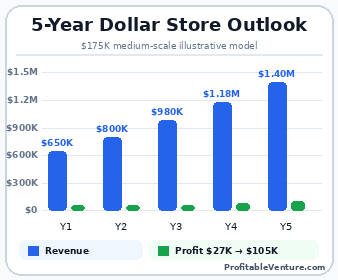
These are planning ranges rather than guaranteed industry averages. The model below assumes approximately $650,000 in first-year sales for the $175,000 medium store.
c. Five-Year Revenue and Profit Projection
| Fiscal Year | Revenue | Total Expenses | Net Profit | Net Margin |
|---|---|---|---|---|
| Year 1 | $650,000 | $623,000 | $27,000 | 4.2% |
| Year 2 | $800,000 | $759,000 | $41,000 | 5.1% |
| Year 3 | $980,000 | $921,000 | $59,000 | 6.0% |
| Year 4 | $1,180,000 | $1,099,000 | $81,000 | 6.9% |
| Year 5 | $1,400,000 | $1,295,000 | $105,000 | 7.5% |
Under this model, cumulative five-year revenue would be approximately $5.01 million.
Cumulative projected net profit would be approximately $313,000.
d. Sample Five-Year Profit and Loss Projection
| Item | Year 1 | Year 2 | Year 3 | Year 4 | Year 5 |
|---|---|---|---|---|---|
| Revenue | $650,000 | $800,000 | $980,000 | $1,180,000 | $1,400,000 |
| Merchandise / Cost of Goods Sold | $390,000 | $480,000 | $588,000 | $708,000 | $840,000 |
| Payroll and Employee Costs | $100,000 | $124,000 | $155,000 | $188,000 | $225,000 |
| Rent and Occupancy | $54,000 | $56,000 | $59,000 | $62,000 | $65,000 |
| Utilities | $18,000 | $21,000 | $24,000 | $27,000 | $30,000 |
| Freight and Receiving | $12,000 | $15,000 | $18,000 | $21,000 | $25,000 |
| POS, Card Processing and Technology | $12,000 | $15,000 | $18,000 | $22,000 | $26,000 |
| Marketing | $8,000 | $10,000 | $12,000 | $14,000 | $17,000 |
| Insurance and Licensing | $7,000 | $8,000 | $9,000 | $10,000 | $11,000 |
| Shrink, Damage and Inventory Loss | $12,000 | $15,000 | $18,000 | $22,000 | $26,000 |
| Administration, Repairs and Other Expenses | $10,000 | $15,000 | $20,000 | $25,000 | $30,000 |
| Total Expenses | $623,000 | $759,000 | $921,000 | $1,099,000 | $1,295,000 |
| Projected Net Profit | $27,000 | $41,000 | $59,000 | $81,000 | $105,000 |
e. How Much Profit Do Dollar Store Owners Make a Year?
There is no standard amount. An owner-operated 2,000-square-foot store may produce less revenue but also have much lower payroll and occupancy expenses.
A larger store can generate substantially more revenue while carrying higher inventory, payroll, rent, and shrink.
Under the medium-scale model in this guide, annual projected business profit increases from approximately $27,000 in Year 1 to approximately $105,000 in Year 5.
The owner’s personal income depends on salary, distributions, debt service, taxes, and reinvestment.
f. What Factors Determine Profit?
- Transactions per day
- Average basket value
- Gross merchandise margin
- Inventory turnover
- Supplier pricing
- Freight
- Rent
- Payroll
- Shoplifting
- Employee theft
- Damaged merchandise
- Product markdowns
- Seasonal sales
- Store traffic.
g. What is the Profit Margin of a Dollar Store?
Net profit margins can be relatively thin because discount retailers compete heavily on price. Use:
Net Profit Margin = Net Profit ÷ Revenue × 100.
The model in this article begins at approximately 4.2% and gradually improves toward approximately 7.5%.
This is an illustrative planning model rather than a guaranteed industry margin.
h. What is the Sales Forecast?
- Year 1: $650,000
- Year 2: $800,000
- Year 3: $980,000
- Year 4: $1,180,000
- Year 5: $1,400,000.
-
Set Up Your Dollar Store
a. How Do You Choose the Perfect Location?
A good dollar-store location generally combines residential density, convenience, visibility, and affordable rent. Look for locations near:
- Apartment complexes
- Family neighborhoods
- Schools
- Bus stops
- Neighborhood shopping centers
- Grocery stores
- Laundromats
- Pharmacies
- Fast-food restaurants
- High-traffic intersections.
You generally want people making frequent everyday trips through the area. Parking matters. So does delivery access.
A store that receives multiple cases and pallets of inventory needs somewhere suppliers can unload without blocking customers.
b. What States and Cities are Worth Researching?
Dollar stores can work in both large metropolitan markets and smaller communities. Cities worth researching include:
- Columbus, Ohio
- Indianapolis, Indiana
- Houston, Texas
- Dallas-Fort Worth, Texas
- Charlotte, North Carolina
- Atlanta, Georgia
- Memphis, Tennessee
- Jacksonville, Florida
- Phoenix, Arizona
- San Antonio, Texas.
However, the neighborhood matters far more than the city name. A strong site in a smaller city can outperform a weak site in Houston.
c. What Equipment is Needed?
- Gondola shelving
- Wall shelving
- End-cap displays
- Checkout counters
- POS terminals
- Barcode scanners
- Receipt printers
- Cash drawers
- Card terminals
- Security cameras
- Mirrors
- Electronic anti-theft equipment where appropriate
- Shopping baskets
- Shopping carts
- Stock carts
- Hand trucks
- Pallet jack
- Price-label equipment
- Office computer
- Inventory-management software
- Refrigeration where applicable.
d. How Should You Lay Out the Store?
Place high-demand essentials deeper inside the store so customers walk past other merchandise.
For example, cleaning products, paper products, snacks, and household necessities can pull customers through several aisles. Use the entrance for:
- Seasonal products
- New arrivals
- Strong bargains
- Limited-time merchandise.
Use end caps for products you actively want to promote. Keep small high-theft merchandise in visible locations. The checkout area should be simple and fast.
A long line can make customers abandon inexpensive purchases because they do not consider a $3 basket worth waiting 15 minutes for.
-
Hire Employees
Employees need to understand that stocking shelves is not their only responsibility. Train staff on:
- Customer service
- POS operation
- Cash handling
- Receiving inventory
- Barcode verification
- Shelf replenishment
- Price accuracy
- Loss prevention
- Store cleanliness
- Safety
- Returns
- Product recalls.
Receiving deserves particular attention.
When 40 cases arrive, an employee should not sign the delivery ticket without checking them.
- Count cases.
- Check obvious damage.
- Confirm expensive or sensitive merchandise.
- Record discrepancies immediately.
Inventory problems often begin at the back door.
Control Shrink From the Beginning
Shrink means inventory that disappears without generating a legitimate sale. It can come from:
- Shoplifting
- Employee theft
- Vendor errors
- Receiving mistakes
- Damaged products
- Administrative errors
- Expired merchandise.
Suppose your store generates $1 million in sales and loses 2% of sales to shrink. That represents approximately: $20,000.
If your store’s net profit would otherwise have been $60,000, controlling just part of that loss can materially improve the owner’s return.
Use cameras, cycle counts, good receiving procedures, employee accountability, and store organization.
-
Launch the Business Properly
Your grand opening should show customers exactly what the store represents.
Do not open with half-empty shelves because you wanted to start earning money immediately.
Customers who walk into an unfinished store may never return to discover how good it became later. Before opening, check:
- Every shelf label
- Every POS price
- Lighting
- Shopping baskets
- Bathrooms
- Security cameras
- Fire exits
- Stockroom organization
- Checkout supplies
- Store cleanliness.
Create several highly visible opening bargains. You may price selected products aggressively to bring people into the store while maintaining normal margins across the larger merchandise assortment.
During the first month, spend time on the sales floor.
- Watch what customers touch.
- Watch what they ignore.
- Listen to what they ask for.
- Review the POS data every week.
If one type of dish detergent sells 20 cases every month while another sells two bottles, your next purchase should reflect reality.
Retail owners sometimes keep ordering products they personally like instead of products customers actually buy. Your sales data should win that argument.
a. What Makes a Dollar Store Successful?
- Strong location – Convenience drives repeat visits.
- Excellent buying – Profit begins when inventory is purchased.
- Fast inventory turnover – Merchandise needs to become cash again.
- Visible value – Customers should immediately recognize bargains.
- Clean shelves – Low price does not require a dirty store.
- Low shrink – Retail theft can consume thin margins.
- Correct price points – Do not trap the business at one artificial price.
- Good stock availability – Empty shelves cannot produce revenue.
- Seasonal execution – Holiday merchandise can create strong sales bursts.
- Customer listening – Independent stores can adapt quickly.
- Working capital – Inventory consumes cash.
b. What Happens During a Typical Day?
The store manager may arrive before opening and review the prior day’s sales.
- The team checks the store for cleanliness and stock availability.
- Employees replenish fast-moving merchandise before customers arrive.
- When a supplier delivery arrives, the receiving employee verifies the shipment against the invoice.
- New merchandise is priced and moved to the sales floor or stockroom.
- Throughout the day, cashiers process transactions while stock employees replenish shelves.
- The manager watches customer traffic and checkout lines.
- If the queue grows, another register is opened.
The manager also monitors:
- Daily sales
- Transaction count
- Average basket
- Voids
- Refunds
- Cash differences
- Employee hours
- Shrink issues
- Inventory deliveries.
During slower periods, staff organize shelves, remove damaged products, clean, conduct cycle counts, and prepare displays. At closing, registers are reconciled and cash is secured.
The owner may spend part of the day away from the store negotiating suppliers, reviewing closeout lists, comparing purchase prices, paying invoices, and planning seasonal inventory.
c. What Skills and Experience Do You Need?
- Retail management – You need to understand store operations.
- Buying – Purchasing determines much of your potential margin.
- Inventory management – Cash is sitting on your shelves.
- Merchandising – Product placement affects basket size.
- Loss prevention – Thin margins make shrink particularly painful.
- Customer service – Repeat traffic matters.
- Employee management – Payroll needs to match traffic.
- Financial management – Sales are not the same as profit.
- Negotiation – Supplier terms directly affect profitability.
- Data analysis – Your POS system tells you what to reorder.
You do not need previous experience managing a national retail chain to start an independent dollar store. But you should learn retail mathematics before signing a lease.
- Learn gross margin.
- Learn markup.
- Learn inventory turnover.
- Learn shrink.
- Learn average basket value.
- Learn sales per square foot.
Then start carefully.
- Visit wholesalers.
- Compare suppliers.
- Study the neighborhood.
- Count competitors.
Build a realistic opening assortment rather than filling the store with random cheap products.
Most importantly, remember that the business is not really about selling things for a dollar.
It is about convincing customers that they will consistently find useful products at prices low enough to make your store worth visiting repeatedly.
If you can buy merchandise intelligently, keep shelves productive, control theft, maintain a clean store, increase basket size, respond quickly to neighborhood demand, and protect your cash flow, you can build a successful dollar store even if you started with no previous retail experience.