
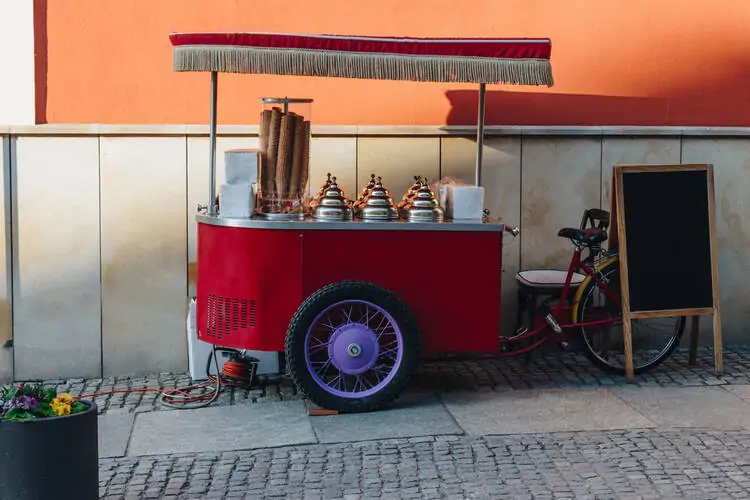
An ice cream bike business is a mobile vending venture where entrepreneurs use specially designed bicycles or tricycles equipped with insulated storage or freezers to sell ice cream and frozen treats in public spaces.
These bikes are commonly found in parks, beaches, festivals, and busy streets, offering convenience and a personalized customer experience.
Unlike traditional shops, they are highly flexible, low-cost, and easy to operate, allowing vendors to move directly to high-traffic locations and events.

The business is gaining popularity due to strong industry growth. The global ice cream market is projected to reach about $104.96 billion by 2029, while the street vending segment, including ice cream bikes, is expected to hit $8 billion by 2032, growing at roughly 6% annually.
Startup costs can be under $10,000, and some operators have scaled to six-figure revenues, showing strong profit potential in this niche.
Steps on How to Start an Ice Cream Bike Business

-
Conduct Market Research
Conducting market research for an ice cream bike business starts with identifying your target customers.
Focus on demographics such as families, children, students, and event-goers who are most likely to purchase ice cream.
Observe their preferences, spending habits, and peak buying times, especially during warm weather or community events.
Next, analyze your local competition. Study other ice cream vendors, food trucks, and nearby stores to understand their pricing, product offerings, and customer flow.
This helps you identify gaps in the market, such as unique flavors, healthier options, or underserved locations where demand is high.
Location research is also essential. Evaluate high-traffic areas like parks, beaches, school zones, and event venues.
Pay attention to foot traffic patterns, local regulations, and permits required for mobile vending.
Choosing the right routes and spots can significantly impact your daily sales.
Finally, gather direct customer feedback through surveys, social media polls, or small test runs. This allows you to refine your menu, pricing, and branding.
Combining data-driven insights with real-world testing ensures your ice cream bike business is well-positioned for profitability and long-term success.
a. Who is the Target Market for the Ice Cream Bike Business?
The target market for an ice cream bike business is broad, but it mainly centers on people who enjoy convenient, affordable treats in outdoor or high-traffic environments.
Children and families are the primary market. Kids are naturally drawn to ice cream, and parents often make spontaneous purchases during outings.
Young adults and students are another key segment. They are often found in busy urban areas, campuses, and recreational spots where ice cream bikes operate.
Event attendees and tourists also represent a strong market. Festivals, fairs, concerts, and tourist attractions provide high foot traffic and impulse buying opportunities.
Lastly, health-conscious and niche consumers are an emerging segment.
By offering options like dairy-free, organic, or low-calorie ice cream, you can attract customers with specific dietary preferences, expanding your reach and increasing profitability.
b. Is the Ice Cream Bike Business Profitable?
An ice cream bike business can be profitable due to its low startup and operating costs compared to traditional shops.
While exact figures vary, the broader ice cream industry shows strong returns, with typical profit margins ranging from 10% to 20% and gross margins as high as 60% to 75% on products.
Of course, small ice cream businesses can generate steady income, with some earning $30,000 to $70,000 annually in profit depending on location and sales volume.
Ice cream bikes benefit from mobility, allowing operators to target high-traffic areas and events, which can significantly boost daily sales.
c. Are There Existing Niches in the Industry?
No, there are no existing niches when it comes to an ice cream bike business.
This is because the ice cream bike business itself is already a niche within the broader mobile food vending and ice cream retail industry.
However, operators can still differentiate by introducing unique flavors, organic or vegan options, themed branding, or targeting specific locations and events.
d. Who are the Major Competitors?
- Cream Cruiser
- Sweet Spokes
- Crema Tutti
- Icicle Tricycles USA
- Dreamers Love
- Be Good Gelato
- Popbar (bike catering units)
- Phrostbite Italian Ice
- Street Treats Bike
- Ice Cream Bike Rentals USA
- Pedal Pops
- Cool Wheels Ice Cream Bike
- Urban Scoops Bike
- Frosty Pedals
- Rolling Scoops Bike Co.
- Chill Cycle Ice Cream
- Scoops on Wheels Bike
- Ice Cream Pedalers
- Frozen Delights Bike Co.
- Cycle Creamery.
e. Are There County or State Regulations or Zoning Laws for Ice cream bike businesses in the United States?
Yes, there are county, city, and state regulations that apply to an ice cream bike business in the United States, although most rules are enforced at the local level.
Street vending laws vary widely by jurisdiction, meaning that requirements in one city may differ significantly from those in another. In general, operators must obtain permits or licenses before selling.
Many municipalities require vendors to apply through local authorities such as the police department or licensing office, and operating without a permit can lead to fines.
Zoning laws also play an important role. Vendors are often restricted from operating in certain areas, such as near schools, restaurants, or large public events, and may be limited to specific streets or time durations to manage traffic and public safety.
Lastly, health and safety regulations apply, including compliance with food safety codes, proper storage temperatures, and liability insurance.
Overall, while ice cream bike businesses are legal, they must operate within a structured regulatory framework that varies by location.
f. Is There a Franchise for the Ice Cream Bike Business?
Yes, there are related franchise opportunities for an ice cream bike business, and here are 10 of them:
- The Polar Peddler (ice cream sandwich bike)
- Bike Café (coffee & ice cream mobile franchise)
- Ice Cream by Bike (franchise-style product & distribution)
- Mister Softee (mobile ice cream franchise)
- Cold Stone Creamery (ice cream shop franchise)
- Jeni’s Splendid Ice Creams (franchising program)
- Baskin-Robbins (ice cream franchise, can be mobile at events) (general ice cream franchise)
- Dairy Queen (ice cream & soft serve franchise) (widely franchised)
- Ben & Jerry’s (ice cream franchise/retail locations) (popular ice cream brand)
- Carvel (ice cream franchise)
g. What Do You Need to Start an Ice Cream Bike Business?
- Ice cream bike (tricycle or cargo bike with freezer unit)
- Freezer or insulated storage system
- Business license
- Food vendor permit
- Health department certification
- Liability insurance
- Initial ice cream inventory and supplies
- Branding materials (uniform, signage, decals)
- Payment system (cash box or mobile POS)
- Operating locations/permits for vending zones.
-
Choose a Memorable Business Name
When looking to start a business, before you can begin to file the necessary documents with the constituted authorities or start your website, it is necessary that you come up with a name that you will be recognized with.
It is essential that the name you come up with can easily be pronounced, is unique and easily memorable.
Some of the catchy business name ideas suitable for an ice cream bike business are:
- Troy Roy® Ice Cream Bike, Inc.
- Janice Swanson™ Ice Cream Bike, LLC
- Monique Garcia© Ice Cream Bike, Inc.
- Sarah Miller® Ice Cream Bike, Inc.
- Daniel Thomson® Ice Cream Bike, LLC
- Alison Van™ Ice Cream Bike, Inc.
- Wayne Greene® Ice Cream Bike, Inc.
- Keith Belk™ Ice Cream Bike, LLC
- Brownie Bronx© Ice Cream Bike, Inc.
- Tami Brown® Ice Cream Bike, Inc.
- Dustin Boler® Ice Cream Bike, Inc.
- Anna Page™ Ice Cream Bike, Inc.
- Ken Stalder™ Ice Cream Bike, LLC
- John McGlone® Ice Cream Bike, Inc.
- Cassandra Tucker® Ice Cream Bike, Inc.
- Mark Estienne© Ice Cream Bike, Inc.
- Bret Hess® Ice Cream Bike, Inc.
- Fido Dido © Ice Cream Bike, LLC
- St Martins® Ice Cream Bike, Inc.
- Cynthia Martins® Ice Cream Bike, Inc.
-
Register Your Business
a. What Type of Business Structure is Best for an Ice Cream Bike Business?
The ideal business structure for an ice cream bike business is determined by a variety of factors, including the size of the company, the number of owners, the level of personal liability the owners are ready to accept, and the tax consequences of the various business structures.
However, we normally recommend that you start the business with minimal liability.
An LLC is a hybrid corporate form that provides the flexibility of a partnership while also providing its owners with limited liability protection.
An LLC can have one or more owners, and the owners are not personally accountable for the debts or liabilities of the business.
This business form is frequently used for small to medium-sized organizations.
b. Steps to Form an LLC
- Choose a Name for Your LLC.
- File Articles of Organization.
- Choose a registered agent.
- Decide on member vs. manager management.
- Create an LLC operating agreement.
- Comply with other tax and regulatory requirements.
- File annual reports.
c. What Type of License is Needed to Open an Ice Cream Bike Business?
- Business license
- Mobile food vendor license
- Health department food handling permit
- Street vending permit
- Sales tax permit (seller’s permit).
d. What Type of Certification is Needed to Open an Ice Cream Bike Business?
You do not need any certifications to open an ice cream bike business; the business is open to all and sundry as long as you have the business expertise and the finances.
e. What Documents are Needed to Open an Ice Cream Bike Business?
- Business registration certificate
- Business name registration (DBA)
- Articles of incorporation (if applicable)
- Federal Employer Identification Number (EIN)
- Business license
- Mobile food vendor permit
- Health department permit
- Food handler certification
- Street vending permit
- Sales tax permit
- Liability insurance certificate
- Vehicle/bike registration documents (if required locally)
- Fire safety clearance (if required)
- Zoning approval or location permit
- Operating agreement or business plan document.
f. Do You Need a Trademark, Copyright, or Patent?
For an ice cream bike business, you do not usually need a patent, copyright, or trademark to start operating, but each can be useful depending on how you want to protect your brand and ideas.
A trademark is the most important intellectual property protection for this type of business.
It helps protect your business name, logo, slogan, and branding so no one else in your area or industry can copy them and confuse customers.
A copyright may apply to original creative materials like marketing designs or menus, while a patent is rarely needed unless you invent a unique bike mechanism or cooling system.
-
Cost Analysis and Budgeting
a. How Much Does It Cost to Start an Ice Cream Bike Business?
Starting an ice cream bike business typically costs between $3,000 and $10,000 or more, depending on the bike type, freezer setup, permits, and branding.
Basic setups are cheaper, while customized or electric-assisted bikes increase costs.
Additional expenses include licenses, insurance, and initial inventory, making it a low-cost food business startup option.
b. What are the Costs Involved in Starting an Ice Cream Bike Business
- Ice cream bike or cart – $2,000 to $10,000
- Freezer or insulated storage – $500 to $2,000 (typical add-on)
- Initial ice cream inventory – $300 to $1,000 (depends on products)
- Business license and permits – $100 to $1,000+
- Health department food handling permit – $100 to $500+
- Liability insurance – $300 to $1,500 (varies by coverage)
- Branding materials (signage/decals) – $100 to $500
- Payment system (mobile POS) – $50 to $300.
c. What Factors Determine the Cost of Opening an Ice Cream Bike Business?
- Type and quality of ice cream bike or cart
- Freezer system and equipment setup
- Location and local permit requirements
- Licensing and regulatory fees
- Insurance coverage level
- Initial inventory and supply costs
- Branding, marketing, and customization expenses.
d. Do You Need to Build a Facility? If YES, How Much Will It Cost?
No, you do not need to build a facility for an ice cream bike business because the business is fully mobile and operates from a bicycle or cart equipped with storage and freezing units.
Unlike traditional ice cream shops that require rental space, kitchens, and utilities, an ice cream bike can be deployed directly to high-traffic areas such as parks, events, and streets.
e. What are the Ongoing Expenses of an Ice Cream Bike Business?
- Ice cream and product restocking
- Fuel or electricity for refrigeration units (if applicable)
- Maintenance and repairs of the bike/cart
- Permit and license renewals
- Insurance premiums
- Packaging supplies (cones, cups, napkins, spoons)
- Marketing and promotions
- Storage and cleaning supplies
- Transportation costs (moving the bike to locations if needed)
- POS/payment processing fees.
f. What is the Average Salary of your Staff?
- Manager/Lead Vendor: $40,000 – $50,000 per year (based on food truck management/lead roles)
- Vendor/Food Truck Staff: $34,000 – $36,000 per year
- Attendant/Crew Member: $27,000 per year
- Part-time Helper/Seasonal Staff: $25,000 – $30,000 per year (typical entry-level range).
g. How Do You Get Funding to Start an Ice Cream Bike Business
- Raising money from personal savings and the sale of personal stocks and properties
- Raising money from investors and business partners
- Sell shares to interested investors
- Applying for a loan from your bank/banks
- Pitching your business idea and applying for business grants and seed funding from the government, donor organizations, and angel investors
- Source for soft loans from your family members and your friends.
-
Write a Business Plan
a. Executive Summary
Cynthia Martins™ Ice Cream Bike, LLC is a mobile ice cream vending business based in Houston, Texas, specializing in delivering high-quality frozen treats through a fully equipped ice cream bike.
The company operates across parks, neighborhoods, festivals, and busy urban areas, offering convenience and accessibility to customers.
Cynthia Martins™ Ice Cream Bike, LLC focuses on providing affordable, artisanal ice cream flavors made with quality ingredients to appeal to families, children, students, and event-goers.
The business emphasizes mobility, customer engagement, and fast service, ensuring fresh products are delivered directly to high-traffic locations throughout Houston.
Cynthia Martins™ Ice Cream Bike, LLC aims to achieve strong profitability through low startup costs and flexible operations while expanding brand visibility across Houston’s growing mobile food market.
b. Products and Service
Cynthia Martins™ Ice Cream Bike, LLC offers a variety of premium frozen treats served through a fully mobile ice cream bike, designed to bring convenience and joy directly to customers across local neighborhoods, parks, and events.
Our core products include soft-serve ice cream, classic scoops, ice cream cones, ice cream cups, sundaes, frozen yogurt, and dairy-free or vegan ice cream options.
We also offer seasonal and limited-edition flavors to keep the menu fresh and exciting for repeat customers.
In addition to ice cream sales, we provide event catering services for birthdays, school functions, festivals, weddings, and corporate gatherings.
Our mobile service ensures fast delivery, personalized customer interaction, and a fun, engaging dessert experience wherever we operate.
c. Mission Statement
Cynthia Martins™ Ice Cream Bike, LLC, our mission is to deliver high-quality, affordable, and refreshing frozen treats directly to communities across Houston, Texas, through a mobile ice cream bike.
We aim to create joyful customer experiences, promote convenience, support local events, and build a trusted, community-centered dessert brand focused on excellence.
Vision Statement:
Our vision is to become a leading brand in the ice cream bike industry, known for our dedication to quality, sustainability, and customer care, while expanding across major cities.
We aim to create memorable experiences, promote community engagement, and redefine mobile dessert service with innovation and consistency.
d. Goals and Objectives
At Cynthia Martins™ Ice Cream Bike, LLC, our goals include building a strong mobile dessert brand in Houston, Texas, increasing daily sales through strategic high-traffic locations, and delivering consistent customer satisfaction with high-quality frozen treats.
Our objectives are to expand operational reach across events, parks, and neighborhoods, introduce innovative and seasonal menu offerings, maintain strong health and safety standards, and gradually grow the business into a recognizable multi-bike operation while ensuring profitability and sustainable long-term growth.
e. Organizational Structure
- Manager/Lead Vendor
- Vendor/Food Truck Staff
- Attendant/Crew Member
- Part-time Helper/Seasonal Staff.
Marketing Plan
a. SWOT Analysis
Strengths
Cynthia Martins™ Ice Cream Bike, LLC benefits from low startup and operating costs compared to traditional ice cream shops.
Its mobile nature allows flexibility in choosing high-traffic locations such as parks, events, and neighborhoods.
The business also offers direct customer interaction, strong branding potential, and the ability to quickly adapt to customer preferences and seasonal demand.
Weaknesses
The business is highly dependent on weather conditions, with sales dropping significantly during cold or rainy seasons.
Limited storage capacity on the bike restricts inventory variety and volume.
There may also be physical fatigue for operators due to long hours of mobility and manual service delivery.
Opportunities
There is strong potential to grow through catering events, festivals, school functions, and corporate gatherings. Expanding to multiple bikes can increase market reach.
Introducing unique flavors, healthier options, or themed branding can help differentiate the business and attract a broader customer base in a competitive food market.
Threats
Competition from ice cream trucks, shops, and dessert chains poses a challenge.
Regulatory changes in vending laws or permit restrictions may limit operating areas.
Rising ingredient costs and fuel or maintenance expenses can also impact profitability.
Additionally, extreme weather events may reduce customer turnout and overall revenue.
b. How Do Ice Cream Bike Business Make Money?
Ice cream bike businesses make money by selling frozen treats such as ice cream cones, cups, sundaes, popsicles, and specialty desserts directly to customers in high-traffic locations like parks, events, and streets.
They also earn additional income through catering services, private bookings, and seasonal festival participation opportunities.
c. Payment Options
- Credit and debit cards
- PayPal
- Apple Pay and Google Wallet
- Gift cards and store credit
- Cash on delivery.
d. Sales & Advertising Strategies
- Social media marketing (Instagram, Facebook, TikTok updates)
- Location-based selling in parks, beaches, and events
- Branded ice cream bike design and signage
- Seasonal promotions and discounts
- Loyalty programs for repeat customers
- Partnerships with schools and event organizers
- Word-of-mouth referrals and customer reviews
- Sampling and free tasting events
- Online presence (Google Business Profile)
- Participation in festivals and community fairs.
Financial Projection
a. How Much Should You Charge for Your Product/Service?
- Single scoop cone – $4.00–$6.00 per serving (aligned with average ice cream shop prices)
- Double scoop cone – $6.00–$8.00 per serving (premium/extra value)
- Cup (single scoop) – $4.00–$6.00 per serving (similar to cone pricing)
- Cup (double scoop) – $6.00–$8.00 per serving
- Specialty sundaes – $7.00–$10.00 each (toppings included)
- Popsicles/novelties – $3.00–$6.00 per item (lower cost frozen treats)
- Event flat rate (party) – $300–$800+ for 2–3 hours service (mobile dessert catering)
- Per guest catering rate – $6.00–$12.00 per person at events (if charging per guest).
b. How Much Profit Do Ice Cream Bike Business Owners Make a Year?
Ice cream bike business owners can earn widely varying profits depending on location, demand, and season.
On average, small operators may make $30,000 – $70,000 annually, while well-positioned or event-focused businesses can exceed $80,000 – $100,000+ per year.
Profit margins are typically strong, ranging from 10% to 20%, due to low overhead costs.
c. What Factors Determine the Amount of Profit to Be Made?
- Location and foot traffic density
- Weather and seasonal conditions
- Pricing strategy for products
- Operating costs (fuel, maintenance, supplies)
- Number of sales/events per day
- Competition in the area
- Marketing and brand visibility.
d. What is the Profit Margin of an Ice Cream Bike Business?
Profit margins for ice cream bike businesses typically range from 5% to 25% of total revenue.
However, it is important to note that these figures can vary based on factors such as the size of the business, cost structure, efficiency of operations, competition, and market demand.
e. What is the Sales Forecast?
- First Fiscal Year (FY1): $200,000
- Second Fiscal Year (FY2): $260,000
- Third Fiscal Year (FY3): $320,000
-
Set Up your Shop/Office
a. How Do You Choose a Perfect Location for an ice cream bike business?
- High foot traffic areas such as parks, beaches, and downtown streets
- Family-friendly locations like playgrounds and recreation centers
- Event venues, including festivals, fairs, and sports games
- School zones and nearby pickup areas (where permitted by law)
- Tourist attractions and busy commercial shopping districts.
b. What State and City is Best to Open an Ice Cream Bike Business?
- California, Los Angeles
- New York, New York City
- Oregon, Portland
- Colorado, Denver
- Washington, Seattle
- Texas, Austin
- Florida, Miami
- Massachusetts, Boston
- Illinois, Chicago
- Vermont, Burlington.
c. What Equipment is Needed to Operate an Ice Cream Bike Business?
- Ice cream bike or cargo tricycle
- Insulated freezer box or mini freezer unit
- Ice packs or cooling system (if applicable)
- Generator or rechargeable battery (for powered units)
- Storage containers for ice cream inventory
- Serving scoops and portioning tools
- Cones, cups, spoons, and napkins
- Cash box or mobile POS system
- Cleaning and sanitizing supplies
- Branded signage and menu board
- Protective gear (gloves, apron, uniform)
- Locking system for security
- Backup storage cooler for extra inventory
- Umbrella or shade cover (for outdoor service)
- Waste bin for proper disposal.
-
Hire Employees
Hiring skilled employees for a new ice cream bike business is important when it comes to ensuring smooth operations and sustainable growth.
Well-trained staff help maintain product quality, deliver excellent customer service, and manage sales efficiently in busy, fast-paced environments.
Additionally, competent employees contribute to building a strong brand reputation through positive customer interactions and consistent service delivery.
As the business grows, skilled staff make it easier to expand into new locations, manage higher demand during peak seasons, and support special events.
-
Launch the Business Proper
Organizing a launch party before opening a new ice cream bike business is necessary for creating buzz and building a positive brand image.
The event serves as a strategic marketing tool, attracting potential customers, local influencers, and the community.
It provides a platform to showcase the business’s unique offerings, allowing attendees to experience the product firsthand.
A well-executed launch party generates excitement, fosters word-of-mouth marketing, and establishes initial customer loyalty.
In addition, it offers an opportunity to gather valuable feedback, make connections with the local community, and create a memorable first impression.
a. What Makes an Ice Cream Bike Business Successful?
An ice cream bike business becomes successful when several key factors work together to attract customers and maintain steady sales.
A strong location strategy is essential when operating in high-traffic areas like parks, events, beaches, and festivals increases visibility and impulse purchases.
Consistent product quality and variety also matter, including tasty flavors and seasonal options.
Excellent customer service and branding help build loyalty and recognition. A well-designed, colorful bike with friendly service encourages repeat customers and word-of-mouth marketing.
Finally, strong operational planning and cost control, including managing inventory, weather challenges, and permits, ensure the business remains profitable and sustainable over time.
b. What Happens During a Typical Day at an Ice Cream Bike Business?
A typical day at an ice cream bike business begins with preparation, where the operator stocks the bike with ice cream, cones, cups, toppings, and necessary supplies.
The equipment is checked to ensure everything is clean, functional, and properly chilled.
The vendor then selects strategic locations such as parks, busy streets, or event venues based on expected foot traffic and weather conditions.
During the selling period, the operator rides or parks the bike in high-traffic areas and serves customers throughout the day.
Orders are taken, payments processed, and products delivered quickly to maintain customer satisfaction. Breaks are used to restock supplies and manage inventory.
At the end of the day, unsold items are stored, the bike is cleaned, and sales are recorded for business tracking and planning future operations.
c. What Skills and Experience Do You Need to Build an Ice Cream Bike Business?
- Customer service and communication skills
- Basic food handling and hygiene knowledge
- Sales and cash handling experience
- Time management and organization skills
- Basic bicycle or equipment maintenance skills
- Marketing and branding awareness
- Inventory and stock management skills
- Ability to work outdoors in varying weather conditions
- Event or mobile vending experience (helpful but not required)
- Entrepreneurial and small business management skills.