
A meal prep business is a food-service company that prepares portioned meals in advance and sells them to customers for pickup, delivery, subscription, or recurring weekly orders.
Unlike a traditional restaurant where customers sit down and order meals one at a time, a meal prep company usually cooks many portions of the same dishes in batches.
Customers may order five lunches for the workweek, a complete weekly meal plan, family-sized meals, high-protein meals, calorie-conscious meals, vegetarian meals, or other convenient ready-to-heat options.

This business model can appeal to busy professionals, fitness enthusiasts, parents, students, athletes, elderly customers, corporate organizations, and anyone who wants home-style meals without having to shop, cook, and clean every day.
A meal prep business can make money through individual meal sales, weekly subscriptions, family plans, corporate meal programs, gym partnerships, office deliveries, catering, and recurring bulk orders.
The business can be started relatively lean compared with a full-service restaurant because you may not need a dining room, servers, expensive storefront, or large front-of-house staff. However, do not mistake lower overhead for an easy business.
The real challenge is producing meals consistently, keeping food safe, controlling portions, purchasing ingredients at the right price, minimizing waste, packaging meals properly, delivering them efficiently, and getting enough customers to order every week.
If you have no experience, your biggest advantage is that you can start with a simple menu and improve the operation gradually rather than trying to compete with large national meal-delivery businesses on your first day.
Steps on How to Start a Meal Prep Business
-
Conduct Market Research
Market research should be your first serious step because your idea of the perfect meal plan may be very different from what people in your area are willing to buy every week. Begin by identifying the problem your business will solve.
- Are you helping office workers avoid fast food?
- Are you serving gym members who want high-protein meals?
- Are you targeting families that want dinner ready after work?
- Are you providing healthy meals for elderly customers or busy professionals?
The more clearly you define your customer, the easier it becomes to design the menu, packaging, delivery schedule, and pricing.
Next, study other meal prep businesses, caterers, restaurants, grocery stores, and prepared-meal delivery companies serving your area.
Look at their menus, portion sizes, prices, minimum orders, delivery fees, subscription options, customer reviews, and how frequently the menu changes. Pay particular attention to customer complaints.
If customers constantly complain about small portions, bland food, late delivery, repetitive menus, or complicated subscriptions, those complaints may reveal an opportunity.
You should also test demand before investing heavily. Instead of immediately signing a long commercial kitchen lease, you can create a small approved pilot menu and speak with potential customers.
Ask them how many meals they would realistically order each week and how much they currently spend on lunch, takeout, or prepared meals.
You can also speak with gyms, offices, apartment communities, schools, sports clubs, and wellness businesses to determine whether partnership opportunities exist.
Finally, study the delivery area carefully. A meal that produces a good profit inside the kitchen can become unprofitable if the driver has to travel 20 miles in traffic to deliver one order.
Route density is extremely important. Ten customers in one apartment complex can be more profitable to serve than ten customers scattered across an entire city.
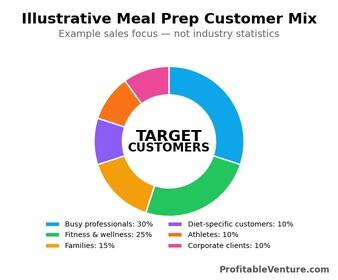
a. Who is the Target Market for a Meal Prep Business?
- Busy professionals
- Office workers
- Fitness enthusiasts
- Gym members
- Athletes
- Bodybuilders
- Parents and families
- College students
- Senior citizens
- People looking for convenient portion-controlled meals
- Vegetarian and plant-based customers
- Customers following specific eating preferences
- Corporate organizations
- Health and wellness businesses
- Personal trainers and fitness coaches
- Apartment communities
- Sports teams.
b. Is a Meal Prep Business Profitable?
Yes, a meal prep business can be profitable when the owner controls food cost, labor, packaging, kitchen expenses, and delivery efficiently.
The recurring nature of the business is particularly attractive. A satisfied customer may order five or ten meals every week rather than making a single purchase.
This makes customer retention extremely important. However, revenue alone does not determine profitability.
A meal prep company can sell hundreds of meals each week and still struggle if portions are inconsistent, ingredients are too expensive, delivery routes are inefficient, or too much unsold food is discarded.
The business works best when you can forecast demand before production.
For example, if customers place orders by Wednesday and you cook on Sunday for Monday delivery, you already know roughly how many portions need to be prepared.
This can reduce the waste that traditional restaurants experience when they must keep ingredients available without knowing exactly what customers will order.
c. Are There Existing Niches in the Industry?
Yes, there are several meal prep niches. They include:
- High-protein meal prep
- Fitness meal prep
- Weight-management meal plans
- Low-carbohydrate meal prep
- Plant-based meal prep
- Vegetarian meal prep
- Family meal plans
- Office lunch meal prep
- Budget meal prep
- Premium chef-prepared meals
- Senior meal delivery
- Athlete meal plans
- Breakfast meal prep
- Meal prep for busy parents
- Corporate meal programs
- Ethnic and culturally inspired meal prep
- Bulk protein and side-dish meal prep.
If you are serving customers with medically prescribed dietary requirements, be careful about presenting yourself as providing medical nutrition treatment unless appropriately qualified.
You may choose to work with a registered dietitian or another qualified professional when designing specialized programs.
d. Who are the Major Competitors?
Your competitors may include:
- National prepared-meal subscription companies
- Local meal prep companies
- Healthy restaurants
- Personal chefs
- Catering companies
- Grocery-store prepared-food departments
- Restaurants offering weekly meal packages
- Fitness-focused food companies
- Online meal delivery businesses
- Dietitian-owned meal services
- Ghost kitchens
- Corporate catering companies.
You should not try to beat every competitor on price.
A local meal prep company can compete through freshness, personal service, local delivery, flexible ordering, culturally relevant food, better portions, corporate partnerships, and menus designed specifically for its community.
e. Are There County, State, or Federal Regulations for a Meal Prep Business in the United States?
Yes. Meal prep businesses are food businesses and are normally subject to state and local health and food-service regulations.
Your city or county health department may require plan review, a food establishment permit, commercial kitchen approval, food handler training, manager certification, sanitation procedures, inspections, and proper refrigeration.
Prepared refrigerated meals containing meat, poultry, dairy products, cooked vegetables, rice, sauces, and other temperature-controlled foods usually require stricter handling than simple shelf-stable cottage foods.
For this reason, you should not assume that a general cottage food permit will allow you to prepare complete refrigerated meals at home.
Check the law in your state before using a residential kitchen. Many operators instead rent space in an approved shared commercial or commissary kitchen.
The FDA Food Code provides a model that many state and local governments use when creating food-service rules.
Depending on your operation, requirements may cover employee hygiene, handwashing, cooking temperatures, cooling, refrigeration, reheating, allergen procedures, equipment sanitation, pest control, water supply, waste disposal, and food storage.
If your business expands beyond ordinary retail food service and begins manufacturing, processing, packaging, or distributing food through broader interstate wholesale channels, additional federal requirements may apply.
Meat, poultry, and certain egg products can also fall under USDA oversight depending on how the products are manufactured and distributed.
Always confirm your particular business model with your state and local health authorities before investing in a kitchen.
f. Is There a Franchise for a Meal Prep Business?
Yes, meal prep, healthy food, nutrition, and prepared-food franchise opportunities exist.
However, many successful meal prep businesses are independently owned. A franchise may provide recipes, branding, suppliers, software, operating procedures, and marketing support.
In return, you may pay an initial franchise fee, royalties, advertising contributions, and other ongoing fees.
You may also have less freedom to change the menu or source ingredients locally.
If you consider a franchise, review the Franchise Disclosure Document carefully and calculate whether the system leaves enough profit after royalties and other required payments.
g. What Do You Need to Start a Meal Prep Business?
- A clearly defined customer niche
- A tested menu
- Approved commercial kitchen access
- Business registration
- Food establishment permits
- Food handler and manager certification where required
- Commercial kitchen equipment
- Refrigeration
- Ingredient suppliers
- Meal containers
- Labels
- Insulated delivery bags or refrigerated delivery system
- Website or online ordering platform
- Payment processing
- Commercial insurance
- Delivery vehicles or delivery partners
- Working capital
- Food-safety procedures
- Customer service system.
-
Choose a Memorable Business Name
Your meal prep business name should be easy to remember and easy to spell. It should also be broad enough to support expansion.
For example, a name built entirely around bodybuilding may become restrictive if you later decide to serve families and corporate clients.
Before committing to a name, search your state’s business database, investigate trademark conflicts, and check whether an appropriate website domain and social media handles are available. Some catchy meal prep business name ideas are:
- FreshFork Meal Prep, LLC
- Ready Plate Kitchen, LLC
- Weekly Table Meals, LLC
- FreshBox Meal Prep, LLC
- Fuel & Fork Kitchen, LLC
- Balanced Plate Prep, LLC
- Prime Meal Kitchen, LLC
- SmartPlate Meal Prep, LLC
- FreshRoute Meals, LLC
- FitFork Meal Prep, LLC
- Daily Dish Kitchen, LLC
- Urban Meal Prep Co., LLC
- Portion House Kitchen, LLC
- MealCraft Kitchen, LLC
- Prepared Table Foods, LLC
- FreshWeek Meal Prep, LLC
- Simply Ready Meals, LLC
- Good Plate Kitchen, LLC
- Prep & Serve Foods, LLC
- Weekly Fuel Kitchen, LLC.
-
Register Your Business
a. What Type of Business Structure is Best for a Meal Prep Business?
The best structure depends on the number of owners, taxes, funding plans, and the level of liability protection you need. Many small food businesses choose a limited liability company.
An LLC can provide separation between personal and business affairs while remaining relatively simple to operate.
However, forming an LLC does not remove the need for product liability insurance, food-safety compliance, workers’ compensation where required, and responsible operating procedures.
Food businesses face risks that include alleged foodborne illness, allergic reactions, employee injuries, delivery accidents, and customer complaints. Insurance and food-safety systems therefore remain extremely important.
b. Steps to Form an LLC
- Choose an available business name
- File formation documents with your state
- Select a registered agent
- Create an operating agreement
- Obtain an EIN where applicable
- Register for relevant state and local taxes
- Open a business bank account
- Obtain food-service permits
- Purchase appropriate insurance
- Maintain state filings and annual reports.
c. What Type of License is Needed to Start a Meal Prep Business?
The exact requirements depend on your location, but you may need:
- General business license
- Food establishment permit
- Commercial kitchen approval
- Food handler permit or card
- Certified food protection manager qualification
- Health department inspection approval
- Sales-tax registration where applicable
- Certificate of occupancy if operating your own facility
- Fire department approval
- Sign permit where applicable
- Commercial vehicle registration for delivery vehicles
- Additional permits for wholesale food processing where applicable.
d. What Type of Certification is Needed to Start a Meal Prep Business?
There is no single national “meal prep certification.” Depending on your jurisdiction and responsibilities, useful or required certifications may include:
- Food handler certification
- Certified food protection manager certification
- Allergen awareness training
- Food safety training
- First aid and CPR
- HACCP training for certain specialized processes
- Nutrition training
- Commercial kitchen sanitation training.
If you make individualized medical or therapeutic nutrition claims, you may also need to work with appropriately licensed nutrition professionals.
e. What Documents are Needed to Start a Meal Prep Business?
- Business formation documents
- Employer Identification Number where applicable
- Business license
- Food establishment permit
- Health inspection records
- Commercial kitchen agreement or lease
- Food handler certificates
- Food manager certification where required
- Insurance policies
- Employee records
- Supplier invoices
- Temperature logs
- Cleaning and sanitation schedules
- Ingredient and allergen records
- Delivery records
- Customer invoices
- Sales-tax documentation where applicable
- Vehicle records where applicable.
f. Do You Need a Trademark, Copyright, or Patent?
You normally do not need a patent to start a meal prep business. A trademark may protect your company name, logo, slogan, or private-label food brand.
Copyright can protect original website content, photographs, menu designs, videos, and marketing materials.
Recipes themselves can be more difficult to protect through ordinary copyright law, especially when they consist mainly of ingredient lists and standard preparation instructions.
For most startups, your immediate priorities should be permits, food safety, kitchen approval, customers, and profitable operations.
-
Cost Analysis and Budgeting
a. How Much Does It Cost to Start a Meal Prep Business?
The amount required depends heavily on whether you rent space in an existing commercial kitchen or build your own food-production facility.
A small owner-operated business using a shared commercial kitchen may be able to start with approximately $15,000 to $30,000.
A medium-scale operation with dedicated equipment, employees, delivery systems, and stronger working capital may require approximately $50,000 to $100,000.
A larger operation using a dedicated commercial facility, larger production equipment, multiple employees, and delivery vehicles may require approximately $150,000 to $300,000 or more.
For this guide, we will use:
- Small-scale meal prep business: approximately $20,000
- Medium-scale meal prep business: approximately $70,000
- Large-scale meal prep business: approximately $180,000.
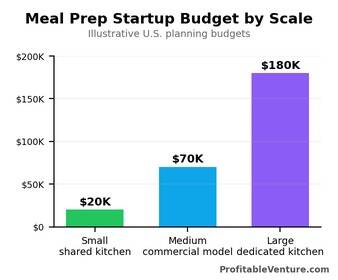
These figures are planning estimates rather than guaranteed prices.
b. What are the Costs Involved in Starting a Meal Prep Business?
Small-Scale Meal Prep Business – Approximately $20,000
- Commercial kitchen deposit and initial rental – $4,000
- Small equipment, utensils, pans, scales, and storage – $4,000
- Licenses, certifications, and initial insurance – $2,000
- Initial ingredients – $2,000
- Meal containers and labels – $1,500
- Website and online ordering – $1,500
- Coolers and delivery equipment – $2,000
- Initial marketing – $1,000
- Working capital reserve – $2,000
- Estimated Total – $20,000.
This setup is most appropriate for an owner who cooks personally, rents an approved kitchen, and keeps the menu and delivery area small.
Medium-Scale Meal Prep Business – Approximately $70,000
- Commercial kitchen deposit and initial rental – $8,000
- Production equipment and small-wares – $15,000
- Working capital reserve – $15,000
- Delivery equipment and transportation setup – $8,000
- Initial marketing and customer acquisition – $6,000
- Website, ordering software, and technology – $5,000
- Initial food inventory – $5,000
- Licenses, certification, and insurance – $4,000
- Packaging and labels – $4,000
- Estimated Total – $70,000.
This is the model used for the financial projection later in this article.
Large-Scale Meal Prep Business – Approximately $180,000
- Dedicated kitchen lease, deposit, and buildout – $45,000
- Commercial production equipment – $40,000
- Working capital reserve – $25,000
- Delivery vehicles and cold-chain equipment – $25,000
- Initial food inventory – $10,000
- Packaging and labeling inventory – $8,000
- Technology and ordering systems – $10,000
- Licensing, insurance, and professional fees – $8,000
- Marketing and launch expenses – $9,000
- Estimated Total – $180,000.
A large kitchen does not create demand by itself. Do not invest in production capacity for 5,000 meals per week if you currently have only enough customers to buy 300 meals.
c. What Factors Determine the Cost of Starting a Meal Prep Business?
- Commercial kitchen arrangement
- Size of production facility
- Menu complexity
- Number of employees
- Refrigeration requirements
- Commercial equipment
- Delivery vehicles
- Packaging type
- Ordering technology
- Health department requirements
- Insurance
- Working capital
- Marketing budget
- Number of meals you intend to produce.
d. Do You Need to Build a Facility? If YES, How Much Will It Cost?
No, you do not necessarily need to build your own commercial kitchen. Many new meal prep companies rent shared or commissary kitchen space.
This can significantly reduce the amount of startup capital required. A shared kitchen may already include ovens, ranges, sinks, refrigeration, prep tables, storage, and approved sanitation facilities.
As the business grows, operating your own dedicated kitchen may become more economical.
However, the decision should be based on actual production volume rather than ego. A large empty kitchen is an expensive way to feel successful.
e. What are the Ongoing Expenses of a Meal Prep Business?
- Food ingredients
- Kitchen rent
- Employee wages
- Payroll taxes
- Packaging
- Labels
- Delivery fuel
- Driver wages
- Vehicle maintenance
- Insurance
- Ordering software
- Payment-processing fees
- Website hosting
- Advertising
- Utilities
- Cleaning and sanitation supplies
- Waste disposal
- Food safety certification
- Accounting and bookkeeping
- Equipment repairs
- Ingredient spoilage and food waste.
f. What is the Average Salary of Your Staff?
Employee wages vary significantly by city and state. A small operation may begin with the owner and one kitchen assistant. A growing meal prep company may employ:
- General Manager
- Kitchen Manager
- Chef or Lead Cook
- Prep Cooks
- Packaging Staff
- Dishwasher/Sanitation Staff
- Delivery Drivers
- Customer Service Staff
- Operations Coordinator
- Marketing Assistant.
Research local wage rates when building your actual business plan. Remember to include payroll taxes, workers’ compensation, training, overtime, and turnover costs.
g. How Do You Get Funding to Start a Meal Prep Business?
- Personal savings
- Small-business loans
- Equipment financing
- Business partners
- Private investors
- Family financing
- Business credit
- Starting in a shared kitchen and reinvesting profits
- Pre-selling meal subscriptions
- Corporate meal contracts.
Starting lean can be particularly useful in meal prep because customer demand can be tested before you invest in a large kitchen.
-
Write a Business Plan
a. Executive Summary
FreshFork Meal Prep, LLC is a proposed meal preparation and delivery company based in Dallas, Texas.
The company will prepare fresh, portioned, ready-to-heat meals for busy professionals, fitness customers, families, corporate clients, and other consumers who want convenient meals without cooking every day.
FreshFork Meal Prep will initially operate from an approved commercial kitchen and focus on weekly preorders rather than operating like a traditional restaurant.
Customers will place orders through the company’s website, choose from a rotating weekly menu, and select pickup or delivery.
The business will generate revenue through individual meals, meal packages, recurring subscriptions, office meal programs, family plans, gym partnerships, and corporate orders. The business will launch with approximately $70,000 in startup capital.
Management will emphasize portion control, efficient batch cooking, reliable delivery, food safety, customer retention, and disciplined menu costing.
The long-term objective is to build enough recurring weekly demand to justify a dedicated commercial kitchen and expanded delivery operation.
b. Products and Services
FreshFork Meal Prep, LLC will offer:
- Individual prepared meals
- Five-meal weekly packages
- Ten-meal weekly packages
- High-protein meals
- Vegetarian meals
- Family dinner packages
- Breakfast meals
- Bulk proteins
- Bulk side dishes
- Corporate lunch programs
- Gym and fitness meal plans
- Office meal deliveries
- Local pickup
- Home delivery.
c. Mission Statement
“At FreshFork Meal Prep, LLC, our mission is to make convenient, freshly prepared meals available to busy people through dependable service, consistent portioning, responsible food-safety practices, and meals customers genuinely look forward to eating.”
Vision Statement
“Our vision is to build FreshFork Meal Prep into a trusted local prepared-food brand known for convenience, consistency, freshness, reliable delivery, and strong relationships with individuals, families, gyms, and corporate customers.”
d. Goals and Objectives
The first objective is to create a profitable recurring weekly customer base.
Management will focus on retention rather than constantly replacing customers who cancel after one order. The company will also develop menus that share ingredients.
For example, grilled chicken may appear in several dishes using different sauces and side dishes.
This reduces inventory complexity and makes bulk purchasing more efficient.
Another objective is to develop dense delivery routes. Corporate offices, gyms, and apartment communities can be particularly useful because many meals can be delivered to one location.
Long-term goals include increasing production volume, hiring additional kitchen staff, adding delivery vehicles, securing corporate contracts, and eventually moving into a dedicated production facility.
e. Organizational Structure
- Owner/General Manager
- Kitchen Manager
- Lead Cook
- Prep Cooks
- Packaging Staff
- Sanitation Staff
- Delivery Drivers
- Customer Service Representative
- Marketing Assistant
- Bookkeeper/Accountant.
A new business does not need every position immediately.
Marketing Plan
a. SWOT Analysis
Strengths
Meal prep can generate recurring weekly revenue. The business can also forecast demand more accurately than many restaurants because customers often order before production begins.
A local company can adapt its menu quickly and provide more personal service than large national delivery companies.
Weaknesses
Fresh food has a limited shelf life. Incorrect demand forecasting can create waste.
The business is also operationally demanding because cooking, portioning, labeling, refrigeration, delivery, and customer service must work together.
Opportunities
Opportunities include corporate meal programs, gyms, personal trainers, apartment communities, family packages, sports teams, and recurring subscriptions.
A successful local brand may eventually expand into multiple kitchens, retail refrigerators, wholesale partnerships, or packaged foods.
Threats
Major threats include food inflation, delivery costs, food-safety incidents, labor shortages, strong competition, customer subscription fatigue, and negative reviews. One late or spoiled order can damage trust very quickly.
b. How Do Meal Prep Businesses Make Money?
- Individual meal sales
- Weekly meal packages
- Subscriptions
- Family plans
- Corporate meals
- Gym partnerships
- Bulk proteins and side dishes
- Office lunch programs
- Sports team orders
- Pickup orders
- Delivery fees where appropriate.
c. Payment Options
- Credit cards
- Debit cards
- Apple Pay
- Google Pay
- Online payments
- Recurring subscription billing
- Corporate invoices
- Gift cards.
d. Sales and Advertising Strategies
- Partner with local gyms
- Work with personal trainers
- Offer free samples at fitness events
- Create Instagram and TikTok food content
- Use high-quality meal photography
- Create referral incentives
- Offer subscription discounts
- Partner with apartment communities
- Target office buildings
- Develop corporate meal programs
- Use email marketing
- Send weekly menu reminders
- Encourage reviews
- Offer pickup locations
- Use introductory meal bundles
- Create loyalty rewards.
Financial Projection
a. How Much Should You Charge for Your Meals?
Do not choose a meal price simply because another company charges the same amount. Calculate the actual cost of producing each meal. Include:
- Protein
- Vegetables
- Carbohydrates
- Sauces
- Seasonings
- Meal container
- Label
- Kitchen labor
- Payment-processing costs
- Delivery allocation
- Kitchen overhead.
A useful formula is:
Meal Selling Price = Total Meal Cost ÷ Target Cost Percentage.
Every menu item should be costed before it is sold.
b. How Much Revenue Can a Meal Prep Business Generate?
Revenue depends on how many active customers you have, how many meals each customer orders, your average selling price, delivery frequency, and corporate business.
For planning purposes:
- Small owner-operated meal prep business: approximately $100,000 to $180,000 in annual revenue
- Medium commercial-kitchen operation: approximately $220,000 to $400,000
- Large regional meal prep business: approximately $500,000 to $1 million or more.
For the financial projection below, we will use the $70,000 medium-scale startup model.
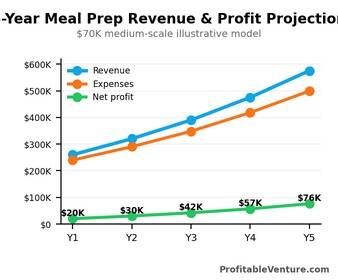
The business is projected to generate approximately $260,000 during its first full year.
c. Five-Year Revenue and Profit Projection
| Fiscal Year | Revenue | Total Expenses | Net Profit | Net Margin |
|---|---|---|---|---|
| Year 1 | $260,000 | $240,000 | $20,000 | 7.7% |
| Year 2 | $320,000 | $290,000 | $30,000 | 9.4% |
| Year 3 | $390,000 | $348,000 | $42,000 | 10.8% |
| Year 4 | $475,000 | $418,000 | $57,000 | 12.0% |
| Year 5 | $575,000 | $499,000 | $76,000 | 13.2% |
Under this projection, cumulative five-year revenue would be approximately $2.02 million, while cumulative projected net profit would be approximately $225,000.
d. Sample Five-Year Profit and Loss Projection
| Item | Year 1 | Year 2 | Year 3 | Year 4 | Year 5 |
|---|---|---|---|---|---|
| Revenue | $260,000 | $320,000 | $390,000 | $475,000 | $575,000 |
| Food Ingredients | $78,000 | $94,000 | $113,000 | $137,000 | $164,000 |
| Labor | $65,000 | $80,000 | $98,000 | $119,000 | $143,000 |
| Commercial Kitchen | $26,000 | $28,000 | $31,000 | $35,000 | $39,000 |
| Packaging | $18,000 | $21,000 | $25,000 | $29,000 | $34,000 |
| Delivery | $15,000 | $18,000 | $22,000 | $27,000 | $33,000 |
| Marketing | $10,000 | $12,000 | $14,000 | $17,000 | $20,000 |
| Insurance and Licensing | $6,000 | $7,000 | $8,000 | $9,000 | $10,000 |
| Technology and Payment Fees | $8,000 | $10,000 | $12,000 | $15,000 | $18,000 |
| Administration | $10,000 | $12,000 | $14,000 | $17,000 | $20,000 |
| Other Operating Expenses | $4,000 | $8,000 | $11,000 | $13,000 | $18,000 |
| Total Expenses | $240,000 | $290,000 | $348,000 | $418,000 | $499,000 |
| Projected Net Profit | $20,000 | $30,000 | $42,000 | $57,000 | $76,000 |
e. How Much Profit Do Meal Prep Business Owners Make a Year?
The amount varies depending on volume, pricing, labor, kitchen expenses, and delivery efficiency.
Using the medium-scale model in this article, projected business profit begins at approximately $20,000 in Year 1 and rises toward approximately $76,000 in Year 5.
An owner who works actively inside the business may also receive compensation through wages or owner draws depending on the company’s structure.
f. What Factors Determine the Amount of Profit to Be Made?
- Number of active customers
- Number of meals ordered per customer
- Average meal price
- Food cost
- Labor cost
- Packaging cost
- Kitchen rent
- Delivery density
- Food waste
- Customer retention
- Corporate contracts
- Subscription revenue
- Marketing costs
- Equipment efficiency.
g. What is the Profit Margin of a Meal Prep Business?
Profit margins vary from one business to another. Calculate your own using:
Net Profit Margin = Net Profit ÷ Revenue × 100.
The medium-scale model used here begins at approximately 8% net profit and gradually improves toward approximately 13%.
h. What is the Sales Forecast?
- First Fiscal Year: $260,000
- Second Fiscal Year: $320,000
- Third Fiscal Year: $390,000
- Fourth Fiscal Year: $475,000
- Fifth Fiscal Year: $575,000.
-
Set Up Your Kitchen and Delivery Operation
a. How Do You Choose a Perfect Location for a Meal Prep Business?
A meal prep kitchen does not necessarily need expensive retail frontage. Customers may rarely visit your kitchen if most orders are delivered. Important considerations include:
- Health department approval
- Affordable commercial rent
- Access to major roads
- Proximity to customers
- Loading and parking
- Refrigeration capacity
- Storage space
- Waste disposal
- Reliable utilities
- Room for future production growth.
b. What State and City is Best to Start a Meal Prep Business?
There is no universally best city. Look for areas with busy professionals, strong fitness communities, corporate employment, universities, apartment developments, and customers willing to pay for convenience. Markets worth researching include:
- Dallas, Texas
- Austin, Texas
- Houston, Texas
- Atlanta, Georgia
- Charlotte, North Carolina
- Denver, Colorado
- Phoenix, Arizona
- Nashville, Tennessee
- Orlando, Florida
- Raleigh, North Carolina.
c. What Equipment is Needed to Operate a Meal Prep Business?
- Commercial ovens
- Ranges
- Griddles
- Commercial refrigerators
- Freezers
- Prep tables
- Food processors
- Mixers
- Commercial scales
- Sheet pans
- Pots and pans
- Knives
- Storage containers
- Cooling racks
- Thermometers
- Label printer
- Meal containers
- Heat-sealing equipment where used
- Dishwashing equipment
- Sanitation supplies
- Insulated delivery bags
- Delivery vehicles where needed.
-
Hire Employees
A small meal prep business may begin with the owner and one or two helpers.
As production increases, you may need cooks, prep workers, packaging staff, drivers, sanitation employees, and customer service personnel.
Train every employee on food safety, portion control, allergen procedures, cleaning, refrigeration, labeling, and personal hygiene. Consistency is critical.
If one employee puts six ounces of chicken into a meal while another uses ten ounces, your food cost becomes unpredictable.
Portion scales and written procedures help protect both consistency and profitability.
-
Launch the Business Proper
A soft launch is usually better than trying to produce hundreds of meals immediately.
Begin with a manageable number of customers. Test your ordering deadline, production schedule, packaging, refrigeration, pickup, and delivery routes.
Ask customers how the meals taste after reheating rather than only how they taste immediately after cooking. This is important because your customer is eating the meal later.
Once the system works, begin expanding through subscriptions, referrals, gym partnerships, corporate offices, and local advertising.
a. What Makes a Meal Prep Business Successful?
- Consistent food quality
- Strong food safety
- Accurate portion control
- Simple menus
- Reliable delivery
- Good packaging
- Customer retention
- Dense delivery routes
- Low food waste
- Accurate menu costing
- Recurring subscriptions
- Strong customer service.
b. What Happens During a Typical Day at a Meal Prep Business?
A typical production day begins with receiving ingredients and checking their quality and temperature.
Staff organize ingredients, prepare vegetables, portion proteins, cook grains, make sauces, and begin batch cooking.
Cooked food is portioned according to standardized recipes. Meals are cooled correctly, packaged, labeled, and refrigerated.
Employees verify that each customer’s order contains the correct meals. Delivery routes are then organized by geographic area.
Drivers load meals into appropriate cold-storage containers and complete deliveries. After production, the kitchen is cleaned and sanitized.
The owner reviews inventory, places supplier orders, answers customer messages, updates the next menu, tracks subscriptions, and analyzes sales.
c. What Skills and Experience Do You Need to Build a Meal Prep Business?
- Cooking skills – Food must remain enjoyable after refrigeration and reheating.
- Food safety knowledge – Safe cooling, storage, and handling are essential.
- Menu costing – You must know the real cost of every meal.
- Batch production – Cooking 100 portions differs from cooking dinner for four people.
- Inventory management – Overbuying creates waste.
- Time management – Production deadlines can be demanding.
- Delivery planning – Routes must be organized efficiently.
- Customer service – Recurring customers expect reliability.
- Marketing – You must continuously attract and retain customers.
- Financial management – Revenue means little if food, labor, and delivery costs are uncontrolled.
If you have no experience, begin by learning the production process before trying to scale.
Cook a small menu repeatedly. Measure portions. Time each recipe. Calculate the ingredient cost. Test how meals taste after three or four days in refrigeration.
Learn how long your packaging takes and how many meals one person can realistically assemble in an hour. Most importantly, build the business around repeatable systems.
A meal prep business becomes difficult when the owner personally remembers every recipe, every customer’s preference, every delivery address, and every ingredient order.
The more successful the company becomes, the more important written procedures, ordering software, standardized recipes, portion scales, production schedules, and delivery systems become.
If you can combine great food with reliable operations, disciplined cost control, strong customer retention, and safe production practices, you can build a profitable meal prep business even if you started with no previous food-business experience.