

A private caregiver business provides non-medical care and daily living assistance to elderly adults, people with disabilities, individuals recovering from surgery, and other clients who need help remaining safely in their own homes.
Your caregivers may assist clients with:
- Bathing
- Dressing
- Grooming
- Toileting
- Mobility assistance
- Meal preparation
- Light housekeeping
- Laundry
- Companionship
- Transportation
- Shopping and errands
- Medication reminders where legally permitted
- Respite care for family caregivers
- Supervision for clients with memory loss.
The business is sometimes described as:
- Private-duty home care
- Non-medical home care
- Personal care services
- Companion care
- Senior home care
- In-home caregiver services.
For this guide, we are talking about a business that employs and schedules caregivers rather than a single self-employed caregiver working alone. You can certainly start as one caregiver and grow later.
However, the scalable business model involves building an agency that finds clients, recruits caregivers, matches employees to clients, handles scheduling, manages payroll, supervises service quality, and earns a margin between what clients pay and what it costs to deliver the care.
You should also understand that a non-medical caregiver agency is different from a skilled home-health agency.
A caregiver may generally help with daily living and companionship within the scope permitted by your state.
A skilled home-health business may provide services such as:
- Registered nursing
- Wound care
- Medication administration
- Physical therapy
- Occupational therapy
- Other clinical services.
Those services can require different licenses, clinical supervision, Medicare/Medicaid requirements, and licensed healthcare professionals.
If you plan to provide skilled medical services, you should also review our guide on how to start a home healthcare agency.
A private caregiver agency can become a very attractive recurring-revenue business because clients often require care for weeks, months, or even years.
- A client receiving five hours of care per day, five days per week creates 25 billable hours every week.
- A client needing daily assistance can generate substantially more.
- A single customer receiving round-the-clock care may require several caregivers working rotating shifts.
But this is also a labor-intensive business. Your greatest challenge may not be finding people who need care. It may be finding enough dependable caregivers to serve them.
The companies that succeed generally become excellent at both sides of the marketplace: Finding clients and keeping caregivers.
Steps on How to Start a Private Caregiver Business
-
Conduct Market Research
Do not begin by printing brochures and recruiting 30 caregivers. First determine who needs care in your market and who is already serving them.
Research:
- Population age
- Senior households
- Retirement communities
- Hospitals
- Rehabilitation centers
- Assisted living communities
- Hospice providers
- Veterans organizations
- Adult day programs
- Existing home care agencies.
Then research competitors. Call several agencies as if you were a prospective client. Ask:
- What do they charge?
- What is the minimum shift?
- Do they provide overnight care?
- Do they provide dementia care?
- How quickly can care begin?
- Do they charge more on weekends?
- Do they accept long-term-care insurance?
- Do they accept Medicaid?
- How many hours must a client purchase?
Read reviews carefully. You may notice recurring complaints such as:
- Caregivers arriving late
- No replacement when a caregiver calls out
- Constantly changing caregivers
- Poor communication from the office
- Untrained caregivers
- Billing problems
- Caregivers spending excessive time on phones.
Every repeated complaint represents an opportunity for your company to operate better.
a. Who is the Target Market?
Your clients can include:
- Older adults aging at home
- People with disabilities
- People recovering after hospitalization
- Individuals recovering from surgery
- Clients with dementia or memory loss
- People receiving hospice care who need additional non-medical assistance
- Veterans
- Adults whose relatives live far away
- Families needing temporary respite care.
However, the person receiving care is not always the person buying the service.
Your real customer may be the adult daughter or son trying to find dependable care for an aging parent. That buyer may live:
- 20 minutes away
- In another state
- Across the country.
They may care enormously about their parent but be unable to provide daily assistance themselves. Your marketing therefore needs to speak to both: The client receiving care and the family making the decision.
b. Is a Private Caregiver Business Profitable?
Yes, but you need to understand the economics of each billable hour. Suppose you charge a private-pay client $36 per caregiver hour.
Your costs might look something like this:
- Caregiver wage – $19
- Payroll taxes, workers’ compensation, and employment burden – $4
- Scheduling, recruiting, supervision, and variable operating cost – $3
- Contribution before fixed overhead – approximately $10 per billable hour.
This is only an illustration. Your actual costs will depend on wages, insurance, state requirements, overtime, and local pricing.
But it shows why billable hours matter. If your company produces 2,000 billable hours per month and earns approximately $10 per hour toward fixed overhead and profit:
2,000 × $10 = $20,000.
If you increase to 6,000 billable hours while maintaining healthy margins:
6,000 × $10 = $60,000.
But careless scheduling can destroy those margins. For example, if several caregivers work excessive overtime because you cannot recruit replacements, your labor cost can increase quickly.
Your most important financial metrics should include:
- Billable hours
- Revenue per billable hour
- Caregiver wage per hour
- Gross contribution per hour
- Overtime percentage
- Caregiver utilization
- Missed shifts
- Client retention
- Caregiver turnover
- Accounts receivable.
c. What Niches Exist?
You can specialize in:
- Senior companion care
- Dementia and Alzheimer’s support
- Respite care
- Post-hospital non-medical support
- Disability assistance
- Veterans care
- Overnight care
- 24-hour shift-based care
- Hospice companion care
- Transportation and errands
- Meal and homemaking assistance
- Short-term post-surgery assistance.
You do not need to provide everything when you start. A new agency might focus initially on:
- Companionship
- Personal care
- Meal preparation
- Respite care
- Light housekeeping.
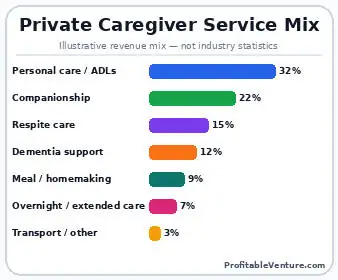
You can introduce specialized dementia or higher-acuity personal care as your training and supervision systems become stronger.
d. Who are the Major Competitors?
Your competition may include national and regional companies such as:
- Home Instead
- Visiting Angels
- Right at Home
- Comfort Keepers
- Senior Helpers
- Home Helpers
- Independent local home-care agencies.
You are also indirectly competing with:
- Assisted living
- Nursing homes
- Family caregivers
- Independent caregivers
- Adult day programs.
You do not need to be the cheapest. Families often value reliability more than saving two dollars per hour.
A company that answers the phone, replaces absent caregivers quickly, communicates with families, and sends consistent caregivers can justify premium pricing.
e. What Regulations Apply?
Home-care licensing is heavily state dependent. Depending on where you operate, you may need:
- Home care agency license
- Personal assistance services license
- Private home care provider license
- Home services agency registration
- Administrator approval
- Local business license.
Some states regulate non-medical caregiver agencies extensively. Others impose fewer requirements.
Do not assume that because you are not providing nursing care, you do not need a home-care license.
Research your state requirements before advertising services or accepting clients. States may also regulate:
- Background checks
- Fingerprinting
- Caregiver training
- Health screening
- Care plans
- Supervision
- Client records
- Complaints
- Emergency procedures
- Medication assistance
- Transportation.
Do Not Turn Non-Medical Care Into Unlicensed Nursing
Your care plan should clearly define what caregivers may and may not do. For example, a caregiver may be permitted to remind a client that it is time to take medication.
That is not automatically the same thing as administering medications. Rules vary.
If a client needs skilled nursing, arrange an appropriate referral or expand your agency only after obtaining the proper licenses and clinical staff.
f. Understand Medicaid and Electronic Visit Verification
You can begin as a completely private-pay business. That is often administratively simpler.
If you later become an approved Medicaid personal-care provider, additional state requirements can apply. These may include:
- Provider enrollment
- Service authorizations
- Care plans
- Electronic visit verification
- Specific caregiver qualifications
- Billing documentation.
Electronic visit verification systems can record information such as:
- Client
- Caregiver
- Service location
- Visit start
- Visit end
- Service delivered.
Even a private-pay agency can benefit from this type of technology because families want to know whether the caregiver actually arrived.
g. Is There a Franchise?
Yes. Private-duty and senior home-care franchises are widely available. Franchise systems can provide:
- Brand recognition
- Training
- Caregiver recruitment systems
- Scheduling systems
- Marketing materials
- Operating procedures
- Business coaching.
The disadvantages can include:
- Initial franchise fees
- Royalties
- Advertising contributions
- Technology fees
- Territory restrictions.
You can compare available options in our guide to home care franchise opportunities.
h. What Do You Need to Start?
- Business entity
- Home-care license or registration where required
- Administrator
- Caregivers
- Background-screening system
- Training program
- Workers’ compensation
- Liability insurance
- Scheduling software
- Payroll system
- Client contracts
- Care plans
- Quality-assurance system
- Emergency procedures
- Marketing strategy
- Payroll working capital.
i. How Does the Service Process Work?
Step 1 – Client Inquiry
A family calls, completes a website form, or receives a referral.
Step 2 – Care Assessment
You determine:
- What help is needed
- How many hours
- Preferred schedule
- Mobility limitations
- Memory concerns
- Household conditions
- Transportation needs
- Safety concerns.
Step 3 – Create the Service Plan
Document exactly what caregivers are expected to do.
Step 4 – Match the Caregiver
Consider:
- Availability
- Experience
- Personality
- Driving requirements
- Physical demands
- Dementia experience
- Language preferences.
Step 5 – Begin Service
The caregiver clocks in, completes assigned tasks, documents the visit, and reports important changes.
Step 6 – Supervise
The office monitors attendance, service quality, client satisfaction, and caregiver performance.
Step 7 – Review the Care Plan
A client’s needs can change. Someone receiving four hours of companionship today may eventually require more intensive personal assistance.
-
Choose a Memorable Business Name
Some private caregiver business name ideas include:
- GentleHands Private Care, LLC
- HomeHeart Caregivers, LLC
- ComfortPath Home Care, LLC
- Golden Years Private Care, LLC
- KindBridge Caregivers, LLC
- SafeHands Home Care, LLC
- EverCare Private Duty, LLC
- Graceful Living Care, LLC
- Companion First Home Care, LLC
- Caring Harbor Services, LLC
- HomeSide Caregivers, LLC
- Trusted Hands Private Care, LLC
- Peaceful Home Care, LLC
- BrightPath Caregiving, LLC
- HomeComfort Care Services, LLC
- FamilyBridge Home Care, LLC
- Gentle Support Caregivers, LLC
- Everyday Care Partners, LLC
- HomeWell Companion Care, LLC
- Compassionate Path Home Care, LLC.
Check state business records and potential trademark conflicts before using your final name.
-
Register Your Business
a. What Business Structure is Best?
An LLC is commonly suitable for a privately owned non-medical home-care agency.
However, the entity structure does not replace required home-care licensing.
You should also discuss taxation with an accountant once payroll and profits become substantial.
b. Typical Formation Steps
- Choose an available business name
- Form the LLC or corporation
- Appoint a registered agent
- Obtain an EIN
- Open a business bank account
- Apply for home-care licensing where required
- Register as an employer
- Purchase insurance
- Establish payroll
- Set up operating policies.
c. What Licenses May Be Required?
Depending on the state:
- Home-care agency license
- Personal care services license
- Private home care provider license
- General business license
- Administrator qualification
- Medicaid provider enrollment if applicable
- Transportation-related requirements where applicable.
d. What Certifications are Useful?
Your caregivers may benefit from training or certification in:
- CPR
- First aid
- Dementia care
- Fall prevention
- Safe transfers
- Infection prevention
- Personal care
- Emergency response.
Some states or payer programs may require specific training hours or credentials.
Do not advertise caregivers as certified nursing assistants unless they actually hold the required credential.
e. What Documents Do You Need?
- Business formation documents
- EIN
- Agency license
- Insurance certificates
- Client service agreement
- Client assessment
- Care/service plan
- Emergency contacts
- Caregiver employment agreement
- Job descriptions
- Background-check records
- Training records
- Timekeeping records
- Visit notes
- Incident reports
- Complaint procedures
- Privacy policy
- Transportation policy
- Medication-assistance policy
- Cancellation policy
- Employee handbook.
f. What Insurance Should You Carry?
Potential coverage includes:
- General liability
- Professional liability
- Workers’ compensation
- Employment-practices liability
- Cyber liability
- Hired and non-owned auto coverage
- Employee dishonesty/fidelity bonding
- Abuse and molestation coverage where appropriate
- Umbrella liability.
g. Be Careful With Independent Contractor Classification
Do not assume every caregiver should receive a 1099 simply because that reduces payroll administration. If your agency:
- Assigns the client
- Controls schedules
- Sets service procedures
- Trains workers
- Supervises performance
- Requires documentation
- Sets pricing
- Controls how work is delivered,
you need competent employment and tax advice regarding worker classification.
Misclassifying employees can create payroll-tax, overtime, workers’ compensation, and labor-law problems.
Plan for Overtime
Caregiver agencies also need to manage overtime carefully. Do not build a 24-hour-care business plan around one caregiver working unlimited hours for a flat daily rate. Use properly designed shifts and compliant payroll practices.
-
Cost Analysis and Budgeting
a. How Much Does It Cost to Start a Private Caregiver Business?
For planning purposes:
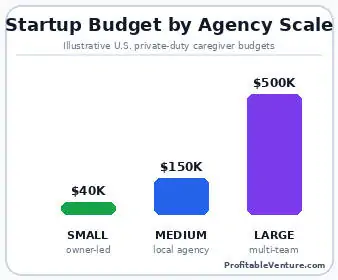
- Small owner-led agency: approximately $20,000 – $60,000
- Professional local home-care agency: approximately $80,000 – $250,000
- Large multi-team agency: approximately $350,000 – $1 million+.
For this guide, we will use:
- Small: $40,000
- Medium: $150,000
- Large: $500,000
b. Small Owner-Led Agency – Approximately $40,000
- Licensing, legal, and business formation – $5,000
- Insurance – $4,000
- Scheduling/payroll technology – $3,000
- Caregiver recruiting and background checks – $5,000
- Website and branding – $4,000
- Marketing – $5,000
- Office and supplies – $2,000
- Training – $2,000
- Payroll/working-capital reserve – $10,000
- Total – $40,000.
c. Medium Professional Agency – Approximately $150,000
- Payroll and working-capital reserve – $60,000
- Licensing, legal, and insurance – $15,000
- Caregiver recruiting, screening, and training – $15,000
- Launch marketing – $15,000
- Office setup and furniture – $10,000
- Scheduling, EVV, payroll, phones, and IT – $12,000
- Field operations, uniforms, and supplies – $8,000
- Referral-development activities – $5,000
- Contingency – $10,000
- Total – $150,000.
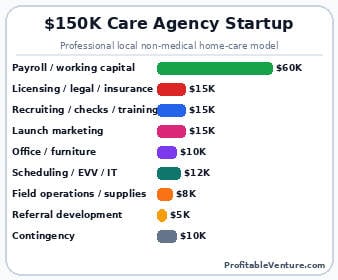
This is the model used in the financial projections below.
d. Large Multi-Team Agency – Approximately $500,000
- Payroll and working-capital reserve – $225,000
- Licensing, insurance, and professional fees – $45,000
- Recruitment and training – $50,000
- Regional office setup – $35,000
- Technology, EVV, payroll, and CRM – $35,000
- Launch and ongoing marketing – $45,000
- Management recruitment – $25,000
- Field equipment and supplies – $15,000
- Business development – $10,000
- Contingency – $15,000
- Total – $500,000.
e. Why Do You Need So Much Working Capital?
Payroll is the answer. Suppose you have 20 caregivers averaging 30 hours per week at $19 per hour. Weekly base caregiver wages are approximately:
20 × 30 × $19 = $11,400.
That does not include payroll taxes, workers’ compensation, administration, or overtime.
If a payer takes several weeks to reimburse you, employees still need to be paid on payday.
A growing caregiver agency can appear profitable on paper while running out of cash because payroll arrives before customer collections.
f. What are the Ongoing Expenses?
- Caregiver payroll
- Payroll taxes
- Workers’ compensation
- Office payroll
- Caregiver recruiting
- Background checks
- Training
- Insurance
- Scheduling software
- Electronic visit verification
- Phones
- Marketing
- Rent
- Accounting
- Legal/compliance
- Mileage reimbursement where applicable.
g. What Staff Do You Need?
A medium agency may employ:
- Owner/Administrator
- Care Coordinator
- Scheduler
- Recruiter
- Caregiver Supervisor
- Home Care Aides/Personal Care Aides
- Marketing/Community Relations Coordinator
- Bookkeeper/Payroll Support.
Illustrative compensation planning ranges may include:
- Caregiver/Home Care Aide: approximately $17 – $24+ per hour
- Care Coordinator/Scheduler: approximately $42,000 – $60,000
- Caregiver Supervisor: approximately $48,000 – $70,000
- Agency Administrator: approximately $65,000 – $100,000+
- Community Relations/Marketing Manager: approximately $50,000 – $80,000.
Use local wages when building your final payroll budget.
h. How Do You Fund the Business?
- Personal savings
- SBA-backed loan
- Business line of credit
- Bank loan
- Business partner
- Private investor
- Family financing
- Starting small and reinvesting profits.
-
Write a Business Plan
For another complete planning example, see our Non-Medical Home Care Business Plan.
a. Executive Summary
GentleHands Private Care, LLC is a proposed non-medical private-duty home-care agency serving Columbus, Ohio and selected surrounding communities.
The company will provide trained caregivers to older adults, adults with disabilities, clients recovering from hospitalization, and families needing respite assistance.
Services will include:
- Companionship
- Personal care
- Bathing and grooming assistance
- Meal preparation
- Light housekeeping
- Respite care
- Dementia support
- Transportation and errands
- Overnight and extended-hour care.
GentleHands will operate as a non-medical agency and will not provide skilled nursing services unless the company later obtains all necessary licenses and clinical resources. The business will launch with approximately $150,000 in startup capital.
Management will focus heavily on caregiver recruitment, employee retention, scheduling reliability, client communication, and recurring private-pay cases.
b. Mission Statement
“At GentleHands Private Care, LLC, our mission is to help clients remain safe, comfortable, respected, and independent in their own homes by providing dependable caregivers, compassionate personal assistance, responsive communication, and consistent service.”
c. Vision Statement
“Our vision is to become one of the most trusted private-duty home-care agencies in our market, known by families for reliable caregivers, strong supervision, transparent communication, and respectful care.”
d. Goals and Objectives
The company will monitor:
- Weekly billable hours
- Revenue per billable hour
- Caregiver pay per hour
- Gross contribution per hour
- Client retention
- Caregiver turnover
- Shift-fill percentage
- Missed visits
- Overtime percentage
- Client complaints
- Referral sources
- Accounts receivable.
A key objective is to build enough caregiver depth that one employee calling out does not leave the client without care.
e. Organizational Structure
- Owner/Administrator
- Operations Manager
- Care Coordinator
- Scheduler
- Recruiter
- Caregiver Supervisor
- Home Care Aides
- Community Relations Manager
- Payroll/Bookkeeping Support.
Marketing Plan
a. SWOT Analysis
Strengths
Home care allows clients to receive assistance without moving into a residential facility. Recurring weekly schedules can also create predictable billable hours.
Weaknesses
The business is extremely dependent on people. If you cannot recruit and retain dependable caregivers, marketing additional clients can actually make your problems worse.
Opportunities
Opportunities include:
- Aging adults
- Dementia care
- Respite care
- Post-hospital support
- Veteran clients
- Long-term-care insurance clients
- 24-hour care
- Additional territories.
Threats
Threats include:
- Caregiver shortages
- Rising wages
- High employee turnover
- Overtime
- Worker misclassification
- Regulatory changes
- Client injuries
- Caregiver misconduct
- Competition from large franchises.
b. How Does a Private Caregiver Business Make Money?
The agency generally charges clients by the hour. Revenue can come from:
- Private-pay hourly care
- Long-term-care insurance reimbursement
- Medicaid programs where enrolled
- Veteran-related programs where eligible
- Respite contracts
- Overnight care
- 24-hour shift coverage.
c. How Much Should You Charge?
Illustrative private-pay planning ranges might include:
- Companion care: $28 – $38 per hour
- Personal care: $32 – $45+ per hour
- Dementia support: $34 – $48+ per hour
- Weekend/evening care: base price plus appropriate premium
- Overnight care: priced according to staffing and labor requirements.
These are planning ranges rather than universal industry rates. Your price needs to cover:
Caregiver Wage + Payroll Burden + Workers’ Compensation + Recruiting + Scheduling + Supervision + Insurance + Office Overhead + Profit.
d. Set a Minimum Shift Carefully
One-hour visits can be difficult to staff. A caregiver may spend 30 minutes driving to perform one billable hour.
Consider requiring:
- Two-hour minimums
- Three-hour minimums
- Four-hour minimums
depending on your market and service model. Longer shifts are often easier to staff and more efficient to administer.
e. How Do You Market the Agency?
- Build a professional website
- Create a Google Business Profile
- Publish helpful senior-care information
- Request family reviews
- Meet discharge planners
- Build relationships with rehabilitation centers
- Network with geriatric care managers
- Build relationships with elder-law professionals
- Contact senior communities
- Network with hospice organizations
- Meet social workers
- Develop community presentations
- Use targeted local advertising.
f. Do Not Pay Improper Referral Fees
Healthcare and publicly funded referrals can involve complicated rules. Do not casually offer money to hospital employees, healthcare providers, or other professionals for sending clients to your agency.
Build relationships by being reliable. If a discharge planner refers a family to you, your agency should:
- Answer quickly
- Assess quickly
- Find a caregiver
- Start on time
- Communicate professionally.
That reliability can generate additional referrals.
Financial Projection
a. Revenue Assumptions
The model below assumes GentleHands grows from a local startup into an established agency with an expanding caregiver workforce.
Year 1 assumes approximately $950,000 in billings. This can be achieved through a combination of part-time and full-time client schedules rather than 950 individual customers.
Remember that one long-term client receiving 40 care hours per week can generate more than 2,000 annual billable hours.
b. Five-Year Revenue and Profit Projection
| Fiscal Year | Revenue | Operating Expenses | Net Profit | Net Margin |
|---|---|---|---|---|
| Year 1 | $950,000 | $893,000 | $57,000 | 6.0% |
| Year 2 | $1,400,000 | $1,302,000 | $98,000 | 7.0% |
| Year 3 | $1,950,000 | $1,794,000 | $156,000 | 8.0% |
| Year 4 | $2,600,000 | $2,340,000 | $260,000 | 10.0% |
| Year 5 | $3,400,000 | $3,026,000 | $374,000 | 11.0% |
Under this illustrative model, cumulative five-year revenue would be approximately $10.3 million. Cumulative projected net profit would be approximately $945,000.
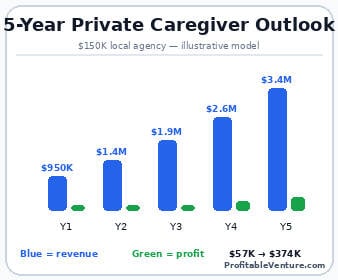
c. Sample Five-Year Profit and Loss Projection
| Item | Year 1 | Year 2 | Year 3 | Year 4 | Year 5 |
|---|---|---|---|---|---|
| Revenue | $950,000 | $1,400,000 | $1,950,000 | $2,600,000 | $3,400,000 |
| Caregiver Wages | $540,000 | $780,000 | $1,060,000 | $1,390,000 | $1,800,000 |
| Payroll Taxes, Benefits and Workers’ Compensation | $90,000 | $130,000 | $180,000 | $240,000 | $310,000 |
| Office and Management Payroll | $70,000 | $100,000 | $130,000 | $170,000 | $210,000 |
| Recruiting, Background Checks and Training | $30,000 | $40,000 | $50,000 | $65,000 | $80,000 |
| Insurance, Licensing and Legal | $25,000 | $30,000 | $35,000 | $42,000 | $50,000 |
| Scheduling, EVV, Phones and IT | $18,000 | $25,000 | $32,000 | $40,000 | $50,000 |
| Marketing and Referral Development | $35,000 | $45,000 | $60,000 | $75,000 | $90,000 |
| Office, Rent and Utilities | $24,000 | $30,000 | $36,000 | $44,000 | $52,000 |
| Mileage, Client Supplies and Field Support | $25,000 | $35,000 | $45,000 | $60,000 | $75,000 |
| Administrative, Payroll Processing, Financing and Other Overhead | $36,000 | $87,000 | $166,000 | $214,000 | $309,000 |
| Total Operating Expenses | $893,000 | $1,302,000 | $1,794,000 | $2,340,000 | $3,026,000 |
| Projected Net Profit | $57,000 | $98,000 | $156,000 | $260,000 | $374,000 |
d. How Much Profit Can a Private Caregiver Business Make?
There is no fixed answer. A small owner-operated agency may produce less revenue but also have limited administrative overhead.
A larger agency can generate several million dollars in revenue but may process hundreds of caregiver shifts every week.
Under this model, projected net profit grows from approximately $57,000 in Year 1 to approximately $374,000 in Year 5.
e. What Determines Profit?
- Billable hours
- Hourly billing rate
- Caregiver wage
- Payroll burden
- Overtime
- Caregiver turnover
- Client retention
- Minimum shift length
- Scheduling efficiency
- Referral cost
- Administrative overhead.
f. What is the Profit Margin?
Use:
Net Profit Margin = Net Profit ÷ Revenue × 100.
The illustrative agency begins at approximately 6% and improves toward approximately 11%.
This improvement assumes better caregiver utilization, lower turnover, stronger recurring referrals, controlled overtime, and administrative economies of scale.
-
Set Up Your Office and Technology
You do not need a large office because care takes place in clients’ homes. Your office mainly supports:
- Scheduling
- Recruiting
- Training
- Client intake
- Payroll
- Care coordination
- Records.
A small office of approximately 500 to 1,200 square feet may be enough for a local agency.
a. What Technology Do You Need?
- Scheduling software
- Electronic visit verification where required or useful
- Caregiver mobile app
- CRM
- Payroll software
- Secure document storage
- Accounting software
- Business phones
- Online hiring tools
- Digital care notes
- Family communication tools.
b. Build an On-Call System
Care does not always follow office hours.
- A caregiver may call out at 6:00 a.m.
- A family may report a problem at 9:00 p.m.
If you offer extended or 24-hour care, somebody needs responsibility for after-hours scheduling emergencies.
-
Recruit and Train Caregivers
This may become the most important part of your entire business. Do not advertise aggressively for clients if you cannot staff the cases.
a. Where Can You Recruit Caregivers?
- Online job boards
- Community colleges
- CNA training programs
- Vocational schools
- Employee referrals
- Community organizations
- Local caregiver groups
- Healthcare employment fairs.
b. What Should You Screen?
Depending on legal requirements and the role:
- Identity
- Background checks
- References
- Driving record
- License/certification where applicable
- Training history
- Employment history
- Ability to perform required physical tasks.
c. What Should Caregivers Learn?
- Bathing and personal care
- Safe transfers
- Fall prevention
- Dementia communication
- Meal preparation
- Emergency procedures
- Infection precautions
- Client rights
- Confidentiality
- Documentation
- Incident reporting
- Professional boundaries.
d. Reduce Caregiver Turnover
You can spend heavily recruiting caregivers and still struggle if employees leave after three weeks. Retention improves when you provide:
- Competitive pay
- Predictable schedules
- Respectful management
- Accurate payroll
- Reasonable travel distances
- Training
- Recognition
- Prompt support when a client situation becomes difficult.
Your caregivers are the service. Families judge your agency largely by the people you send into their homes.
-
Launch and Manage the Agency Properly
Start with a manageable service area. If caregivers are constantly driving 45 minutes between clients, scheduling becomes difficult and employees become frustrated. Build density gradually.
a. Create Backup Coverage
Suppose Mrs. Davis needs help every morning from 8:00 a.m. to noon.
Her primary caregiver calls at 6:30 a.m and says she is sick. Your company needs an answer.
The family’s biggest concern is not your internal staffing problem. They want to know:
“Who is helping Mom this morning?”
Maintain:
- Backup caregivers
- On-call employees
- Part-time workers with flexible availability
- Accurate availability records.
b. What Makes a Private Caregiver Business Successful?
- Reliable caregivers – Clients need people who actually show up.
- Strong recruitment – Growth stops when staffing stops.
- Low turnover – Constant recruiting is expensive.
- Accurate scheduling – One scheduling mistake can leave a vulnerable client alone.
- Controlled overtime – Labor costs need discipline.
- Good supervision – Problems should be discovered early.
- Family communication – Adult children want reassurance.
- Strong referrals – Healthcare and community relationships reduce marketing costs.
- Payroll reserves – Caregivers must be paid even when receivables are slow.
- Client retention – Long-term cases create recurring billable hours.
c. What Happens During a Typical Day?
The scheduler begins the morning reviewing every active shift. One caregiver has called out.
- The scheduler contacts the backup employee and confirms the replacement.
- A caregiver starting a 7:00 a.m. shift clocks in electronically at the client’s home.
- Another caregiver assists an elderly client with bathing, dressing, breakfast, and light housekeeping.
- At 9:00 a.m., the care coordinator completes an assessment for a new client whose daughter contacted the agency after a hospital discharge.
The client needs four hours of help each afternoon.
- The recruiter interviews two caregiver applicants.
- Background-check documents are processed.
At noon, the office receives a call from a family requesting weekend respite care. The scheduler checks availability and prepares the case.
During the afternoon, the caregiver supervisor contacts several clients to review service quality.
The marketing coordinator visits a rehabilitation facility and explains the agency’s non-medical post-discharge services.
Before closing, management reviews:
- Today’s completed shifts
- Tomorrow’s open shifts
- Caregiver call-outs
- Overtime
- New inquiries
- New hires
- Client complaints
- Billable hours.
d. What Skills and Experience Do You Need?
- Caregiver recruitment – You constantly need dependable workers.
- Scheduling – Hundreds of weekly shifts can become complicated.
- People management – Caregiver performance directly affects clients.
- Customer service – Families may be stressed and emotional.
- Compliance – Home care is regulated differently by state.
- Payroll management – Labor is your largest expense.
- Sales and referrals – You need a steady flow of new cases.
- Financial management – Revenue does not matter if labor costs consume it.
You do not personally have to work as a caregiver before owning a private caregiver agency.
But you should understand what caregivers actually do. Spend time learning the daily realities of home care.
- Understand bathing assistance.
- Understand safe transfers.
- Understand dementia-related behavior.
Understand how quickly a family can panic when a caregiver does not arrive. Hire experienced care-management leadership where appropriate.
- Learn your state’s licensing rules.
- Build payroll reserves.
- Recruit continuously.
- Measure caregiver turnover.
- Control overtime.
And resist the temptation to accept every client simply because they are willing to pay.
If a client requires care beyond your agency’s legal or operational capability, accepting the case can create more risk than revenue.
The strongest private caregiver businesses grow because families trust them and caregivers are willing to stay with them.
If you can combine compassionate care, dependable employees, disciplined recruitment, good scheduling, strong supervision, clear communication, legal compliance, referral relationships, and careful financial management, you can build a profitable private caregiver business even if you have never previously owned a home-care agency.