

A BBQ catering business prepares smoked meats, side dishes, sauces, desserts, and beverages for weddings, corporate events, birthday parties, family reunions, festivals, graduations, church functions, community events, and other gatherings.
You might serve brisket that has been smoked for 12 hours, pulled pork, ribs, smoked chicken, turkey, sausages, baked beans, macaroni and cheese, coleslaw, potato salad, cornbread, rolls, banana pudding, cobbler, and several barbecue sauces.
However, the business is not simply about making good ribs. A successful BBQ caterer needs to:

Produce large quantities of food safely, deliver everything on time, keep hot food hot, keep cold food cold, calculate portions accurately,
Provide enough serving equipment, manage employees, and make sure the last guest receives food that is just as good as what the first guest received.
This is one reason BBQ catering can be more complicated than cooking for your family.

- Cooking brisket for 10 people is forgiving.
- Cooking brisket for a 250-person wedding where dinner must begin at exactly 6:30 p.m. is a production and logistics operation.
The advantage is that catering can produce substantial sales from a single booking.
If you charge $35 per guest for an event with 150 guests, the catering contract is worth approximately $5,250 before upgrades, staffing, delivery, rentals, beverages, desserts, and gratuities.
A catering company completing several of those events every month can generate meaningful revenue without needing hundreds of customers to visit a restaurant every day.
You also do not necessarily need to open a full restaurant. A beginner may operate from a licensed commissary or commercial kitchen, prepare meats using commercial smokers, transport the food to customer locations, and serve from catering equipment.
You can start with drop-off catering and gradually add staffed buffets, weddings, corporate functions, and large events.
Steps on How to Start a BBQ Catering Business
-
Conduct Market Research
Before buying an expensive smoker, study the types of events happening in your market.
Your goal is to understand who buys catering, how many guests they normally feed, what competing caterers charge, and what customers expect at different price points.
You can start by researching:
- Wedding venues
- Corporate event venues
- Churches
- Schools
- Universities
- Breweries
- Event halls
- Wedding planners
- Party planners
- Funeral homes
- Sports facilities
- Community organizations
- Construction companies
- Factories and warehouses
- Local festivals.
Then study competing BBQ caterers. Pay attention to how their packages are structured. One company may offer:
- One meat and two sides
- Two meats and three sides
- Three meats and three sides
- Sandwich packages
- Boxed lunches
- Wedding buffets
- Full-service packages
- Delivery-only packages.
Look at the minimum number of guests required. A caterer may be happy to provide a simple drop-off meal for 20 people while requiring 75 or 100 guests for a fully staffed event.
These minimums exist because setup, transportation, employee travel, serving equipment, and cleanup create fixed costs regardless of whether you serve 20 people or 200.
Talk to wedding planners and venue managers. Ask what they dislike about caterers. You may hear complaints such as:
- Caterers arrive late
- Food runs out
- Food arrives cold
- Brisket is dry
- Staff look unprofessional
- Buffet tables look messy
- Quotes contain surprise charges
- The caterer is difficult to contact
- Cleanup is poor.
Those complaints show you where operational excellence can become a competitive advantage.
You should also research local meat prices. Brisket can create a very different food-cost percentage from pulled pork.
Do not create catering packages based entirely on what competitors charge without calculating your own ingredient and labor costs.
a. Who is the Target Market for a BBQ Catering Business?
- Couples planning weddings
- Wedding planners
- Corporate organizations
- Construction companies
- Manufacturing companies
- Churches
- Schools
- Universities
- Families organizing parties
- Graduation celebrations
- Family reunions
- Birthday parties
- Funeral receptions
- Sports organizations
- Community groups
- Festival organizers
- Breweries
- Event venues
- Nonprofit organizations
- Government departments.
b. Is a BBQ Catering Business Profitable?
Yes, BBQ catering can be profitable when the company prices events correctly and controls food, labor, transportation, and equipment costs.
The business benefits from relatively high average transactions. Instead of making $15 from one restaurant customer, you may invoice several thousand dollars for a single event.
However, a large catering invoice does not automatically mean a large profit.
Suppose a wedding produces $6,000 in revenue. You may still need to pay for:
- Brisket, pork, chicken, and sausages
- Side-dish ingredients
- Sauces
- Disposable plates and utensils
- Serving staff
- Kitchen labor
- Fuel
- Wood, charcoal, or propane
- Vehicle costs
- Chafing equipment
- Commissary rent
- Insurance
- Payment-processing fees.
The profit depends on what remains after all of those expenses. Food waste deserves special attention.
Running out of meat during a wedding is unacceptable, but preparing 50 extra pounds of brisket for every event can destroy margins.
A successful caterer learns to forecast quantities carefully and maintains a reasonable safety margin without consistently overproducing.
c. Are There Existing Niches in BBQ Catering?
Yes. Potential niches include:
- Wedding BBQ catering
- Corporate BBQ catering
- Construction-site catering
- Drop-off BBQ catering
- Full-service BBQ buffets
- Backyard party catering
- Graduation catering
- Funeral reception catering
- Festival catering
- Church-event catering
- Whole-hog catering
- Texas-style BBQ catering
- Carolina BBQ catering
- Kansas City-style BBQ catering
- Premium brisket catering
- BBQ box lunches
- BBQ food-truck catering
- Mobile smoker catering.
You do not need to serve every niche.
A company targeting weddings may invest more heavily in presentation, professional servers, attractive buffet equipment, linens, china rentals, and tastings.
A company targeting construction sites may prioritize generous portions, fast service, disposable packaging, and predictable weekday lunch contracts.
d. Who are the Major Competitors?
Your most important competitors will usually be independent caterers in your local area.
However, several larger BBQ brands also provide catering services, including:
- Dickey’s Barbecue Pit
- Sonny’s BBQ
- City Barbeque
- Regional BBQ restaurant chains
- Independent smokehouses
- Wedding caterers
- Food trucks that provide event catering
- Full-service event caterers.
These businesses illustrate several catering models you may consider.
- Some offer customer pickup.
- Others deliver and set up buffets.
- Full-service packages may include employees who stay throughout the event and maintain the buffet.
You can build your service tiers similarly.
e. Are There County, State, or Federal Regulations for a BBQ Catering Business?
Yes. A BBQ catering business is a food-service operation and will normally be regulated primarily by state and local health departments.
The FDA Food Code is widely used as a model by state and local agencies when developing food-service rules. Your exact requirements depend on where you operate. You may need:
- Food establishment permit
- Catering license
- Commercial kitchen approval
- Mobile food permit if cooking from a mobile unit
- Temporary food permits for certain festivals or events
- Food manager certification
- Food handler training
- Business license
- Sales-tax registration
- Fire inspection
- Propane or fuel-system approval where applicable
- Vehicle and trailer registrations.
A home kitchen is generally not automatically acceptable simply because you are catering private events.
BBQ meats, macaroni and cheese, beans containing meat, cooked vegetables, and many common catering foods require strict time and temperature control.
Your local regulator may require preparation inside a licensed commercial kitchen or approved commissary. Temperature control is particularly important.
The FDA Food Code model generally requires hot time/temperature-controlled food to be held at 135°F or above and cold food at 41°F or below.
That means you need more than insulated foil pans. You need reliable hot-holding equipment, cold storage, calibrated thermometers, and procedures for checking temperatures.
Cooking temperature requirements also depend on the food. For example, poultry requires a higher minimum cooking temperature than intact beef or pork cuts.
Check the food code adopted in your jurisdiction and train staff accordingly.
f. Is There a Franchise for a BBQ Catering Business?
Pure catering-only BBQ franchises are less common than BBQ restaurant franchises that also generate substantial catering revenue.
Dickey’s Barbecue Pit, for example, operates a large restaurant system with catering services.
Other barbecue restaurant concepts also make catering an important part of their business. A franchise can provide:
- Established brand recognition
- Recipes
- Operating procedures
- Approved suppliers
- Marketing
- Training
- Technology
- Catering systems.
However, an independent BBQ catering business gives you more flexibility over menu, smoker type, event style, pricing, and branding.
g. What Do You Need to Start a BBQ Catering Business?
- Business registration
- Licensed commercial kitchen or commissary
- Commercial smoker
- Food-service permits
- Commercial insurance
- Reliable catering vehicle or trailer
- Hot-holding equipment
- Refrigeration and coolers
- Food transport containers
- Serving equipment
- Tables where required
- Chafing dishes
- Food thermometers
- Cooking utensils
- Handwashing equipment for mobile setups where required
- Fire extinguishers
- Point-of-sale system
- Catering contracts
- Website
- Working capital.
-
Choose a Memorable Business Name
Your name should sound good on a smoker trailer, catering van, staff shirt, wedding proposal, and website. Some BBQ catering business name ideas are:
- Smokehouse Brothers BBQ Catering, LLC
- Red Oak BBQ Catering, LLC
- Iron Pit Catering Co., LLC
- Slow Smoke Catering, LLC
- Ember & Oak BBQ, LLC
- Big Smoke BBQ Catering, LLC
- Firewood Pit Catering, LLC
- Brisket House Catering, LLC
- Southern Smoke Events, LLC
- Old Hickory BBQ Catering, LLC
- Smoke Trail Catering, LLC
- Backyard Pitmasters Catering, LLC
- Smoke & Flame Catering Co., LLC
- Oak Barrel BBQ Catering, LLC
- Heritage Pit BBQ, LLC
- Slow Fire Catering, LLC
- Smoke Wagon BBQ Catering, LLC
- Ironwood BBQ Events, LLC
- Red Barn BBQ Catering, LLC
- Big Oak Smokehouse Catering, LLC.
Before purchasing signs or uniforms, check your state’s business database and investigate possible trademark conflicts.
-
Register Your Business
a. What Type of Business Structure is Best?
Many independent catering companies operate as limited liability companies.
An LLC can provide separation between the owner’s personal and business affairs while remaining relatively straightforward to manage. This is important because catering creates several areas of liability.
You have food-safety exposure, employees, commercial vehicles, smokers, hot equipment, propane or fuel systems, public events, and customer contracts. Business structure does not replace liability insurance.
b. Steps to Form an LLC
- Select an available business name
- File Articles of Organization
- Choose a registered agent
- Create an operating agreement
- Obtain an EIN
- Open a business bank account
- Register for applicable state and local taxes
- Obtain food-service permits
- Purchase business insurance
- Maintain annual filings.
c. What Licenses are Needed to Start a BBQ Catering Business?
Requirements vary by jurisdiction. You may need:
- General business license
- Caterer’s permit
- Food establishment permit
- Food manager certification
- Food handler certificates
- Commercial kitchen approval
- Mobile food establishment permit
- Temporary event permit
- Fire department approval
- Trailer registration
- Sales-tax registration
- Employer registrations
- Liquor catering license if separately selling alcohol where permitted.
d. What Certifications are Needed?
There is no universal BBQ caterer certification. Useful or required credentials may include:
- Certified Food Protection Manager
- Food handler certification
- Food allergen awareness
- First aid and CPR
- Fire-safety training
- Propane safety training where relevant
- Commercial driving training where applicable.
e. What Documents are Needed?
- Business formation documents
- EIN
- Business license
- Food-service permits
- Commissary agreement
- Insurance policies
- Food manager certifications
- Employee training records
- Vehicle and trailer records
- Equipment inspection records
- Cleaning schedules
- Temperature logs
- Supplier invoices
- Catering contracts
- Event worksheets
- Customer invoices
- Employee records.
f. Do You Need a Trademark, Copyright, or Patent?
You normally do not need a patent. A trademark can protect your BBQ catering name, logo, slogan, or branded sauce line.
Copyright can protect original photographs, website content, menus, advertising materials, videos, and graphics.
If you eventually sell bottled BBQ sauce or seasoning commercially, additional food-manufacturing and labeling considerations may apply.
-
Cost Analysis and Budgeting
a. How Much Does It Cost to Start a BBQ Catering Business?
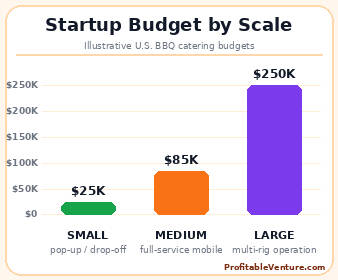
You can enter BBQ catering at several levels. A small operation emphasizing drop-off orders and private parties may start for approximately $15,000 to $40,000.
A medium full-service mobile catering business with commercial smokers, catering equipment, transportation, commissary access, and adequate working capital may require approximately $60,000 to $120,000.
A larger operation with multiple smokers, trucks, trailers, full-time employees, substantial refrigeration, large event inventory, and several simultaneous event teams can require approximately $175,000 to $400,000 or more.
For this guide, we will use:
- Small BBQ catering business: $25,000
- Medium full-service BBQ catering business: $85,000
- Large multi-rig catering operation: $250,000.
b. What are the Costs Involved?
Small BBQ Catering Business – Approximately $25,000
- Commercial smoker – $6,000
- Commissary deposit and kitchen access – $3,000
- Hot boxes, coolers, and food transport – $3,000
- Chafing dishes and serving equipment – $2,500
- Tables, utensils, pans, and smallwares – $2,000
- Licenses and insurance – $2,000
- Website, branding, and marketing – $1,500
- Opening food and disposables – $1,500
- Working capital – $3,500
- Estimated Total – $25,000.
Medium Full-Service BBQ Catering Business – Approximately $85,000
- Catering trailer or dedicated transport setup – $22,000
- Commercial smoker – $18,000
- Commissary deposit and kitchen setup – $10,000
- Hot-holding and serving equipment – $8,000
- Refrigeration, insulated coolers, and food transport – $5,000
- Opening food inventory and disposables – $4,000
- Licensing and insurance – $4,000
- Marketing, technology, and working capital – $14,000
- Estimated Total – $85,000.
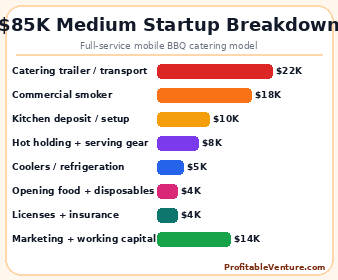
This is the model used in the financial projection later in the article.
Large Multi-Rig BBQ Catering Operation – Approximately $250,000
- Multiple commercial smokers – $55,000
- Catering truck and trailers – $60,000
- Commercial kitchen improvements – $30,000
- Refrigeration and freezers – $18,000
- Hot-holding, buffet, and serving equipment – $18,000
- Tables, tents, portable equipment, and event inventory – $15,000
- Opening food and disposable inventory – $8,000
- Licensing, insurance, and professional fees – $8,000
- Marketing and sales – $8,000
- Working capital and payroll reserve – $30,000
- Estimated Total – $250,000.
c. What Factors Determine Startup Cost?
- Number and size of smokers
- New versus used equipment
- Trailer requirements
- Commercial kitchen cost
- Number of employees
- Refrigeration
- Event equipment
- Vehicle requirements
- Insurance
- Food inventory
- Service style
- Size of events
- Working capital.
d. Do You Need to Build a Facility?
No. You do not need a restaurant dining room. A licensed commissary or commercial kitchen can provide preparation, refrigeration, dishwashing, ingredient storage, handwashing facilities, and sanitation infrastructure.
This allows you to spend more capital on equipment that directly supports catering. Your kitchen should ideally have:
- Walk-in or reach-in refrigeration
- Freezer space
- Prep tables
- Three-compartment sink
- Handwashing stations
- Dry storage
- Dishwashing facilities
- Floor drainage
- Grease disposal arrangements
- Vehicle loading access.
e. What are the Ongoing Expenses?
- Meat
- Side-dish ingredients
- Sauces and seasoning
- Beverages
- Disposable plates
- Napkins
- Cutlery
- Aluminum pans
- Employee wages
- Commissary rent
- Vehicle fuel
- Wood
- Charcoal
- Propane
- Insurance
- Equipment maintenance
- Vehicle maintenance
- Marketing
- Payment-processing fees
- Equipment rentals.
f. What is the Average Salary of Your Staff?
Compensation depends heavily on location, experience, and whether employees work full-time or only at events. Potential positions include:
- General Manager
- Pitmaster
- Kitchen Manager
- Prep Cook
- Catering Chef
- Event Captain
- Catering Servers
- Delivery Driver
- Sales Coordinator
- Dishwasher
- Bookkeeper.
A catering business can keep fixed payroll lower by maintaining a small year-round team and using trained part-time event employees when bookings require them.
g. How Do You Get Funding?
- Personal savings
- SBA-backed loans
- Equipment financing
- Trailer financing
- Business credit
- Business partners
- Family financing
- Private investors
- Customer deposits
- Starting with drop-off catering and reinvesting profits.
Customer deposits are especially important. A large wedding may require thousands of dollars in meat, labor, rentals, and supplies before the event occurs.
You should not routinely finance customer events from your own cash while waiting to be paid afterward.
-
Write a Business Plan
a. Executive Summary
Red Oak BBQ Catering, LLC is a proposed mobile and full-service BBQ catering company based in Nashville, Tennessee.
The business will prepare slow-smoked meats and Southern-style side dishes for weddings, corporate events, private parties, graduations, family reunions, church functions, and public events.
Red Oak will operate from a licensed commercial commissary rather than opening a traditional restaurant.
The company’s core menu will include beef brisket, pulled pork, smoked chicken, ribs, sausage, baked beans, macaroni and cheese, coleslaw, potato salad, cornbread, sauces, and selected desserts.
Three service levels will be offered:
- Pickup and drop-off catering
- Delivery and buffet setup
- Fully staffed event catering.
The business will launch with approximately $85,000 in startup capital. Management will focus on:
Profitable menu pricing, consistent meat quality, food safety, accurate portioning, professional event presentation, punctuality, and developing repeat corporate and venue relationships.
b. Products and Services
Red Oak BBQ Catering, LLC will offer:
- Brisket catering
- Pulled pork
- Smoked chicken
- BBQ ribs
- Smoked sausage
- Turkey
- Traditional BBQ sides
- Sandwich buffets
- Box lunches
- Wedding buffets
- Corporate lunches
- Private-party catering
- Drop-off catering
- Buffet setup
- Full-service staffed events
- Dessert packages
- Beverage packages.
c. Mission Statement
“At Red Oak BBQ Catering, LLC, our mission is to bring slow-smoked barbecue, generous hospitality, dependable service, and professionally executed catering to weddings, businesses, families, and community events.”
Vision Statement
“Our vision is to build Red Oak BBQ Catering into a respected regional catering company known for outstanding barbecue, reliable event execution, friendly service, and memorable guest experiences.”
d. Goals and Objectives
The first goal is to develop a profitable core catering menu. Management will calculate the cost of every menu item by:
- Raw food cost
- Cooked yield
- Portion size
- Packaging
- Labor
- Fuel
- Serving equipment.
The second objective is to increase average event value. A basic drop-off package may provide an entry-level service. The customer can then add:
- Additional meat
- Premium brisket
- Dessert
- Drinks
- Serving staff
- Buffet equipment
- Late-night snacks
- Cleanup.
Another objective is to develop repeat weekday corporate catering so the business is not dependent exclusively on Saturday weddings.
Long-term goals include additional smokers, a second catering team, preferred-vendor relationships with wedding venues, and larger corporate contracts.
e. Organizational Structure
- Owner/General Manager
- Head Pitmaster
- Kitchen Manager
- Prep Cooks
- Catering/Event Manager
- Event Captains
- Servers
- Delivery Drivers
- Sales Coordinator
- Bookkeeper.
Marketing Plan
a. SWOT Analysis
Strengths
BBQ works well for large groups because meats and sides can be prepared in bulk and served buffet-style.
Catering also allows the company to generate several thousand dollars from one event without operating a full dining room.
Weaknesses
- Smoking meat is time-consuming.
- A brisket needed at 5:00 p.m. may have to begin cooking the night before.
- This leaves limited room for production mistakes.
The business is also dependent on employees arriving on time and food maintaining safe temperatures while traveling.
Opportunities
Growth opportunities include weddings, corporate lunches, construction-site meals, graduation parties, brewery events, festivals, preferred-vendor agreements, box lunches, holiday parties, and private events.
Threats
Threats include rising meat prices, foodborne illness, bad weather, vehicle failures, smoker breakdowns, staff shortages, intense catering competition, event cancellations, and poor online reviews.
b. How Does a BBQ Catering Business Make Money?
- Per-person catering packages
- Drop-off catering
- Delivery and setup fees
- Full-service catering
- Wedding packages
- Corporate catering
- Box lunches
- Staffing charges
- Premium meat upgrades
- Desserts
- Beverage packages
- Equipment rentals
- Festival sales.
c. Payment Options
- Credit cards
- Debit cards
- ACH transfers
- Online invoices
- Corporate invoices
- Event deposits
- Final pre-event payments.
A practical policy is to require a deposit when the date is reserved and collect the remaining balance before the event according to the terms of your contract.
d. Sales and Advertising Strategies
- Create a professional catering website
- Build a Google Business Profile
- Use professional food photography
- Partner with wedding venues
- Develop relationships with wedding planners
- Offer wedding tastings
- Contact office managers
- Market to construction companies
- Contact manufacturing plants
- Offer corporate lunch packages
- Participate in bridal shows
- Cater community events
- Work with breweries
- Ask customers for online reviews
- Build an email list
- Develop referral partnerships with event professionals.
Financial Projection
a. How Much Should You Charge for BBQ Catering?
Your prices should depend on meat selection, number of sides, service level, guest count, staffing, travel, and rentals. Illustrative planning prices might look like:
- Simple drop-off BBQ: $18 – $28 per person
- Two-meat buffet with sides: $25 – $40 per person
- Full-service staffed BBQ: $35 – $60 per person
- Premium wedding BBQ: $45 – $85+ per person depending on menu and service.
These are planning examples, not fixed industry prices. A 100-person wedding at $40 per guest produces:
100 × $40 = $4,000 in catering revenue.
If the couple also purchases $600 of staffing, $300 of beverages, and $400 of desserts, the total booking becomes: $5,300.
This is why increasing average event value can sometimes be more profitable than trying to book every small party available.
b. How Much Revenue Can a BBQ Catering Business Generate?
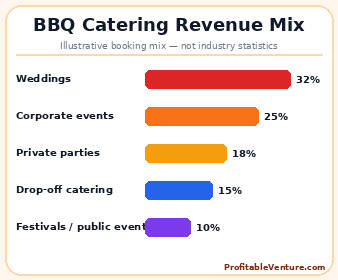
For planning purposes:
- Small owner-operated operation: approximately $75,000 – $180,000 annually
- Medium full-service caterer: approximately $250,000 – $600,000
- Larger multi-team catering company: approximately $600,000 – $1.5 million or more.
These are planning ranges rather than guaranteed industry averages.
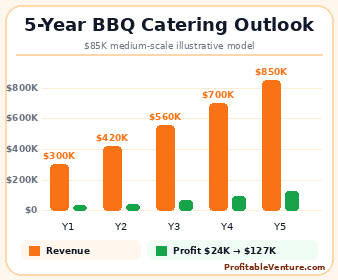
The financial model below assumes the $85,000 medium operation generates approximately $300,000 in first-year revenue.
c. Five-Year Revenue and Profit Projection
| Fiscal Year | Revenue | Total Expenses | Net Profit | Net Margin |
|---|---|---|---|---|
| Year 1 | $300,000 | $276,000 | $24,000 | 8.0% |
| Year 2 | $420,000 | $378,000 | $42,000 | 10.0% |
| Year 3 | $560,000 | $493,000 | $67,000 | 12.0% |
| Year 4 | $700,000 | $606,000 | $94,000 | 13.4% |
| Year 5 | $850,000 | $723,000 | $127,000 | 14.9% |
Under this model, cumulative five-year revenue would be approximately $2.83 million, while cumulative projected net profit would be approximately $354,000.
d. Sample Five-Year Profit and Loss Projection
| Item | Year 1 | Year 2 | Year 3 | Year 4 | Year 5 |
|---|---|---|---|---|---|
| Revenue | $300,000 | $420,000 | $560,000 | $700,000 | $850,000 |
| Meat, Food and Beverages | $90,000 | $125,000 | $165,000 | $205,000 | $245,000 |
| Payroll and Event Labor | $65,000 | $90,000 | $120,000 | $150,000 | $180,000 |
| Commissary Rent and Occupancy | $24,000 | $26,000 | $28,000 | $30,000 | $32,000 |
| Transportation and Fuel | $20,000 | $26,000 | $32,000 | $38,000 | $45,000 |
| Wood, Charcoal, Propane and Equipment Maintenance | $15,000 | $20,000 | $25,000 | $30,000 | $35,000 |
| Insurance and Licensing | $8,000 | $9,000 | $10,000 | $11,000 | $12,000 |
| Marketing and Sales | $12,000 | $15,000 | $18,000 | $22,000 | $25,000 |
| Disposables and Event Rentals | $18,000 | $25,000 | $32,000 | $38,000 | $45,000 |
| POS, Card Processing and Administration | $10,000 | $14,000 | $18,000 | $22,000 | $26,000 |
| Equipment/Vehicle Financing, Storage and Other Expenses | $14,000 | $28,000 | $45,000 | $60,000 | $78,000 |
| Total Expenses | $276,000 | $378,000 | $493,000 | $606,000 | $723,000 |
| Projected Net Profit | $24,000 | $42,000 | $67,000 | $94,000 | $127,000 |
e. How Much Profit Do BBQ Catering Business Owners Make?
There is no standard owner income.
A small owner-operated caterer may keep more of the company’s earnings because the owner performs much of the cooking and event work.
A larger business can generate more revenue but must pay managers, pitmasters, cooks, servers, drivers, and administrative employees.
Under this medium-scale model, annual projected net profit grows from approximately $24,000 in Year 1 to approximately $127,000 by Year 5.
f. What Factors Determine Profit?
- Guest count
- Price per person
- Meat selection
- Food costs
- Cooked meat yield
- Labor
- Number of events
- Average event value
- Transportation
- Food waste
- Corporate accounts
- Wedding bookings
- Equipment rentals
- Customer deposits
- Seasonality.
g. What is the Profit Margin?
Calculate net margin using:
Net Profit Margin = Net Profit ÷ Revenue × 100.
The medium-scale planning model begins at approximately 8% in Year 1 and improves toward approximately 15% by Year 5.
That improvement assumes the company becomes more efficient, books larger events, increases repeat corporate work, and makes better use of existing equipment.
h. What is the Sales Forecast?
- Year 1: $300,000
- Year 2: $420,000
- Year 3: $560,000
- Year 4: $700,000
- Year 5: $850,000.
-
Set Up Your Kitchen and Catering Operation
a. How Do You Choose the Perfect Location?
A BBQ caterer does not need an expensive downtown storefront. You need a practical commissary location that gives your team access to customers and venues. Look for:
- Commercial kitchen approval
- Easy highway access
- Trailer parking
- Smoker storage
- Delivery vehicle access
- Loading area
- Refrigeration
- Dry storage
- Affordable rent
- Proximity to wedding venues
- Reasonable travel time to corporate districts.
Travel distance matters. A company that spends three hours transporting employees and equipment to every event will have higher labor and vehicle costs than one located near its main market.
b. What States and Cities are Worth Researching?
BBQ catering can work in almost any sizable U.S. market. Cities worth researching include:
- Nashville, Tennessee
- Dallas-Fort Worth, Texas
- Austin, Texas
- Houston, Texas
- Charlotte, North Carolina
- Atlanta, Georgia
- Raleigh, North Carolina
- Kansas City, Missouri
- Columbus, Ohio
- Indianapolis, Indiana.
However, venue density, wedding activity, competition, commercial kitchen costs, and local event demand matter more than simply choosing a city famous for barbecue.
c. What Equipment is Needed?
- Commercial smoker
- Backup cooking equipment
- Commercial refrigerator
- Freezer
- Prep tables
- Knives
- Cutting boards
- Meat slicer where appropriate
- Food thermometers
- Hot-holding cabinets
- Insulated food carriers
- Commercial coolers
- Chafing dishes
- Serving utensils
- Sheet pans
- Food pans
- Catering tables
- Serving tents where needed
- Handwashing setup
- Fire extinguishers
- Catering trailer
- Delivery vehicle.
Do not neglect backup equipment.
If your only smoker fails at midnight before a 300-person wedding, replacing it the next morning will not solve the problem.
-
Hire Employees
Your employees need more than BBQ knowledge. They need to understand catering. Train them on:
- Food safety
- Handwashing
- Cross-contamination prevention
- Allergen awareness
- Temperature monitoring
- Portion control
- Buffet setup
- Guest interaction
- Uniform standards
- Equipment loading
- Event cleanup
- Emergency procedures.
An event captain should have a written event sheet showing:
- Customer name
- Venue
- Guest count
- Arrival time
- Meal time
- Menu
- Special dietary requirements
- Equipment list
- Staff assigned
- Customer contact
- Final payment status.
Do not rely on employees remembering event details from text messages.
Food Safety During Catering
Transporting food creates additional food-safety risk. Use appropriate insulated carriers and hot-holding equipment.
Check food temperatures when food leaves the kitchen, after arrival, and periodically during service.
Under the FDA Food Code model, hot time/temperature-controlled food is generally held at 135°F or above, while cold TCS food is generally held at 41°F or below.
Your jurisdiction may have additional requirements.
Do not assume food is safe because a pan still feels warm.
Use calibrated thermometers.
-
Launch the Business Properly
Do not make a 300-person wedding your first event. Start with controlled events.
- Serve 30 people.
- Then serve 60.
- Then 100.
Use each event to refine production quantities and timing. Record exactly:
- How many pounds of raw meat were purchased
- Cooked yield
- Number of guests
- Amount served
- Amount left over
- Number of employee hours
- Travel time
- Fuel use
- Event revenue
- Actual profit.
This gives you your own catering data. You may discover that pulled pork is highly profitable while brisket needs a premium surcharge.
You may discover that weddings generate large revenue but require much more labor.
You may discover that recurring corporate drop-offs produce lower individual invoices but excellent profit because service is simple and predictable.
Your numbers should determine which work you pursue.
a. What Makes a BBQ Catering Business Successful?
- Excellent BBQ – Marketing cannot compensate for dry meat.
- Consistency – Your brisket should not be excellent one week and disappointing the next.
- Accurate portions – Running out is unacceptable; chronic overproduction is expensive.
- Food safety – Temperature control needs to continue through transport and service.
- Punctuality – Weddings do not postpone dinner because your trailer arrived late.
- Professional staff – Servers represent your company.
- Clean presentation – Buffet appearance influences perceived value.
- Clear contracts – Guest count, menu, service, payment, and cancellation terms should be written.
- Strong venue relationships – Preferred-vendor status can generate recurring leads.
- Corporate accounts – Weekday bookings help balance weekend events.
- Good financial controls – Know the profit on every event.
b. What Happens During a Typical Day?
A large catering event may begin the previous evening.
The pitmaster trims briskets and pork shoulders, applies seasoning, prepares smokers, and begins the long cooking process.
Employees arrive early the following morning to prepare side dishes, sauces, desserts, bread, garnishes, beverages, and serving supplies.
The catering manager checks the event sheet against every item being loaded. The team confirms:
- Correct quantity of meat
- All side dishes
- Sauces
- Serving utensils
- Chafing equipment
- Fuel for chafers
- Disposable products
- Thermometers
- Gloves
- Cleaning supplies
- Customer paperwork.
Food temperatures are checked before transport. The catering vehicle travels to the venue early enough that unexpected traffic does not delay meal service.
At the venue, employees build the buffet, arrange chafing dishes, prepare service stations, and coordinate with the event planner.
During service, employees replenish the buffet gradually rather than exposing all food at once.
After the meal, staff clean the service area, pack equipment, dispose of waste properly, return to the commissary, wash equipment, and prepare for the next event.
The following day, management reviews the numbers.
- Did a 150-person event consume the quantity forecast?
- Were 20 pounds of pulled pork returned to the kitchen?
- Did employees work 15 more hours than budgeted?
Those answers help improve future quotes.
c. What Skills and Experience Do You Need?
- BBQ cooking skills – The core product must be good.
- Food safety knowledge – You are serving large groups.
- Production planning – Long smoking times must match event schedules.
- Portion control – Both shortages and excessive leftovers cost money.
- Event management – Venues operate on schedules.
- Customer service – Weddings and celebrations can be emotionally important.
- Employee management – Large events need coordinated teams.
- Financial management – Calculate profit event by event.
- Sales – Venue and corporate relationships generate bookings.
- Logistics – Food, equipment, employees, and vehicles must arrive together.
You do not need previous experience running a catering company to start a BBQ catering business.
However, do not mistake being the person everyone loves at backyard cookouts for being ready to cater 250 wedding guests.
Professional catering adds food safety, scheduling, large-batch production, contracts, employees, transportation, equipment, portioning, and customer expectations.
- Start with smaller paid events.
- Measure everything.
- Standardize your recipes.
- Calculate yields.
- Develop loading checklists.
- Create written event procedures.
- Build relationships with venues.
- Require deposits.
- Most importantly, quote every event with profit in mind.
If you can combine excellent smoked meat with safe food handling, accurate portioning, professional presentation, reliable event execution, disciplined pricing, and repeat corporate and wedding bookings, you can build a successful BBQ catering business even if you started with no previous catering experience.