

A hot shot trucking business is a transportation company that uses pickup trucks, usually paired with flatbed, gooseneck, or similar trailers, to move relatively small and often time-sensitive loads for businesses and individuals.
Unlike traditional tractor-trailer trucking, hot shot trucking is built around flexibility.
A customer may need construction equipment delivered to a job site, machinery transported to a repair shop, building materials moved between locations, or an urgent replacement part delivered hundreds of miles away.

This creates an opportunity for entrepreneurs who want to enter the transportation industry without immediately building a large fleet of semi-trucks.
The business makes money by charging customers or freight brokers to transport loads.
Depending on the operation, loads may be priced by the mile, by the trip, by the weight or dimensions of the cargo, or through a negotiated flat rate.
Some hot shot operators work directly with manufacturers, equipment dealers, contractors, farms, oilfield companies, and other shippers, while others find loads through freight brokers and online load boards.
You do not need years of trucking experience to start a hot shot trucking business, but you do need to take the learning process seriously. Driving is only one part of the business.
You must understand your operating costs, cargo securement, vehicle maintenance, insurance, federal and state regulations, customer service, freight documentation, route planning, and how to choose profitable loads.
One of the biggest mistakes beginners make is buying an expensive truck and trailer before understanding how the business works.
A smarter approach is to study your local freight market first, decide what type of cargo you want to haul, understand the weight limits and regulatory requirements that apply to your intended setup, and then buy equipment that matches your business model.
Steps on How to Start a Hot Shot Trucking Business
-
Conduct Market Research
Conducting proper market research can save you from making some very expensive mistakes when starting a hot shot trucking business.
You can begin by finding out what types of freight regularly move within your area.
Look for construction companies, equipment rental businesses, manufacturers, agricultural businesses, machinery dealers, building-material suppliers, oil and gas service companies, warehouses, automobile businesses, and other companies that regularly need smaller loads transported quickly.
You should also decide how far you are willing to travel. Some hot shot businesses operate mainly within one state or region, allowing the driver to return home frequently.
Others operate across several states and may keep the driver on the road for days at a time.
Your preferred lifestyle will influence the type of customers you target, the equipment you purchase, and the rates you need to charge.
Next, you need to research the freight lanes available from your home base.
A load that pays well going from your city to another state may not be profitable if you cannot find another load coming back.
This is known as deadhead mileage, and it is one of the easiest ways for inexperienced hot shot operators to lose money.
The important question is therefore not simply, “How much does this load pay?” It is, “How much will I actually make after considering every mile I have to drive?”
Talk to freight brokers, local businesses, drivers, equipment dealers, insurance agents, and experienced owner-operators.
Spend time studying load boards even before you purchase your truck. Pay attention to the types of trailers requested, common pickup and delivery locations, cargo weights, and frequency of available loads.
The more you understand before spending money, the easier it becomes to build the right operation from the beginning.
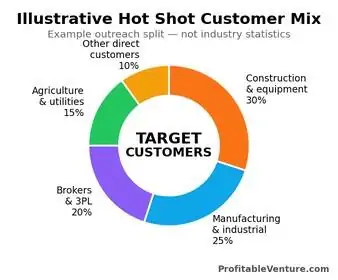
a. Who is the Target Market for a Hot Shot Trucking Business?
- Construction companies and contractors
- Equipment rental companies
- Manufacturers and industrial businesses
- Oil and gas service companies
- Agricultural businesses and farmers
- Building-material suppliers
- Machinery and heavy-equipment dealers
- Automobile and automotive-parts businesses
- Freight brokers and third-party logistics companies
- Warehouses and distribution businesses
- Utility and infrastructure contractors
- Landscaping companies
- Small businesses needing urgent deliveries
- Individuals transporting vehicles, equipment, or other suitable cargo.
b. Is Hot Shot Trucking a Profitable Business?
Yes, hot shot trucking can be profitable, but profitability depends much more on cost control and load selection than on how much gross revenue appears on your settlement statement.
A truck that stays busy can still lose money if the owner accepts cheap freight, drives too many empty miles, has excessive truck payments, ignores maintenance reserves, or fails to calculate the true cost of operating the vehicle.
So the basic formula is simple. Your revenue must consistently exceed your fuel, maintenance, tires, insurance, truck and trailer expenses, permits, tolls, taxes, administrative costs, deadhead expenses, and the value of your own labor.
Operators who understand those numbers have a much better chance of building a sustainable business.
c. Are There Existing Niches in the Industry?
Yes, there are several niches within the hot shot trucking industry, and choosing one can make marketing your business easier. They include:
- Construction equipment hauling
- Agricultural equipment transportation
- Oilfield and energy-sector freight
- Machinery and industrial parts delivery
- Automotive parts transportation
- Vehicle and small-equipment hauling
- Building-material transportation
- Expedited and emergency freight
- Regional dedicated-route transportation
- Less-than-truckload flatbed freight
- RV and trailer transportation
- Power-only transportation
- Local business-to-business delivery.
For a beginner, specializing can be useful because you gradually learn the needs of a particular customer group instead of trying to haul everything that appears on a load board.
d. Who are the Major Competitors?
Hot shot trucking is highly fragmented, so your biggest competitors will often be independent owner-operators and small regional transportation companies rather than one dominant company. You may also compete with:
- Independent hot shot truck owner-operators
- Small flatbed trucking companies
- Regional trucking companies
- Expedited freight carriers
- Less-than-truckload carriers
- Equipment-hauling businesses
- Vehicle transportation companies
- Courier and same-day freight companies
- Freight brokers with established carrier networks
- Large transportation companies offering expedited services.
Do not assume that competing only on price is the best strategy. Reliability, communication, cargo care, accurate arrival times, professional paperwork, and the ability to respond quickly can be more valuable to a shipper than simply offering the lowest rate.
e. Are There County, State, or Federal Regulations for a Hot Shot Trucking Business in the United States?
Yes. Hot shot trucking is regulated, and the exact requirements depend on your vehicle configuration, weight, cargo, whether you cross state lines, and whether you operate under your own authority or under another motor carrier.
A business operating commercial vehicles in interstate commerce may need a USDOT number.
For-hire carriers transporting federally regulated property across state lines generally also need the appropriate federal operating authority.
The important point for beginners is that operating a pickup truck does not automatically exempt you from commercial trucking regulations.
Federal commercial motor vehicle rules can begin applying at weights below the threshold that requires a commercial driver’s license.
Under the federal framework, a Class A CDL generally applies to qualifying combination vehicles with a gross combination weight rating or weight of at least 26,001 pounds when the towed unit exceeds 10,000 pounds.
A combination below the CDL threshold may still be considered a commercial motor vehicle for other federal safety requirements.
Depending on your operation, you may also need to comply with requirements relating to driver qualification, hours of service, electronic logging, vehicle inspection and maintenance, medical qualification, cargo securement, insurance, drug and alcohol testing for CDL operations, process-agent designation, and interstate registration.
State requirements can add another layer of rules. For example, you may need state vehicle registrations, apportioned registration for certain interstate operations, fuel-tax credentials when applicable, oversize or overweight permits, local business licenses, or commercial parking approval.
Since transportation regulations can change at any point in time, you must confirm the requirements for your exact truck, trailer, cargo, routes, and operating model with the Federal Motor Carrier Safety Administration and relevant state agencies before beginning operations.
f. Is There a Franchise for a Hot Shot Trucking Business?
Traditional hot shot trucking franchises are uncommon. Most operators either establish their own trucking company and obtain the required operating authority or lease their truck and services to an established motor carrier.
For someone with no experience, leasing on to a reputable carrier can be worth considering because the carrier may handle some areas such as freight sourcing, customer billing, and certain administrative responsibilities.
However, you should carefully read any lease agreement. Understand what percentage or fees the carrier keeps, who pays for insurance, permits, fuel, cargo claims, trailer expenses, maintenance, and whether you are free to select or reject loads.
g. What Do You Need to Start a Hot Shot Trucking Business?
- A reliable pickup truck suitable for the loads you intend to haul
- A properly rated flatbed, gooseneck, or other appropriate trailer
- A registered business entity
- Federal and state registrations applicable to your operation
- Commercial vehicle and liability insurance
- Cargo insurance when required by customers, brokers, or contracts
- A CDL if your vehicle configuration requires one
- DOT medical qualification when applicable
- An electronic logging device when your operation requires one
- Cargo securement equipment such as chains, binders, straps, and edge protectors
- Safety equipment
- Load-board or freight-sourcing access
- A smartphone, laptop, or tablet
- Navigation and route-planning tools
- Working capital for fuel, repairs, and expenses while waiting for customers to pay
- Basic knowledge of freight paperwork and trucking regulations.
-
Choose a Memorable Business Name
Before registering your hot shot trucking business, you will need a name that customers, brokers, and shippers can easily recognize. You should choose something simple enough to pronounce over the telephone.
Remember that brokers and dispatchers may eventually say your company name several times a day while confirming loads, so an overly complicated name can become annoying very quickly.
Check your state’s business database to determine whether the name is available, and search online to avoid choosing a name that could easily be confused with an established transportation company.
Some catchy business name ideas suitable for a hot shot trucking business are:
- Redline Hot Shot Logistics, LLC
- Iron Trail Transport, LLC
- Rapid Haul Hot Shot, LLC
- Blue Ridge Express Freight, LLC
- Silver Mile Transport, LLC
- Road Hawk Logistics, LLC
- Prime Route Hot Shot, LLC
- Swift Ridge Transport, LLC
- Reliable Haul Logistics, LLC
- CrossCountry Hot Shot, LLC
- Highway Forge Transport, LLC
- QuickTow Freight Services, LLC
- Red Oak Hot Shot Transport, LLC
- Iron Horse Expedited Freight, LLC
- Falcon Route Logistics, LLC
- Frontier Hot Shot Services, LLC
- Next Mile Transport, LLC
- RoadBridge Logistics, LLC
- Fast Track Equipment Hauling, LLC
- Summit Hot Shot Transport, LLC.
-
Register Your Business
a. What Type of Business Structure is Best for a Hot Shot Trucking Business?
The right legal structure depends on your ownership arrangement, tax situation, plans for growth, and the level of liability protection you need.
However, many small trucking companies choose a limited liability company.
An LLC creates a legal separation between the company and its owner and is relatively straightforward to manage compared with more complicated corporate structures.
This does not mean an LLC magically protects you from every possible liability.
You still need proper commercial insurance, safe operating procedures, accurate records, and responsible driving.
Speak with a qualified accountant or business attorney if you are unsure which structure is most appropriate for your situation.
b. Steps to Form an LLC
- Choose an available name for your LLC
- File the required formation document with your state
- Choose a registered agent
- Create an operating agreement
- Obtain an Employer Identification Number when required
- Open a separate business bank account
- Register for applicable state taxes
- Obtain required transportation registrations and permits
- Maintain annual reports and other state compliance requirements.
c. What Type of License is Needed to Start a Hot Shot Trucking Business?
The licenses and registrations you need will depend on how you operate. They may include:
- General state or local business registration
- USDOT number
- Federal motor carrier operating authority when applicable
- Unified Carrier Registration for applicable interstate operations
- Commercial driver’s license when your vehicle combination requires one
- DOT medical certification when applicable
- State commercial vehicle registration
- Apportioned registration when applicable
- Fuel-tax registration when applicable
- Oversize or overweight permits for qualifying loads
- Hazardous-material permits or endorsements if you choose to transport regulated hazardous materials.
Do not purchase a truck based solely on someone telling you that it is a “non-CDL hot shot setup.”
Check the ratings of both the truck and trailer and understand how federal and state agencies classify the combination.
A non-CDL operation can reduce some regulatory requirements, but it does not mean the business is free from commercial motor vehicle rules.
d. What Type of Certification is Needed to Start a Hot Shot Trucking Business?
There is no universal certificate called a “hot shot trucking certification.” Depending on your operation, however, you may need or benefit from having a:
- A commercial driver’s license for qualifying vehicle combinations
- A DOT medical certificate when required
- Entry-level commercial driver training when applicable to your CDL situation
- Hazardous-material endorsement and related training if hauling regulated hazardous freight
- Cargo securement training
- Defensive driving training
- First aid and emergency-response training
- Forklift or equipment training if your work requires you to operate customer equipment.
Even when a training program is not legally mandatory, proper cargo securement training is worth taking seriously.
A load that shifts during transportation can damage the cargo, damage your equipment, cause a crash, or injure someone.
e. What Documents are Needed to Start a Hot Shot Trucking Business?
- Business registration documents
- Employer Identification Number where applicable
- USDOT registration
- Operating authority documentation where required
- BOC-3 process-agent filing where required
- Insurance certificates and federal insurance filings where applicable
- Unified Carrier Registration documentation where applicable
- Commercial driver’s license when required
- Driver medical documentation when required
- Vehicle and trailer registration documents
- Equipment lease or ownership documents
- Driver qualification records
- Vehicle inspection and maintenance records
- Electronic logging records when applicable
- Rate confirmations
- Bills of lading
- Proof-of-delivery documents
- Fuel and toll receipts
- Invoices and accounting records
- Oversize, overweight, or specialized permits when required.
f. Do You Need a Trademark, Copyright, or Patent?
You do not normally need a patent to operate a hot shot trucking company.
A trademark may be useful if you want to protect your company name, logo, or slogan as your brand grows.
Copyright can protect original materials you create, such as website content, photographs, videos, training manuals, and marketing materials.
For a new owner-operator, however, intellectual-property registration usually comes after the essential priorities of establishing the business properly, securing insurance, meeting transportation regulations, purchasing suitable equipment, and finding customers.
-
Cost Analysis and Budgeting
a. How Much Does It Cost to Start a Hot Shot Trucking Business?
A small owner-operator who starts with one reliable used pickup truck and one gooseneck trailer may be able to launch with approximately $55,000 to $70,000.
A medium-scale operation starting with two trucks and two trailers may require approximately $140,000 to $180,000.
A larger hot shot trucking company beginning with four trucks, four trailers, additional insurance, dispatch systems, and stronger working capital may require approximately $300,000 to $400,000.
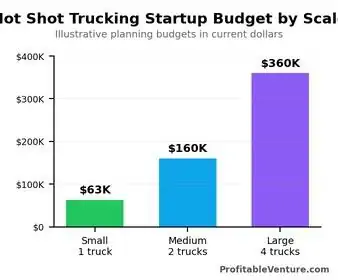
For the purpose of this research guide, we will use the following sample startup budgets:
- Small-scale hot shot business: approximately $63,000
- Medium-scale hot shot business: approximately $160,000
- Large-scale hot shot business: approximately $360,000.
These figures should be viewed as planning estimates rather than fixed industry prices.
Truck prices, insurance premiums, financing costs, permits, and equipment costs vary significantly by location, credit history, driving record, equipment age, and operating model.
b. What are the Costs Involved in Starting a Hot Shot Trucking Business?
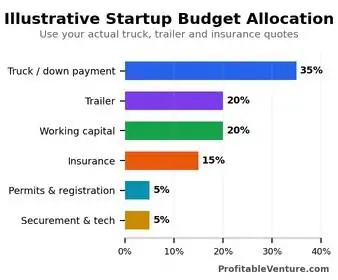
Below is an illustrative startup cost breakdown for three different sizes of hot shot trucking businesses.
Small-Scale Hot Shot Trucking Business – Approximately $63,000
- Used heavy-duty pickup truck – $32,000
- Used gooseneck or flatbed trailer – $9,000
- First-year commercial insurance – $10,000
- Business registration, operating authority, permits, and vehicle registration – $1,500
- ELD, load boards, cargo securement equipment, tools, and safety equipment – $2,500
- Website, bookkeeping setup, branding, and administrative expenses – $1,000
- Initial fuel and working capital reserve – $7,000
Estimated Total – $63,000.
This setup is best suited to an owner-operator who plans to drive the truck personally and keep payroll and overhead expenses low.
Medium-Scale Hot Shot Trucking Business – Approximately $160,000
- Two reliable heavy-duty pickup trucks – $80,000
- Two gooseneck or flatbed trailers – $26,000
- First-year commercial insurance – $24,000
- Business registration, operating authority, permits, and vehicle registrations – $3,000
- ELDs, load-board subscriptions, securement equipment, tools, and technology – $5,000
- Website, accounting setup, marketing, and administration – $2,000
- Initial fuel, repairs, payroll, and working capital reserve – $20,000
Estimated Total – $160,000
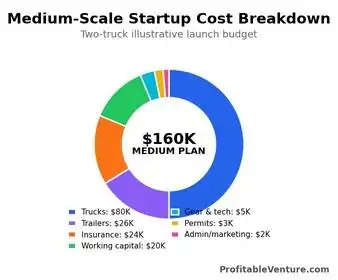
A two-truck operation allows the owner to drive one truck while employing another driver, or manage both trucks while using hired drivers.
It also gives the company more capacity to serve repeat customers without immediately becoming a large trucking company.
Large-Scale Hot Shot Trucking Business – Approximately $360,000
- Four newer heavy-duty pickup trucks – $180,000
- Four commercial gooseneck or flatbed trailers – $60,000
- First-year insurance coverage – $52,000
- Operating authority, permits, registrations, compliance, and professional fees – $6,000
- ELDs, dispatching technology, securement equipment, tools, and safety equipment – $10,000
- Office, dispatch setup, website, recruiting, branding, and marketing – $12,000
- Fuel, payroll, maintenance, and working capital reserve – $40,000
Estimated Total – $360,000
A business starting at this level should already have a strong operating plan, experienced drivers or management support, adequate working capital, and reliable sources of freight.
Buying four trucks without enough freight to keep them moving can create large monthly expenses very quickly.
c. What Factors Determine the Cost of Starting a Hot Shot Trucking Business?
- Number of trucks – A one-truck owner-operator costs far less to establish than a company beginning with several trucks.
- New versus used equipment – New trucks and trailers normally require more capital but may reduce early repair risk.
- Truck specifications – Heavy-duty diesel pickups with higher towing capacities generally cost more.
- Trailer type – Longer gooseneck, step-deck, enclosed, and specialized trailers may cost significantly more than basic flatbeds.
- Insurance – New motor carriers may face substantial first-year insurance premiums.
- Financing – Interest rates and down-payment requirements affect both startup cash requirements and monthly expenses.
- Operating authority – Operating under your own authority creates additional registration, insurance, compliance, and administrative costs.
- Type of freight – Specialized loads may require additional securement equipment, permits, insurance, or training.
- Working capital – You need enough cash to purchase fuel, pay drivers, repair equipment, and continue operating while waiting for customers to pay invoices.
- Operating area – Long-distance and interstate operations may involve additional tolls, permits, registration, and compliance expenses.
d. Do You Need to Build a Facility? If YES, How Much Will It Cost?
No, you do not normally need to construct a dedicated facility before starting a small hot shot trucking business.
A one- or two-truck company can usually operate its administrative activities from a home office, provided local regulations permit it. You will, however, need legal and secure parking for your truck and trailer.
As the company grows, leasing a small commercial yard with fenced parking, storage, maintenance space, and an office may become worthwhile.
A larger operation may also need space for dispatching, driver meetings, equipment storage, minor repairs, and record keeping.
e. What are the Ongoing Expenses of a Hot Shot Trucking Business?
- Fuel
- Tolls and parking
- Driver wages
- Commercial vehicle insurance
- Cargo insurance
- Truck and trailer payments
- Oil changes and routine servicing
- Tires
- Truck repairs
- Trailer repairs
- Preventive maintenance
- Load-board subscriptions
- Dispatch fees
- Factoring and quick-pay fees when used
- Electronic logging subscriptions
- Registration and permit renewals
- Accounting and bookkeeping
- Phone and internet expenses
- Marketing
- Taxes
- Roadside assistance
- Cargo securement replacement
- Administrative expenses.
f. What is the Average Salary of Your Staff?
A small hot shot trucking business may have no employees initially because the owner can serve as the driver and manage dispatching, customer service, invoicing, and administration.
A growing operation may employ drivers, dispatchers, safety personnel, and administrative workers.
Rather than budgeting based on one nationwide salary figure, research prevailing wages in the city where you operate.
Driver compensation should be included in the financial projections from the beginning, especially if your growth plan requires additional trucks.
g. How Do You Get Funding to Start a Hot Shot Trucking Business?
- Use personal savings
- Finance a truck through a commercial vehicle lender
- Use equipment financing for trailers
- Apply for a small-business loan
- Bring in an investment partner
- Raise capital from family members or private investors
- Purchase reliable used equipment instead of new equipment
- Lease equipment where the economics make sense
- Start with one truck and reinvest profits into additional trucks.
A beginner should be careful about borrowing too heavily.
A trucking company can have impressive revenue and still struggle financially if too much of its income is committed to truck payments, trailer payments, insurance, fuel, and debt.
-
Write a Business Plan
a. Executive Summary
Redline Hot Shot Logistics, LLC is a proposed hot shot transportation company based in Fort Worth, Texas.
The company will provide reliable regional and interstate transportation services for construction companies, machinery dealers, manufacturers, equipment rental companies, freight brokers, and other businesses that need smaller or time-sensitive loads delivered efficiently.
The business will begin with one properly equipped pickup truck and gooseneck trailer.
Management will initially focus on flatbed freight that fits the vehicle’s legal payload and trailer capacity, rather than attempting to accept every type of load.
This focused approach will allow the company to build experience, develop reliable customer relationships, and understand profitable freight lanes before expanding.
Redline Hot Shot Logistics, LLC will generate revenue through direct shipper contracts, brokered freight, repeat business accounts, and expedited transportation services.
The company will emphasize safe operations, communication, on-time delivery, proper cargo securement, equipment maintenance, accurate documentation, and disciplined cost management.
The long-term objective is to develop enough recurring freight to reduce dependence on public load boards and eventually add additional trucks only when existing operations demonstrate consistent profitability.
b. Products and Services
Redline Hot Shot Logistics, LLC will offer services such as:
- General hot shot freight transportation
- Construction equipment transportation
- Machinery and industrial component hauling
- Building-material transportation
- Expedited and time-sensitive freight delivery
- Agricultural equipment transportation
- Automotive parts delivery
- Equipment dealership transfers
- Regional dedicated-route transportation
- Direct business-to-business deliveries
- Brokered freight transportation
- Emergency replacement-part deliveries.
c. Mission Statement
“At Redline Hot Shot Logistics, LLC, our mission is to provide safe, dependable, and responsive freight transportation that helps businesses move important cargo exactly where it needs to go.
We are committed to honest communication, professional service, proper cargo handling, responsible driving, and building long-term relationships with customers who value reliability.”
Vision Statement
“Our vision at Redline Hot Shot Logistics, LLC is to build a respected transportation company known for reliability, safety, and customer service.
We aim to grow from a single-truck operation into a sustainable logistics business supported by repeat customers, dependable drivers, well-maintained equipment, and disciplined financial management.”
d. Goals and Objectives
The primary goal of a hot shot trucking company is to provide dependable transportation while earning enough from every load to cover operating expenses and produce a sustainable profit.
For a new company, the first objective should not be adding multiple trucks.
The first objective should be learning how to operate one truck profitably. This includes:
Controlling fuel consumption, minimizing empty miles, selecting good freight, maintaining the truck, communicating with customers, keeping accurate records, and learning which routes consistently produce worthwhile opportunities.
Your company should also work toward developing direct relationships with shippers.
Load boards are extremely useful when starting, but relying entirely on spot-market freight can make revenue unpredictable.
Repeat customers can provide more consistent work and reduce the time spent searching for the next load.
Long-term objectives may include establishing dedicated routes, hiring drivers, purchasing additional equipment, creating relationships with freight brokers and direct shippers, improving backhaul opportunities, and building a maintenance and replacement reserve for every vehicle.
e. Organizational Structure
- Owner/General Manager
- Operations Manager
- Hot Shot Drivers
- Dispatcher
- Safety and Compliance Manager
- Maintenance Technician or Outside Maintenance Provider
- Sales and Business Development Officer
- Bookkeeper/Accountant
- Administrative Assistant.
A one-truck business obviously does not need all these employees. The owner can perform several roles at first and outsource areas such as accounting, compliance support, maintenance, and website management.
Marketing Plan
a. SWOT Analysis
Strengths
A hot shot trucking business can be more flexible than a large trucking operation.
Smaller equipment can make certain pickups and deliveries easier, and an owner-operated company can respond quickly to customers without layers of management.
A new business can also focus on a specific local or regional niche and build personal relationships with contractors, equipment dealers, manufacturers, and other repeat customers.
Because the owner is directly involved, customers may receive faster communication and more personal service.
Weaknesses
A one-truck operation is heavily dependent on a single vehicle and driver. If the truck breaks down or the driver cannot work, revenue may stop immediately while many expenses continue.
New operators may also have limited relationships with brokers and direct shippers.
Insurance can represent a significant expense, and an inexperienced owner may initially struggle to calculate profitable rates, understand freight lanes, manage paperwork, or estimate maintenance costs accurately.
Opportunities
Hot shot businesses can serve many industries that occasionally need cargo moved faster than their normal transportation arrangements allow.
Construction projects need equipment and materials. Manufacturers need replacement parts.
Machinery dealers need equipment transferred. Agricultural businesses need tools and machinery transported.
A reliable operator can gradually turn one-time jobs into recurring customer relationships.
There are also opportunities to specialize in particular types of cargo, provide dedicated routes, establish direct shipper contracts, or expand into additional trucks once the first operation is consistently profitable.
Threats
Fuel-price increases, insurance increases, equipment breakdowns, freight downturns, excessive competition, accidents, cargo claims, regulatory violations, and poor-paying customers can all affect profitability.
Another major threat is accepting freight at rates that look attractive until deadhead, fuel, maintenance, and unpaid time are taken into account.
New operators must resist the temptation to haul freight simply to keep the wheels turning. Sometimes the most profitable load is the bad load you refuse.
b. How Do Hot Shot Trucking Companies Make Money?
Hot shot trucking companies make money by charging for transporting freight.
The carrier may negotiate directly with a shipper or accept a load offered by a freight broker.
Payment may be structured as a flat amount for the load, a rate based on distance, or another negotiated pricing arrangement.
Some operators also charge for services such as detention, additional stops, tarping, specialized securement, expedited delivery, or other work when agreed upon with the customer.
The key is to evaluate the entire trip rather than concentrating on the headline load price.
Suppose a load requires you to drive empty to the pickup, transport the cargo, wait several hours to unload, and then drive a long distance empty before finding another load.
All of those activities consume time and money. Your pricing and load-selection decisions must account for them.
c. Payment Options
A hot shot trucking company may receive payment through:
- ACH bank transfers
- Business checks
- Electronic freight-payment systems
- Broker quick-pay programs
- Freight factoring companies
- Wire transfers
- Credit or debit cards for suitable direct customers
- Approved customer invoicing accounts.
Always understand the payment terms before accepting a load. Know who is responsible for paying you, what paperwork must be submitted, how long payment normally takes, and what happens if the customer disputes a charge.
d. Sales and Advertising Strategies
- Create a professional website explaining your equipment, service area, and freight capabilities
- Set up a business email address rather than relying entirely on a personal account
- Register with reputable freight brokers
- Use established load boards to find initial freight
- Contact local construction companies directly
- Visit equipment rental and machinery dealerships
- Introduce your business to manufacturers and industrial companies
- Build relationships with freight forwarders and logistics companies
- Create a Google Business Profile for local visibility where appropriate
- Use LinkedIn to identify logistics and operations managers
- Ask satisfied customers for referrals
- Follow up with previous customers instead of constantly chasing new ones
- Keep professional photos of your truck, trailer, and properly secured loads
- Answer calls and messages quickly
- Build a reputation for accurate pickup and delivery updates.
When marketing directly to businesses, keep your message simple. Tell the potential customer what equipment you operate, the type of freight you can legally haul, your service area, and how quickly you can respond.
A purchasing manager does not need a long speech. The person needs to know whether you can solve a transportation problem.
Financial Projection
a. How Much Should You Charge for Your Service?
Hot shot trucking rates vary according to the route, load size, urgency, distance, equipment required, freight availability, fuel prices, and competition.
For this reason, you should never accept a load simply because the rate sounds attractive.
Calculate your operating cost first. Your minimum acceptable load price should cover:
- Fuel
- Tolls
- Maintenance
- Tires
- Insurance
- Truck and trailer expenses
- Driver wages
- Dispatch and load-board expenses
- Deadhead miles
- Administrative overhead
- Taxes
- A maintenance reserve
- A reasonable profit.
A useful formula is:
Minimum Load Price = Estimated Trip Cost + Allocated Fixed Expenses + Desired Profit.
You should calculate the cost using all miles driven rather than only loaded miles.
A truck that travels 80 miles empty to pick up a load and then carries that load another 420 miles has traveled 500 business miles, not 420.
b. How Much Revenue Can a Hot Shot Trucking Business Generate?
A realistic revenue target depends primarily on the number of working trucks, how many miles they run, the percentage of miles that are paid, the rates negotiated, and how much downtime the business experiences.
For planning purposes, the following first-year revenue estimates can be used:
- Small one-truck owner-operator: approximately $160,000 to $190,000 in annual gross revenue
- Medium two-truck operation: approximately $320,000 to $380,000 in annual gross revenue
- Large four-truck operation: approximately $650,000 to $750,000 in annual gross revenue.
These are not guaranteed earnings. A truck that spends too much time empty, waiting for loads, undergoing repairs, or accepting poorly priced freight may earn substantially less.
For the financial projection below, we will use the $160,000 medium-scale startup model, beginning with two trucks.
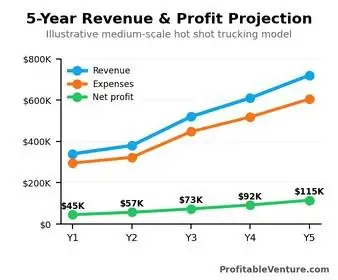
The model assumes the company generates approximately $340,000 in gross revenue during its first full year.
c. Five-Year Revenue and Profit Projection
The following projection assumes the company begins with two trucks, gradually improves its customer base and route selection, and adds capacity only after the existing operation has demonstrated that it can operate profitably.
| Fiscal Year | Revenue | Total Expenses | Net Profit | Net Margin |
|---|---|---|---|---|
| Year 1 | $340,000 | $295,000 | $45,000 | 13.2% |
| Year 2 | $380,000 | $323,000 | $57,000 | 15.0% |
| Year 3 | $520,000 | $447,000 | $73,000 | 14.0% |
| Year 4 | $610,000 | $518,000 | $92,000 | 15.1% |
| Year 5 | $720,000 | $605,000 | $115,000 | 16.0% |
Under this example, cumulative five-year revenue would be approximately $2.57 million, while cumulative projected net profit would be approximately $382,000.
Again, these figures are projections rather than guaranteed results.
Actual results will depend on freight rates, fuel costs, insurance, driver performance, repairs, customer payment habits, truck utilization, and management decisions.
d. Sample Five-Year Profit and Loss Projection
Below is a more detailed profit and loss estimate for the medium-scale operation.
| Item | Year 1 | Year 2 | Year 3 | Year 4 | Year 5 |
|---|---|---|---|---|---|
| Revenue | $340,000 | $380,000 | $520,000 | $610,000 | $720,000 |
| Fuel and Tolls | $88,000 | $96,000 | $133,000 | $153,000 | $180,000 |
| Driver Wages | $70,000 | $78,000 | $112,000 | $131,000 | $155,000 |
| Maintenance and Tires | $30,000 | $32,000 | $45,000 | $50,000 | $60,000 |
| Insurance | $26,000 | $25,000 | $36,000 | $38,000 | $42,000 |
| Truck and Trailer Payments / Depreciation | $36,000 | $36,000 | $54,000 | $54,000 | $72,000 |
| Dispatch, Load Boards and Payment Fees | $17,000 | $19,000 | $26,000 | $30,000 | $36,000 |
| Administration and Compliance | $12,000 | $13,000 | $17,000 | $20,000 | $22,000 |
| Other Operating Expenses | $16,000 | $24,000 | $24,000 | $42,000 | $38,000 |
| Total Expenses | $295,000 | $323,000 | $447,000 | $518,000 | $605,000 |
| Projected Net Profit | $45,000 | $57,000 | $73,000 | $92,000 | $115,000 |
The increase in revenue during later years assumes the company develops repeat customers, improves backhaul opportunities, reduces unnecessary empty mileage, and selectively adds additional truck capacity.
The owner should not add another truck simply because revenue is growing.
Expansion makes sense only when there is enough dependable freight to keep the additional equipment working and enough cash reserves to absorb repairs, insurance, payroll, and slow-paying customers.
e. How Much Profit Do Hot Shot Trucking Business Owners Make a Year?
Using the medium-scale projection, your hot shot business could generate approximately $45,000 in net profit during the first full year, rising toward approximately $115,000 annually by Year 5 if revenue grows and costs remain under control.
This profit is separate from gross revenue. A hot shot trucking company generating $700,000 in sales does not mean the owner earns $700,000.
Fuel, wages, insurance, equipment payments, repairs, tires, dispatch expenses, permits, taxes, and other operating expenses must first be paid.
f. What Factors Determine the Amount of Profit to Be Made?
- Number of trucks operating
- Freight rates negotiated
- Percentage of miles that are paid
- Amount of deadhead mileage
- Fuel prices
- Fuel efficiency
- Driver wages
- Truck and trailer financing costs
- Insurance premiums
- Maintenance and repair costs
- Frequency of breakdowns
- Availability of backhaul freight
- Customer payment speed
- Dispatch and broker-related expenses
- Quality of direct customer relationships
- Truck utilization
- Management efficiency.
g. What is the Profit Margin of a Hot Shot Trucking Business?
Instead of assuming that every hot shot trucking company should achieve the same profit margin, calculate your company’s actual margin every month. Use the following formula:
Net Profit Margin = Net Profit ÷ Revenue × 100.
In the medium-scale projection used above, the business operates at approximately a 13% to 16% projected net margin over the five-year period.
That should be treated as a planning objective rather than an industry guarantee.
A company with excessive repairs, poor freight selection, high debt, or excessive empty mileage may operate at a much lower margin.
h. What is the Sales Forecast?
Based on the medium-scale operation described above, the sales forecast is:
- First Fiscal Year: $340,000
- Second Fiscal Year: $380,000
- Third Fiscal Year: $520,000
- Fourth Fiscal Year: $610,000
- Fifth Fiscal Year: $720,000.
The increase in later years assumes that the company builds direct customer relationships, obtains more repeat freight, improves route efficiency, and adds additional capacity gradually.
A new hot shot trucking business should therefore treat growth as something earned through profitable operations rather than something created simply by purchasing more trucks.
-
Set Up Your Office
a. How Do You Choose a Perfect Location for a Hot Shot Trucking Business?
A hot shot trucking business does not need an expensive storefront.
Your ideal base is somewhere that gives you reasonable access to freight while allowing you to park and maintain your equipment legally.
Important considerations include:
- Proximity to freight – Being near industrial areas, construction activity, warehouses, factories, farms, energy projects, or equipment dealers can reduce empty mileage.
- Highway access – Easy access to major highways saves time and fuel.
- Commercial vehicle parking – Make sure there is somewhere safe and legal to park your truck and trailer.
- Maintenance services – Access to reliable diesel mechanics, tire shops, trailer repair businesses, and parts suppliers can reduce downtime.
- Insurance considerations – Your operating location can affect insurance costs.
- Local regulations – Verify zoning and parking rules before running the business from home.
- Freight balance – A good location should ideally provide both outbound and inbound freight opportunities.
b. What State and City is Best to Start a Hot Shot Trucking Business?
There is no universally best city.
A good location is one where the type of freight your equipment can carry is regularly produced and received.
Places with manufacturing, construction, agriculture, energy production, warehousing, equipment dealerships, and strong highway connections can be attractive.
Examples of major transportation and industrial markets worth researching include:
- Dallas-Fort Worth, Texas
- Houston, Texas
- San Antonio, Texas
- Oklahoma City, Oklahoma
- Kansas City, Missouri/Kansas
- Atlanta, Georgia
- Nashville, Tennessee
- Charlotte, North Carolina
- Indianapolis, Indiana
- Phoenix, Arizona.
Do not move to a city simply because someone online says hot shot trucking is profitable there.
Research the freight you can actually haul, competition, parking, insurance, maintenance availability, cost of living, and the likelihood of finding return loads.
c. What Equipment is Needed to Operate a Hot Shot Trucking Business?
- Heavy-duty pickup truck appropriate for the intended workload
- Flatbed, gooseneck, step-deck, enclosed, or specialized trailer suited to your niche
- Properly rated hitch and towing components
- Chains
- Load binders
- Ratchet straps
- Tarps when needed
- Edge protectors
- Dunnage
- Flags and warning devices where required
- Fire extinguisher
- Reflective emergency triangles
- Spare tires
- Jack and tire-changing equipment suitable for your truck and trailer
- Basic tool kit
- Tire-pressure gauge
- Work gloves and protective clothing
- Flashlight
- Electronic logging device when required
- Smartphone
- GPS/navigation equipment
- Laptop or tablet for paperwork
- Document storage system
- Dash camera where desired
- First aid kit.
Never buy securement equipment simply because it looks strong.
Your chains, straps, binders, attachment points, hitch components, tires, axles, truck, and trailer all have ratings and limitations.
You must understand them and stay within the legal capacity of the complete setup.
-
Hire Employees
You may not need to hire anyone when you first launch your hot shot trucking business.
If you own one truck and plan to drive it yourself, keeping the operation lean gives you time to learn the business without immediately adding payroll.
You can outsource bookkeeping, tax preparation, website work, or specialized compliance assistance while handling driving, customer communication, and basic administration yourself.
Once the business becomes busy enough to justify another truck, you may need to hire a qualified driver.
Do not treat driver hiring casually. Check licensing, driving history, qualifications, medical status, employment records where required, and any other documentation applicable to the position.
Drivers should receive proper training on vehicle inspections, cargo securement, accident procedures, customer communication, electronic logs, paperwork, and company safety policies.
You may eventually hire a dispatcher as well, but remember that a dispatcher does not magically make an unprofitable trucking business profitable.
You still need to understand your own numbers.
Even when someone else finds the loads, the owner should know which loads make money and which do not.
-
Launch the Business Proper
You do not need a launch party to start a hot shot trucking business. Your real launch happens when your equipment is ready, your insurance and required registrations are active, your paperwork is organized, and you accept your first legitimate load.
Before that first trip, perform a complete inspection of your truck and trailer.
You must make sure you understand the cargo, weight, pickup instructions, delivery appointment, rate agreement, route, securement requirements, and contact information.
Never allow excitement about getting your first load to make you ignore something you do not understand.
If the cargo appears heavier than stated, the securement looks unsafe, the paperwork does not match the load, or the broker changes important terms, get clarification before leaving.
Your first few months should be treated as both an operating period and an education.
Track every mile, every gallon of fuel, every toll, every maintenance expense, every broker, every customer, every load, and every payment.
After a few months, these records will begin showing you which customers, freight types, and routes are actually helping the business.
a. What Makes a Hot Shot Trucking Business Successful?
- Reliable equipment – A truck cannot produce revenue while sitting in a repair shop.
- Safe driving – No load is worth risking your life, somebody else’s life, or your business.
- Proper cargo securement – Delivering freight undamaged is a basic requirement of professional trucking.
- Accurate cost tracking – Know what operating your truck actually costs.
- Good load selection – Evaluate the whole trip, including deadhead and waiting time.
- Strong communication – Keep brokers and customers informed about pickups, delays, and deliveries.
- Preventive maintenance – Fix small problems before they become expensive roadside failures.
- Cash reserves – Be prepared for repairs, slow-paying customers, and periods when good freight is limited.
- Repeat customers – Building direct relationships creates stability.
- Professionalism – Clean paperwork, punctuality, honesty, and respectful communication help win repeat business.
b. What Happens During a Typical Day at a Hot Shot Trucking Business?
A typical day may begin before the hotshot truck starts moving. The driver conducts a pre-trip inspection of the truck and trailer, checking tires, lights, brakes, hitch components, fluids, securement equipment, and other safety items.
The owner or dispatcher then confirms the day’s pickup details. At the shipper, the driver checks that the cargo matches the paperwork and that the load can legally and safely be transported with the truck and trailer.
After loading, the cargo must be secured correctly before leaving. The driver then travels to the destination while complying with applicable driving and hours-of-service requirements.
Customers or brokers may expect status updates during the trip. After delivery, the customer signs or otherwise confirms proof of delivery.
The driver submits the necessary paperwork so the company can invoice the customer or broker. If another load is available, the driver may proceed to the next pickup.
Otherwise, the owner has to decide whether returning empty, waiting for a better load, or repositioning to another freight market makes the most financial sense.
The day does not necessarily end when the truck is parked. The owner may still have invoices to submit, receipts to record, maintenance to schedule, fuel purchases to review, loads to search for, and customers to contact.
This is why hot shot trucking should be viewed as a business first and a driving job second.
c. What Skills and Experience Do You Need to Build a Hot Shot Trucking Business?
- Safe driving skills – You must be comfortable controlling a loaded pickup and trailer in different road and weather conditions.
- Trailer handling skills – Backing, turning, parking, and maneuvering with a long trailer require practice.
- Cargo securement knowledge – You need to understand how to secure different types of freight safely.
- Basic mechanical awareness – You do not have to be a mechanic, but you should recognize warning signs before they become breakdowns.
- Financial management – You must understand revenue, expenses, cash flow, taxes, and maintenance reserves.
- Negotiation skills – Brokers and customers will not always offer the rate you need.
- Route-planning skills – Good planning reduces wasted mileage and unexpected problems.
- Customer service skills – Reliable communication can turn one load into a long-term customer.
- Time management – Pickup appointments, delivery deadlines, rest requirements, traffic, and maintenance all have to fit together.
- Record-keeping skills – Good records make invoicing, taxes, compliance, and profitability analysis easier.
- Regulatory awareness – You need to understand the rules that apply to your exact operation.
- Sales skills – Direct customers can become one of your most valuable sources of dependable freight.
If you have no trucking experience, do not let that automatically stop you from entering the business.
Just avoid pretending that buying a truck makes you a trucking professional overnight.
Spend time learning how trailers behave when loaded. Practice backing and maneuvering.
Learn cargo securement. Understand weight ratings. Study the regulations that apply to you.
Learn how freight paperwork works. Talk to experienced drivers and reputable insurance and compliance professionals. Most importantly, learn your numbers before chasing revenue.
Hot shot trucking can look simple from the outside: hook a trailer to a pickup, find a load, deliver it, and get paid.
In reality, the owners who build sustainable businesses are the ones who understand everything happening between those four steps.
They know how much each mile costs, maintain their equipment, protect their safety record, choose freight carefully, communicate professionally, keep cash available for difficult periods, and gradually build direct relationships with customers.
If you approach the business that way, lack of experience becomes a problem you can solve through preparation rather than a reason you cannot get started.