
A mobile oil change business brings routine vehicle maintenance directly to the customer instead of requiring the customer to drive to a quick-lube shop, dealership, or mechanic.
You travel to:
- Customers’ homes
- Office parking lots
- Apartment communities
- Commercial fleets
- Delivery companies
- Construction yards
- Car dealerships
- Rental-car facilities
- Schools
- Hotels
- Government fleet locations.
You then perform oil changes and other basic preventive-maintenance services while the vehicle remains at that location. The business solves a very simple problem.
People need their oil changed, but many people dislike spending part of their day driving to a shop and waiting for the work to be completed.
- A mobile operator sells convenience.
- A customer can continue working at the office while you service the car in the parking lot.
- A parent can remain at home.
- A delivery company can have several vans serviced during downtime instead of sending each driver to a separate repair shop.
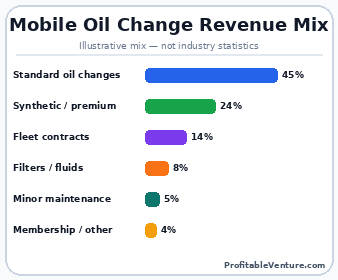
This convenience allows a well-run mobile company to compete even when its price is slightly higher than a conventional quick-lube shop. You can generate revenue from:
- Conventional oil changes
- Full-synthetic oil changes
- Diesel oil changes
- Fleet maintenance contracts
- Air-filter replacement
- Cabin-filter replacement
- Wiper replacement
- Fluid checks and top-ups
- Battery replacement
- Basic preventive-maintenance inspections
- Maintenance memberships.
You should avoid turning the business into a full mobile repair shop unless you have the technicians, insurance, licenses, equipment, and systems required for those additional services.
A focused oil-change operation can be easier to standardize because the service is repetitive.
You can train technicians around a consistent process, stock commonly used oils and filters, optimize routes, and complete multiple vehicles at one location.
The real opportunity becomes especially attractive with fleets. Imagine driving 20 minutes to change one customer’s oil.
You perform the service and then drive another 25 minutes to your next appointment.
A significant portion of your working day disappears into travel. Now compare that with arriving at a plumbing company where 10 vans are parked in the same yard.
You can service several vehicles without repeatedly packing your equipment and driving across town.
This is why route density and fleet contracts can have an enormous effect on profitability.
If you want an additional planning reference, you can also review our Mobile Oil Change Business Plan.
Steps on How to Start a Mobile Oil Change Business
-
Conduct Market Research
Your first step should be deciding exactly where you will operate. Do not define your market as an entire metropolitan area simply because your van can physically drive there.
A mobile business can become unprofitable if your technicians spend too much time traveling between customers.
Start with a compact service territory. For example, identify several ZIP codes where there are large concentrations of:
- Single-family homes
- Apartment communities
- Office buildings
- Commercial vehicle fleets
- Delivery companies
- Trades businesses
- Schools
- Rental fleets.
Then study existing competitors. Look at:
- Quick-lube shops
- Dealerships
- Independent repair garages
- Mobile mechanics
- Other mobile oil-change providers.
Record:
- Oil-change prices
- Service packages
- Appointment availability
- Operating hours
- Fleet services
- Customer reviews
- Mobile-service fees.
Then talk directly to potential fleet customers. Visit:
- Plumbing companies
- HVAC businesses
- Electricians
- Landscapers
- Pest-control companies
- Delivery businesses
- Home-health companies
- Security companies
- Construction contractors
- Real-estate companies.
Ask who currently services their vehicles. Ask how much employee time is lost sending vehicles for maintenance.
Ask whether they would consider having maintenance completed on-site during early mornings, evenings, or scheduled fleet-service days.
a. Who is the Target Market?
Your customers can include:
- Busy professionals
- Families
- Older vehicle owners
- Remote workers
- Apartment residents
- Rideshare drivers
- Delivery drivers
- Taxi operators
- Small businesses
- Commercial fleets
- Construction companies
- Service contractors
- Property-management companies
- Schools
- Car dealerships
- Rental companies.
Commercial fleets can become particularly valuable because vehicle maintenance is not optional.
If a company operates 40 vehicles, those vehicles need regular preventive maintenance throughout the year.
Winning that account can provide recurring work without repeatedly paying to acquire the same customer.
b. Is a Mobile Oil Change Business Profitable?
Yes, but profitability depends heavily on scheduling and route efficiency.
Suppose the average collected ticket is $105. If you complete eight jobs per day for 250 working days:
8 × $105 × 250 = $210,000 in annual revenue.
Now suppose better fleet contracts and route planning allow you to complete 11 services per day:
11 × $105 × 250 = $288,750.
The vehicle, insurance, software, and many administrative costs may be relatively similar.
This is why route density can dramatically increase profitability. You should track:
- Completed services per day
- Average ticket
- Oil cost per service
- Filter cost per service
- Technician labor per service
- Miles driven between appointments
- Travel time
- Customer acquisition cost
- Fleet versus residential revenue
- Repeat-customer rate.
c. What Niches Exist?
You can specialize in:
- Residential mobile oil changes
- Commercial fleet service
- Rideshare-driver maintenance
- Delivery-vehicle maintenance
- Diesel pickup oil changes
- Construction fleet maintenance
- Luxury vehicle maintenance
- Apartment-community service days
- Corporate office oil-change days
- Subscription-based maintenance.
You can also combine oil changes with selected roadside or preventive-maintenance services.
If you eventually want to expand in that direction, see our guide on starting a roadside assistance business.
d. Who are the Major Competitors?
Your competition can include:
- Jiffy Lube locations
- Valvoline Instant Oil Change
- Take 5 Oil Change
- Dealership service departments
- Independent repair shops
- Mobile mechanics
- Local mobile oil-change companies.
You do not need to beat fixed shops on price. Your competitive advantage can be:
- No waiting room
- No customer travel time
- Appointments at home or work
- Fleet service at one location
- Early-morning service
- Evening service
- Transparent pricing
- Digital maintenance records
- Automatic service reminders.
e. What Regulations Apply?
Requirements vary according to your city, county, and state. Potential requirements include:
- General business license
- Mobile-service permit
- Sales-tax registration where applicable
- Commercial vehicle registration
- Employer registrations
- Used-oil handling requirements
- Waste-management rules
- Stormwater protections
- Property-owner permission.
Used motor oil should never be dumped into:
- Storm drains
- Soil
- Trash
- Waterways
- Ordinary drains.
Your service vehicle should have a controlled system for collecting used oil and transporting it safely to an approved recycling or collection facility. You should also maintain:
- Clearly labeled used-oil containers
- Secure container lids
- Spill pans
- Absorbent material
- Spill kits
- Protective gloves
- Waste records where required.
Do not assume you can perform oil changes in any parking lot simply because the customer invited you.
Apartment complexes, office properties, municipalities, HOAs, and commercial landlords may have rules against vehicle servicing.
For fleet or property partnerships, obtain permission before scheduling recurring service.
f. Is There a Franchise?
Yes, mobile and conventional oil-change franchise opportunities exist. The advantage of a franchise may include:
- Recognized branding
- Equipment systems
- Training
- Supplier relationships
- Marketing support
- Operating procedures.
Disadvantages can include franchise fees, royalties, marketing fees, territory restrictions, and less operating flexibility.
You can compare some options in our guide to mobile oil change franchise opportunities.
g. What Do You Need to Start?
- Service van, truck, or suitable trailer setup
- Oil storage system
- Used-oil collection tank
- Oil drain pans
- Fluid evacuation equipment
- Oil transfer pumps
- Filter inventory
- Oil inventory
- Hand tools
- Filter wrenches
- Torque wrenches
- Jack and stands where appropriate
- Wheel chocks
- Drain-plug inventory
- Spill-control equipment
- Safety equipment
- POS/payment system
- Scheduling software
- Insurance
- Working capital.
h. How Does the Mobile Oil Change Process Work?
Step 1 – Customer Books
The customer provides:
- Vehicle year
- Make
- Model
- Engine information where necessary
- Location
- Preferred appointment time.
Step 2 – Confirm Oil and Filter
Verify the manufacturer’s oil specification, viscosity, capacity, and correct filter.
Step 3 – Route the Appointment
Schedule appointments geographically rather than sending technicians back and forth across town.
Step 4 – Inspect the Service Area
Before starting, confirm that the vehicle is parked safely and that servicing is permitted.
Step 5 – Protect the Ground
Position your containment system and spill-control equipment before draining oil.
Step 6 – Perform the Oil Change
Drain or extract the old oil using the appropriate procedure, replace the filter, install the correct oil, and tighten applicable components to the proper specifications.
Step 7 – Inspect
Check for leaks and verify the oil level.
Step 8 – Record the Service
Your digital record should include:
- Vehicle
- Mileage
- Date
- Oil type
- Oil quantity
- Filter used
- Technician
- Recommended next service.
Step 9 – Collect Payment
Provide the customer with a digital invoice or receipt.
Step 10 – Schedule the Next Service
Send reminders based on mileage, time, or fleet-maintenance schedule.
-
Choose a Memorable Business Name
Some mobile oil change business name ideas include:
- Driveway Lube Mobile Services, LLC
- OilOnCall Mobile Service, LLC
- QuickRoute Oil Change, LLC
- Mobile Lube Pros, LLC
- DriveSide Oil Service, LLC
- FreshOil Mobile, LLC
- OilRunner Mobile Service, LLC
- Convenient Lube Mobile, LLC
- AutoFresh Mobile Oil Change, LLC
- Doorstep Lube Service, LLC
- FleetFresh Oil Service, LLC
- RoadReady Mobile Lube, LLC
- QuickLube To You, LLC
- OilGo Mobile Maintenance, LLC
- DriveWell Mobile Lube, LLC
- Mobile Motor Care, LLC
- OnSite Oil Pros, LLC
- RouteLube Mobile Services, LLC
- ServiceVan Oil Change, LLC
- HomeDrive Mobile Lube, LLC.
Check business-name availability and potential trademark conflicts before using any name.
-
Register Your Business
a. What Business Structure is Best?
An LLC is commonly suitable for a privately owned mobile oil-change company.
It creates a formal business entity and can help separate business obligations from your personal affairs.
You still need appropriate insurance because an LLC does not prevent claims involving:
- Vehicle damage
- Oil leaks
- Engine damage
- Property damage
- Employee injuries
- Vehicle accidents
- Environmental spills.
b. Typical Registration Steps
- Choose an available business name
- Form the LLC or other entity
- Appoint a registered agent
- Obtain an EIN
- Open a business bank account
- Register for applicable taxes
- Obtain local permits
- Register commercial vehicles
- Purchase insurance
- Set up accounting and recordkeeping.
c. What Licenses and Permits May Be Needed?
Depending on the location:
- General business license
- Mobile vendor/service permit
- Commercial vehicle registration
- Waste-oil registration or documentation where required
- Sales-tax permit where applicable
- Employer registrations
- Local environmental permits where applicable.
d. Do You Need a Mechanic Certification?
A universal national mechanic license is not required simply to own an oil-change company.
However, state and local requirements can differ, particularly if you expand into additional automotive repair services.
Useful technical training includes:
- Vehicle lubrication systems
- Oil specifications
- Filter identification
- Torque procedures
- Vehicle lifting safety
- Used-oil management
- Spill response
- Basic vehicle inspection.
e. What Documents Do You Need?
- Business formation documents
- EIN
- Insurance policies
- Commercial vehicle records
- Customer invoices
- Service records
- Fleet agreements
- Employee records
- Safety procedures
- Used-oil records where required
- Supplier invoices
- Vehicle maintenance records
- Incident reports
- Customer terms and conditions.
f. What Insurance Should You Carry?
Consider coverage such as:
- General liability
- Garage liability where applicable
- Commercial auto
- Workers’ compensation
- Tools and equipment coverage
- Pollution/environmental coverage where appropriate
- Business property coverage
- Umbrella liability.
Tell your insurance provider that you perform automotive maintenance at customer locations.
Do not purchase an ordinary commercial-vehicle policy and assume it covers every service-related risk.
-
Cost Analysis and Budgeting
a. How Much Does It Cost to Start a Mobile Oil Change Business?
Mobile operations can cost considerably less than opening a conventional quick-lube facility because you do not need multiple service bays, lifts, and expensive commercial real estate.
For planning purposes:
- Small owner-operated setup: approximately $20,000 – $50,000
- Professional single-van operation: approximately $60,000 – $140,000
- Multi-vehicle mobile fleet: approximately $200,000 – $500,000+.
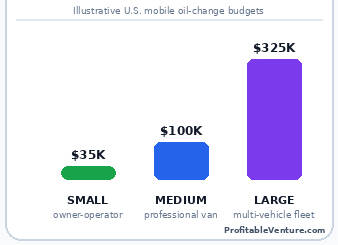
For this guide, we will use:
- Small: $35,000
- Medium: $100,000
- Large: $325,000.
If you are comparing mobile service with opening a traditional quick-lube location, see our breakdown of the cost to start an oil change business.
b. Small Owner-Operator Setup – Approximately $35,000
- Used van or trailer setup – $15,000
- Oil and waste-oil equipment – $5,000
- Tools and safety equipment – $3,000
- Initial oil/filter inventory – $3,000
- Insurance and licensing – $2,500
- Branding and website – $1,500
- POS/scheduling equipment – $1,000
- Launch marketing – $1,500
- Working capital – $2,500
- Estimated Total – $35,000.
c. Medium Professional Single-Van Operation – Approximately $100,000
- Professional service van – $42,000
- Oil-delivery, draining, evacuation, and used-oil recovery equipment – $12,000
- Working capital – $13,000
- Initial oil and filter inventory – $8,000
- Tools, spill-control equipment, and safety gear – $6,000
- Insurance, licenses, and legal setup – $5,000
- Branding, vehicle graphics, website, and POS – $5,000
- Launch marketing – $5,000
- Storage, parking, and basic administrative setup – $4,000
- Estimated Total – $100,000.
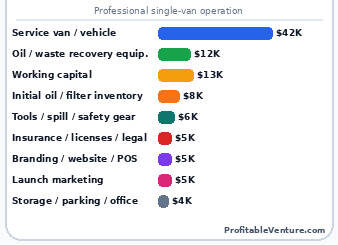
This is the model used in the financial projection below.
d. Large Multi-Vehicle Operation – Approximately $325,000
- Three service vehicles – $125,000
- Mobile oil-handling systems – $40,000
- Tools and equipment – $25,000
- Initial oil/filter inventory – $25,000
- Warehouse/storage setup – $20,000
- Insurance, licensing, and legal setup – $15,000
- Technology, dispatch, CRM, and POS – $10,000
- Marketing and vehicle branding – $15,000
- Working capital/payroll reserve – $50,000
- Estimated Total – $325,000.
e. What Determines Startup Cost?
- New versus used van
- Number of vehicles
- Bulk oil system
- Oil varieties stocked
- Filter inventory
- Waste-oil capacity
- Insurance
- Employees
- Storage
- Marketing
- Working capital.
f. What are the Ongoing Expenses?
- Motor oil
- Oil filters
- Air and cabin filters
- Technician payroll
- Vehicle fuel
- Vehicle maintenance
- Insurance
- Waste-oil handling
- Spill supplies
- Scheduling software
- POS/card fees
- Marketing
- Storage
- Phones and internet
- Accounting.
g. What Employees Do You Need?
A small company may begin with:
- Owner/Technician
- One Additional Oil-Change Technician
- Part-Time Administrative/Booking Support.
A larger business may employ:
- General Manager
- Operations/Dispatch Manager
- Lead Technician
- Mobile Technicians
- Fleet Account Manager
- Customer Service Representative
- Bookkeeper.
h. How Do You Fund the Business?
- Personal savings
- SBA-backed financing
- Commercial vehicle financing
- Equipment financing
- Business line of credit
- Business partner
- Starting with one used van and reinvesting profits.
-
Write a Business Plan
a. Executive Summary
Driveway Lube Mobile Services, LLC is a proposed mobile preventive-maintenance company based in Dallas, Texas.
The company will provide convenient oil changes and selected basic maintenance services at customers’ homes, workplaces, apartment communities, and commercial fleet locations.
The business will initially operate one professionally equipped service van. Primary services will include:
- Conventional oil changes
- Synthetic oil changes
- Diesel pickup oil changes
- Fleet maintenance
- Air-filter replacement
- Cabin-filter replacement
- Wiper replacement
- Fluid inspections and selected top-ups.
Driveway Lube will launch with approximately $100,000 in startup capital. The company’s strategy will emphasize route density, recurring customers, fleet accounts, appointment reliability, clean work practices, digital service records, and automatic maintenance reminders.
b. Mission Statement
“At Driveway Lube Mobile Services, LLC, our mission is to make routine vehicle maintenance convenient by bringing professional, clean, reliable oil-change services directly to customers while protecting their vehicles, property, time, and environment.”
c. Vision Statement
“Our vision is to build Driveway Lube into a trusted mobile preventive-maintenance brand known for convenient scheduling, dependable technicians, transparent pricing, responsible used-oil management, and long-term fleet and residential customer relationships.”
d. Goals and Objectives
The first goal is to reach consistent route density. Management will track:
- Services completed per day
- Revenue per route day
- Average ticket
- Miles per completed job
- Travel minutes per job
- Oil and filter cost per service
- Technician productivity
- Fleet revenue
- Repeat-booking percentage.
The second goal is to build recurring fleet accounts. By Year 3, management should seek to generate a meaningful percentage of revenue from customers operating multiple vehicles.
e. Organizational Structure
- Owner/General Manager
- Operations/Dispatch Manager
- Lead Mobile Technician
- Mobile Oil-Change Technicians
- Fleet Account Manager
- Customer Service/Booking Representative
- Bookkeeper.
Marketing Plan
a. SWOT Analysis
Strengths
The business eliminates much of the inconvenience associated with traditional oil changes.
It can also operate without the real-estate costs associated with a multi-bay quick-lube facility.
Weaknesses
Travel between appointments can reduce technician productivity. Weather, parking restrictions, and limited working space can also affect operations.
Opportunities
Opportunities include:
- Commercial fleets
- Apartment partnerships
- Corporate parking-lot service days
- Rideshare drivers
- Delivery fleets
- Maintenance memberships
- Diesel pickup service
- Additional service vans.
Threats
Threats include:
- Quick-lube chains
- Dealership promotions
- Oil-price increases
- Technician mistakes
- Environmental spills
- Fleet customer concentration
- Vehicle breakdowns
- Increasing electric-vehicle adoption.
b. How Does a Mobile Oil Change Business Make Money?
- Conventional oil changes
- Full-synthetic oil changes
- Diesel oil changes
- Fleet contracts
- Air-filter replacement
- Cabin-filter replacement
- Wiper replacement
- Fluid services within your scope
- Maintenance memberships.
c. How Much Should You Charge?
Actual pricing depends on oil quantity, oil specification, filter cost, vehicle type, travel, and local competition. Illustrative planning ranges may include:
- Conventional oil change: $65 – $95
- Synthetic-blend oil change: $75 – $110
- Full synthetic oil change: $90 – $150+
- Large pickup/SUV service: $110 – $180+
- Diesel pickup oil change: $130 – $250+
- Fleet service: approximately $65 – $120+ per unit depending on volume and vehicle requirements.
These are planning ranges rather than universal prices. You should price using:
Oil + Filter + Technician Labor + Vehicle/Travel Cost + Disposal/Consumables + Overhead + Desired Profit.
d. Do Not Forget Extra Oil
A common pricing mistake is advertising one flat price without limiting the amount of oil included.
A vehicle requiring nine quarts should not be priced exactly like one requiring four. Your advertised packages should clearly explain:
- Oil type
- Number of quarts included
- Filter allowance
- Extra-quart price
- Travel-zone charges where applicable.
e. Marketing Strategies
- Create a local service website
- Maintain a Google Business Profile
- Target searches for mobile oil changes
- Send service reminders
- Use online booking
- Offer first-service promotions
- Develop referral rewards
- Visit commercial fleets
- Partner with apartment complexes
- Offer office parking-lot service days
- Market to rideshare drivers
- Approach delivery companies
- Use branded service vehicles.
Build Fleet Accounts
Create a simple fleet proposal showing:
- Service price by vehicle type
- Minimum vehicle quantity
- Available service days
- Oil specifications
- Digital maintenance records
- Payment terms
- Emergency rescheduling procedures.
Do not simply tell the business owner you can change oil. Explain how your service can reduce:
- Driver downtime
- Fuel spent traveling to shops
- Employee waiting time
- Missed maintenance.
Financial Projection
a. Revenue Assumptions
The financial model below assumes a professionally equipped single-van operation gradually increasing residential customers, route density, fleet accounts, and average ticket value.
The business begins with approximately $240,000 in Year 1 revenue and grows as recurring business supports better technician utilization.
b. Five-Year Revenue and Profit Projection
| Fiscal Year | Revenue | Operating Expenses | Net Profit | Net Margin |
|---|---|---|---|---|
| Year 1 | $240,000 | $211,000 | $29,000 | 12.1% |
| Year 2 | $330,000 | $287,000 | $43,000 | 13.0% |
| Year 3 | $430,000 | $365,000 | $65,000 | 15.1% |
| Year 4 | $540,000 | $448,000 | $92,000 | 17.0% |
| Year 5 | $670,000 | $549,000 | $121,000 | 18.1% |
Under this illustrative model, cumulative five-year revenue would be approximately $2.21 million. Cumulative projected net profit would be approximately $350,000.

c. Sample Five-Year Profit and Loss Projection
| Item | Year 1 | Year 2 | Year 3 | Year 4 | Year 5 |
|---|---|---|---|---|---|
| Revenue | $240,000 | $330,000 | $430,000 | $540,000 | $670,000 |
| Oil, Filters and Service Materials | $84,000 | $116,000 | $151,000 | $189,000 | $235,000 |
| Technician Payroll | $60,000 | $85,000 | $110,000 | $135,000 | $165,000 |
| Vehicle Fuel and Maintenance | $18,000 | $23,000 | $29,000 | $35,000 | $42,000 |
| Insurance and Licensing | $8,000 | $9,000 | $10,000 | $11,000 | $12,000 |
| Marketing and Customer Acquisition | $12,000 | $15,000 | $18,000 | $22,000 | $26,000 |
| Scheduling, POS and Card Fees | $7,000 | $10,000 | $13,000 | $16,000 | $20,000 |
| Waste Oil, Spill Supplies and Shop Consumables | $6,000 | $8,000 | $10,000 | $12,000 | $15,000 |
| Storage, Parking and Administration | $8,000 | $10,000 | $12,000 | $14,000 | $16,000 |
| Vehicle Financing, Depreciation and Other Costs | $8,000 | $11,000 | $12,000 | $14,000 | $18,000 |
| Total Operating Expenses | $211,000 | $287,000 | $365,000 | $448,000 | $549,000 |
| Projected Net Profit | $29,000 | $43,000 | $65,000 | $92,000 | $121,000 |
d. How Much Profit Can a Mobile Oil Change Business Make?
There is no fixed amount. An owner-operator may effectively earn both technician compensation and business profit.
A larger operation can generate more revenue but will support technicians, service vans, management, and administrative employees.
Under this model, projected net profit increases from approximately $29,000 in Year 1 to approximately $121,000 in Year 5.
e. What Determines Profit?
- Services completed per day
- Average ticket
- Oil acquisition cost
- Filter cost
- Technician labor
- Travel time
- Route density
- Fleet contracts
- Vehicle fuel
- Repeat customers
- Marketing cost
- Service mistakes.
f. What is the Profit Margin?
Use:
Net Profit Margin = Net Profit ÷ Revenue × 100.
The illustrative operation begins at approximately 12.1% and improves toward approximately 18.1%.
The improvement assumes higher route density, more fleet business, better purchasing, stronger customer retention, and improved technician productivity.
g. What is the Sales Forecast?
- Year 1: $240,000
- Year 2: $330,000
- Year 3: $430,000
- Year 4: $540,000
- Year 5: $670,000.
-
Set Up Your Mobile Oil Change Van
Your van is effectively your shop. Do not simply throw oil containers and tools into the back of a cargo van.
Design the vehicle around safe, efficient workflow. You may need dedicated areas for:
- New engine oil
- Used oil
- Filters
- Tools
- Spill-control equipment
- Parts
- Waste materials.
a. Bulk Oil Versus Bottled Oil
A very small operation may begin with bottled oil.
As volume grows, bulk oil can improve purchasing efficiency and reduce packaging waste.
The challenge is inventory. You may need several common viscosities and specifications.
Do not carry excessive slow-moving oil that occupies van space and working capital. Use your customer history to determine what you should stock.
b. What Equipment is Needed?
- Service van
- Bulk oil tanks or organized packaged-oil storage
- Used-oil tank
- Transfer pumps
- Oil evacuation equipment
- Drain pans
- Funnels
- Filter wrenches
- Socket sets
- Torque wrenches
- Drain-plug tools
- Wheel chocks
- Portable lighting
- Protective mats
- Absorbent materials
- Spill kit
- Gloves
- Eye protection
- Fire extinguisher
- Filter inventory
- POS/tablet/phone.
c. Organize Filter Inventory
Filters can quietly consume substantial working capital because thousands of vehicle applications exist.
Stock the filters used most frequently in your service area. Use supplier access for less common applications. Track every filter by:
- Part number
- Vehicle application
- Purchase cost
- Quantity
- Usage frequency.
-
Hire and Train Employees
An oil change looks simple until somebody makes a serious mistake. Examples include:
- Installing the wrong oil
- Underfilling the engine
- Overfilling the engine
- Leaving the drain plug loose
- Cross-threading the drain plug
- Double-gasketing the oil filter
- Installing the wrong filter
- Failing to check for leaks.
A small mistake can destroy an engine. Build a standardized service checklist.
Require a Final Verification
Before the technician leaves:
- Confirm correct oil
- Confirm correct quantity
- Confirm filter installation
- Check drain plug
- Start engine
- Check for leaks
- Shut down
- Verify final oil level
- Clean the work area
- Record the service.
This checklist should be completed every time, even when the technician has performed thousands of oil changes.
Train Employees on Customer Property
Your technician is working in someone’s driveway or commercial property. Train employees to:
- Avoid oil stains
- Keep tools organized
- Respect customer property
- Avoid loud music
- Dress professionally
- Never leave waste behind.
-
Launch and Manage the Business Properly
Start with a smaller service territory. Do not accept appointments scattered across a 70-mile radius simply because customers are willing to pay you.
Group appointments geographically. For example:
- Monday – Northside residential customers
- Tuesday – Downtown office accounts
- Wednesday – Fleet accounts
- Thursday – Westside residential customers
- Friday – Fleet and overflow appointments.
Your routing software should help reduce unnecessary travel.
a. What Makes a Mobile Oil Change Business Successful?
- Route density – Less driving means more billable services.
- Fleet contracts – Multiple vehicles at one site improve productivity.
- Accurate vehicle information – Bring the correct oil and filter.
- Clean work – Customers do not want oil on their driveway.
- Reliable appointments – Convenience disappears if you arrive two hours late.
- Repeat customers – Routine maintenance naturally creates repeat demand.
- Digital service records – Make maintenance easy to track.
- Service reminders – Do not wait for customers to remember.
- Good purchasing – Oil and filter cost strongly affect margin.
- Quality control – One damaged engine can eliminate months of profit.
b. What Happens During a Typical Day?
The technician arrives at the service van early in the morning. Before leaving, the day’s appointments are checked. The van needs:
- Correct filters
- Correct oil grades
- Enough oil inventory
- Spill-control materials
- Sufficient waste-oil capacity.
The first appointment is at 7:30 a.m. at a customer’s home.
- The technician performs a full-synthetic oil change.
- The service is recorded and the customer pays electronically.
- The next three appointments are within the same neighborhood.
- At 11:00 a.m., the van arrives at a landscaping company.
- The business has six pickup trucks scheduled.
- Because the vehicles are parked together, the technician can work efficiently without repeated travel.
- After lunch, several residential jobs are completed.
At the end of the route, the technician returns to the storage location. Management checks:
- Services completed
- Revenue
- Oil consumed
- Filters consumed
- Miles driven
- Used-oil capacity
- Tomorrow’s inventory requirements.
c. What Skills and Experience Do You Need?
- Basic automotive maintenance – You need to service vehicles correctly.
- Oil specification knowledge – Modern engines can have very specific requirements.
- Route management – Driving time is lost production time.
- Customer service – You work directly on customer property.
- Fleet sales – Commercial accounts can transform profitability.
- Inventory control – You need the right oil and filter when you arrive.
- Environmental responsibility – Used oil and spills need proper handling.
- Financial management – Know your cost per service.
You do not need to be an experienced auto-repair shop owner to start a mobile oil change business.
But you should know how to perform the service correctly before taking customer appointments.
- Practice identifying filters.
- Learn oil specifications.
- Learn proper torque procedures.
- Understand drain plugs.
- Learn how to prevent spills.
- Develop a used-oil handling system.
- Create a service checklist.
- Then focus aggressively on route density.
The difference between a mediocre mobile oil-change business and an excellent one is often not the physical oil change. It is how efficiently you organize the day.
If one technician completes five scattered appointments while another completes 12 vehicles at two commercial locations, the second route can generate dramatically more revenue with less driving.
Build your company around convenience for the customer and efficiency for your technicians.
If you can combine clean service, correct vehicle maintenance, good scheduling, dense routes, recurring fleet accounts, responsible used-oil handling, reliable technicians, digital reminders, and disciplined cost control, you can build a profitable mobile oil change business even if you have never previously owned an automotive service company.