

A wedding rental business provides couples, wedding planners, venues, caterers, decorators, and event professionals with items they need temporarily for weddings and receptions.
Instead of a couple buying 150 chairs, 20 tables, linens, an arch, lounge furniture, charger plates, candleholders, and other equipment they may use only once, they rent those items from you for the event.
Your company delivers the items, may set them up, collects them after the wedding, cleans or repairs them, and rents them again to another customer.

That repeatability is one of the most attractive parts of the business. A chair you purchase once can potentially generate rental income dozens of times before it needs to be replaced.
A good wedding rental company can make money from chairs, tables, linens, tents, arches, backdrops, lounge furniture, dance floors, lighting, tableware, bars, décor pieces, delivery, setup, breakdown, cleaning, and damage-related charges.
You do not have to start by owning everything a wedding could possibly require.
In fact, trying to become a one-stop rental company on your first day can be one of the fastest ways to tie up your money in equipment that sits inside a warehouse.
A beginner is usually better off owning a strong core inventory that is requested repeatedly and developing relationships with other rental companies that can supply specialty equipment when needed.
For example, you may own tables, chairs, linens, wedding arches, backdrops, and several popular décor collections while sub-renting a very large tent, specialty dance floor, or unusual lounge collection for the occasional wedding that requires it.

This allows you to build revenue before investing hundreds of thousands of dollars in equipment. The biggest challenge is not simply buying attractive wedding items.
You need to know what couples actually rent, how much inventory to own, how to transport it safely, how long setup takes, how to price delivery, how to prevent damage and loss, and how to avoid accepting more weddings on the same weekend than your staff and inventory can handle.
Steps on How to Start a Wedding Rental Business
-
Conduct Market Research
Wedding rental market research should begin with the weddings already taking place in your proposed service area.
Visit wedding venues, bridal shows, wedding fairs, banquet halls, hotels, farms, gardens, churches, country clubs, and outdoor event locations. Pay attention to what couples are renting.
- Are clear acrylic chairs popular?
- Do most venues already provide basic tables and chairs?
- Are couples renting specialty linens instead?
- Is there strong demand for arches, backdrops, charger plates, lounge furniture, tents, bars, dance floors, or decorative lighting?
The answers vary from one market to another. A wedding venue that already includes 200 banquet chairs may create little demand for ordinary folding chairs but plenty of demand for upgraded chairs, specialty linens, bars, tableware, and décor.
A rural outdoor venue may create strong demand for tents, flooring, generators, tables, chairs, and lighting. Talk directly to wedding planners.
They can tell you which rental companies are reliable, which items constantly book out, what couples complain about, and what they have difficulty sourcing locally.
Caterers are also valuable sources of information because they regularly need tables, linen, china, glassware, food-service equipment, and staging support.
Study your competitors’ online catalogs. Do not simply compare prices. Look at inventory depth.
A company may advertise a particular chair, but can it supply 250 identical chairs on a Saturday in June? That matters.
Also investigate their delivery fees, setup policies, minimum orders, damage policies, cancellation terms, weekend schedules, and how far they deliver.
Finally, study your local wedding calendar. This business can be seasonal. If most weddings in your area occur between April and October, you need to earn enough during the busy months to support warehouse rent, insurance, vehicle payments, and employees during slower periods.
a. Who is the Target Market for a Wedding Rental Business?
- Engaged couples
- Wedding planners
- Wedding coordinators
- Wedding venues
- Hotels
- Country clubs
- Banquet halls
- Churches
- Caterers
- Wedding decorators and stylists
- Florists
- Photographers
- Event production companies
- Corporate event planners
- Birthday and private-party customers
- Nonprofit organizations
- Schools and universities.
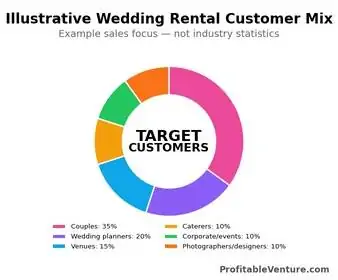
Although weddings may be your main specialty, many of the same tables, chairs, tents, linens, bars, and décor can also be rented for birthdays, corporate events, graduations, anniversaries, galas, and community events. That can help generate revenue outside the main wedding season.
b. Is a Wedding Rental Business Profitable?
Yes, a wedding rental business can be profitable because the same inventory can produce revenue repeatedly.
However, that does not mean every rental item is a good investment. Suppose you spend $8,000 on a specialty lounge collection because it looks impressive in photographs.
If customers rent it twice a year, you may wait a long time to recover that investment.
Meanwhile, simple chairs that rent almost every weekend could recover their purchase price much faster. This is why utilization is so important. You should know:
- How much an item costs to purchase
- How much you charge per rental
- How often it is rented
- How much labor is required to deliver and set it up
- How much space it occupies in your warehouse
- How often it is damaged
- How long it is likely to remain fashionable.
Wedding rentals can also generate additional income through delivery, installation, teardown, late pickup, cleaning, and damage charges.
Profitability improves when equipment is rented frequently and delivery routes are organized efficiently.
c. Are There Existing Niches in the Industry?
Yes. You can build a wedding rental business around one or several niches.
- Tables and chair rentals
- Luxury chair rentals
- Wedding linen rentals
- China, flatware, and glassware
- Wedding arches
- Backdrops
- Luxury décor rentals
- Lounge furniture
- Tent rentals
- Sailcloth tent rentals
- Dance-floor rentals
- Wedding lighting
- Portable bars
- Rustic wedding rentals
- Vintage wedding rentals
- Modern and minimalist rentals
- Luxury tabletop rentals
- Micro-wedding rentals
- Outdoor wedding equipment
- Wedding ceremony packages.
A niche can help you start with less inventory. You could become known for luxury chairs and tabletop pieces before gradually expanding into tents, lighting, lounge furniture, and full event infrastructure.
d. Who are the Major Competitors?
Your competitors will depend heavily on your location. Current established event rental operators in the United States include companies such as:
- PEAK Event Services
- Bright Event Rentals
- Party Reflections
- Regional tent and event rental companies
- Independent wedding rental businesses
- Party rental companies
- Wedding decorators that own rental inventory
- Wedding venues that provide their own equipment
- Online décor rental businesses.
Large operators may have thousands of products and enormous warehouses.
A small company should not try to compete by owning everything they own.
You can compete by serving a smaller geographic area extremely well, offering carefully selected inventory, communicating quickly, delivering on time, and developing close relationships with planners and venues.
e. Are There County, State, or Federal Regulations for a Wedding Rental Business in the United States?
Yes, although most wedding rental businesses are regulated primarily through ordinary state and local business requirements.
You may need a general business license, local registration, zoning approval for your warehouse, sales-tax registration, commercial vehicle registration, and employer registrations.
Rental transactions may be taxable in many states, but the treatment of rental income, delivery fees, damage waivers, labor, and other charges varies.
Do not assume that because you are renting rather than selling merchandise there is no sales-tax obligation.
Check your state’s rules before setting up your accounting system. Tent rentals require additional attention.
Large temporary tents and membrane structures may require permits, site plans, inspections, flame-resistance documentation, emergency exits, fire extinguishers, and approval from a local fire marshal or building authority.
The exact size at which a permit becomes necessary differs by jurisdiction. This means your employee should never simply arrive at a wedding venue and erect a large tent without determining who is responsible for securing the required approval.
Your rental agreement should clearly state whether your company or the customer is responsible for event permits.
Companies that install tents should also understand manufacturer instructions, anchoring requirements, underground utility risks, wind limitations, and weather procedures.
Temporary heaters, generators, cooking equipment, stages, and electrical systems can create additional permitting and safety requirements.
If you rent trailers or operate commercial trucks, additional vehicle, weight, driver, and insurance requirements may apply depending on vehicle size and how the business operates.
f. Is There a Franchise for a Wedding Rental Business?
Franchising exists within the broader wedding and event-service industry, although pure wedding-equipment rental franchises are less common than independent rental companies.
You may find franchise opportunities involving wedding services, event production, photo booths, décor, entertainment, or event support.
Before purchasing one, determine whether you are actually buying a rental-business system or a completely different wedding-service model. Review the Franchise Disclosure Document and pay attention to:
- Initial franchise fees
- Royalty payments
- Required equipment purchases
- Approved suppliers
- Territory restrictions
- Marketing contributions
- Software fees
- Vehicle requirements
- Inventory requirements
- Renewal obligations.
Because a wedding rental business can be started independently, compare the cost of a franchise with what you would spend building your own local brand.
g. What Do You Need to Start a Wedding Rental Business?
- A defined rental niche
- Market research
- Business registration
- Warehouse or secure storage
- Rental inventory
- Delivery vehicle or trailer
- Rental-management software
- Website and online catalog
- Commercial insurance
- Rental contracts
- Damage and replacement policy
- Cleaning equipment
- Repair tools
- Loading carts and dollies
- Inventory identification system
- Employees or event crew
- Supplier relationships
- Working capital.
-
Choose a Memorable Business Name
Your business name should fit the type of weddings you want to serve. A company focusing on luxury weddings may want a more polished name, while a company specializing in rustic outdoor weddings can use something warmer and more relaxed.
Try not to make the name so narrow that you cannot rent equipment for corporate or social events later. Some wedding rental business name ideas are:
- Ever After Event Rentals, LLC
- White Rose Wedding Rentals, LLC
- Golden Aisle Event Rentals, LLC
- Grand Table Rentals, LLC
- Perfect Day Event Rentals, LLC
- Wedding House Rentals, LLC
- Celebration Lane Rentals, LLC
- Velvet & Vine Event Rentals, LLC
- Ivory Table Rentals, LLC
- Premier Wedding Rentals, LLC
- Gather & Grace Rentals, LLC
- Willow Event Rentals, LLC
- Golden Vow Rentals, LLC
- Signature Celebration Rentals, LLC
- Timeless Table Event Rentals, LLC
- White Linen Event Co., LLC
- Grand Occasion Rentals, LLC
- Vow & Venue Rentals, LLC
- Celebration Foundry Rentals, LLC
- Evergreen Wedding Rentals, LLC.
Check your state’s business-name database and potential trademark conflicts before investing in branding.
-
Register Your Business
a. What Type of Business Structure is Best for a Wedding Rental Business?
Many independent wedding rental companies operate as limited liability companies.
An LLC can create separation between the owner and business while remaining relatively easy to administer.
This is particularly useful in an equipment rental business because several risks exist.
An item could allegedly injure a guest, an employee could damage a venue, a delivery truck could be involved in an accident, or a tent could fail if it is improperly installed.
However, an LLC does not replace appropriate insurance, safe equipment, proper installation, or good contracts.
b. Steps to Form an LLC
- Choose an available LLC name
- File formation documents with your state
- Select a registered agent
- Create an operating agreement
- Obtain an EIN where required
- Register for state and local taxes
- Obtain sales-tax registration where required
- Open a business bank account
- Apply for required licenses
- Purchase business insurance
- Maintain annual state filings.
c. What Type of License is Needed to Start a Wedding Rental Business?
The exact requirements depend on your location and inventory. You may need:
- General business license
- Local business registration
- Sales-tax or seller registration
- Warehouse zoning approval
- Certificate of occupancy
- Fire inspection approval for your storage facility
- Commercial vehicle registration
- Temporary-structure permits for certain tents
- Special-event permits where applicable
- Sign permit if operating a showroom
- Employer registrations.
d. What Type of Certification is Needed to Start a Wedding Rental Business?
There is no universal wedding rental certification required across the United States. Useful training may include:
- Tent installation training
- Equipment safety training
- Forklift certification where appropriate
- Workplace safety training
- First aid and CPR
- Defensive driving
- Rigging or staging training where appropriate
- Event layout and floor-plan training.
If employees install specialized structures, lighting, or electrical systems, additional qualifications may be appropriate.
e. What Documents are Needed to Start a Wedding Rental Business?
- Business formation documents
- EIN where applicable
- Business licenses
- Sales-tax registration
- Commercial lease
- Insurance policies
- Rental agreement
- Damage policy
- Cancellation policy
- Deposit and payment policy
- Delivery agreement
- Employee records
- Vehicle records
- Equipment inspection records
- Tent flame-resistance certificates where applicable
- Maintenance logs
- Inventory records
- Customer invoices
- Permit documentation where applicable.
f. Do You Need a Trademark, Copyright, or Patent?
You normally do not need a patent. A trademark may protect your company name, logo, slogan, or branded rental collection.
Copyright can protect original photographs, website copy, catalogs, brochures, design guides, and marketing materials.
Professional photographs are particularly important in wedding rentals because couples often choose items based on how they look inside completed events.
-
Cost Analysis and Budgeting
a. How Much Does It Cost to Start a Wedding Rental Business?
The amount required depends primarily on what you decide to own. A small operator focusing on tables, chairs, linens, arches, and smaller décor pieces may be able to begin with approximately $15,000 to $40,000.
A medium-scale company with broader inventory, a delivery vehicle, warehouse space, and a professional booking operation may require approximately $60,000 to $120,000.
A larger premium event rental operation with tents, luxury furniture, tabletop inventory, several vehicles, warehouse space, and a large crew may require approximately $175,000 to $400,000 or more.
For this guide, we will use:
- Small-scale wedding rental business: approximately $25,000
- Medium-scale wedding rental business: approximately $85,000
- Large-scale wedding rental business: approximately $250,000.
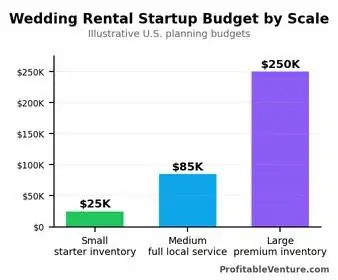
These are planning estimates rather than guaranteed prices.
b. What are the Costs Involved in Starting a Wedding Rental Business?
Small-Scale Wedding Rental Business – Approximately $25,000
- Tables and chairs – $8,000
- Linens, arches, backdrops, and basic décor – $5,000
- Used trailer or delivery equipment – $3,000
- Storage deposit and initial rent – $2,000
- Website and rental software – $1,500
- Insurance and licensing – $1,500
- Cleaning, repair, dollies, and tools – $1,500
- Initial marketing – $1,000
- Working capital – $1,500
- Estimated Total – $25,000.
This works best when you focus on a narrow inventory category and sub-rent products you do not own.
Medium-Scale Wedding Rental Business – Approximately $85,000
- Tables, chairs, linens, arches, tabletop, and décor inventory – $35,000
- Used box truck or truck/trailer combination – $15,000
- Working capital reserve – $10,000
- Warehouse deposit and initial storage costs – $8,000
- Cleaning, repair, carts, dollies, racks, and tools – $5,000
- Website, photography, branding, and initial marketing – $5,000
- Rental-management software and technology – $4,000
- Insurance, licensing, and professional fees – $3,000
- Estimated Total – $85,000.
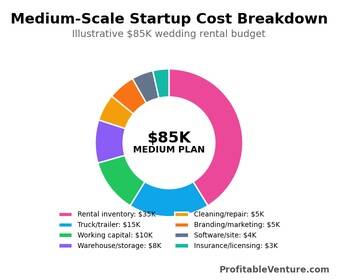
This is the model used for the financial projection later in this article.
Large-Scale Wedding Rental Business – Approximately $250,000
- Tables, chairs, linens, tabletop, luxury furniture, and décor – $90,000
- Tents and outdoor-event equipment – $50,000
- Delivery trucks and trailers – $35,000
- Warehouse setup and storage systems – $20,000
- Working capital and payroll reserve – $25,000
- Cleaning and maintenance equipment – $8,000
- Rental software, website, and inventory technology – $7,000
- Insurance, permits, and professional fees – $7,000
- Marketing, showroom samples, and launch costs – $8,000
- Estimated Total – $250,000.
You can easily spend more if you purchase large clear-span tents, luxury lounge furniture, dance floors, staging systems, generators, and additional trucks.
c. What Factors Determine the Cost of Starting a Wedding Rental Business?
- Type of inventory
- Number of items
- Quality of furniture
- Whether you offer tents
- Warehouse size
- Delivery vehicles
- Local insurance costs
- Number of employees
- Cleaning requirements
- Showroom requirements
- Technology
- Marketing
- Working capital.
d. Do You Need to Build a Facility? If YES, How Much Will It Cost?
No. You generally need storage rather than an expensive customer-facing storefront.
A warehouse or industrial unit with easy truck access is often more valuable than a beautiful retail location. Look for:
- Drive-in or loading-door access
- High ceilings
- Dry storage
- Security
- Vehicle parking
- Enough room to clean inventory
- Racking space
- Easy access to major roads.
A small showroom can be useful for luxury tableware, linens, and design consultations, but you do not need one immediately.
e. What are the Ongoing Expenses of a Wedding Rental Business?
- Employee wages
- Payroll taxes
- Warehouse rent
- Truck payments
- Fuel
- Commercial auto insurance
- General liability insurance
- Equipment insurance
- Inventory replacement
- Cleaning
- Laundry
- Repairs
- Rental software
- Payment-processing fees
- Website expenses
- Advertising
- Vehicle maintenance
- Licenses and permit renewals
- Accounting
- Equipment sub-rentals.
f. What is the Average Salary of Your Staff?
Payroll varies considerably by city and employee responsibility. A wedding rental company may employ:
- General Manager
- Rental Sales Consultant
- Warehouse Manager
- Inventory Associates
- Delivery Drivers
- Setup Crew
- Tent Installers
- Linen and Cleaning Staff
- Event Designers
- Bookkeeper
- Customer Service Staff.
Use current wages in your local labor market when developing the actual budget.
Wedding work also frequently occurs during evenings and weekends, so scheduling and overtime need to be managed carefully.
g. How Do You Get Funding to Start a Wedding Rental Business?
- Personal savings
- Small-business loans
- Equipment financing
- Vehicle financing
- Business lines of credit
- Private investors
- Business partners
- Family financing
- Starting with small inventory and reinvesting profits
- Purchasing used rental inventory from retiring companies.
Do not use all your money to buy inventory. You still need cash to pay warehouse rent, fuel, employees, insurance, and repairs before enough rental income has accumulated.
-
Write a Business Plan
a. Executive Summary
Ever After Event Rentals, LLC is a proposed wedding and special-event rental company based in Charlotte, North Carolina.
The company will provide tables, chairs, linens, wedding arches, backdrops, charger plates, tabletop accessories, cocktail tables, portable bars, décor pieces, and selected lounge furniture.
Ever After Event Rentals will primarily serve engaged couples, wedding planners, venues, caterers, and event designers.
The company will also rent inventory for corporate functions, birthday parties, galas, graduations, and other special events when capacity is available.
The business will launch with approximately $85,000 in startup capital. Management will deliberately avoid purchasing every possible event item during the first year.
Large specialty tents, unusual furniture, and infrequently requested equipment will initially be sourced from trusted partner rental companies when necessary.
The company will generate revenue through equipment rentals, delivery, setup, breakdown, cleaning, and approved damage-related charges.
The business will emphasize clean equipment, accurate orders, reliable delivery, professional setup, inventory control, and strong relationships with wedding planners and venues.
The long-term objective is to build a profitable local rental operation and gradually add premium furniture, tenting, tabletop, and event infrastructure based on demonstrated customer demand.
b. Products and Services
Ever After Event Rentals, LLC will offer:
- Wedding chairs
- Folding chairs
- Cross-back chairs
- Chiavari-style chairs
- Round tables
- Rectangular tables
- Cocktail tables
- Table linens
- Napkins
- Table runners
- Wedding arches
- Ceremony backdrops
- Charger plates
- Candleholders
- Centerpiece stands
- Portable bars
- Lounge furniture
- Ceremony accessories
- Delivery
- Setup
- Breakdown and pickup.
c. Mission Statement
“At Ever After Event Rentals, LLC, our mission is to make beautiful weddings easier to create by providing clean, stylish, dependable rental equipment supported by professional delivery, careful setup, and responsive customer service.”
Vision Statement
“Our vision is to become a trusted regional wedding rental company known by couples, planners, and venues for dependable service, beautiful inventory, professional logistics, and consistently well-executed events.”
d. Goals and Objectives
The company’s first objective is to develop a profitable core inventory. Management will monitor how frequently each product is rented.
Items with strong utilization will receive additional investment. Items that rarely rent will not be expanded simply because they photograph well.
Another major objective is to build relationships with wedding planners and venues.
A planner who trusts your company may bring several weddings each year.
The company will also develop strict logistics procedures so delivery times, setup instructions, quantities, and pickup schedules are confirmed before every event.
Long-term objectives include adding tenting, luxury furniture, a larger tabletop collection, additional trucks, a design showroom, and eventually a second warehouse serving another metropolitan area.
e. Organizational Structure
- Owner/General Manager
- Rental Sales Manager
- Wedding Rental Consultants
- Warehouse Manager
- Inventory Associates
- Delivery Drivers
- Setup and Breakdown Crew
- Cleaning/Linen Staff
- Marketing Coordinator
- Bookkeeper/Accountant.
Marketing Plan
a. SWOT Analysis
Strengths
Rental inventory can generate revenue many times after it has been purchased.
The company can also sell to both individual couples and professional wedding planners.
A strong local reputation can create repeat business from venues, caterers, and planners even though individual couples generally marry only once.
Weaknesses
Inventory requires capital and warehouse space. The company also faces complicated weekend logistics.
Several weddings may require deliveries and pickups within the same narrow period. Equipment can be damaged, lost, stained, or broken.
Opportunities
The company can expand into luxury furniture, tenting, lighting, tabletop rentals, corporate events, holiday parties, graduations, and event production.
Strong relationships with wedding planners and venues can generate recurring referrals.
Threats
Threats include established rental companies, economic slowdowns, bad weather, equipment damage, vehicle breakdowns, labor shortages, rapidly changing wedding trends, warehouse rent increases, and clients canceling events.
Outdoor events also create weather and safety risks that must be managed carefully.
b. How Do Wedding Rental Businesses Make Money?
- Chair rentals
- Table rentals
- Linen rentals
- Tabletop rentals
- Tent rentals
- Arch rentals
- Backdrop rentals
- Furniture rentals
- Dance-floor rentals
- Bar rentals
- Decor rentals
- Delivery fees
- Setup charges
- Breakdown fees
- Cleaning fees where appropriate
- Damage and replacement charges
- Rush-order fees
- After-hours delivery or pickup charges.
Do not hide delivery inside the rental price unless that approach works financially.
A delivery 10 minutes from your warehouse is very different from a wedding 70 miles away that requires a box truck and four employees.
c. Payment Options
- Credit cards
- Debit cards
- ACH transfers
- Online invoices
- Bank transfers
- Corporate checks where appropriate
- Deposits and scheduled installment payments.
Wedding rentals should normally require a signed contract and deposit before inventory is reserved.
A verbal promise should not remove 150 chairs from your available inventory for a busy Saturday.
d. Sales and Advertising Strategies
- Build a highly visual website
- Create an online rental catalog
- Use professional wedding photography
- Market on Instagram and Pinterest
- Network with wedding planners
- Partner with venues
- Build relationships with caterers
- Attend bridal shows
- Participate in venue open houses
- Create styled wedding shoots
- Offer planner trade accounts where profitable
- Create wedding rental packages
- Ask planners and couples for reviews
- Build relationships with florists and photographers
- Use Google Business Profile
- Offer weekday showroom appointments
- Create venue-specific rental packages.
Photography is particularly important.
A customer is more likely to rent a chair after seeing it inside a beautiful completed wedding than after seeing it stacked inside your warehouse.
Financial Projection
a. How Much Should You Charge for Wedding Rentals?
Do not simply look at what another company charges and copy the price. You should know the economics of each item. A useful starting calculation is:
Minimum Equipment Recovery per Rental = Replacement Cost ÷ Target Number of Paid Rentals Before Replacement.
You then need to account for:
- Cleaning
- Repairs
- Warehouse space
- Loading labor
- Equipment handling
- Insurance
- Administrative overhead
- Expected damage
- Desired profit.
Delivery and setup should also be priced based on actual labor, distance, vehicle requirements, and timing.
A 200-chair ceremony may require considerably more labor than simply dropping off ten tablecloths.
b. How Much Revenue Can a Wedding Rental Business Generate?
Revenue depends on inventory size, local wedding volume, average order value, utilization, and whether you also serve corporate and social events. For planning purposes:
- Small wedding rental operation: approximately $100,000 to $200,000 in annual gross revenue
- Medium local rental business: approximately $225,000 to $450,000
- Large full-service event rental operation: approximately $500,000 to $1.2 million or more.
These are planning estimates rather than guaranteed results.
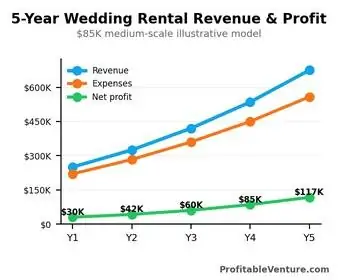
The projection below uses the $85,000 medium-scale business model and assumes approximately $250,000 in first-year revenue.
c. Five-Year Revenue and Profit Projection
| Fiscal Year | Revenue | Total Expenses | Net Profit | Net Margin |
|---|---|---|---|---|
| Year 1 | $250,000 | $220,000 | $30,000 | 12.0% |
| Year 2 | $325,000 | $283,000 | $42,000 | 12.9% |
| Year 3 | $420,000 | $360,000 | $60,000 | 14.3% |
| Year 4 | $535,000 | $450,000 | $85,000 | 15.9% |
| Year 5 | $675,000 | $558,000 | $117,000 | 17.3% |
Under this projection, cumulative five-year revenue would be approximately $2.205 million, while cumulative projected net profit would be approximately $334,000.
d. Sample Five-Year Profit and Loss Projection
| Item | Year 1 | Year 2 | Year 3 | Year 4 | Year 5 |
|---|---|---|---|---|---|
| Revenue | $250,000 | $325,000 | $420,000 | $535,000 | $675,000 |
| Labor and Event Crew | $70,000 | $95,000 | $125,000 | $160,000 | $205,000 |
| Warehouse and Storage | $30,000 | $32,000 | $36,000 | $40,000 | $45,000 |
| Vehicles, Fuel and Delivery | $26,000 | $34,000 | $44,000 | $54,000 | $65,000 |
| Cleaning, Repairs and Inventory Loss | $22,000 | $28,000 | $36,000 | $44,000 | $53,000 |
| Marketing and Sales | $16,000 | $18,000 | $22,000 | $27,000 | $32,000 |
| Insurance, Licensing and Permits | $8,000 | $9,000 | $10,000 | $12,000 | $14,000 |
| Software and Payment Processing | $8,000 | $10,000 | $13,000 | $16,000 | $20,000 |
| Equipment Replacement and Depreciation | $22,000 | $30,000 | $38,000 | $48,000 | $58,000 |
| Administration and Other Expenses | $18,000 | $27,000 | $36,000 | $49,000 | $66,000 |
| Total Expenses | $220,000 | $283,000 | $360,000 | $450,000 | $558,000 |
| Projected Net Profit | $30,000 | $42,000 | $60,000 | $85,000 | $117,000 |
e. How Much Profit Do Wedding Rental Business Owners Make a Year?
There is no fixed amount.
A small owner-operated company may generate less revenue but retain a larger percentage because the owner personally handles sales, delivery, and setup.
A larger company can produce substantially more revenue but must support warehouse staff, delivery crews, vehicles, management, and a much larger inventory.
Using the medium-scale model above, projected business profit starts at approximately $30,000 in Year 1 and reaches approximately $117,000 in Year 5.
f. What Factors Determine the Amount of Profit to Be Made?
- Number of weddings booked
- Average rental order
- Inventory utilization
- Rental pricing
- Delivery fees
- Setup fees
- Warehouse rent
- Employee wages
- Fuel
- Equipment damage
- Cleaning costs
- Number of repeat planner accounts
- Wedding season length
- Corporate and social-event revenue
- Inventory trends
- Vehicle efficiency.
g. What is the Profit Margin of a Wedding Rental Business?
Profit margins depend heavily on utilization and labor. Calculate your actual margin using:
Net Profit Margin = Net Profit ÷ Total Revenue × 100.
The medium-scale model in this guide begins at approximately 12% and gradually improves toward approximately 17%. This is a planning model rather than a guaranteed industry margin.
h. What is the Sales Forecast?
- First Fiscal Year: $250,000
- Second Fiscal Year: $325,000
- Third Fiscal Year: $420,000
- Fourth Fiscal Year: $535,000
- Fifth Fiscal Year: $675,000.
-
Set Up Your Warehouse and Operations
a. How Do You Choose a Perfect Location for a Wedding Rental Business?
Your warehouse should be positioned for logistics rather than expensive retail exposure. Look for:
- Affordable industrial or commercial rent
- Easy access to highways
- Reasonable distance from popular wedding venues
- Loading doors
- Truck parking
- High ceilings
- Secure storage
- Space for washing and repairs
- Good drainage where cleaning occurs
- Room for expansion.
A warehouse located 40 miles away from most of your customers may save money on rent but increase fuel, payroll, and delivery time every weekend.
b. What State and City is Best to Start a Wedding Rental Business?
There is no universally best city. You should look for markets with active wedding venues, strong population growth, corporate events, and enough customers to support the type of inventory you intend to carry. Markets worth researching include:
- Charlotte, North Carolina
- Raleigh, North Carolina
- Atlanta, Georgia
- Dallas-Fort Worth, Texas
- Austin, Texas
- Nashville, Tennessee
- Orlando, Florida
- Phoenix, Arizona
- Denver, Colorado
- Columbus, Ohio.
The number and type of wedding venues within your delivery radius matter more than simply choosing a famous city.
c. What Equipment is Needed to Operate a Wedding Rental Business?
- Rental chairs
- Rental tables
- Linens
- Arches
- Backdrops
- Décor pieces
- Storage racks
- Chair carts
- Table carts
- Dollies
- Hand trucks
- Box truck or cargo van
- Trailers
- Tie-down straps
- Moving blankets
- Cleaning equipment
- Commercial laundry equipment or laundry partner
- Repair tools
- Inventory labels or barcodes
- Computers
- Rental-management software
- Warehouse shelving
- Safety equipment.
-
Hire Employees
Wedding rentals are labor-intensive. Employees load trucks, unload equipment, carry tables, place chairs, install arches, collect rentals after events, clean products, repair damaged inventory, and prepare everything for the next wedding.
Reliability is essential. If a setup crew fails to arrive, the couple may be standing at a venue with 150 guests arriving in two hours and no chairs. Train employees on:
- Safe lifting
- Truck loading
- Inventory counting
- Venue protection
- Furniture handling
- Tent safety where applicable
- Setup diagrams
- Customer communication
- Damage reporting
- Vehicle safety
- Weather procedures
- Breakdown and pickup procedures.
Use checklists. If the contract requires 120 chairs, ten round tables, eight cocktail tables, 20 linens, one arch, and 120 charger plates, someone should verify every quantity before the truck leaves the warehouse.
-
Launch the Business Proper
A wedding rental company does not need an enormous grand opening. Your first priority should be proving that your logistics system works.
- Start with manageable events.
- Confirm orders several days before delivery.
- Create truck-loading lists.
- Photograph inventory before it leaves.
- Confirm venue access times.
- Know whether stairs, elevators, loading docks, grass, gravel, narrow doors, or long walking distances will affect setup.
- After each wedding, review what went wrong.
- Did the crew underestimate setup time?
- Were chair cushions missing?
- Did the customer misunderstand the pickup time?
- Was an item damaged?
- Did the delivery fee actually cover the labor and fuel?
Fix those problems before taking on more weddings.
a. What Makes a Wedding Rental Business Successful?
- Reliable delivery – Wedding deadlines cannot simply be moved to tomorrow.
- Clean inventory – Couples should not receive stained linens or dirty chairs.
- Accurate quantities – Missing inventory creates last-minute emergencies.
- Strong relationships – Planners and venues can send repeat business.
- Good inventory selection – Buy what customers repeatedly rent.
- Proper pricing – Include delivery and labor costs.
- Inventory control – Know where every item is.
- Good employees – Setup crews represent your company at the venue.
- Professional photographs – Wedding customers buy visually.
- Good contracts – Clearly define damage, cancellations, delivery, and responsibility.
- Careful expansion – Do not buy expensive inventory simply because it is trendy.
b. What Happens During a Typical Day at a Wedding Rental Business?
A typical busy Friday may begin early in the warehouse.
- Employees inspect that weekend’s orders and load trucks according to individual event lists.
- Chairs may be stacked onto carts, tables secured inside the truck, linens packed separately, and fragile décor wrapped carefully.
- The first crew drives to a venue and checks in with the coordinator.
- Tables are placed according to the floor plan.
- Chairs are arranged.
- Arches and décor are installed.
The crew photographs the completed setup and reports any venue or equipment issues.
Back at the warehouse, another team prepares Saturday’s orders. Used linens from earlier events may be sorted for cleaning while damaged equipment is separated for repair.
The office team answers inquiries, prepares quotes, processes deposits, checks inventory availability, coordinates with wedding planners, and confirms future delivery schedules.
Later that evening or the following morning, another crew may return to collect rentals.
Everything is counted before leaving the venue.
Back at the warehouse, equipment is inspected, cleaned, repaired if necessary, and returned to storage so it is ready for the next event.
c. What Skills and Experience Do You Need to Build a Wedding Rental Business?
- Inventory management – You need to know what is available for every date.
- Logistics – Deliveries and pickups must be coordinated precisely.
- Customer service – Weddings are emotional and deadline-sensitive.
- Pricing – Rental income must cover equipment, labor, storage, and delivery.
- Sales – Couples and planners need help choosing products.
- Visual design – Understanding how pieces work together can increase orders.
- Employee management – Crews often work long weekend hours.
- Vehicle management – Trucks are central to the business.
- Equipment maintenance – Damaged inventory reduces earning capacity.
- Financial management – Buying equipment is easy; earning a return on it is harder.
- Problem solving – Something unexpected will eventually happen at a venue.
You can start a wedding rental business without having planned hundreds of weddings.
However, you should learn the logistics before purchasing large amounts of inventory.
Visit venues. Talk to planners. Help on event setups if possible. Measure how many chairs fit in a truck. Learn how long it takes two employees to set up 150 chairs. Understand how much warehouse space tables consume. Learn what happens when linens return wet or stained.
Most importantly, understand that wedding rental is not simply a business of owning beautiful things.
It is a logistics business built around beautiful things.
Your inventory has to leave the warehouse in the correct quantity, arrive at the correct venue at the correct time, look clean and presentable, be installed safely, and return to the warehouse so it can earn money again.
If you can manage that process reliably while buying inventory based on demand rather than impulse, you can build a profitable wedding rental business even if you started with no previous industry experience.