An RV park business is an outdoor hospitality business that provides designated spaces where recreational vehicle owners can park their motorhomes, travel trailers, fifth wheels, camper vans, and other RVs for short- or long-term stays.
RV parks typically provide utility hookups such as electricity, water, and sewer connections, together with amenities such as Wi-Fi, laundry rooms, bathhouses, swimming pools, dog parks, clubhouses, picnic areas, convenience stores, and recreational facilities.

The RV and camping market represents a significant part of the American tourism and outdoor recreation economy.
According to the RV Industry Association, the U.S. RV industry generates approximately $159 billion in annual economic activity, including about $50 billion attributed to RV campgrounds and related travel.
Camping participation also remains strong. KOA’s 2026 Camping & Outdoor Hospitality Report states that more than 52 million North American households camped during 2025, generating an estimated $66 billion economic footprint.

This makes a well-located RV park potentially profitable, especially when the owner combines campsite rentals with cabins, convenience-store sales, equipment storage, recreational activities, laundry services, and other ancillary revenue streams.
Steps on How to Write an RV Park Business Plan
-
Executive Summary
Suncrest® RV Park, LLC, based in Kissimmee, Florida, is an outdoor hospitality company focused on providing safe, clean, comfortable, and modern accommodation for recreational vehicle travelers.
Our proposed RV park will feature approximately 70 full-service RV sites designed for motor-homes, fifth wheels, camper vans, and travel trailers, together with six furnished vacation cabins.
Each RV site will provide dependable electrical, water, and sewer connections, with selected premium sites offering concrete patios, additional outdoor space, picnic tables, and fire rings.
Suncrest® RV Park will also provide facilities such as a swimming pool, bathhouses, laundry facilities, a clubhouse, convenience store, dog park, children’s play area, picnic pavilion, recreational spaces, and high-speed internet access.
Our location in Kissimmee will allow us to target tourists visiting Central Florida attractions, traveling families, retirees, snowbirds, digital nomads, long-term RV residents, and travelers passing through the Orlando metropolitan area.
Our objective is to build Suncrest® RV Park into a recognized independent RV hospitality brand known for excellent customer service, clean facilities, dependable utilities, attractive landscaping, family-friendly amenities, and competitive pricing.
-
Company Profile
a. Our Products and Services
Accommodation:
Suncrest® RV Park, LLC will provide:
- Standard Full-Hookup RV Sites: Back-in RV spaces with water, sewer, and 30/50-amp electrical connections.
- Premium RV Sites: Larger sites suitable for big rigs with upgraded patios, outdoor seating, fire rings, and improved landscaping.
- Pull-Through RV Sites: Sites designed to allow larger RVs to enter and exit without backing up.
- Extended-Stay RV Sites: Selected sites available for weekly, monthly, and seasonal guests.
- Vacation Cabins: Furnished cabins for guests who want an outdoor-resort experience but do not own an RV.
Services:
- Daily, weekly, monthly, and seasonal RV site rentals
- High-speed Wi-Fi
- Laundry services
- Swimming pool access
- Bathhouse and shower facilities
- Dog park and pet-friendly amenities
- Clubhouse and recreation facilities
- RV and boat storage
- Camp store and convenience retail
- Propane sales where properly licensed
- Firewood, ice, charcoal, and camping supplies
- Picnic and barbecue areas
- Children’s playground
- Guest events and recreational activities
- Vending machines
- Cabin rentals
- Group camping reservations
b. Nature of the Business
Our RV park company will operate primarily using the business-to-consumer model.
We may also generate business-to-business revenue by entering agreements with RV clubs, tour operators, event organizers, construction companies, relocation companies, travel agencies, and corporations requiring temporary accommodations for employees.
c. The Industry
Suncrest® RV Park, LLC will operate in the outdoor hospitality industry, specifically the RV parks and campgrounds segment of the accommodation and recreational tourism market.
d. Mission Statement
“At Suncrest® RV Park, LLC, our mission is to provide RV travelers and outdoor enthusiasts with a safe, clean, welcoming, and comfortable place to stay while delivering modern amenities, dependable utilities, outstanding hospitality, and memorable outdoor experiences.
We are committed to creating an environment where families, retirees, vacationers, and long-term travelers can relax, connect, and enjoy everything Central Florida has to offer.”
e. Vision Statement
“Suncrest® RV Park, LLC envisions becoming one of the most trusted independent RV park brands in Florida, recognized for exceptional customer service, well-maintained facilities, attractive locations, innovative guest amenities, and memorable outdoor hospitality experiences.
Our long-term vision is to establish additional RV parks in high-demand tourism and travel destinations across the United States.”
f. Our Tagline (Slogan)
“Suncrest® RV Park, LLC – Park, Relax, Explore!”
g. Legal Structure of the Business (LLC, C Corp, S Corp, LLP)
Suncrest® RV Park, LLC will be formed as a Limited Liability Company (LLC).
Considering the liability exposure associated with operating accommodation facilities, swimming pools, recreational amenities, vehicles, utilities, and public spaces, the owners will work with attorneys and insurance professionals to establish appropriate liability protection.
h. Our Organizational Structure
- Chief Executive Officer (Owner)
- General Manager
- Operations and Guest Services Manager
- Accountant/Bookkeeper
- Front Desk/Reservations Officers
- Maintenance Technicians
- Groundskeepers
- Housekeeping/Cleaning Staff
- Camp Store Attendant
- Security Personnel
- Seasonal Recreation Staff
i. Ownership/Shareholder Structure and Board Members
- Michael Anderson (Owner and Chairman/Chief Executive Officer) – 52 Percent Shares
- Sarah Anderson (Board Member) – 18 Percent Shares
- David Mitchell (Board Member) – 10 Percent Shares
- Robert Hayes (Board Member) – 10 Percent Shares
- Jennifer Clark (Board Member and Secretary) – 10 Percent Shares.
-
SWOT Analysis
a. Strength
- Strategic Location: Kissimmee provides access to the large Central Florida tourism market and major regional highways.
- Diversified Revenue: Revenue will come from RV sites, cabins, extended stays, retail sales, storage, laundry, and other guest services.
- Modern Full Hookups: The park will accommodate modern RVs requiring reliable 30/50-amp electricity, water, sewer connections, and internet.
- Year-Round Market: Florida attracts tourists, retirees, snowbirds, families, and long-term RV travelers throughout the year.
- Multiple Length-of-Stay Options: Daily, weekly, monthly, and seasonal reservations will reduce dependence on one customer segment.
- Guest Amenities: Swimming, recreation, laundry, pet facilities, and retail services will help distinguish the park from basic overnight campgrounds.
b. Weakness
- RV park development requires substantial upfront capital.
- Utility infrastructure and underground site development can be expensive.
- The business requires continuous maintenance of roads, landscaping, electrical pedestals, sewer connections, bathrooms, pools, and common areas.
- Revenue may fluctuate according to travel seasons.
- A new independent park initially lacks the brand recognition of KOA and other established campground networks.
- Poor online reviews can quickly affect occupancy.
- Weather-related events can disrupt operations and increase maintenance and insurance expenses.
c. Opportunities
- Growing demand for outdoor and experience-based travel.
- Increasing interest from younger RV owners and families.
- Growth in premium RV resorts with hotel-style amenities.
- Demand for long-term and seasonal RV accommodations.
- Opportunities to introduce glamping cabins and vacation rentals.
- RV and boat storage can generate recurring revenue.
- Dynamic pricing can increase revenue during holidays and peak seasons.
- Partnerships with RV clubs, attractions, tourism businesses, and event organizers.
- Increasing demand for pet-friendly travel accommodations.
- Future development of additional locations.
i. How Big is the Industry?
The RV and outdoor hospitality industry is a large component of the U.S. tourism economy.
The RV Industry Association’s latest economic impact study reports approximately $159 billion in annual economic activity generated by the broader U.S. RV industry, supporting more than 643,000 jobs.
Approximately $50 billion of that economic impact is associated with RV campgrounds and related travel.
RVIA also reports that there are more than 20,000 public and privately owned campgrounds across the United States.
In addition, a 2026 private-sector feasibility analysis estimated that U.S. RV parks and campgrounds generated approximately $10.9 billion in direct industry revenue during 2025.
These figures show that an RV park is not simply a land-rental business; it participates in a much larger ecosystem encompassing tourism, entertainment, restaurants, fuel, attractions, outdoor recreation, RV sales, and travel services.
ii. Is the Industry Growing or Declining?
The RV park and campground industry remains attractive, although growth is becoming more normalized after the exceptional camping boom experienced during and immediately after the COVID-19 pandemic.
KOA reported that more than 52 million North American households camped in 2025.
The RV customer base is also changing. RVIA reported in its 2025 owner demographic research that the median RV-owner age had fallen to 49, while about 46 percent of owners were between ages 35 and 54.
RV owners were also using their RVs for a median of approximately 30 days annually.
Therefore, we expect long-term demand for well-located, professionally operated RV parks to remain healthy.
iii. What are the Future Trends in the Industry?
The RV park industry is gradually moving beyond traditional campsites where operators simply provide electricity, water, and a place to park. Future trends include:
- Luxury RV Resorts: Travelers increasingly expect pools, clubhouses, fitness centers, concrete patios, landscaping, pickleball courts, and resort-style services.
- Big-Rig Friendly Sites: Larger motorhomes and fifth wheels require wider roads, longer sites, larger turning radiuses, and higher-capacity electrical systems.
- High-Speed Internet: Reliable Wi-Fi is becoming essential for digital nomads, remote workers, families, and streaming.
- Dynamic Pricing: Operators increasingly vary rates according to season, occupancy, holidays, events, site type, and booking demand.
- Cabins and Glamping: Parks are diversifying beyond customers who own RVs.
- Pet-Friendly Amenities: Dog parks, wash stations, walking areas, and pet-friendly cabins are increasingly valuable.
- Contactless Operations: Online booking, automated check-in, digital waivers, text messaging, and electronic gate access will become increasingly common.
- Longer Stays: Snowbirds, retirees, traveling professionals, remote workers, and full-time RVers create opportunities for monthly and seasonal packages.
- Electric-Vehicle Infrastructure: Selected parks may introduce EV charging while upgrading electrical capacity.
- Sustainable Operations: Water conservation, efficient lighting, solar installations, recycling, native landscaping, and environmentally responsible wastewater systems will become more important.
iv. Are There Existing Niches in the Industry?
Yes, there are several niches in the RV park business. They include:
- Luxury RV resorts
- Family-oriented RV parks
- 55+ and retirement RV communities
- Snowbird and seasonal RV parks
- Long-term RV parks
- Destination RV resorts
- Waterfront RV parks
- Pet-friendly RV parks
- Adult-only RV resorts
- Eco-friendly campgrounds
- RV parks with cabins and glamping
- Work-camping communities
- Event-oriented RV parks
- Motorsports RV parks
- Fishing and outdoor-adventure RV parks.
v. Can You Sell a Franchise of your Business in the Future?
Yes. Suncrest® RV Park, LLC could potentially develop a franchise model after establishing several profitable company-owned parks and creating standardized operating systems.
However, we have no immediate plans to franchise the business. Our first objective will be proving the business model, establishing brand recognition, documenting operating procedures, and developing profitable locations.
d. Threats
- Hurricanes, tropical storms, flooding, tornadoes, wildfires, and other natural disasters.
- Increasing commercial insurance premiums.
- Competition from established RV park brands.
- Higher electricity, water, sewer, and waste-disposal costs.
- Economic recessions that reduce discretionary travel.
- Fuel-price increases that discourage long-distance RV trips.
- Changes in local zoning regulations.
- Rising property taxes.
- Labor shortages.
- Negative online reviews.
- Unexpected infrastructure failures.
- Development of new competing RV resorts near our location.
i. Who are the Major Competitors?
Some well-known operators, brands, resort groups, and campground competitors in the United States include:
- Kampgrounds of America (KOA)
- Sun Outdoors
- Encore RV Resorts
- Thousand Trails
- Yogi Bear’s Jellystone Park Camp-Resorts
- Camp Margaritaville RV Resorts
- Spacious Skies Campgrounds
- Northgate Resorts
- Blue Water Development
- Highway West Vacations
- RVC Outdoor Destinations
- Cove Communities
- Sunland RV Resorts
- Orlando/Kissimmee KOA Holiday
- Kissimmee RV Park
- Tropical Palms RV Resort
- Sherwood Forest RV Resort
- Mouse Mountain RV Resort
- Johnston Springs RV Park
- Orlando Southwest KOA Holiday.
ii. Is There a Franchise for an RV Park Business?
Yes. Unlike pumpkin farming, franchising already exists in the campground and RV park industry.
Kampgrounds of America allows entrepreneurs to convert an independent campground to a KOA, develop a new KOA campground, or purchase an existing KOA property.
Yogi Bear’s Jellystone Park Camp-Resorts also offers campground franchise opportunities.
Its published information indicates that new developments require substantial land, capital, RV sites, cabins, a swimming pool, store, bathhouse, pavilion, playground, and other amenities. Suncrest® RV Park will initially operate independently.
iii. Are There Policies, Regulations, or Zoning Laws Affecting RV Park Businesses in the United States of America?
Yes. RV parks are affected by state laws, county regulations, municipal zoning ordinances, environmental rules, health regulations, building codes, fire codes, accessibility requirements, utility regulations, and other requirements.
The exact approvals depend heavily on the state and county where the RV park is being developed.
Because Suncrest® RV Park will operate in Florida, the business will need to comply with Florida requirements and applicable local ordinances.
Florida’s Department of Health states that mobile home parks, lodging parks, recreational vehicle parks, and recreational camps are licensed annually under Chapter 513, Florida Statutes and Chapter 64E-15 of the Florida Administrative Code.
For a new RV park, the Department requires an application and plans showing information such as the:
Property dimensions, proposed RV spaces, roadways and service buildings, together with information concerning water, sewage disposal and swimming pools where applicable. Other potential requirements can include:
- Local land-use and zoning approval
- Site-plan approval
- Building permits
- Electrical permits
- Plumbing permits
- Stormwater and drainage approval
- Water and wastewater approval
- Septic permits where applicable
- Fire-department approval
- Public swimming-pool permits
- Food-service or retail permits where applicable
- Signage permits
- ADA accessibility compliance
- Business licenses
- Sales and lodging tax registration
- Environmental approvals where applicable.
The owners will engage local land-use counsel, civil engineers, architects, environmental professionals, and county officials before purchasing or developing land.
-
Marketing Plan
a. Who is Your Target Audience?
i. Age Range: Primarily adults aged 30 to 70, with particular emphasis on families, working adults, retirees, and RV owners between approximately 35 and 64 years old.
ii. Level of Education: RV travel cuts across educational levels. Our marketing will target consumers who can independently plan and purchase leisure travel and extended-stay accommodations.
iii. Income Level: Middle-income to upper-middle-income households, retirees with discretionary travel income, remote-working professionals, and financially stable long-term travelers.
iv. Ethnicity: No specific ethnicity. Suncrest® RV Park will welcome customers from all backgrounds.
v. Language: English will be the principal language, while selected guest information and digital marketing may also be offered in Spanish due to Florida’s diverse tourism market.
vi. Geographical Location: Our primary audience will include travelers from Florida, Georgia, Alabama, North Carolina, South Carolina, Tennessee, Texas, the Midwest, Northeast, Canada, and other regions that regularly send visitors to Central Florida.
vii. Lifestyle: Our target customers include road-trip enthusiasts, retirees, snowbirds, families visiting theme parks, outdoor recreation enthusiasts, full-time RVers, digital nomads, remote workers, pet owners, seasonal travelers, and guests who prefer flexible accommodation over traditional hotels.
b. Advertising and Promotion Strategies
- Build relationships with RV clubs and associations.
- Partner with tourism businesses and attractions.
- List the park on major campground reservation and discovery platforms.
- Develop relationships with travel bloggers and RV influencers.
- Create referral arrangements with RV dealerships and rental companies.
- Install highway and directional signage where permitted.
- Optimize our Google Business Profile.
- Encourage satisfied guests to leave online reviews.
- Offer seasonal and extended-stay promotions.
- Market special packages around holidays and major Central Florida events.
- Develop email campaigns targeting previous guests.
- Use loyalty and referral programs.
i. Traditional Marketing Strategies
- Direct-mail campaigns
- RV magazines and travel publications
- Local newspapers
- Billboards and highway signage
- Brochures distributed through visitor centers
- RV dealership partnerships
- RV rallies and trade shows
- Tourism-industry networking
- Referral marketing
- Local radio advertising.
ii. Digital Marketing Strategies
- Search Engine Optimization (SEO)
- Google Ads
- Social media marketing
- Facebook and Instagram advertising
- YouTube marketing
- Email marketing
- Content marketing
- Influencer marketing
- Online travel and campground directories
- Retargeting campaigns
- SMS marketing
- Online reputation management.
iii. Social Media Marketing Plan
- Create profiles on Facebook, Instagram, TikTok, Pinterest, and YouTube.
- Publish professional photographs and short videos of RV sites and amenities.
- Feature guest experiences with permission.
- Create campground tours and site walkthroughs.
- Publish travel guides for visitors to Kissimmee and Central Florida.
- Share local attraction recommendations.
- Promote last-minute vacancies and seasonal offers.
- Use targeted advertising to reach RV owners.
- Partner with RV travel creators.
- Respond quickly to comments, messages, and reviews.
- Encourage guests to tag the campground in social content.
- Create referral campaigns for repeat guests.
c. Pricing Strategy
Suncrest® RV Park, LLC will adopt a competitive and dynamic pricing strategy.
Rates will vary according to site type, season, demand, holidays, length of stay, location within the park, and amenities.
Current Central Florida pricing illustrates this range. Orlando/Kissimmee KOA Holiday has advertised RV sites starting at approximately $64 per night, while Johnston Springs RV Park lists a $65 daily full-hookup rate.
Long-term rates at Orlando Southwest KOA for 2026 start at $765 per month during summer and $1,070 per month during winter for back-in sites.
Suncrest® RV Park will position itself in the middle-to-upper-middle portion of the local market rather than competing purely on price.
-
Sales and Distribution Plan
a. Sales Channels
Suncrest® RV Park, LLC will use several channels to generate reservations.
The company’s website will serve as the primary direct-booking platform, allowing guests to check availability, select a site, make payments, review policies, and receive automated confirmations.
We will also obtain customers through campground directories, RV travel websites, search engines, social media, RV clubs, travel agencies, referral partners, online advertising, tourism organizations, and word-of-mouth referrals.
Direct bookings will be encouraged because they reduce dependence on third-party platforms and allow us to build long-term relationships with guests.
Our reservation system will support daily, weekly, monthly, seasonal, cabin, group, and repeat-guest bookings.
b. Inventory Strategy
Unlike a retail business, the principal inventory in an RV park is the number of rentable site nights available.
A 70-site RV park has a theoretical capacity of 25,550 RV site nights annually before accounting for maintenance closures or other restrictions.
Suncrest® RV Park will use campground-management software to track reservations, occupancy, site types, maintenance blocks, length of stay, cancellations, and rates.
Premium sites will be managed separately from standard sites so we can maximize revenue. Cabins will also be treated as separate accommodation inventory.
During high-demand periods, minimum-stay requirements and dynamic pricing may be implemented.
During slower periods, weekly and monthly promotions will be used to increase occupancy.
c. Payment Options for Customers
Here are the payment options that Suncrest® RV Park, LLC will make available to customers:
- Credit cards
- Debit cards
- Bank transfers
- Cash
- Electronic payment systems
- Approved digital wallets
- Gift certificates
- Checks for approved long-term customers where appropriate.
d. Return Policy, Incentives and Guarantees
Return/Cancellation Policy:
Suncrest® RV Park, LLC will operate a clearly published cancellation and refund policy.
Customers cancelling sufficiently in advance may receive a refund less an administrative cancellation fee.
Cancellations made close to the arrival date may result in partial or complete forfeiture of the deposit.
Holiday periods, special events, monthly stays, and seasonal reservations may carry stricter cancellation requirements because replacing those bookings at short notice can be difficult.
No refunds will normally be provided for early departures caused by changes in a guest’s personal travel plans.
Weather emergencies and mandatory evacuation situations will be handled according to company policies and applicable laws.
Incentives:
Suncrest® RV Park will provide incentives such as:
- Repeat-guest discounts
- Weekly and monthly discounts
- Off-season packages
- Referral rewards
- Early-booking discounts
- RV club discounts
- Seasonal specials
- Group booking discounts
- Loyalty-program benefits.
Guarantees:
Suncrest® RV Park guarantees that reserved sites will be prepared and available according to the customer’s confirmed reservation, subject to emergencies or circumstances outside our control.
We will maintain clear descriptions of site sizes, hookups, restrictions, and amenities so customers know what they are purchasing before arrival.
Where a significant service failure occurs because of the park’s actions, management may provide a refund, site change, credit, discount, or another appropriate remedy.
e. Customer Support Strategy
Suncrest® RV Park, LLC will maintain a guest-centered customer support system.
Customers will be able to contact our reservation and guest-service team by telephone, email, website messaging, and social media.
Guests staying on-site will have access to staff during published office hours as well as an emergency contact procedure for urgent after-hours issues.
Our employees will receive customer-service training focused on professional communication, conflict resolution, campground policies, reservation management, safety, and local tourism information.
Guest reviews will be monitored closely. Complaints will be investigated promptly, and recurring problems will be analyzed to improve our facilities and operating procedures.
-
Operational Plan
Suncrest® RV Park, LLC will operate throughout the year. Operations will focus on reservations, guest check-in and check-out, grounds maintenance, utility management, cleaning, security, retail sales, recreational amenities, landscaping, customer service, and preventive maintenance.
A computerized property-management system will manage availability, customer records, payments, site allocation, dynamic pricing, and operational reports.
The maintenance team will perform scheduled inspections of electrical pedestals, water connections, sewer systems, roads, drainage systems, pools, lighting, buildings, fire extinguishers, landscaping, and other infrastructure.
Cleaning staff will maintain bathhouses, cabins, laundry facilities, the clubhouse, pool area, and other common spaces.
Management will also maintain emergency procedures for severe weather, fire, medical emergencies, utility failures, and other potential incidents.
a. What Happens During a Typical Day at an RV Park Business?
A typical day at Suncrest® RV Park begins with staff reviewing arrivals, departures, vacancies, maintenance requests, and outstanding reservations.
Housekeeping employees clean cabins, bathrooms, showers, laundry areas, and common facilities.
Grounds staff inspect roads, campsites, landscaping, garbage areas, recreational facilities, and utility connections.
Departing guests check out while staff inspect vacated sites and prepare them for new arrivals.
Throughout the afternoon, arriving guests check in, receive their site assignment, park rules, access credentials, Wi-Fi information, and directions.
Staff assist guests experiencing difficulty connecting electricity, water, or sewer systems.
The camp store processes retail sales while maintenance personnel respond to operational problems.
During high season, recreational activities may take place during the afternoon and evening.
At the end of the day, management reviews occupancy, cash transactions, maintenance issues, reservation activity, and security matters.
b. Production Process
There is no traditional manufacturing production process in an RV park business. However, the process of producing a rentable RV site involves:
- Inspecting the campsite.
- Removing litter.
- Checking landscaping.
- Testing electrical connections where required.
- Checking water connections.
- Inspecting sewer hookups.
- Cleaning patios and picnic furniture.
- Confirming the site number and signage.
- Updating the reservation system.
- Releasing the site for the next customer.
Rental cabins require additional housekeeping, linen changes, inventory checks, inspections, and cleaning between guests.
c. Service Procedure
Customers will begin by visiting our website, contacting the reservation office, or locating Suncrest® RV Park through an online campground directory.
The customer selects travel dates and provides information concerning the length and type of RV. Available sites will be displayed, together with rates and amenities.
Once payment or the required deposit has been processed, the customer receives confirmation and campground policies.
Before arrival, an automated email or text message will provide check-in instructions.
Upon arrival, customers will be welcomed at reception or use an approved after-hours check-in process.
The guest will then proceed to the assigned site. During the stay, customers can request assistance through the front desk.
At departure, guests check out according to the campground’s published procedures, after which the site is inspected and prepared for the next reservation.
d. The Supply Chain
Suncrest® RV Park’s supply chain will consist primarily of service and maintenance vendors. The business will establish relationships with:
- Electricians
- Plumbers
- Septic and wastewater contractors
- Internet service providers
- Pool-maintenance companies
- Landscaping suppliers
- Propane suppliers
- Waste-management companies
- Pest-control companies
- Laundry-equipment suppliers
- Cleaning-product suppliers
- Camp-store wholesalers
- Firewood and ice suppliers
- Security companies
- Reservation-software providers
- Insurance providers
- RV repair and towing companies.
Maintaining multiple qualified suppliers for important services will reduce the risk of operational disruptions.
e. Sources of Income
Suncrest® RV Park, LLC will generate income from:
- Daily RV site rentals
- Weekly RV site rentals
- Monthly RV site rentals
- Seasonal RV site rentals
- Premium-site surcharges
- Vacation cabin rentals
- RV and boat storage
- Laundry services
- Camp-store sales
- Firewood sales
- Ice sales
- Propane sales where permitted
- Vending machines
- Guest recreational activities
- Group reservations
- Pet-related services
- Late checkout and approved ancillary fees.
-
Financial Plan
a. Amount Needed to Start your RV Park Business?
Suncrest® RV Park, LLC will require an estimated $4.5 million to acquire and develop a suitable property and successfully establish approximately 70 full-service RV sites, six cabins, basic resort amenities, utility infrastructure, guest-service facilities, and sufficient working capital.
The actual amount required can vary dramatically according to land prices, soil conditions, utility availability, site density, drainage requirements, the number of RV spaces, road construction, landscaping, and the quality of amenities.
Published 2026 estimates from campground-development sources illustrate this variation: professionally developed RV sites can cost tens of thousands of dollars per site, while complete resort developments can run into several million dollars.
Jellystone’s published new-build information, for example, estimates approximately $2.5 million to $10 million for its required development configuration, excluding land and some professional/permitting costs.
b. What are the Costs Involved?
Our preliminary $4.5 million startup budget is:
- Land Acquisition, Closing Costs and Initial Site Expenses: $1,200,000
- Grading, Drainage, Roads, Water, Sewer and Utility Infrastructure: $1,550,000
- RV Pads, Electrical Pedestals and Individual Site Improvements: $700,000
- Clubhouse, Bathhouses, Laundry, Pool, Cabins and Other Amenities: $550,000
- Engineering, Architecture, Legal, Permits and Professional Fees: $200,000
- Website, Reservation Technology, Signage, Branding and Opening Marketing: $100,000
- Working Capital, Initial Payroll and Contingency: $200,000.
Total Estimated Startup Capital: $4,500,000.
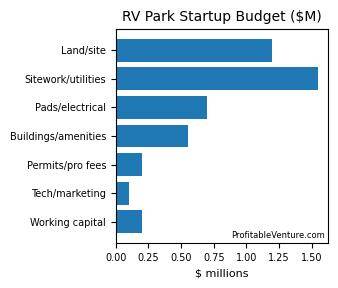
These figures represent planning assumptions for this business plan rather than guaranteed construction quotations.
c. Do You Need to Build a Facility? If YES, How Much will it cost?
Yes. Unlike businesses that can simply lease ordinary retail or office space, Suncrest® RV Park requires specialized infrastructure.
The site will need RV pads, internal roads, drainage systems, electrical pedestals, water connections, sewer infrastructure, lighting, signage, landscaping, office and registration facilities, bathhouses, laundry facilities, and other guest amenities.
Our overall $4.5 million development budget includes approximately $2.8 million allocated to infrastructure, RV sites, buildings, and guest amenities after excluding land acquisition, professional fees, technology, marketing, and working capital.
To reduce risk, construction may be phased, with non-essential premium amenities added after the first phase has established consistent occupancy.
d. What are the Ongoing Expenses for Running an RV Park Business?
- Employee salaries and payroll taxes
- Electricity
- Water and sewer bills
- Internet services
- Waste collection
- Property taxes
- Commercial insurance
- Property and liability insurance
- Workers’ compensation insurance
- Landscaping
- Pool maintenance
- Road repairs
- Electrical-system maintenance
- Plumbing and sewer repairs
- Building maintenance
- Cleaning and housekeeping supplies
- Laundry expenses
- Pest control
- Reservation software
- Merchant processing charges
- Website hosting
- Marketing and advertising
- Security
- Professional services
- License and permit renewals
- Camp-store inventory
- Equipment replacement
- Capital reserves for major repairs.
e. What is the Average Salary of your Staff?
Our estimated annual salaries are:
- Chief Executive Officer – $85,000 Per Year
- General Manager – $70,000 Per Year
- Operations and Guest Services Manager – $55,000 Per Year
- Accountant/Bookkeeper – $45,000 Per Year
- Front Desk/Reservations Officers – $34,000 Per Year
- Maintenance Technicians – $45,000 Per Year
- Groundskeepers – $36,000 Per Year
- Housekeeping/Cleaning Staff – $32,000 Per Year
- Camp Store Attendant – $31,000 Per Year
- Seasonal Recreation Staff – approximately $15 to $22 Per Hour.
Actual compensation will depend on experience, local labor conditions, hours, benefits, and whether positions are full-time or seasonal.
f. How Do You Get Funding to Start an RV Park Business?
- Personal savings
- Equity contributed by founders
- Commercial real-estate loans
- Bank loans
- SBA-backed financing where eligible
- Private investors
- Real-estate investment partners
- Family offices
- Joint ventures with landowners
- Seller financing when acquiring an existing campground
- Private-equity investment
- Construction loans
- Equipment financing
- Loans from family members and friends.
Because RV park projects are real-estate intensive, lenders and investors will usually want to see a feasibility study, detailed development budget, site plan, zoning confirmation, market analysis, projected occupancy, operating assumptions, and evidence that the owners can contribute meaningful equity.
-
Financial Projection
a. How Much Should You Charge for Your Product/Service?
Suncrest® RV Park will use dynamic pricing rather than maintaining one rate throughout the year.
Current competing parks around Central Florida demonstrate that rates vary significantly by season, site type, amenities, and duration.
Orlando/Kissimmee KOA has advertised RV sites starting around $64 per night, while other area properties offer monthly rates ranging from the high hundreds to more than $1,000 depending on season and site type. Our proposed rates are:
Standard Full-Hookup RV Sites
- Daily Rate: $55 – $75 per night
- Weekly Rate: $350 – $475 per week
- Monthly Rate: $850 – $1,150 per month
Premium/Pull-Through RV Sites
- Daily Rate: $75 – $110 per night
- Weekly Rate: $475 – $650 per week
- Monthly Rate: $1,050 – $1,400 per month
Seasonal RV Sites
- Three-Month Package: $3,000 – $4,200
- Six-Month Package: $5,500 – $7,500
Electricity may be separately metered for selected monthly or seasonal reservations.
Vacation Cabins
- Standard Cabin: $120 – $170 per night
- Premium Cabin: $160 – $220 per night
RV and Boat Storage
- Outdoor Storage: $100 – $175 per month
Other Services
- Laundry: Market-based per wash/dry cycle
- Firewood Bundle: $7 – $12
- Bagged Ice: $3 – $6
- Late Checkout: $20 – $40 when available
- Additional Vehicle Parking: $5 – $15 per day
- Selected Recreational Activities: Free or separately priced depending on activity.
Rates will increase during high-demand weekends, holidays, school breaks, major events, and peak winter periods.
b. Sales Forecast?
Based on approximately 70 RV sites, six cabins, gradually improving occupancy, premium-site revenue, seasonal customers, retail sales, storage, and ancillary services, our projected gross sales are:
- First Fiscal Year (FY1): $1,350,000
- Second Fiscal Year (FY2): $1,750,000
- Third Fiscal Year (FY3): $2,250,000
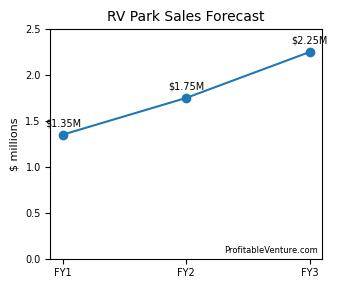
The growth forecast assumes that the business will build online reviews and brand awareness during FY1, improve occupancy and pricing power during FY2, and operate closer to stabilized performance during FY3.
c. Estimated Profit You Will Make a Year?
Our target profit after tax is:
- First Fiscal Year (FY1): 10 Percent
- Second Fiscal Year (FY2): 15 Percent
- Third Fiscal Year (FY3): 20 Percent
At the projected sales levels, this would equal approximately:
- FY1: $135,000
- FY2: $262,500
- FY3: $450,000.
These projections are business-plan assumptions and actual results will depend on debt service, occupancy, average daily rate, insurance costs, property taxes, utility expenses, staffing, maintenance, and other operating factors.
d. Profit Margin of an RV Park Business
The ideal net profit margin we hope to achieve at Suncrest® RV Park, LLC will be approximately 15 to 25 percent once the park reaches stabilized occupancy.
A newly developed RV park may produce a significantly smaller profit during its opening years because marketing expenses, payroll, debt service, depreciation, repairs, and customer-acquisition costs can be high while occupancy is still developing.
Therefore, management will focus heavily on occupancy, average revenue per occupied site, operating expenses, repeat customers, and ancillary revenue rather than simply increasing the number of reservations.
-
Growth Plan
a. How do you intend to grow and expand? By opening more retail outlets/offices or selling a Franchise?
Suncrest® RV Park, LLC intends to grow by developing or acquiring additional RV parks rather than immediately selling franchises.
During the first five years, management will focus on maximizing the profitability of the Kissimmee location.
Expansion may begin once the first park achieves stable occupancy, consistent cash flow, strong customer reviews, standardized operating procedures, and a capable management team.
We will initially look for opportunities to purchase underperforming independent campgrounds that can be renovated, rebranded, and upgraded.
Acquiring an operating campground may sometimes be faster than developing raw land because existing properties may already have roads, utilities, RV pads, buildings, permits, customer history, and established revenue.
After successfully operating multiple company-owned locations, Suncrest® RV Park may evaluate franchising or management agreements as an additional growth strategy.
b. Where do you intend to expand to and why? (Geographical Locations)
Suncrest® RV Park, LLC plans to consider expansion into the following markets:
- Orlando, Florida
- Tampa, Florida
- Fort Myers, Florida
- Daytona Beach, Florida
- St. Augustine, Florida
- Myrtle Beach, South Carolina
- Gatlinburg/Pigeon Forge, Tennessee
- San Antonio, Texas
- Dallas/Fort Worth, Texas
- Phoenix, Arizona.
These markets are attractive because they combine tourism, highway accessibility, warm-weather travel, outdoor recreation, large population centers, snowbird demand, or established RV tourism. We will not automatically expand simply because a city attracts tourists.
Every proposed location will undergo a feasibility study examining land prices, zoning, competition, traffic patterns, tourism demand, seasonality, utility availability, development costs, achievable rates, and projected occupancy.
-
Exit Plan
Suncrest® RV Park, LLC envisions a long-term exit strategy through the potential sale or acquisition of the company or its individual RV park properties.
As the business expands, management will work to build valuable real-estate assets alongside a recognizable hospitality brand.
Potential acquirers may include larger campground operators, outdoor hospitality companies, private-equity firms, real-estate investment groups, family offices, institutional investors, and existing RV resort chains seeking expansion into our markets.
To maximize future valuation, Suncrest® RV Park will maintain accurate financial statements, strong occupancy records, documented operating procedures, well-maintained infrastructure, positive guest reviews, established management systems, and clear property records.
Management may also consider recapitalization, partial sale of ownership interests, or selling individual properties while retaining the Suncrest® brand.
The preferred exit will depend on market conditions and shareholder objectives at the time.
Our ultimate goal will be to build a profitable, well-managed outdoor hospitality business with valuable real estate and dependable recurring revenue so that shareholders have several attractive exit options rather than being forced to sell under unfavorable circumstances.