
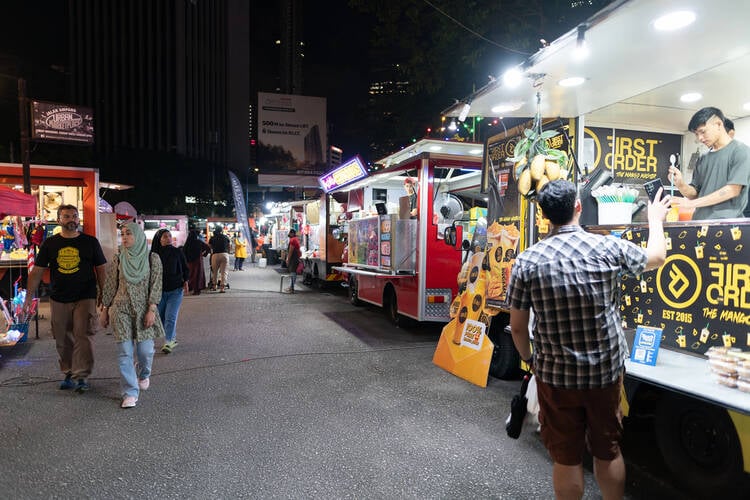
A food truck park is a permanent or semi-permanent outdoor venue where several independently owned food trucks operate from designated spaces while customers share seating, restrooms, lighting, parking, entertainment areas, and other amenities provided by the park operator.
You can think of it as an outdoor food hall. The difference is that instead of building several restaurant kitchens inside one building, you create properly serviced spaces where food trucks can park and operate.
The food truck owners handle their own menus, ingredients, kitchen labor, cooking equipment, and food-business operations.
Your job is to create the location people want to visit and where food truck owners want to operate.
A good park may include eight or ten truck spaces, shaded picnic tables, restrooms, decorative lighting, landscaping, a children’s play area, a small stage, a beverage counter, games, parking, music, and space for private events.
The food trucks may pay you fixed daily or monthly space rent, a percentage of sales, utility fees, or a combination of these.

You can also earn money from an operator-owned beverage stand, event rentals, sponsorships, private parties, vendor markets, parking, entertainment, advertising, and other services.
This means the business is different from owning a food truck. You do not necessarily have to cook food.
Instead, you are operating a combination of commercial real estate, hospitality, entertainment, vendor management, and event space.

The biggest beginner mistake you can make is believing that simply placing six food trucks on an empty lot will automatically create a successful food truck park.
It will not. Customers need a reason to stay. The site has to feel safe, comfortable, clean, and worth visiting even when people have several restaurant alternatives nearby.
At the same time, food truck operators need to believe that the customer traffic you generate is worth the rent they pay you.

If customers do not come, food trucks leave. If food trucks leave, customers have less reason to come. That relationship is the foundation of the entire business.
Steps on How to Start a Food Truck Park Business

-
Conduct Market Research
Your first job is not finding food trucks. Your first job is finding a market capable of supporting a food truck destination. You can start by researching your proposed trade area.
Look for neighborhoods with apartments, offices, universities, breweries, entertainment districts, sports facilities, tourism, family attractions, and active weekend traffic.
Pay attention to when people are actually present. An office district may be packed Monday through Friday at lunchtime but almost empty on Saturday night.
A residential area may perform poorly for weekday lunch but extremely well for Friday evenings and weekends. You should also investigate existing food truck activity.
- Are mobile food vendors already popular in the city?
- Do food trucks struggle to find legal operating locations?
- Are good parking spaces expensive?
- Do customers regularly visit food truck gatherings or breweries that host trucks?
If truck operators already compete heavily for legal, high-traffic spaces, a properly developed park may solve a real problem for vendors. Talk to food truck owners directly.
Ask how much they currently pay for parking or vending locations, what amenities they need, and which problems make a site unattractive. For example, truck owners may want:
- Reliable electrical hookups
- Fresh-water connections where allowed
- Wastewater disposal arrangements
- Strong customer traffic
- Safe overnight parking where permitted
- Restrooms
- Security
- Lighting
- Marketing support
- Reasonable rent
- Predictable operating hours.
You should also research customers. Visit existing food truck parks, food halls, breweries, outdoor markets, and similar gathering places.
Count customers during lunch, dinner, Friday evening, Saturday afternoon, and Sunday. Observe how long people stay.
A food truck park where customers eat and leave after 20 minutes behaves very differently from a destination where families remain for two hours listening to music, buying drinks, and trying several vendors.
Also study weather. An outdoor venue in a very hot, rainy, or cold market needs a strong shade, heating, cooling, or covered-seating strategy.
Weather is not a small operational detail when most of your seating is outdoors.
a. Who is the Target Market for a Food Truck Park?
- Families
- Local residents
- Young professionals
- Office workers
- Students
- Tourists
- Couples looking for casual dining
- Groups of friends
- Parents with children
- Pet owners where the park is pet-friendly
- Corporate groups
- Birthday parties
- Community groups
- Sports fans
- Festival and event customers
- People looking for live music or entertainment
- Customers who want several cuisine choices in one location.
You actually have a second target market as well: food truck operators. Your park needs enough quality vendors to make the customer experience attractive.
That means you must market the property to both diners and truck owners.
b. Is a Food Truck Park a Profitable Business?
Yes, a food truck park can be profitable, but the economics are different from those of an ordinary restaurant.
Food truck space rent alone may not always be enough to support an expensive property.
For example, imagine you have eight food truck spaces and charge $1,000 per month for each. If all eight are occupied, that produces $96,000 per year in pad rent.
That sounds attractive until you consider land rent, employees, utilities, restrooms, insurance, cleaning, maintenance, security, landscaping, advertising, and entertainment.
This is why successful parks often develop several revenue streams.
You may charge pad rent while also earning money from beverages, events, sponsorships, markets, private rentals, parking, utility fees, or percentage-based agreements.
The business becomes particularly interesting when your property is busy enough that trucks are willing to remain long term.
Stable vendors reduce the amount of time you spend trying to fill empty spaces. However, you cannot simply maximize rent.
If you charge so much that truck owners cannot make money, they will eventually leave. A healthy park needs economics that work for both sides.
c. Are There Existing Niches in the Industry?
Yes. A food truck park can be built around several different concepts.
- Family-oriented food truck parks
- Nightlife food truck parks
- International food truck parks
- Food truck parks with live music
- Food truck parks attached to breweries
- Food truck parks with bars
- University food truck parks
- Tourist-area food truck parks
- Dog-friendly food parks
- Food parks with children’s play areas
- Sports-themed food truck parks
- Food truck parks with farmers’ markets
- Food truck parks designed for private events
- Late-night food truck parks
- Drive-through food truck parks
- Mixed food-and-retail vendor parks.
Your niche should make sense for the surrounding community. A family-oriented suburban park might need playground equipment, shade, restrooms, and early-evening programming.
A downtown nightlife park may focus more heavily on music, alcohol where properly licensed, lighting, security, and late-night food.
d. Who are the Major Competitors?
Food truck parks are generally local businesses, so your biggest competitors will usually be within your own city.
Examples of established food truck park concepts in the United States include:
- The Picnic in Austin, Texas
- Thicket Food Park in Austin, Texas
- Area 51 Food Park in San Antonio, Texas
- World Food Trucks in Kissimmee, Florida
- Arbor Food Park in Austin, Texas
- Independent neighborhood food truck courts
- Breweries hosting multiple food trucks
- Food halls
- Outdoor markets
- Restaurant districts
- Entertainment venues with food vendors.
Do not limit competitor research to places called “food truck parks.” If a nearby brewery has seating, music, drinks, games, and three food trucks every weekend, customers may view it as an alternative to your park.
e. Are There County, State, or Federal Regulations for a Food Truck Park in the United States?
Yes, and this is one area where you should investigate carefully before signing a long-term lease or purchasing land.
A food truck park can involve several layers of regulation because you are operating a commercial property where several independent food businesses gather. Your first issue is usually zoning.
Local planning authorities determine whether mobile food vendors can operate on the site, how many may operate, required parking, setbacks, operating hours, landscaping, lighting, noise, signage, and customer seating.
Some jurisdictions treat a collection of food trucks differently from a single truck.
You may need a conditional-use permit, special-use permit, site-plan approval, or another planning approval. Do not assume that a vacant commercial lot automatically qualifies.
Another important issue is utilities. Your local authorities may have requirements governing potable water, electrical hookups, wastewater, grease disposal, trash collection, and restrooms.
Food trucks themselves are normally subject to state and local food-safety requirements.
The FDA Food Code serves as a model used by many jurisdictions to regulate retail food and food-service establishments.
Each truck should have the permits required to operate in your jurisdiction.
Your vendor contract should require trucks to maintain all required permits, insurance, and food-safety approvals throughout the time they operate at the park.
If the park itself sells food or beverages, your business may need separate health permits.
If you operate an alcoholic beverage program, you will need the licenses applicable to your jurisdiction.
You also need to understand where alcohol may be consumed and how the licensed premises are defined.
Live music and outdoor entertainment may trigger noise restrictions or entertainment permits.
Permanent structures such as restrooms, bars, pavilions, decks, stages, and shade structures may require building permits and inspections.
Fire department approval may also be relevant because food trucks may contain propane, generators, grills, fryers, and other cooking equipment.
Accessibility requirements need to be incorporated into parking, paths, restrooms, seating, and other public areas.
Because food truck park requirements can vary dramatically between cities, meet with planning, zoning, building, fire, health, and licensing authorities before finalizing your site.
f. Is There a Franchise for a Food Truck Park?
Food truck parks are still predominantly independent businesses rather than standardized national franchises.
That is partly because the success of the concept depends heavily on local real estate, zoning, weather, food truck supply, customer demographics, and entertainment demand.
You may encounter hospitality, food hall, event venue, or entertainment franchise opportunities that share some characteristics with the model. However, you do not need a franchise to build a food truck park.
For many operators, creating an independent local destination may actually be an advantage because you can choose your own vendors, design, events, pricing, and atmosphere.
g. What Do You Need to Start a Food Truck Park?
- A properly zoned property
- Site plan and feasibility study
- Long-term land lease or owned property
- Food truck parking pads
- Electrical connections where provided
- Water connections where provided
- Wastewater and grease plan
- Restrooms
- Customer parking
- Picnic tables or other seating
- Shade structures
- Lighting
- Trash and recycling facilities
- Security cameras
- Business insurance
- Vendor agreements
- Food truck tenants
- Website and social media
- Entertainment program
- Working capital.
-
Choose a Memorable Business Name
Your business name should sound like a destination rather than simply a parking lot.
People should feel that they are visiting somewhere they can eat, relax, meet friends, and spend time.
Before committing to a name, check your state’s business database and investigate potential trademark conflicts. Some food truck park business name ideas are:
- Truck Yard Social, LLC
- Flavor Park Food Trucks, LLC
- The Rolling Table Food Park, LLC
- Street Feast Park, LLC
- Fork Yard Food Park, LLC
- Gather & Grub Food Park, LLC
- Truckside Social, LLC
- Flavor Lane Food Park, LLC
- The Food Truck Commons, LLC
- Rolling Kitchens Park, LLC
- Open Table Food Park, LLC
- Fork & Field Food Park, LLC
- Street Kitchen Yard, LLC
- Truck Town Food Park, LLC
- The Hungry Yard, LLC
- Community Fork Food Park, LLC
- Food Lane Social, LLC
- Urban Truck Garden, LLC
- Gathering Grounds Food Park, LLC
- The Mobile Kitchen Yard, LLC.
-
Register Your Business
a. What Type of Business Structure is Best for a Food Truck Park?
Many operators choose a limited liability company. An LLC can provide separation between the owner’s personal affairs and the park’s operations while remaining relatively flexible.
However, this business involves customers, vehicles, food vendors, structures, entertainment, and potentially alcohol.
You should therefore combine an appropriate business structure with substantial insurance and properly drafted contracts.
If you purchase the property, you may also want professional advice about whether the real estate should be owned by a separate entity and leased to the operating company.
b. Steps to Form an LLC
- Choose an available business name
- File LLC formation documents
- Choose a registered agent
- Create an operating agreement
- Obtain an EIN where required
- Register for state and local taxes
- Open a business bank account
- Obtain zoning and site approvals
- Apply for required licenses and permits
- Purchase insurance
- Maintain annual filings.
c. What Type of License is Needed to Start a Food Truck Park?
Depending on your city and business model, you may need:
- General business license
- Zoning approval
- Conditional-use or special-use permit
- Site-plan approval
- Building permits
- Certificate of occupancy
- Fire department approval
- Food establishment permit if the park sells food or beverages
- Alcohol license where applicable
- Entertainment permit where applicable
- Sign permit
- Outdoor seating approval
- Special-event permits
- Sales-tax registration
- Employer registrations.
Individual food truck vendors should also maintain the mobile-food permits required by the relevant jurisdiction.
d. What Type of Certification is Needed to Start a Food Truck Park?
There is no single national certification required specifically to own a food truck park. Useful training can include:
- Food safety management
- Alcohol-service training where applicable
- First aid and CPR
- Event safety training
- Fire-safety training
- Crowd-management training
- Hospitality management
- Property-management training.
e. What Documents are Needed to Start a Food Truck Park?
- Business formation documents
- EIN where applicable
- Property deed or commercial lease
- Zoning approval
- Site plans
- Building permits
- Certificate of occupancy
- Insurance policies
- Vendor pad agreements
- Park rules
- Vendor insurance certificates
- Vendor food permits
- Utility agreements
- Maintenance contracts
- Waste and grease-disposal agreements
- Alcohol licensing documents where applicable
- Entertainment permits where applicable
- Private-event contracts
- Employee records.
f. Do You Need a Trademark, Copyright, or Patent?
You normally do not need a patent. A trademark may protect your park name, logo, slogan, or branded event series.
Copyright can protect original website content, event photographs, advertising materials, graphics, maps, and videos.
If the park becomes a recognizable destination, the brand itself can become one of your most valuable assets.
-
Cost Analysis and Budgeting
a. How Much Does It Cost to Start a Food Truck Park?
The cost can vary enormously depending on whether you already control a suitable lot or are building a full destination venue from undeveloped land.
A relatively simple food truck park using leased land, gravel parking, several pads, portable or existing restroom facilities, basic seating, lighting, and limited amenities may require approximately $75,000 to $175,000.
A medium-scale permanent park with improved parking, utility hookups, restrooms, shade, landscaping, lighting, seating, a beverage pavilion, and professional site development may require approximately $250,000 to $500,000.
A large destination food truck park with extensive construction, permanent buildings, entertainment facilities, a substantial bar, elaborate landscaping, children’s areas, large parking lots, and several truck pads may require approximately $700,000 to $1.5 million or more.
For this guide, we will use:
- Small-scale food truck park: approximately $125,000
- Medium-scale food truck park: approximately $350,000
- Large-scale food truck park: approximately $900,000.
These budgets exclude purchasing the land. If you buy a valuable commercial parcel, the real estate alone could cost more than the entire park development.
b. What are the Costs Involved in Starting a Food Truck Park?
Small-Scale Food Truck Park – Approximately $125,000
- Lease deposit and initial site work – $30,000
- Food truck pads and basic utility improvements – $25,000
- Restrooms and sanitation facilities – $15,000
- Seating, umbrellas, and shade – $12,000
- Lighting, signage, fencing, and security – $10,000
- Permits, engineering, legal, and professional fees – $8,000
- Initial marketing and launch events – $5,000
- Working capital – $20,000
- Estimated Total – $125,000.
This model may work for a smaller neighborhood park with approximately four to six truck spaces.
Medium-Scale Food Truck Park – Approximately $350,000
- Site preparation, parking, drainage, and landscaping – $75,000
- Eight food truck pads, electrical service, and utility infrastructure – $80,000
- Permanent restrooms, seating, shade structures, and shared amenities – $60,000
- Beverage and concessions pavilion – $40,000
- Lighting, security, fencing, signage, and entertainment infrastructure – $25,000
- Zoning, permits, architecture, engineering, legal, and professional fees – $20,000
- Working capital reserve – $35,000
- Branding, website, truck recruitment, and grand-opening marketing – $15,000
- Estimated Total – $350,000.
This is the model used for our financial projection.
Large-Scale Food Truck Park – Approximately $900,000
- Major site work, parking, drainage, and landscaping – $210,000
- Truck pads and utility infrastructure – $150,000
- Permanent restrooms and customer facilities – $100,000
- Large covered seating and pavilion areas – $100,000
- Beverage/bar structure and equipment – $90,000
- Stage, entertainment equipment, games, and family amenities – $60,000
- Lighting, security, fencing, and signage – $50,000
- Architecture, engineering, permits, and professional fees – $50,000
- Working capital – $60,000
- Marketing, vendor recruitment, and launch – $30,000
- Estimated Total – $900,000.
c. What Factors Determine the Cost of Starting a Food Truck Park?
- Land price or lease cost
- Site condition
- Number of truck spaces
- Paving requirements
- Drainage
- Electrical infrastructure
- Water and sewer availability
- Restrooms
- Parking requirements
- Shade structures
- Bar or beverage facilities
- Entertainment equipment
- Building-code requirements
- Zoning requirements
- Landscaping
- Working capital.
d. Do You Need to Build a Facility? If YES, How Much Will It Cost?
You do not necessarily need a conventional building. However, a serious permanent food truck park usually needs more infrastructure than an empty lot.
At minimum, customers need comfortable seating, lighting, restrooms, trash disposal, and safe access.
Your city may also require paved parking, accessible paths, permanent restroom facilities, landscaping, drainage improvements, or other site work.
An existing commercial site can dramatically reduce startup costs if it already has utilities, parking, restrooms, and zoning compatible with your plan.
For this reason, a former restaurant, bar, entertainment venue, or other commercial property with excess outdoor land can sometimes be easier to convert than a completely undeveloped parcel.
e. What are the Ongoing Expenses of a Food Truck Park?
- Land rent or mortgage
- Property taxes where applicable
- Employee wages
- Utilities
- Trash removal
- Grease and wastewater management
- Restroom cleaning
- Landscaping
- Security
- Insurance
- Repairs and maintenance
- Lighting
- Entertainment
- Marketing
- Event expenses
- Alcohol or beverage inventory where applicable
- Payment-processing fees
- Software
- Licenses and permit renewals
- Accounting
- Professional fees.
f. What is the Average Salary of Your Staff?
Compensation depends heavily on your city and the scope of the venue. A medium or large food truck park may employ:
- General Manager
- Operations Manager
- Vendor Coordinator
- Event Coordinator
- Beverage Manager
- Bartenders where applicable
- Customer Service Staff
- Security Personnel
- Cleaning and Maintenance Staff
- Marketing Coordinator
- Bookkeeper.
A small operation may combine several of these positions. Research current local wage rates before creating your payroll budget.
g. How Do You Get Funding to Start a Food Truck Park?
- Personal savings
- Commercial real estate financing
- Small-business loans
- Private investors
- Business partners
- Property-owner joint ventures
- Equipment financing
- Business lines of credit
- Local development incentives where available
- Landlord improvement allowances
- Phased development.
Phased development can be particularly useful. You might open with six truck spaces and basic amenities before adding a permanent bar, stage, children’s area, or additional pads after customer demand has been proven.
a. Executive Summary
Gather & Grub Food Park, LLC is a proposed food truck and entertainment venue based in San Antonio, Texas.
The business will operate an approximately eight-pad food truck park featuring a curated mix of independent mobile food vendors.
The park will provide food truck operators with designated spaces, electrical infrastructure, customer seating, restrooms, parking, lighting, security, shared marketing, and a predictable operating environment.
Customers will have access to multiple cuisine options in one destination along with covered seating, games, weekend entertainment, and an operator-managed beverage pavilion.
The park will serve families, young professionals, local residents, office workers, tourists, students, and event groups.
Gather & Grub Food Park will launch using approximately $350,000 in startup capital, excluding land purchase.
The business will earn revenue from food truck pad fees, beverage and concession sales, private events, sponsorships, markets, utility charges where appropriate, and other venue income.
Management will deliberately curate the truck lineup to avoid excessive menu duplication.
The goal is to create complementary choices such as tacos, barbecue, burgers, Asian cuisine, desserts, pizza, coffee, and specialty foods rather than filling the park with several trucks offering almost identical menus.
The long-term objective is to establish a profitable local destination and gradually add additional programming, sponsorships, private events, and truck spaces as customer demand increases.
b. Products and Services
Gather & Grub Food Park, LLC will provide:
- Food truck pad rentals
- Daily and monthly vendor spaces
- Electrical hookups
- Shared customer seating
- Restrooms
- Vendor marketing
- Beverage sales
- Non-alcoholic refreshments
- Alcoholic beverages where appropriately licensed
- Live entertainment
- Private-event rentals
- Birthday-event space
- Corporate gatherings
- Vendor markets
- Holiday events
- Advertising and sponsorship opportunities.
c. Mission Statement
“At Gather & Grub Food Park, LLC, our mission is to create a welcoming community destination where independent food businesses can thrive and customers can enjoy great food, comfortable outdoor dining, entertainment, and memorable shared experiences.”
Vision Statement
“Our vision is to build Gather & Grub Food Park into one of the area’s most trusted outdoor dining and entertainment destinations while providing independent food truck entrepreneurs with a stable environment in which to grow their businesses.”
d. Goals and Objectives
The first objective is to maintain high food truck occupancy. An empty food truck pad produces little revenue and makes the park appear less active to customers.
The company will recruit a core group of reliable vendors while keeping one or two spaces available for rotating guest trucks.
Another objective is to build a balanced food lineup. The park does not need four taco trucks competing for the same customer.
Management will prioritize complementary cuisines so groups can visit knowing everyone can find something they want. The company will also create a strong event calendar.
Weekly programming may include live music, trivia, family nights, sports watch parties, vendor markets, seasonal celebrations, and community events.
The long-term objective is to increase both truck occupancy and customer dwell time.
When customers remain longer, they may purchase meals from more than one truck, buy beverages, and return for entertainment rather than visiting only when they are hungry.
e. Organizational Structure
- Owner/General Manager
- Operations Manager
- Vendor Relations Coordinator
- Event Coordinator
- Beverage Manager
- Beverage Staff
- Customer Service Staff
- Security Personnel
- Cleaning/Maintenance Staff
- Marketing Coordinator
- Bookkeeper/Accountant.
Marketing Plan
a. SWOT Analysis
Strengths
The park provides customers with several food choices in one location without the operator having to manage several restaurant kitchens.
The business can also create recurring revenue from vendor spaces. Events, beverages, sponsorships, and private bookings create additional revenue opportunities.
Weaknesses
The business depends on both vendors and customers. If strong food trucks leave, customer traffic may decline.
If customer traffic declines, additional trucks may leave. The business is also vulnerable to outdoor weather and can have significant real-estate costs.
Opportunities
Opportunities include live entertainment, corporate events, private parties, farmers’ markets, artisan markets, sports watch parties, sponsorships, children’s activities, beverage programs, and seasonal festivals.
A successful park may also increase the value and visibility of previously underutilized commercial land.
Threats
Threats include rising land rent, zoning changes, food truck turnover, bad weather, nearby restaurant competition, noise complaints, insurance costs, security incidents, liquor-license issues, and customer traffic declining after the novelty wears off.
b. How Do Food Truck Parks Make Money?
A food truck park can generate revenue from several sources:
- Daily food truck pad fees
- Monthly food truck rent
- Percentage-of-sales agreements
- Utility fees
- Beverage sales
- Alcohol sales where properly licensed
- Private events
- Birthday parties
- Corporate events
- Vendor market fees
- Sponsorships
- Advertising
- Parking fees where appropriate
- Merchandise
- Holiday events.
One common vendor-fee structure is a fixed pad rental. Depending on the city, customer traffic, utility package, and amenities, food truck spaces may be rented for a few hundred dollars per month to $2,000 or more in stronger locations.
Another option is a smaller fixed fee plus a percentage of sales. You should avoid setting fees based only on what you want to earn.
Talk to food truck operators and understand how much revenue they realistically need to generate for the location to remain worthwhile.
c. Payment Options
- Credit cards
- Debit cards
- ACH payments from vendors
- Online invoices
- Recurring vendor billing
- Event deposits
- Corporate invoices
- Digital wallets.
d. Sales and Advertising Strategies
- Create a regularly updated truck lineup online
- Use Instagram and TikTok
- Maintain a Google Business Profile
- Publish weekly event calendars
- Promote individual truck operators
- Host live music
- Create family nights
- Host trivia
- Host local markets
- Partner with apartment communities
- Work with local employers
- Create corporate event packages
- Partner with nearby hotels
- Offer birthday packages
- Create sports watch parties
- Use local influencers selectively
- Partner with tourism organizations
- Create loyalty promotions
- Offer rotating guest-truck weekends.
Do not market only the individual food trucks. You want customers to become loyal to the park itself. That way, if one vendor changes, customers still have a reason to return.
Financial Projection
a. How Much Should You Charge Food Trucks to Park?
Your fee should reflect the value of the location. A truck parked on an empty gravel lot with no electricity or customers should not pay the same amount as a truck receiving utilities, restrooms, seating, security, marketing, events, and strong customer traffic.
Possible structures include:
- Daily pad fee: useful for rotating vendors and special events
- Monthly fixed rent: useful for permanent vendors
- Percentage of sales: aligns your revenue with vendor performance
- Base rent plus percentage: provides predictable income plus upside
- Utility fee: useful when the park supplies meaningful electricity, water, or waste services.
As a broad planning example, a permanent truck space might command approximately $500 to $2,000 per month, depending on the market and amenities.
High-traffic sites can command more. Your own market research should determine the actual price.
b. How Much Revenue Can a Food Truck Park Generate?
Revenue varies dramatically because some parks earn mainly from pad rent while others operate substantial beverage, event, and entertainment businesses.
For planning purposes:
- Small neighborhood food truck park: approximately $150,000 to $300,000 in annual gross revenue
- Medium destination food truck park: approximately $400,000 to $700,000
- Large food and entertainment park: approximately $800,000 to $1.5 million or more.
These are planning estimates rather than guaranteed results. The financial projection below uses the $350,000 medium-scale eight-pad park.
Year 1 assumes approximately $450,000 in total revenue from vendor fees, beverage/concession sales, events, sponsorships, and other park income.
c. Five-Year Revenue and Profit Projection
| Fiscal Year | Revenue | Total Expenses | Net Profit | Net Margin |
|---|---|---|---|---|
| Year 1 | $450,000 | $414,000 | $36,000 | 8.0% |
| Year 2 | $540,000 | $490,000 | $50,000 | 9.3% |
| Year 3 | $650,000 | $580,000 | $70,000 | 10.8% |
| Year 4 | $780,000 | $686,000 | $94,000 | 12.1% |
| Year 5 | $930,000 | $806,000 | $124,000 | 13.3% |
Under this illustrative model, cumulative five-year revenue would be approximately $3.35 million, while cumulative projected net profit would be approximately $374,000.
d. Sample Five-Year Profit and Loss Projection
| Item | Year 1 | Year 2 | Year 3 | Year 4 | Year 5 |
|---|---|---|---|---|---|
| Revenue | $450,000 | $540,000 | $650,000 | $780,000 | $930,000 |
| Land Lease and Property Costs | $84,000 | $88,000 | $92,000 | $96,000 | $101,000 |
| Payroll and Staff Costs | $105,000 | $125,000 | $150,000 | $177,000 | $205,000 |
| Beverage and Concession Cost of Goods | $65,000 | $78,000 | $95,000 | $114,000 | $136,000 |
| Utilities, Trash and Restrooms | $32,000 | $38,000 | $45,000 | $52,000 | $60,000 |
| Insurance, Licenses and Permits | $15,000 | $17,000 | $19,000 | $21,000 | $23,000 |
| Maintenance, Landscaping and Security | $24,000 | $28,000 | $33,000 | $39,000 | $45,000 |
| Marketing and Programming | $26,000 | $31,000 | $36,000 | $42,000 | $48,000 |
| Payment Processing, Software and Administration | $18,000 | $22,000 | $26,000 | $31,000 | $36,000 |
| Entertainment and Private Event Costs | $20,000 | $25,000 | $30,000 | $35,000 | $40,000 |
| Other Operating Expenses and Reserves | $25,000 | $38,000 | $54,000 | $79,000 | $112,000 |
| Total Expenses | $414,000 | $490,000 | $580,000 | $686,000 | $806,000 |
| Projected Net Profit | $36,000 | $50,000 | $70,000 | $94,000 | $124,000 |
e. How Much Profit Do Food Truck Park Owners Make a Year?
There is no fixed amount. A small landowner who already owns the property and simply rents several pads may have very different economics from a heavily financed entertainment venue with employees and a full beverage operation.
Under the medium-scale model in this guide, projected business profit begins at approximately $36,000 in Year 1 and grows toward approximately $124,000 in Year 5.
The owner’s personal income will depend on debt service, salary, distributions, taxes, and reinvestment.
f. What Factors Determine the Amount of Profit to Be Made?
- Food truck occupancy
- Pad rental rates
- Customer traffic
- Land cost
- Beverage sales
- Private events
- Sponsorships
- Entertainment costs
- Weather
- Operating hours
- Payroll
- Utility expenses
- Security
- Vendor turnover
- Customer dwell time
- Event programming
- Parking availability.
g. What is the Profit Margin of a Food Truck Park?
Margins differ substantially depending on whether the operator earns mainly from pad rent or operates additional food, beverage, and entertainment services. Calculate your own using:
Net Profit Margin = Net Profit ÷ Total Revenue × 100.
The medium-scale model used here starts at approximately 8% and improves toward approximately 13%.
This should be treated as an illustrative business-planning target rather than an industry guarantee.
h. What is the Sales Forecast?
- First Fiscal Year: $450,000
- Second Fiscal Year: $540,000
- Third Fiscal Year: $650,000
- Fourth Fiscal Year: $780,000
- Fifth Fiscal Year: $930,000.
-
Set Up Your Food Truck Park
a. How Do You Choose a Perfect Location for a Food Truck Park?
A strong food truck park location should have enough population and traffic to create repeat visits but enough space for vehicles, trucks, seating, restrooms, and customer circulation. Consider:
- Zoning – Confirm the use is allowed before committing.
- Population density – Nearby residents can create regular business.
- Office population – Useful for lunch traffic.
- Visibility – Customers should be able to find the park easily.
- Parking – Poor parking can limit the number of customers you can serve.
- Road access – Trucks and customers need safe entrances and exits.
- Utilities – Electrical, water, and sewer access can reduce development costs.
- Noise sensitivity – Live music near residential neighbors can create problems.
- Weather – Shade and rain protection may be essential.
- Land cost – The property must be affordable enough for the business model.
Do not choose a location simply because the land is cheap. Cheap land without customers can become very expensive once you spend hundreds of thousands of dollars developing it.
b. What State and City is Best to Start a Food Truck Park?
There is no universally best city, but cities with established food truck cultures can make vendor recruitment and customer education easier. Markets worth researching include:
- Austin, Texas
- Houston, Texas
- San Antonio, Texas
- Dallas-Fort Worth, Texas
- Portland, Oregon
- Orlando and Kissimmee, Florida
- Atlanta, Georgia
- Nashville, Tennessee
- Phoenix, Arizona
- Charlotte, North Carolina.
Do not interpret this as a guarantee that a food truck park will succeed in those cities.
Real estate, zoning, competition, neighborhood demographics, vendor supply, and weather should determine your final decision.
c. What Equipment is Needed to Operate a Food Truck Park?
- Food truck utility pedestals
- Electrical distribution equipment
- Water connections where applicable
- Wastewater infrastructure
- Trash and recycling containers
- Grease disposal facilities where appropriate
- Picnic tables
- Outdoor chairs
- Shade structures
- Umbrellas
- Exterior lighting
- Security cameras
- Public restrooms
- Handwashing facilities where required
- Outdoor heaters or fans where appropriate
- Stage or entertainment equipment
- Sound system
- Televisions where appropriate
- Games
- Point-of-sale equipment for park-operated sales
- Beverage refrigeration
- Office equipment
- Cleaning equipment
- Landscaping equipment.
-
Hire Employees
The food truck operators bring their own food employees. You are hiring people to operate the park itself.
A smaller venue may need only a manager, cleaning staff, and part-time event employees.
A larger operation with beverages and entertainment may require considerably more staff. Train employees on:
- Customer service
- Vendor communication
- Park rules
- Emergency procedures
- Security
- Restroom inspections
- Trash management
- Alcohol compliance where applicable
- Event operations
- Weather procedures
- Incident reporting.
Your vendor coordinator is particularly important. Food truck owners are not your employees.
They are independent businesses operating inside the ecosystem you manage.
Your relationship needs to remain professional and clearly governed by written agreements.
-
Launch the Business Proper
Do not open with only two trucks parked on a property designed for eight. The site will feel empty, and early customers may decide the park does not have enough choice.
So recruit a strong opening lineup first. You should also test the site before holding a major grand-opening event.
Invite friends, neighbors, local business owners, and community groups for a smaller soft opening. Observe:
- Where cars become congested
- Whether parking is adequate
- Whether customers understand the layout
- Whether electrical connections work properly
- Whether restrooms remain clean
- Whether lines block pedestrian paths
- Whether trash cans fill too quickly
- Whether lighting is adequate after dark
- Whether music creates complaints
- Whether customers have enough seating.
Fix those problems before advertising a huge opening weekend. Then launch with a schedule rather than one event. Give customers a reason to come back the following week.
a. What Makes a Food Truck Park Successful?
- Strong vendors – Your food truck lineup is the heart of the customer experience.
- Menu variety – Avoid too many trucks selling the same thing.
- Comfortable seating – Customers should want to stay.
- Clean restrooms – Small details strongly affect perception.
- Shade and weather protection – Especially important in outdoor venues.
- Good parking – Customers will leave if parking is too difficult.
- Events – Programming gives customers reasons to return.
- Vendor economics – Trucks need to make money too.
- Strong branding – Build loyalty to the park rather than only individual trucks.
- Security – Customers and vendors need to feel safe.
- Good maintenance – Outdoor venues can deteriorate quickly if neglected.
b. What Happens During a Typical Day at a Food Truck Park?
A typical day may begin before the trucks open. Employees inspect restrooms, trash areas, seating, lighting, landscaping, security, and utility connections.
Food trucks begin arriving or opening their service windows. The vendor coordinator confirms which trucks are operating and updates the website or social media lineup.
During lunch or dinner, customers enter the property, choose from several trucks, and use the common seating area.
Park employees clean tables, monitor trash, answer questions, inspect restrooms, manage parking problems, and operate park-owned beverage facilities where applicable.
If there is an event that evening, staff prepare the stage or event area. Security may arrive before larger crowds. The manager monitors customer volume and speaks with truck operators.
If one truck repeatedly fails to open during required hours or another produces long service delays, management may need to address the problem.
After closing, employees clean the park, inspect the property, secure park facilities, check trash, and prepare for the following day.
The owner or manager may still need to recruit trucks, answer event inquiries, negotiate vendor agreements, market upcoming programs, process payments, pay bills, and review financial performance.
c. What Skills and Experience Do You Need to Build a Food Truck Park?
- Property management – You are operating a commercial site.
- Vendor management – Multiple independent businesses need to work together.
- Hospitality – The customer experience matters.
- Event management – Programming can become a major traffic driver.
- Financial management – Real estate and infrastructure costs can be substantial.
- Marketing – The park has to remain a destination after opening-day excitement fades.
- Negotiation – Important for vendors, landlords, entertainers, and sponsors.
- Operations – Restrooms, trash, utilities, security, parking, and maintenance have to work every day.
- Community relations – Noise and traffic can affect neighbors.
- Leadership – Employees and vendors need clear rules.
You do not have to have owned a restaurant or food truck before starting a food truck park. However, you should understand the businesses your tenants operate.
- Spend time talking with food truck owners.
- Learn what they earn on a good day and what destroys their profitability.
- Visit food truck parks at different times of the week.
- Count customers.
- Observe empty pads.
- Watch parking.
- Use the restrooms.
- See whether customers stay after eating.
- Study how the park changes after dark.
Most importantly, remember that you are not simply renting pieces of pavement.
You are building a destination where independent food businesses and customers both need to succeed.
If you choose the right site, create comfortable amenities, recruit strong vendors, keep the park clean and safe, develop multiple revenue streams, and continually give customers reasons to return, you can build a profitable food truck park even if you started with no previous hospitality experience.