

A smartphone repair business diagnoses and repairs damaged or malfunctioning mobile phones for individuals, businesses, schools, delivery drivers, professionals, and other customers who would rather repair a device than replace it.
Your services can include cracked-screen replacement, battery replacement, charging-port repair, back-glass replacement, camera repair, speaker and microphone replacement, button repair, water-damage diagnostics, software troubleshooting, data-transfer assistance, and more advanced motherboard or microsoldering work.
You can also make additional money selling:
- Phone cases
- Screen protectors
- Chargers
- Cables
- Power banks
- Earbuds
- Refurbished smartphones
- Device protection accessories.
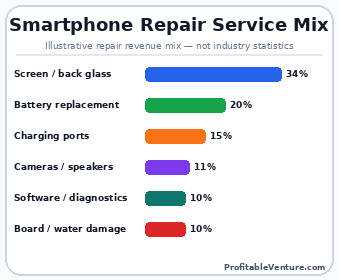
The attraction is easy to understand. A customer may own a smartphone worth $800 or $1,200 but have a broken screen, weak battery, or damaged charging port.
Paying $120 or $200 to restore that phone can make much more sense than immediately replacing the entire device.
The business also has relatively modest infrastructure requirements compared with many retail businesses.
You do not need a 10,000-square-foot shop. A clean 500- to 1,000-square-foot storefront with a reception counter, repair benches, secure parts storage, good lighting, cameras, and the proper tools can support a substantial repair operation.
The difficult part is trust. Customers are handing you devices containing photographs, banking apps, emails, business information, passwords, personal conversations, and sometimes their entire digital lives.
- One dishonest employee can destroy your reputation.
- One careless technician can turn a $120 screen repair into a $900 replacement claim.
That means your real product is not simply technical repair. You are selling skill, trust, speed, transparency, and accountability.
The business can be highly attractive once you develop a reputation for doing repairs correctly the first time.
A good customer may initially visit because of a broken screen. Six months later, the same customer may return for a battery. Then his spouse needs a charging port.
His business may eventually send you 20 company phones. This is how a repair shop gradually develops recurring value.
Steps on How to Start a Smartphone Repair Business
-
Conduct Market Research
Your market research should begin with the phones people actually use in your area.
Do not spend thousands of dollars stocking screens for models your customers rarely own. Visit competing repair shops. Look at:
- Brands they service
- Screen replacement prices
- Battery prices
- Turnaround times
- Warranty periods
- Customer reviews
- Opening hours
- Accessories sold
- Whether repairs are performed while customers wait
- Whether they offer mail-in or pickup service.
Pay particular attention to customer complaints. Common complaints about repair shops can include:
- The replacement screen was poor quality
- The phone came back with another problem
- The quoted price suddenly increased
- The technician took too long
- The shop stopped answering calls
- The repair failed several days later
- Customer data was accessed
- A replacement part was not what the customer expected.
Each complaint reveals a possible way to differentiate your business. You could offer written quotes, clearly defined parts-quality options, before-and-after device inspection, repair warranties, automated status updates, and documented privacy procedures.
You should also count competitors within approximately a three- to five-mile radius of your proposed storefront. Then visit nearby:
- Shopping centers
- Universities
- Office districts
- Apartment communities
- Transit stations
- Electronics stores
- Mobile carrier stores.
A repair store benefits from locations where people already carry smartphones throughout the day.
a. Who is the Target Market for a Smartphone Repair Business?
- iPhone owners
- Samsung Galaxy owners
- Google Pixel owners
- Motorola owners
- Other Android smartphone users
- Students
- College students
- Working professionals
- Parents
- Delivery drivers
- Rideshare drivers
- Small-business owners
- Schools
- Restaurants
- Construction companies
- Real-estate companies
- Companies maintaining employee smartphones.
Business-to-business work deserves particular attention. Repairing one employee’s phone is useful.
Becoming the preferred repair company for a plumbing business with 40 technicians, a delivery company with 70 drivers, or a school with hundreds of devices can create recurring work.
b. Is a Smartphone Repair Business Profitable?
Yes, a smartphone repair business can be profitable because customers are paying for both the replacement part and your technical skill.
Consider a simplified example. Suppose a screen assembly, adhesive, and other consumables cost you $65.
You charge $145 for the completed repair. Your gross contribution before overhead would be approximately:
$145 − $65 = $80.
That $80 still needs to contribute toward:
- Technician wages
- Rent
- Insurance
- Utilities
- Card fees
- Marketing
- Warranty callbacks
- Tools
- Taxes.
This is why you should not judge profitability by markup on the part alone. Some repairs also produce better margins than others. Battery replacement can be relatively fast for an experienced technician.
A difficult motherboard repair may command a higher price but consume hours of technician time. The useful metric is:
Gross Profit per Technician Hour.
If one repair produces $70 of gross profit in 30 minutes and another produces $80 after three hours of bench work, they are not equally attractive.
c. What Niches Exist in Smartphone Repair?
You can specialize in:
- iPhone repair
- Samsung repair
- Android repair
- Screen replacement
- Battery replacement
- Back-glass repair
- Charging-port repair
- Water-damage diagnosis
- Microsoldering
- Board-level repair
- Camera repair
- Speaker and microphone repair
- Software troubleshooting
- Business fleet repair
- Mobile/on-site phone repair
- Mail-in repair
- Refurbished phone repair and resale.
A beginner does not need to offer every repair immediately. It may be wiser to become excellent at the most common repairs first. For example:
- Screens
- Batteries
- Charging ports
- Speakers
- Cameras
- Basic diagnostics.
You can then add microsoldering once you have the equipment and technical expertise.
d. Who are the Major Competitors?
Your competitors can include:
- uBreakiFix by Asurion
- CPR Cell Phone Repair
- Batteries Plus repair locations
- Apple Stores and authorized providers
- Samsung authorized service providers
- Carrier-store repair partners
- Independent local phone repair shops
- Mobile repair technicians
- Mail-in repair companies.
You do not need to beat large repair networks at everything. An independent shop can compete through:
- Faster turnaround
- Better personal service
- Convenient location
- Competitive pricing
- Transparent parts options
- Specialized board repair
- Pickup and delivery
- Business accounts.
e. Are There County, State, or Federal Regulations?
There is no single federal smartphone-repair license covering every U.S. repair business.
Your requirements will generally depend on your state, county, city, and services. You may need:
- General business license
- Sales-tax registration
- Seller’s permit
- Resale certificate
- Certificate of occupancy
- Sign permit
- Employer registrations
- Secondhand-dealer license if buying used phones in some jurisdictions
- Electronic-waste handling compliance
- Battery disposal procedures.
Right-to-repair laws in some states may also affect access to parts, tools, diagnostic information, and required customer disclosures. Check the rules that apply in the state where you operate.
Customer Data and Privacy
Privacy should become part of your operating procedure. Your technicians may work on devices containing extremely sensitive information. Develop a written policy covering:
- When a device password is genuinely required
- Who may access customer devices
- What diagnostic access is permitted
- How passwords are recorded and destroyed
- Whether customers should enable a maintenance or repair mode where supported
- How customer backups are handled
- How abandoned devices are handled
- How removed storage components are destroyed or returned.
Technicians should never browse customer photographs, messages, financial applications, or files simply because they can. You are repairing the phone—not investigating the customer’s life.
f. Can You Become an Authorized or Manufacturer-Supported Repair Provider?
Possibly. Some manufacturers operate authorized-service or independent-repair programs that can provide qualifying businesses with access to genuine parts, repair documentation, diagnostic resources, training, or specialized tools.
These programs can impose requirements involving:
- Business premises
- Technician certification
- Repair procedures
- Parts handling
- Audits
- Brand standards.
You do not necessarily need manufacturer authorization to operate an independent repair business.
However, you should never advertise yourself as “authorized” by a manufacturer unless you genuinely have that authorization.
g. What Do You Need to Start?
- Repair skills
- Business registration
- Repair workbench
- Precision screwdriver sets
- Opening tools
- Heat mat or heating equipment
- Microscope
- Soldering station
- Hot-air rework station
- Multimeter
- DC power supply
- Battery testing equipment
- ESD protection
- Screen separator where appropriate
- Adhesives
- Replacement parts
- POS system
- Repair-ticket software
- Security cameras
- Insurance
- Working capital.
-
Choose a Memorable Business Name
Your name should communicate speed, technology, repair, reliability, or device care without misleading customers into believing you are an authorized manufacturer location.
Some smartphone repair business name ideas are:
- FixPoint Smartphone Repair, LLC
- SmartFix Device Repair, LLC
- Phone Rescue Lab, LLC
- QuickFix Mobile Repair, LLC
- Device Doctor Repair, LLC
- ScreenWorks Repair, LLC
- PhoneLab Repair Center, LLC
- Smartphone Medic, LLC
- Restore Mobile Repair, LLC
- DeviceCare Repair Center, LLC
- PhoneRevive, LLC
- RepairHub Mobile, LLC
- Screen Rescue, LLC
- TechFix Mobile Repair, LLC
- Mobile Revival Repair, LLC
- Device Renew, LLC
- PhoneWorks Repair, LLC
- Smart Device Clinic, LLC
- Phone Restore Center, LLC
- Rapid Device Repair, LLC.
Check business-name availability and possible trademark conflicts before purchasing signs or registering a domain.
-
Register Your Business
a. What Business Structure is Best?
An LLC is commonly suitable for an independent smartphone repair shop. It provides a formal business structure while remaining relatively straightforward to manage.
However, forming an LLC does not eliminate the need for insurance. Your business can potentially face claims involving:
- Damaged phones
- Lost devices
- Lost customer data
- Battery fires
- Employee theft
- Customer injuries
- Property theft.
b. Steps to Form an LLC
- Choose an available business name
- File Articles of Organization
- Select a registered agent
- Create an operating agreement
- Obtain an EIN
- Register for sales taxes
- Obtain a resale certificate where applicable
- Open a business bank account
- Purchase insurance
- Maintain required annual filings.
c. What Licenses are Needed?
You may need:
- General business license
- Sales-tax permit
- Seller’s permit
- Resale certificate
- Certificate of occupancy
- Sign permit
- Secondhand dealer permit if purchasing/reselling used devices where required
- Employer registrations.
d. What Certifications are Needed?
You normally do not need one universal professional certification simply to open an independent phone repair shop.
However, training and credentials can strengthen your technical capability. Useful areas include:
- Manufacturer repair certification where available
- Wireless-device repair certification
- Microsoldering training
- Electronics soldering
- ESD safety
- Lithium-ion battery safety
- Data privacy
- Workplace safety.
More important than collecting certificates is being able to perform repairs without damaging customer devices.
e. What Documents are Needed?
- Business registration documents
- EIN
- Business license
- Sales-tax registration
- Lease agreement
- Insurance policies
- Supplier invoices
- Customer repair authorization
- Device intake checklist
- Repair estimate
- Customer privacy agreement
- Repair warranty policy
- Abandoned-device policy
- Employee confidentiality agreement
- Inventory records
- Battery disposal records where required
- Training records.
f. What Insurance Should You Consider?
Potential coverage includes:
- General liability
- Commercial property insurance
- Workers’ compensation
- Business interruption coverage
- Commercial crime coverage
- Coverage for customers’ devices in your possession
- Cyber liability or data-related coverage.
Tell your insurance provider exactly what your company does. A repair shop routinely holding $20,000 worth of customer smartphones overnight faces different risks from an ordinary office.
-
Cost Analysis and Budgeting
a. How Much Does It Cost to Start a Smartphone Repair Business?
Startup cost depends greatly on whether you operate from home, travel to customers, rent a kiosk, or open a professional retail storefront. For planning purposes:
- Home/mobile repair operation: approximately $4,000 to $12,000
- Professional storefront repair shop: approximately $20,000 to $50,000
- Large multi-technician repair shop: approximately $70,000 to $150,000+.
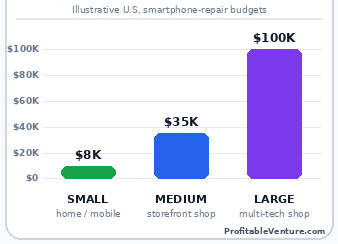
For this guide, we will use:
- Small: $8,000
- Medium: $35,000
- Large: $100,000.
b. What are the Costs Involved?
Small Home or Mobile Repair Business – Approximately $8,000
- Basic professional repair tools – $1,500
- Microscope, soldering, hot air, and diagnostic equipment – $1,500
- Starter parts inventory – $2,000
- Workbench and ESD setup – $500
- Business registration and insurance – $600
- Website, branding, and marketing – $500
- Repair/POS software – $300
- Working capital – $1,100
- Estimated Total – $8,000.
Medium Storefront Repair Shop – Approximately $35,000
- Lease deposit and storefront buildout – $8,000
- Starter screens, batteries, charging ports, and parts – $8,000
- Repair benches, tools, heating equipment, and diagnostics – $6,000
- Microsoldering and board-repair equipment – $3,000
- POS, repair software, computers, and security – $3,000
- Working capital – $3,000
- Signage and launch marketing – $2,000
- Licensing and insurance – $2,000
- Estimated Total – $35,000.
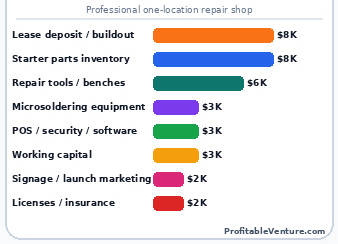
This is the model used in the financial forecast.
Large Multi-Technician Shop – Approximately $100,000
- Lease/buildout and customer area – $20,000
- Large parts inventory – $25,000
- Multiple technician benches and tools – $15,000
- Advanced board-repair equipment – $8,000
- POS, inventory, security, and technology – $7,000
- Refurbished-device/accessories inventory – $8,000
- Licenses, insurance, and professional fees – $4,000
- Marketing – $5,000
- Working capital and payroll reserve – $8,000
- Estimated Total – $100,000.
c. What Factors Determine Startup Cost?
- Storefront versus home operation
- Rent
- Number of technicians
- Parts inventory
- Repair brands supported
- Microsoldering capabilities
- Diagnostic equipment
- Security
- Refurbished-phone inventory
- Accessories inventory
- Working capital.
d. Do You Need a Storefront?
No. You can begin from an approved home workshop, operate a pickup/drop-off service, or perform mobile repairs where practical. However, a storefront can improve:
- Customer trust
- Walk-in traffic
- Local visibility
- Security
- Parts storage
- Employee productivity
- Business-account credibility.
A small professional shop is often enough. You need more secure bench space than retail floor space.
e. What are the Ongoing Expenses?
- Replacement screens
- Batteries
- Charging ports
- Cameras and speakers
- Adhesives
- Small electronic components
- Technician wages
- Rent
- Utilities
- Insurance
- Software
- Card-processing fees
- Tools
- Equipment maintenance
- Marketing
- Warranty repairs
- Shipping
- Electronic-waste disposal.
f. What Staff Do You Need?
A small shop may initially need only:
- Owner/Lead Technician
- Junior Repair Technician
- Customer Service/Front Desk Employee.
A larger operation may add:
- Microsoldering Technician
- Store Manager
- Inventory Manager
- Business Account Representative
- Refurbishment Technician
- Bookkeeper.
g. How Do You Fund the Business?
- Personal savings
- Small-business loans
- SBA-backed loans
- Business line of credit
- Equipment financing
- Business partner
- Family financing
- Starting mobile and reinvesting profits.
Starting small can make sense in this business because repair tools can generate revenue immediately once you have the skills. You do not necessarily need a large storefront on day one.
a. Executive Summary
FixPoint Smartphone Repair, LLC is a proposed smartphone repair shop operating from a professional storefront in Columbus, Ohio.
The company will provide same-day and next-day repairs for popular smartphone brands, with initial emphasis on high-volume services such as screen replacement, battery replacement, charging-port repair, cameras, speakers, software diagnostics, and selected motherboard repairs.
FixPoint will differentiate itself through transparent pricing, professional device intake, customer privacy, parts-quality options, fast turnaround, written repair warranties, and strong communication.
The company will launch with approximately $35,000 in capital.
In addition to consumer repairs, management will pursue recurring business accounts with local employers, schools, delivery businesses, property managers, restaurants, and other organizations maintaining multiple mobile devices.
The long-term strategy is to develop advanced microsoldering capability, expand business-account repairs, add refurbished devices and accessories, and eventually add a second location or pickup/drop-off route.
b. Products and Services
FixPoint Smartphone Repair will offer:
- Screen replacement
- Back-glass replacement
- Battery replacement
- Charging-port repair
- Camera replacement
- Speaker repair
- Microphone repair
- Button repair
- Water-damage diagnostics
- Software troubleshooting
- Device diagnostics
- Microsoldering
- Board-level repair
- Data-transfer assistance
- Screen protectors
- Cases
- Chargers
- Cables
- Refurbished devices.
c. Mission Statement
“At FixPoint Smartphone Repair, LLC, our mission is to restore customers’ devices quickly and professionally through skilled repair, transparent pricing, responsible data handling, quality parts, and dependable customer service.”
Vision Statement
“Our vision is to build FixPoint into the most trusted independent smartphone repair company in our market, known for technical expertise, customer privacy, honest advice, reliable warranties, and fast turnaround.”
d. Goals and Objectives
The first objective is to build strong same-day repair volume. Management will track:
- Repairs per day
- Average repair ticket
- Parts cost
- Gross profit per repair
- Technician hours
- Repair turnaround time
- Warranty-return rate
- Customer review rating
- Repeat customers
- Parts inventory turnover.
The second objective is to reduce repair mistakes. Every device will receive an intake inspection documenting:
- Existing screen damage
- Frame condition
- Camera condition
- Charging condition
- Buttons
- Device power status
- Visible liquid damage where apparent.
This protects both the customer and the business. Another objective is to develop business accounts. Commercial customers can receive:
- Priority turnaround
- Monthly invoicing
- Pickup/drop-off
- Volume pricing
- Device repair records.
e. Organizational Structure
- Owner/General Manager
- Lead Technician
- Repair Technicians
- Microsoldering Technician
- Customer Service Representative
- Inventory/Parts Coordinator
- Business Account Representative
- Bookkeeper.
Marketing Plan
a. SWOT Analysis
Strengths
Smartphones are essential devices, and many repairs can be completed relatively quickly.
A skilled technician can generate substantial value from a small workstation.
The business also creates repeat and referral opportunities.
Weaknesses
The business depends heavily on technician skill. A technician mistake can be expensive.
Parts quality also varies considerably, and stocking too many slow-moving screens can tie up cash.
Opportunities
Opportunities include business device fleets, refurbished phones, accessories, mail-in repairs, mobile repairs, pickup/delivery, microsoldering, tablets, smartwatches, and additional locations.
Threats
Threats include manufacturer repair competition, device trade-in programs, self-repair options, parts shortages, counterfeit parts, repairability changes, theft, customer data issues, and rapidly changing smartphone models.
b. How Does a Smartphone Repair Business Make Money?
- Screen replacement
- Battery replacement
- Charging-port repair
- Back-glass repair
- Camera repair
- Speaker/microphone repair
- Diagnostics
- Board repair
- Water-damage work
- Business fleet repairs
- Accessories
- Screen protectors
- Refurbished smartphones.
c. Payment Options
- Cash
- Credit cards
- Debit cards
- Apple Pay
- Google Pay
- Online invoices
- ACH for business customers.
d. Sales and Advertising Strategies
- Create a professional website
- Maintain a Google Business Profile
- Ask satisfied customers for reviews
- Optimize for local “phone repair near me” searches
- Use exterior signage
- Partner with mobile-phone stores that do not repair
- Contact small businesses
- Offer business fleet repair
- Partner with schools where appropriate
- Market to delivery and rideshare drivers
- Offer pickup and delivery
- Use social media to show repairs and results
- Offer referral incentives
- Promote same-day repairs where genuinely available.
Local reviews are extremely important. A customer deciding where to leave an expensive smartphone may choose a shop with hundreds of strong reviews over a cheaper business with almost no reputation.
Financial Projection
a. How Much Should You Charge for Smartphone Repair?
Pricing varies dramatically according to model and parts quality. Illustrative U.S. planning prices might include:
- Diagnostic service: $30 – $60
- Battery replacement: $70 – $140+
- Screen replacement: $100 – $350+
- Charging-port repair: $80 – $180+
- Back-glass repair: $100 – $250+
- Camera or speaker repair: $80 – $200+
- Water-damage diagnostic service: $50 – $100+
- Board-level/microsoldering repair: $120 – $300+ depending on complexity.
These are planning ranges rather than a universal price list. Calculate each repair using:
Repair Price = Part Cost + Technician Labor + Shop Overhead + Warranty Allowance + Desired Profit.
b. How Much Revenue Can a Smartphone Repair Business Generate?
For planning purposes:
- Home/mobile technician: approximately $60,000 – $150,000 annual revenue
- Professional storefront: approximately $150,000 – $400,000
- Large multi-technician shop: approximately $400,000 – $1 million+.
These are illustrative ranges.
The financial model below assumes approximately $180,000 in first-year revenue for the $35,000 storefront operation.
c. Five-Year Revenue and Profit Projection
| Fiscal Year | Revenue | Total Expenses | Net Profit | Net Margin |
|---|---|---|---|---|
| Year 1 | $180,000 | $152,000 | $28,000 | 15.6% |
| Year 2 | $240,000 | $200,000 | $40,000 | 16.7% |
| Year 3 | $300,000 | $246,000 | $54,000 | 18.0% |
| Year 4 | $360,000 | $291,000 | $69,000 | 19.2% |
| Year 5 | $430,000 | $344,000 | $86,000 | 20.0% |
Under this illustrative model, cumulative five-year revenue would be approximately $1.51 million. Cumulative projected net profit would be approximately $277,000.

d. Sample Five-Year Profit and Loss Projection
| Item | Year 1 | Year 2 | Year 3 | Year 4 | Year 5 |
|---|---|---|---|---|---|
| Revenue | $180,000 | $240,000 | $300,000 | $360,000 | $430,000 |
| Parts and Accessories Cost | $55,000 | $72,000 | $90,000 | $106,000 | $126,000 |
| Payroll and Technician Costs | $45,000 | $60,000 | $75,000 | $90,000 | $108,000 |
| Rent and Occupancy | $18,000 | $19,000 | $20,000 | $21,000 | $22,000 |
| Utilities and Internet | $4,000 | $5,000 | $6,000 | $7,000 | $8,000 |
| POS, Card Fees and Repair Software | $5,000 | $7,000 | $9,000 | $11,000 | $13,000 |
| Marketing | $7,000 | $8,000 | $9,000 | $10,000 | $11,000 |
| Insurance and Licensing | $4,000 | $4,000 | $5,000 | $5,000 | $6,000 |
| Tools, Equipment and Maintenance | $5,000 | $6,000 | $7,000 | $8,000 | $9,000 |
| Warranty Returns, Damage and Shrink | $3,000 | $4,000 | $5,000 | $6,000 | $7,000 |
| Administration and Other Expenses | $6,000 | $15,000 | $20,000 | $27,000 | $34,000 |
| Total Expenses | $152,000 | $200,000 | $246,000 | $291,000 | $344,000 |
| Projected Net Profit | $28,000 | $40,000 | $54,000 | $69,000 | $86,000 |
e. How Much Profit Do Smartphone Repair Shop Owners Make?
There is no fixed amount.
A solo technician who performs most of the repairs personally may effectively earn both technician compensation and business profit.
A larger shop may generate considerably more sales but support several employees.
Under this model, projected business profit increases from approximately $28,000 in Year 1 to approximately $86,000 in Year 5.
The owner’s actual income will depend on salary, taxes, debt, distributions, and reinvestment.
f. What Factors Determine Profit?
- Repairs per day
- Average repair ticket
- Parts cost
- Parts quality
- Technician speed
- Warranty callbacks
- Rent
- Payroll
- Business accounts
- Accessories
- Refurbished-device sales
- Repair mistakes
- Customer acquisition cost.
g. What is the Profit Margin?
Use:
Net Profit Margin = Net Profit ÷ Revenue × 100.
The illustrative medium shop begins at approximately 15.6% net margin and improves toward approximately 20% as the operation develops.
This assumes better technician utilization, stronger supplier pricing, repeat customers, and higher-value business accounts.
h. What is the Sales Forecast?
- Year 1: $180,000
- Year 2: $240,000
- Year 3: $300,000
- Year 4: $360,000
- Year 5: $430,000.
-
Set Up Your Smartphone Repair Shop
a. How Do You Choose the Perfect Location?
A repair shop benefits from visibility, convenience, and trust. Good locations may be near:
- Shopping centers
- Universities
- Mobile-phone stores
- Grocery stores
- Busy residential areas
- Public transportation
- Office districts
- Electronics retailers.
You do not necessarily need premium mall rent. A visible neighborhood storefront with parking and strong online reviews can be more profitable than an expensive mall kiosk.
b. What Cities are Worth Researching?
There is no universally best city. Markets worth researching can include:
- Dallas-Fort Worth, Texas
- Houston, Texas
- Atlanta, Georgia
- Phoenix, Arizona
- Orlando, Florida
- Charlotte, North Carolina
- Columbus, Ohio
- Indianapolis, Indiana
- Nashville, Tennessee
- Las Vegas, Nevada.
The neighborhood is more important than the city. A location close to apartments, colleges, offices, and daily traffic can outperform a prestigious location with high rent.
c. What Equipment is Needed?
- Precision screwdriver sets
- Opening picks and pry tools
- Suction tools
- Heat mats
- Hot-air rework station
- Soldering station
- Microscope
- Multimeter
- DC power supply
- USB power meter
- Battery tester
- ESD mats
- ESD wrist straps
- Screen separation equipment
- Ultrasonic cleaner where appropriate
- Fume extraction
- Precision tweezers
- Adhesives
- Clamps
- Parts organizers
- Bench lighting
- Computer
- POS terminal
- Security cameras.
Do not buy advanced equipment simply because it looks professional. If you do not yet know how to perform board-level repair, invest first in training.
d. How Should You Organize Parts Inventory?
Stock the parts that correspond with your actual repair volume. For example, you may keep several screens and batteries for your most common models while ordering unusual parts only after receiving the customer’s deposit.
You can track:
- Part number
- Supplier
- Purchase cost
- Compatible models
- Quantity
- Defect rate
- Warranty replacements.
Cheap parts can become very expensive when customers keep returning. If one screen supplier has an 8% defect rate and another has a 1% defect rate, the slightly cheaper screen may not actually be cheaper.
-
Hire and Train Employees
Do not hire a technician simply because the person says, “I have repaired phones for years.”
Test the person’s work. Give candidates practical tasks. Then observe:
- Tool handling
- ESD procedures
- Screw organization
- Adhesive removal
- Battery handling
- Connector handling
- Cleanliness
- Diagnostic logic
- Device reassembly.
A careless technician may strip screws, tear flex cables, damage connectors, puncture batteries, or lose small components.
Train employees on your customer-data rules as carefully as you train them on repair.
Customer devices should be stored securely. Do not allow devices to sit unattended near the front counter. Each device should have a repair ticket and identifiable storage location.
Battery Safety
Lithium-ion batteries require particular care. A technician should never casually puncture, bend, crush, or overheat a battery.
Damaged or swollen batteries should be handled using appropriate safety procedures and stored/disposed of according to applicable rules.
Keep appropriate fire-safety equipment available and train technicians on what to do if a battery begins smoking or enters thermal runaway.
-
Launch the Business Properly
Before your grand opening, create a complete repair workflow. A customer should not hand a phone to somebody at the counter and hear:
“Come back later.”
A professional intake process is better.
Step 1 – Inspect the Device
Document visible damage.
Step 2 – Create the Repair Ticket
Record the customer, device model, serial/IMEI where appropriate, complaint, quoted amount, parts choice, and estimated completion time.
Step 3 – Obtain Authorization
The customer approves the repair terms.
Step 4 – Perform the Repair
The technician follows the appropriate repair procedure.
Step 5 – Test the Device
Depending on the repair, test:
- Display
- Touchscreen
- Cameras
- Speaker
- Microphone
- Charging
- Buttons
- Wi-Fi
- Bluetooth
- Cellular functionality where appropriate.
Step 6 – Document Completion
Record the part used and technician responsible.
Step 7 – Customer Pickup
Allow the customer to inspect and test the phone where practical before leaving. This simple workflow reduces disputes.
a. What Makes a Smartphone Repair Business Successful?
- Technical competence – Repairs must actually work.
- Parts quality – Cheap defective parts create repeat problems.
- Fast turnaround – Customers depend on their phones.
- Privacy – Customer data needs respect.
- Transparent pricing – Avoid surprise charges.
- Written warranties – Customers should know what is covered.
- Inventory control – Fast-moving parts should remain available.
- Strong local reviews – Trust drives repair selection.
- Business accounts – Commercial work can stabilize volume.
- Low callback rate – Repeating work for free destroys profitability.
b. What Happens During a Typical Day?
The technician arrives before opening and checks the repair queue. Several phones may have been left overnight.
- The first job is a battery replacement scheduled for pickup at 9:30 a.m.
- The second is a cracked screen.
- The third phone does not power on and requires diagnosis.
Customers begin arriving.
- A front-desk employee checks in each device and creates a repair ticket.
- A technician performs the battery replacement while another begins the screen job.
- At 11:00 a.m., a local landscaping company arrives with three employee phones that need charging-port repairs.
- During the afternoon, the shop receives replacement parts from its supplier.
The inventory coordinator verifies:
- Part models
- Quantities
- Supplier quality grades
- Purchase prices.
Completed phones go through quality-control tests. Customers receive pickup notifications. At the end of the day, management reviews:
- Repairs completed
- Revenue
- Parts consumed
- Warranty repairs
- Repairs still pending
- Cash/card reconciliation
- Parts that need reordering.
c. What Skills and Experience Do You Need?
- Electronics repair – The foundation of the business.
- Diagnostics – Replacing random parts is expensive.
- Microsoldering – Useful for advanced repairs.
- Customer service – Customers may be stressed about losing their phone.
- Inventory control – Parts inventory can consume significant cash.
- Data privacy – Customer devices contain sensitive information.
- Sales – Business accounts and accessories can increase revenue.
- Financial management – Know the actual profit per repair.
- Employee management – Quality needs to remain consistent across technicians.
You do not need to have owned an electronics company before starting a smartphone repair business.
But this is not a business where you should learn every repair using a paying customer’s $1,200 smartphone.
Practice first.
- Buy damaged devices.
- Take them apart.
- Reassemble them.
- Learn proper battery removal.
- Learn screen replacement.
- Learn charging-port diagnosis.
- Practice soldering on scrap boards.
- Learn to recognize when a repair is beyond your current ability.
There is nothing wrong with initially outsourcing advanced board work to an experienced specialist. Most importantly, create a reputation customers can trust.
When somebody hands you a phone containing years of photographs, financial apps, contacts, business records, and private messages, the customer is trusting you with far more than a piece of electronics.
If you can combine skilled repairs, good parts, customer privacy, transparent pricing, fast turnaround, strong warranties, disciplined inventory management, and excellent local reviews, you can build a successful smartphone repair business even if you started with no previous business experience.