
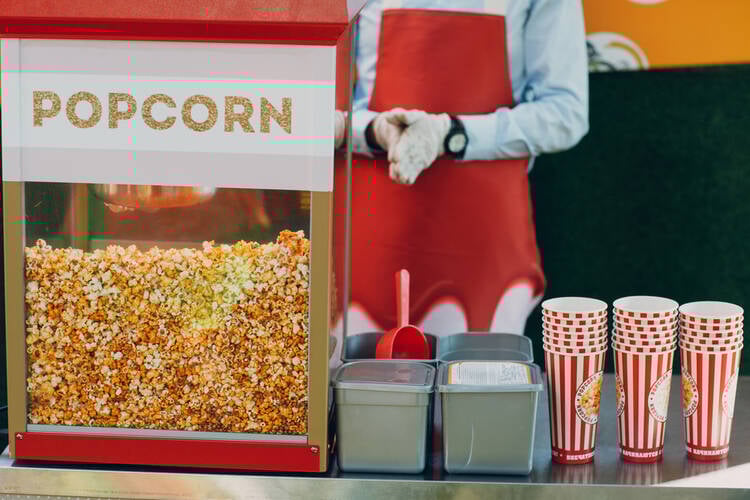
A gourmet popcorn business produces and sells freshly popped or packaged popcorn in specialty flavors such as caramel, cheddar cheese, kettle corn, chocolate drizzle, cookies and cream, spicy varieties, birthday-cake flavors, and other creative combinations.
You can operate the business from a small commercial kitchen, farmers’ market booth, kiosk, food trailer, retail store, online shop, or a combination of several sales channels.
One of the biggest attractions of gourmet popcorn is that the basic ingredient is inexpensive compared with many foods, yet flavoring, attractive packaging, gifting, and branding can substantially increase the amount customers are willing to pay.

A customer may not pay much for plain popcorn in a paper bag, but that same customer may happily spend considerably more on premium caramel popcorn packaged in an attractive gift tin.
This means you are not simply selling popcorn. You are selling flavor, convenience, gifts, entertainment, celebration, and presentation.
A gourmet popcorn company can make money through walk-in retail sales, online orders, corporate gifts, party favors, weddings, festivals, farmers’ markets, fundraising programs, wholesale accounts, holiday gift tins, catering, and bulk orders.
You do not necessarily need previous food-business experience to get started, but you do need to understand food safety, production, packaging, shelf life, pricing, inventory, customer service, and marketing.
The easiest way to make the business unnecessarily complicated is to launch with 40 different flavors before you know which five customers actually want.
A beginner is usually better off starting with several excellent core flavors, learning the production process, building repeat customers, and expanding the menu based on proven demand.
Steps on How to Start a Gourmet Popcorn Business
-
Conduct Market Research
Market research helps you decide what type of gourmet popcorn company you should actually build.
You can start by deciding whether you want to operate mainly as a snack business, gift business, event business, online company, or local retail store.
The products, packaging, pricing, and marketing can be very different. A popcorn shop inside a busy entertainment district may sell cups and bags for immediate consumption.
An online gourmet popcorn company may depend heavily on decorative tins, shipping boxes, gift bundles, holiday products, and products that remain fresh during transportation.
A company targeting weddings and corporate clients may focus on custom labels, small favor bags, branded tins, and bulk orders.
Visit popcorn shops, candy stores, farmers’ markets, shopping malls, movie theaters, gift stores, and specialty food businesses in your proposed market.
Look at which flavors are offered, package sizes, prices, product presentation, customer traffic, and how products are displayed. You should also research online competitors.
Study how established gourmet popcorn companies package products for birthdays, holidays, corporate gifts, graduations, weddings, and other occasions. You must also pay particular attention to customer reviews.
People may complain that the popcorn arrived stale, the bag was smaller than expected, flavors were too sweet, packaging was damaged, or shipping cost almost as much as the product.
Those complaints can help you design a better customer experience. Before investing heavily, make sure you test your flavors.
Give samples to people who are not relatives or close friends and ask which products they would actually purchase with their own money.
There is a big difference between someone saying, “This tastes great,” and someone paying $12 for a bag.
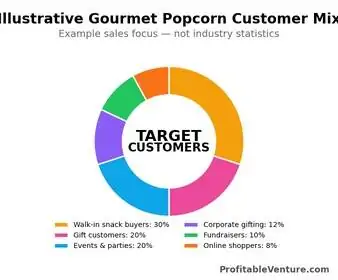
a. Who is the Target Market for a Gourmet Popcorn Business?
- Families
- Children and teenagers
- College students
- Office workers
- Movie and entertainment customers
- Tourists
- Online gift shoppers
- Corporate organizations
- Wedding planners
- Birthday party organizers
- Event planners
- Schools
- Churches
- Sports teams
- Nonprofit organizations
- Fundraising groups
- Hotels
- Gift basket companies
- Convenience and specialty stores
- Customers looking for holiday gifts
b. Is a Gourmet Popcorn Business Profitable?
Yes, a gourmet popcorn business can be profitable when the owner controls ingredient costs, packaging, labor, rent, shipping, and waste. The basic popcorn kernel is only one part of your cost.
You may also need oil, sugar, cheese seasoning, chocolate, caramel ingredients, nuts, cookies, flavor powders, bags, labels, tins, boxes, merchant fees, and shipping materials. Presentation also plays an unusually important role in this business.
A well-branded popcorn tin purchased as a Christmas gift can command a very different selling price from the same quantity of popcorn sold in a plain plastic bag.
Another advantage is that gourmet popcorn can support multiple revenue streams.
A retail customer may purchase one bag, while a corporate customer could order hundreds of branded packages at once.
Fundraising, weddings, parties, and holiday gifting can also create large orders.
Profitability therefore depends not only on the number of bags you sell but also on your product mix and customer type.
c. Are There Existing Niches in the Industry?
Yes. Gourmet popcorn has many niches, including:
- Caramel popcorn
- Cheese popcorn
- Chicago-style cheese and caramel mixes
- Kettle corn
- Chocolate-covered popcorn
- Drizzled dessert popcorn
- Spicy popcorn
- Birthday and celebration popcorn
- Holiday popcorn tins
- Corporate gift popcorn
- Wedding popcorn favors
- Fundraising popcorn
- Vegan popcorn
- Organic-positioned popcorn
- Premium nut and caramel popcorn
- Novelty flavors
- Movie-night popcorn packages
- Bulk event popcorn
- Online gourmet popcorn gifts.
You do not need to choose only one niche. However, having a recognizable specialty can make the business easier to remember.
d. Who are the Major Competitors?
Depending on your market, competitors may include:
- Garrett Popcorn Shops
- Popcornopolis
- The Popcorn Factory
- Doc Popcorn
- Independent gourmet popcorn stores
- Candy and confectionery shops
- Movie theaters
- Farmers’ market popcorn vendors
- Online gourmet snack companies
- Gift basket companies
- Supermarket premium snack brands
- Fundraising snack companies.
You do not necessarily have to compete with national brands on size. A local operator can compete through fresh production, creative seasonal flavors, local delivery, custom party favors, corporate customization, community partnerships, and personal customer service.
e. Are There County, State, or Federal Regulations for a Gourmet Popcorn Business in the United States?
Yes. The regulatory requirements depend on where the popcorn is produced, how it is packaged, and where it is sold.
A retail gourmet popcorn store will generally be subject to state and local food-business requirements.
You may need a business license, food establishment permit, health department approval, food handler certification, commercial kitchen approval, fire inspection, certificate of occupancy, and sales-tax registration.
Some states allow certain shelf-stable food products to be produced under cottage food laws.
Popcorn may qualify under some state programs, but you should never assume that every gourmet popcorn product qualifies.
Adding chocolate, dairy ingredients, nuts, specialty coatings, or other ingredients can affect how a product is regulated. Cottage food rules also vary dramatically from one state to another.
Some states restrict where cottage foods can be sold, how much revenue can be earned, whether online sales are permitted, or whether products can be shipped.
If you produce food from a commercial facility for broader distribution, federal food requirements may also become relevant.
Facilities that manufacture, process, pack, or hold food for consumption in the United States may need FDA food facility registration unless an exemption applies.
Retail food establishments are generally exempt from FDA food facility registration, but a business that grows into a manufacturing or wholesale operation should confirm its status rather than assuming the retail exemption still applies.
Packaged popcorn also needs appropriate labeling. Labels may need information such as the product identity, net quantity, ingredient list, business information, and allergen declarations.
Many gourmet popcorn recipes contain major allergens such as milk, peanuts, tree nuts, wheat, soy, or sesame.
You should develop strict allergen procedures and never make casual claims such as “nut-free” or “allergy safe” unless your production system genuinely supports them.
Nutrition labeling requirements can also apply to packaged foods, although certain small businesses and qualifying products may be eligible for exemptions.
Verify your exact obligations before printing thousands of labels.
f. Is There a Franchise for a Gourmet Popcorn Business?
Yes. Gourmet popcorn franchise opportunities exist. Doc Popcorn is an example of an established popcorn brand that has expanded through franchising.
A franchise may provide recipes, equipment specifications, supplier relationships, branding, operating procedures, location support, and marketing systems.
However, the convenience comes with costs. You may have to pay an initial franchise fee, ongoing royalties, marketing contributions, and other expenses.
You may also have less freedom to create your own flavors or purchase ingredients from different suppliers.
Review the Franchise Disclosure Document carefully before making a decision.
g. What Do You Need to Start a Gourmet Popcorn Business?
- A tested popcorn concept
- Several proven flavors
- An approved production location
- Business registration
- Food permits and licenses
- Commercial popcorn equipment
- Food-safe storage
- Ingredient suppliers
- Packaging suppliers
- Product labels
- Point-of-sale system
- Website or online store
- Commercial insurance
- Food safety procedures
- Cleaning and sanitation supplies
- Working capital
- A marketing plan.
-
Choose a Memorable Business Name
A gourmet popcorn business benefits from a name that is fun, easy to pronounce, and suitable for attractive packaging.
Your name may eventually appear on bags, tins, gift boxes, shipping cartons, kiosks, websites, and wholesale displays. Try not to choose something so narrow that it prevents future expansion.
Before using the name commercially, search your state’s business database and investigate possible trademark conflicts. Some catchy gourmet popcorn business name ideas are:
- Golden Kernel Gourmet, LLC
- Pop & Joy Gourmet Popcorn, LLC
- Sweet Kernel Popcorn Co., LLC
- PopCraft Gourmet, LLC
- Happy Kernel Popcorn, LLC
- Flavor Pop Kitchen, LLC
- Golden Popcorn Works, LLC
- Pop Haven Gourmet, LLC
- Crunch & Caramel Popcorn, LLC
- Pop District Gourmet, LLC
- Kernel House Popcorn, LLC
- Sweet & Savory Pop Co., LLC
- Pop Culture Gourmet, LLC
- Celebration Popcorn Co., LLC
- Pop Barrel Gourmet, LLC
- Golden Crunch Popcorn, LLC
- Pop Street Gourmet, LLC
- Kernel & Co. Popcorn, LLC
- Joyful Pop Gourmet, LLC
- Popfection Gourmet Popcorn, LLC.
-
Register Your Business
a. What Type of Business Structure is Best for a Gourmet Popcorn Business?
The right business structure depends on ownership, taxes, liability, and expansion plans.
Many independent gourmet food businesses choose a limited liability company.
An LLC can separate the business from the owner’s personal affairs while remaining relatively straightforward to manage.
Food businesses also face liability risks. A customer could claim to have suffered an allergic reaction, foodborne illness, or another injury connected with your product.
An LLC should therefore be combined with suitable business and product liability insurance rather than treated as a substitute for insurance.
b. Steps to Form an LLC
- Choose an available business name
- File LLC formation documents with your state
- Choose a registered agent
- Create an operating agreement
- Obtain an EIN where applicable
- Register for state and local taxes
- Open a business bank account
- Apply for required food and retail permits
- Purchase business insurance
- Maintain annual reports and other state requirements.
c. What Type of License is Needed to Start a Gourmet Popcorn Business?
Your location and business model determine the licenses you need. They may include:
- General business license
- Food establishment permit
- Food processor or manufacturer license where applicable
- Cottage food registration or permit where applicable
- Food handler certification
- Food manager certification
- Health department approval
- Sales-tax or seller permit
- Certificate of occupancy
- Fire inspection approval
- Sign permit
- Temporary event permits
- Farmers’ market vendor permits
- FDA food facility registration where applicable.
d. What Type of Certification is Needed to Start a Gourmet Popcorn Business?
There is no universal gourmet popcorn certification. Depending on your jurisdiction and operating model, you may need or benefit from:
- Food handler certification
- Certified food protection manager certification
- Food allergen awareness training
- Food safety training
- HACCP training for certain production processes
- First aid and CPR training
- Commercial kitchen sanitation training.
e. What Documents are Needed to Start a Gourmet Popcorn Business?
- Business formation documents
- Employer Identification Number where applicable
- Business license
- Food establishment permit
- Health inspection records
- Commercial kitchen lease or agreement
- Cottage food documentation where applicable
- Food handler certificates
- Insurance policies
- Sales-tax registration
- Supplier invoices
- Ingredient specifications
- Product labels
- Allergen information
- Cleaning and sanitation procedures
- Employee records
- Sales records
- Wholesale agreements where applicable.
f. Do You Need a Trademark, Copyright, or Patent?
You normally do not need a patent to start a gourmet popcorn company. A trademark can become valuable because branding plays a major role in gift foods.
You may eventually want to protect your company name, logo, slogan, or branded product line.
Copyright can protect original product photographs, website copy, package artwork, videos, and marketing material.
A secret seasoning formula or production method may sometimes be protected operationally as confidential business information rather than through ordinary copyright.
-
Cost Analysis and Budgeting
a. How Much Does It Cost to Start a Gourmet Popcorn Business?
A gourmet popcorn business can be started at several different levels. A small operator using an approved shared commercial kitchen, selling at events and online, may be able to begin with approximately $10,000 to $25,000.
A medium operation with professional equipment, a small retail location or dedicated production space, attractive packaging, e-commerce, and working capital may require approximately $40,000 to $80,000.
A larger operation with a substantial storefront, production kitchen, multiple kettles, employees, shipping systems, and wholesale capability may require approximately $125,000 to $250,000 or more.
For the purpose of this guide, we will use:
- Small-scale gourmet popcorn business: approximately $18,000
- Medium-scale gourmet popcorn business: approximately $60,000
- Large-scale gourmet popcorn business: approximately $175,000.
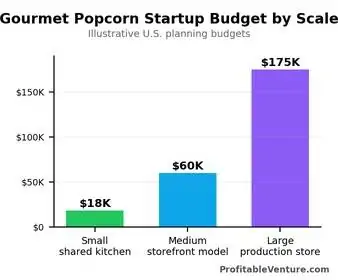
These are planning estimates rather than fixed industry prices.
b. What are the Costs Involved in Starting a Gourmet Popcorn Business?
Small-Scale Gourmet Popcorn Business – Approximately $18,000
- Shared commercial kitchen deposit and initial rent – $2,000
- Commercial popcorn kettle and basic equipment – $5,000
- Initial kernels, oils, seasonings, and ingredients – $2,000
- Packaging, labels, and boxes – $2,000
- Licenses, food safety training, and insurance – $1,500
- Website, payment processing, and branding – $2,000
- Event display equipment – $1,500
- Working capital reserve – $2,000
- Estimated Total – $18,000.
This setup is suitable for an owner who sells through online orders, markets, events, fundraisers, and local pickup rather than immediately opening a full retail store.
Medium-Scale Gourmet Popcorn Business – Approximately $60,000
- Professional popcorn production equipment – $16,000
- Lease deposit, buildout, and basic fixtures – $10,000
- Working capital reserve – $12,000
- Branding, website, POS, and e-commerce – $6,000
- Opening ingredients and flavor inventory – $5,000
- Packaging, tins, bags, labels, and shipping materials – $4,000
- Licenses, professional fees, and insurance – $3,000
- Delivery and event equipment – $4,000
- Estimated Total – $60,000.
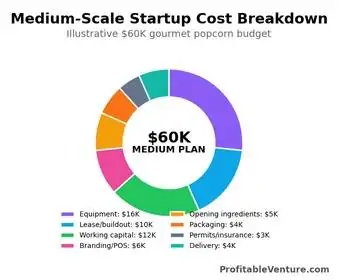
This is the financial model used later in the article.
Large-Scale Gourmet Popcorn Business – Approximately $175,000
- Commercial popcorn production line and equipment – $45,000
- Store and production facility buildout – $35,000
- Opening ingredients and inventory – $15,000
- Packaging, tins, boxes, and labeling inventory – $18,000
- Working capital and payroll reserve – $30,000
- E-commerce, POS, computers, and shipping systems – $10,000
- Licenses, insurance, professional fees, and testing – $7,000
- Marketing and grand opening – $8,000
- Delivery, storage, and miscellaneous equipment – $7,000
- Estimated Total – $175,000.
Do not spend heavily on production capacity until you have a realistic plan for selling the output.
A machine capable of producing hundreds of pounds of popcorn is not valuable if most of that popcorn remains unsold.
c. What Factors Determine the Cost of Starting a Gourmet Popcorn Business?
- Whether you use a shared or dedicated kitchen
- Retail store size
- Popcorn production capacity
- Number of flavors
- Packaging quality
- Gift tins and boxes
- Commercial equipment
- Rent and buildout
- Shipping requirements
- Employees
- Health department requirements
- Website and e-commerce systems
- Marketing budget
- Working capital.
d. Do You Need to Build a Facility? If YES, How Much Will It Cost?
No. You can start by renting an approved commercial kitchen rather than building a dedicated facility.
This can be particularly useful when most sales initially come from online orders, festivals, corporate gifts, and farmers’ markets.
If customer demand becomes consistent, you may eventually lease a retail shop with production space.
A physical popcorn store has an additional advantage: the smell of freshly popped caramel or cheese popcorn can become part of the marketing.
However, retail space adds rent, utilities, payroll, insurance, and staffing requirements.
e. What are the Ongoing Expenses of a Gourmet Popcorn Business?
- Popcorn kernels
- Cooking oils
- Sugar and caramel ingredients
- Cheese and flavor seasonings
- Chocolate
- Nuts and specialty ingredients
- Bags and tins
- Boxes and shipping materials
- Product labels
- Rent
- Employee wages
- Utilities
- Insurance
- Merchant processing fees
- Website and software
- Shipping
- Advertising
- Cleaning supplies
- Equipment maintenance
- Food waste
- License renewals
- Accounting and bookkeeping.
f. What is the Average Salary of Your Staff?
Wages depend on your city, state, and employee responsibilities. A small operation may begin with only the owner and a part-time assistant. A growing business may employ:
- General Manager
- Production Manager
- Popcorn Production Staff
- Packaging Staff
- Retail Associates
- Cashiers
- Shipping and Fulfillment Staff
- Sales Representative
- Marketing Assistant
- Bookkeeper.
Use current local wage rates when preparing your actual payroll budget.
g. How Do You Get Funding to Start a Gourmet Popcorn Business?
- Personal savings
- Small-business loans
- Equipment financing
- Business credit
- Family financing
- Business partners
- Private investors
- Preorders
- Corporate gift contracts
- Starting small and reinvesting profits.
One attractive approach is to prove the product through events and online sales before taking on the expense of a permanent storefront.
-
Write a Business Plan
a. Executive Summary
Golden Kernel Gourmet, LLC is a proposed gourmet popcorn company based in Columbus, Ohio.
The company will produce fresh sweet and savory popcorn in small batches and sell through a combination of retail, online orders, local events, corporate gifting, fundraisers, and custom party orders.
The initial menu will focus on approximately eight core flavors rather than an oversized selection.
Core offerings may include caramel, cheddar, white cheddar, kettle corn, caramel-and-cheese mix, cookies and cream, spicy cheese, and a rotating seasonal flavor. The business will launch using approximately $60,000 in startup capital.
Golden Kernel Gourmet will use professional production equipment and attractive branded packaging suitable for both everyday snacking and gifting.
Management will focus on product consistency, food safety, packaging quality, customer retention, corporate orders, and seasonal gift sales.
The company’s long-term objective is to develop a strong regional brand and gradually expand its online, corporate, fundraising, and wholesale channels.
b. Products and Services
Golden Kernel Gourmet, LLC will offer:
- Caramel popcorn
- Cheddar popcorn
- White cheddar popcorn
- Kettle corn
- Cheese-and-caramel mixes
- Chocolate-drizzled popcorn
- Dessert popcorn
- Spicy popcorn
- Seasonal flavors
- Gift tins
- Gift baskets
- Corporate gifts
- Wedding favors
- Birthday party packages
- Fundraising programs
- Bulk event orders
- Online shipping
- Local pickup.
c. Mission Statement
“At Golden Kernel Gourmet, LLC, our mission is to create fresh, flavorful gourmet popcorn that turns an everyday snack into something worth sharing, gifting, and celebrating.”
Vision Statement
“Our vision is to build Golden Kernel Gourmet into a recognizable specialty snack brand known for creative flavors, consistent quality, attractive gifts, and memorable customer experiences.”
d. Goals and Objectives
The first objective is to identify a small group of flavors that generate consistent repeat sales.
The business will measure sales by flavor rather than continuing to produce products simply because the owner personally enjoys them.
Another objective is to develop business-to-business sales. Corporate gifting can provide large seasonal orders, while schools, sports teams, churches, and community organizations can become fundraising partners.
The company will also build an online store capable of handling holiday gifts and nationwide shipping where legally permitted.
Long-term objectives may include wholesale accounts, additional stores, kiosks, franchise development, private-label products, and larger production facilities.
e. Organizational Structure
- Owner/General Manager
- Production Manager
- Popcorn Production Staff
- Packaging and Fulfillment Staff
- Retail Sales Associates
- Corporate Sales Representative
- Marketing Assistant
- Bookkeeper/Accountant.
Marketing Plan
a. SWOT Analysis
Strengths
Gourmet popcorn has the advantage of being both an everyday snack and a gift product.
The business can also create many flavors from a relatively simple base ingredient.
Products can be sold through stores, events, online orders, fundraisers, corporate gifts, and wholesale accounts.
Weaknesses
Popcorn can become stale if packaging is poor or inventory is held too long.
Demand can also be seasonal, particularly when gift sales represent a large part of revenue.
Small operators may struggle with shipping costs and packaging expenses when competing online.
Opportunities
Corporate gifting, fundraising, weddings, birthdays, tourism, online gifting, branded event favors, subscription boxes, and wholesale partnerships create expansion opportunities. Seasonal flavors can also keep customers interested throughout the year.
Threats
Competition from national brands, supermarkets, snack companies, local candy stores, and online retailers can be significant.
Other risks include food inflation, shipping increases, allergen incidents, product staleness, ingredient shortages, negative reviews, and changing customer tastes.
b. How Do Gourmet Popcorn Businesses Make Money?
- Individual bags and cups
- Large refill bags
- Gift tins
- Gift baskets
- Online orders
- Corporate gifting
- Holiday gifts
- Wedding favors
- Birthday party orders
- Fundraisers
- Festivals and events
- Wholesale accounts
- Private-label products
- Subscription boxes.
c. Payment Options
- Credit cards
- Debit cards
- Cash
- Apple Pay
- Google Pay
- Online payments
- Corporate invoices
- Gift cards.
d. Sales and Advertising Strategies
- Offer free samples
- Use Instagram and TikTok
- Create attractive product photography
- Sell at farmers’ markets
- Attend festivals and fairs
- Create corporate gift catalogs
- Contact local businesses before the holidays
- Partner with wedding planners
- Offer party favor packages
- Create school fundraising programs
- Partner with sports teams
- Offer seasonal flavors
- Create customer loyalty rewards
- Build an email list
- Offer online gift ordering
- Ask customers for reviews
- Create holiday gift bundles.
Financial Projection
a. How Much Should You Charge for Your Gourmet Popcorn?
Price each product based on its complete cost rather than merely the cost of the popcorn kernels. Your cost should include:
- Popcorn kernels
- Oil
- Seasonings
- Sugar and caramel ingredients
- Chocolate or other toppings
- Packaging
- Labels
- Production labor
- Merchant processing
- Waste
- Shipping materials where applicable.
A useful formula is:
Gross Margin = (Selling Price – Product Cost) ÷ Selling Price × 100.
For example, if the total direct cost of producing and packaging a bag is $2.25 and you sell it for $7.50, the difference is not automatically your final profit.
Rent, payroll, insurance, utilities, marketing, taxes, equipment, and other overhead still need to be paid.
b. How Much Revenue Can a Gourmet Popcorn Business Generate?
Revenue depends on location, customer traffic, online sales, corporate accounts, events, gifting, and production capacity.
For planning purposes:
- Small owner-operated business: approximately $80,000 to $150,000 in annual gross revenue
- Medium storefront and online operation: approximately $180,000 to $320,000
- Large retail and production business: approximately $400,000 to $800,000 or more.
These are planning estimates rather than guaranteed results. For the financial projection below, we will use the $60,000 medium-scale business.
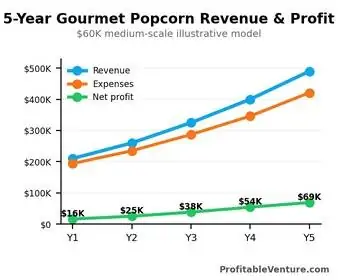
The company is projected to generate approximately $210,000 in first-year revenue.
c. Five-Year Revenue and Profit Projection
| Fiscal Year | Revenue | Total Expenses | Net Profit | Net Margin |
|---|---|---|---|---|
| Year 1 | $210,000 | $194,000 | $16,000 | 7.6% |
| Year 2 | $260,000 | $235,000 | $25,000 | 9.6% |
| Year 3 | $325,000 | $287,000 | $38,000 | 11.7% |
| Year 4 | $400,000 | $346,000 | $54,000 | 13.5% |
| Year 5 | $490,000 | $421,000 | $69,000 | 14.1% |
Under this model, cumulative five-year revenue would be approximately $1.685 million, while cumulative projected net profit would be approximately $202,000.
d. Sample Five-Year Profit and Loss Projection
| Item | Year 1 | Year 2 | Year 3 | Year 4 | Year 5 |
|---|---|---|---|---|---|
| Revenue | $210,000 | $260,000 | $325,000 | $400,000 | $490,000 |
| Ingredients and Packaging | $70,000 | $84,000 | $103,000 | $125,000 | $150,000 |
| Labor | $48,000 | $60,000 | $75,000 | $92,000 | $115,000 |
| Rent and Utilities | $27,000 | $29,000 | $32,000 | $35,000 | $38,000 |
| Marketing | $12,000 | $13,000 | $15,000 | $18,000 | $20,000 |
| Payment Processing and Technology | $7,000 | $9,000 | $11,000 | $13,000 | $16,000 |
| Insurance and Licensing | $5,000 | $5,000 | $6,000 | $6,000 | $7,000 |
| Equipment and Depreciation | $8,000 | $8,000 | $9,000 | $10,000 | $10,000 |
| Shipping and Delivery | $5,000 | $7,000 | $10,000 | $14,000 | $20,000 |
| Administration and Other Expenses | $12,000 | $20,000 | $26,000 | $33,000 | $45,000 |
| Total Expenses | $194,000 | $235,000 | $287,000 | $346,000 | $421,000 |
| Projected Net Profit | $16,000 | $25,000 | $38,000 | $54,000 | $69,000 |
e. How Much Profit Do Gourmet Popcorn Business Owners Make a Year?
There is no fixed amount. A home-based or shared-kitchen operator with low overhead can have very different profitability from a company operating an expensive mall storefront.
Using the medium-scale model above, projected business profit begins at approximately $16,000 in Year 1 and increases toward approximately $69,000 in Year 5.
The owner’s personal income will depend on wages, distributions, taxes, debt payments, and how much money is reinvested.
f. What Factors Determine the Amount of Profit to Be Made?
- Number of customers
- Average order value
- Ingredient costs
- Packaging costs
- Product pricing
- Retail rent
- Employee wages
- Corporate orders
- Online sales
- Holiday gift sales
- Shipping costs
- Fundraising volume
- Food waste
- Product shelf life
- Customer retention.
g. What is the Profit Margin of a Gourmet Popcorn Business?
Profit margin varies based on your business model. Calculate your actual margin using:
Net Profit Margin = Net Profit ÷ Revenue × 100.
The medium-scale projection in this guide starts at approximately 8% and gradually improves toward approximately 14%. This is a planning model rather than a guaranteed industry margin.
h. What is the Sales Forecast?
- First Fiscal Year: $210,000
- Second Fiscal Year: $260,000
- Third Fiscal Year: $325,000
- Fourth Fiscal Year: $400,000
- Fifth Fiscal Year: $490,000.
-
Set Up Your Store and Production Area
a. How Do You Choose a Perfect Location for a Gourmet Popcorn Business?
If walk-in retail will be important, choose a location where people are already in the mood to snack or spend discretionary money. Good possibilities include:
- Shopping districts
- Malls
- Tourist areas
- Entertainment districts
- Movie theater areas
- Family entertainment centers
- Downtown pedestrian areas
- College neighborhoods
- Food halls
- Markets and festival districts.
If online and corporate orders will dominate, expensive storefront visibility becomes less important. A lower-cost production facility with easy shipping access may be better.
b. What State and City is Best to Start a Gourmet Popcorn Business?
There is no universally best city. Markets with tourism, entertainment, corporate employment, festivals, colleges, and active gifting demand can be attractive. Places worth researching include:
- Chicago, Illinois
- Columbus, Ohio
- Dallas, Texas
- Houston, Texas
- Atlanta, Georgia
- Nashville, Tennessee
- Orlando, Florida
- Charlotte, North Carolina
- Indianapolis, Indiana
- Kansas City, Missouri.
Your neighborhood and sales strategy matter more than simply appearing in a large city.
c. What Equipment is Needed to Operate a Gourmet Popcorn Business?
- Commercial popcorn kettle
- Caramel corn cooker or caramelizer
- Coating or mixing tumbler
- Cheese and seasoning application equipment
- Commercial work tables
- Food-safe storage bins
- Cooling tables or racks
- Scales
- Measuring equipment
- Heat sealers
- Bagging equipment
- Label printer
- Packaging station
- Shelving
- Ingredient storage
- Refrigeration where required by ingredients
- Handwashing facilities
- Cleaning and sanitation equipment
- POS system
- Barcode scanner
- Computer
- Shipping scale
- Boxes and shipping supplies.
-
Hire Employees
A small popcorn business may begin with the owner and one assistant. During holiday periods, festivals, and large corporate orders, you may need additional temporary production and packaging help.
Train employees carefully. They need to understand recipes, portioning, food safety, allergens, sanitation, packaging, and customer service. Written recipes are particularly important.
If one employee applies twice as much cheese seasoning as another employee, the product will taste inconsistent and your ingredient cost will become unpredictable.
Employees should also understand allergen controls. If you produce peanut caramel popcorn and regular caramel popcorn using shared equipment, your cleaning, labeling, and production procedures need to reflect the risk of cross-contact.
-
Launch the Business Proper
Start with a soft launch rather than immediately producing huge quantities. Use the first few weeks to determine how much customers actually buy.
Monitor which flavors sell, which package sizes customers prefer, and how long products remain fresh.
Test online shipping before advertising nationally. Send packages to friends or testers in different regions and ask them to evaluate the condition of the product when it arrives.
A popcorn bag that looks perfect when it leaves your kitchen may be crushed or stale after several days inside a shipping box.
Once the production and packaging systems are reliable, promote the business through samples, events, corporate outreach, social media, fundraising organizations, and seasonal gift campaigns.
a. What Makes a Gourmet Popcorn Business Successful?
- Great flavors – Customers need a reason to buy your popcorn again.
- Freshness – Stale popcorn can damage the brand quickly.
- Consistent recipes – Every batch should taste familiar.
- Good packaging – Packaging protects freshness and communicates value.
- Food safety – Ingredients and allergens must be controlled carefully.
- Profitable pricing – Attractive sales numbers mean little without margin.
- Gift sales – Gifting can increase average order value.
- Corporate customers – Large recurring orders can improve revenue stability.
- Seasonal planning – Holiday demand may require production planning months ahead.
- Customer service – Gift customers expect accurate and timely delivery.
b. What Happens During a Typical Day at a Gourmet Popcorn Business?
A typical day may begin with checking production orders and preparing ingredients.
Staff measure popcorn kernels, oils, sugars, flavorings, coatings, and toppings according to standardized recipes.
Popcorn is popped in batches and transferred to coating or mixing equipment.
Sweet products may require caramel cooking, chocolate application, or cooling before packaging.
Savory products may be seasoned while still warm so flavor adheres properly.
Finished popcorn is cooled before being sealed into bags or tins. Employees apply labels and prepare online orders for shipment.
Retail staff replenish displays, provide samples, serve customers, and process payments.
The manager monitors inventory and production levels. Large corporate orders or fundraisers may require separate production schedules.
At the end of production, equipment and food-contact surfaces must be properly cleaned.
The owner may then review sales, answer customer inquiries, purchase ingredients, prepare shipping labels, plan marketing campaigns, and develop new flavors.
c. What Skills and Experience Do You Need to Build a Gourmet Popcorn Business?
- Food production skills – You need consistent batch results.
- Food safety knowledge – Safe handling and sanitation are essential.
- Allergen awareness – Gourmet toppings introduce important allergen risks.
- Recipe costing – Every flavor needs to be financially viable.
- Packaging knowledge – Freshness depends heavily on proper packaging.
- Retail skills – Physical stores need strong customer service.
- E-commerce knowledge – Online gifting can become a significant revenue source.
- Sales skills – Corporate and fundraising accounts rarely appear automatically.
- Inventory management – Ingredients and packaging must be available without excessive waste.
- Marketing – Gourmet popcorn is a visual and gift-oriented product.
- Financial management – High markup does not automatically mean high net profit.
If you have no previous experience, start small enough that mistakes are affordable.
Learn to make five excellent flavors before trying to make 50. Measure every ingredient rather than seasoning by eye.
Calculate the cost of every bag, including packaging. Test shelf life honestly.
Learn how your product travels through the mail. Talk to customers and watch which flavors they actually reorder.
A gourmet popcorn business may appear simple because popcorn itself is a simple food.
But the businesses that become memorable usually do more than pop corn.
They build an attractive brand, create dependable recipes, package products professionally, develop corporate and gift customers, control food safety, and turn an inexpensive snack into something customers believe is worth paying a premium to enjoy or give to someone else.
If you can do those things consistently, you can build a successful gourmet popcorn business even if you started with no previous food-industry experience.