

A personal assistance business provides individuals, families, executives, entrepreneurs, and other busy clients with practical help managing everyday tasks they either do not have the time or desire to handle personally.
Depending on your business model, you might help clients schedule appointments, run errands, purchase groceries, return packages, coordinate travel, organize calendars, manage household vendors, wait for repair technicians, arrange reservations, pick up dry cleaning, research purchases, organize paperwork, or handle routine administrative duties.
You can offer the service physically, virtually, or through a combination of both.
For example, one client may hire you to manage an executive calendar and book travel remotely, while another may need someone locally to shop for groceries, return online purchases, coordinate a home repair, and collect dry cleaning.
The biggest product you are really selling is time. Your clients are paying you to remove small but necessary tasks from their lives so they can spend their time on work, family, health, travel, or other priorities.
This can make personal assistance attractive as a business because you do not necessarily need expensive machinery, inventory, a storefront, or a large office to get started.
A reliable car, computer, smartphone, good organizational skills, insurance, a professional brand, and enough working capital may be sufficient for a solo operation.
However, the low financial barrier to entry does not mean the business is easy. Trust is extremely important.
Clients may give you access to their homes, schedules, travel plans, personal information, credit cards, vehicles, packages, family routines, and sometimes valuable possessions.
One careless employee can damage a reputation you spent years building. For this reason, the strongest personal assistance companies are not necessarily the ones offering the longest service list.
They are the ones clients believe will answer the phone, arrive when promised, protect confidential information, keep accurate receipts, communicate clearly, and complete tasks without creating additional problems.
Steps on How to Start a Personal Assistance Business
-
Conduct Market Research
Before deciding what services to offer, find out what people in your proposed market actually need assistance with.
A common beginner mistake is creating a long menu of services without identifying the type of customer most likely to pay for them regularly. You can start by choosing several potential customer groups.
You might target busy executives, working parents, entrepreneurs, senior citizens who need non-medical assistance, frequent travelers, high-income households, or small-business owners.
Then talk to people who fit those groups. Ask which tasks consume their time unnecessarily.
A corporate executive might want calendar management, travel arrangements, restaurant reservations, research, and personal shopping.
A working parent might value grocery shopping, package returns, appointment scheduling, home-service coordination, and errand running.
An older adult who still lives independently might want grocery assistance, organization, appointment reminders, errands, and help coordinating household services without needing medical or hands-on personal care.
You should also research how customers currently solve these problems. Some hire a traditional personal assistant.
Others use Taskrabbit-style platforms, virtual assistants, grocery delivery services, cleaners, personal shoppers, family members, or several unrelated apps.
Your opportunity may be to become one reliable point of contact instead of making the customer coordinate five different service providers.
Another issue to study is geography. A local personal assistant can lose a surprising amount of money driving between clients.
Three clients located within the same neighborhood may be more profitable than three clients located 20 miles apart.
Map your intended service area and estimate travel time during normal traffic. Do not forget to include that travel when calculating prices.
Finally, investigate what prospective customers value most when choosing an assistant.
In this business, trust, responsiveness, discretion, reliability, background screening, communication, and attention to detail can matter more than having the lowest hourly rate.
a. Who is the Target Market for a Personal Assistance Business?
- Busy professionals
- Corporate executives
- Business founders and entrepreneurs
- Small-business owners
- Working parents
- High-income households
- Frequent business travelers
- Senior citizens who need non-medical assistance
- Adult children arranging help for independent parents
- People relocating to a new city
- People managing multiple homes
- Real estate professionals
- Doctors and attorneys
- Consultants
- Public figures and other privacy-conscious clients
- People recovering temporarily from an injury who need non-medical help
- Companies seeking executive-assistant support.
b. Is a Personal Assistance Business Profitable?
Yes, a personal assistance business can be profitable because the startup investment can be relatively low compared with businesses requiring inventory or commercial premises.
A solo operator can work from a home office and charge clients for time spent completing agreed tasks.
The business can become more profitable when customers move from occasional errands to recurring weekly or monthly service arrangements.
For example, a client paying for three hours every week is normally more valuable than a customer who calls once every four months.
Recurring clients also make scheduling and revenue easier to forecast. The biggest profitability challenge is labor.
When you expand beyond working alone, assistants need to be paid while the business still has to cover payroll taxes where applicable, insurance, travel reimbursements, software, marketing, administration, and profit.
This means you cannot hire an assistant for $25 per hour and charge the customer $28 per hour and expect to build a strong agency. Your price has to cover the complete cost of providing the service.
c. Are There Existing Niches in the Industry?
Yes. Personal assistance can be divided into several niches. They include:
- Executive personal assistance
- Family assistance
- Household management
- Personal concierge services
- Senior concierge services that do not involve medical or hands-on personal care
- Errand-running services
- Personal shopping
- Travel coordination
- Virtual personal assistance
- Relocation assistance
- Home organization assistance
- Vacation-home coordination
- Appointment and calendar management
- Small-business executive assistance
- Luxury lifestyle management
- Corporate concierge services
- Event and reservation coordination
- Hybrid virtual and local assistance.
A niche can be especially useful when you are small. It is easier to become known as the reliable assistant service for busy executives in your city than to advertise that you will do almost anything for anyone.
d. Who are the Major Competitors?
The market includes both direct personal-assistance businesses and platforms that allow customers to hire help task by task. Competitors may include:
- Taskrabbit
- Care.com
- BELAY
- Upwork virtual assistants
- Local concierge businesses
- Independent personal assistants
- Virtual assistant agencies
- Personal shoppers
- Professional organizers
- Errand-running companies
- Household managers
- Executive assistant staffing firms
- Delivery and grocery apps.
You should not try to compete with every platform purely on price. An independent personal assistance company can compete by providing continuity.
Instead of receiving a different person every time, clients can work with an assistant who already understands their preferences, household, schedule, favorite vendors, communication style, and priorities. That relationship can become a major competitive advantage.
e. Are There County, State, or Federal Regulations for a Personal Assistance Business in the United States?
Yes, although an ordinary non-medical personal assistance business is generally regulated as a service business rather than through one nationwide personal-assistant licensing system.
Licensing requirements depend on your state, city, county, location, and the services you actually provide.
You may need a general business license, local registration, assumed-name registration, tax registration, home-occupation approval if working from home, and employer registrations if hiring workers.
The most important issue is understanding where ordinary personal assistance ends and a separately regulated activity begins.
For example, helping an older client buy groceries or schedule appointments is very different from helping that person bathe, dress, transfer from a bed, manage medication, or receive other hands-on personal care.
Those activities can move the company toward regulated home-care or caregiving services depending on state law.
Likewise, routinely transporting clients for compensation can create additional insurance, vehicle, or transportation requirements.
Providing childcare can trigger childcare regulations.
Managing investments, providing legal advice, preparing regulated tax work, or performing healthcare tasks can also require qualifications or licenses that an ordinary personal assistant does not have.
You should therefore define your service boundaries clearly. A useful rule is simple: if a task normally requires a professional license, do not assume that calling yourself a personal assistant allows you to perform it.
Another important issue appears when you hire assistants. Do not automatically call every worker an independent contractor simply because that seems easier.
Worker classification depends on the actual relationship, including how much control your company has over the person’s work and other relevant factors.
If you recruit assistants, set their schedules, train them in your procedures, assign them customers, control how the work is performed, and make their services a central part of your company, you should obtain appropriate professional advice about classification.
f. Is There a Franchise for a Personal Assistance Business?
Yes, franchise opportunities can exist in concierge, lifestyle-management, errand, senior-assistance, and related service categories.
However, independently owned businesses are extremely common because startup costs can be relatively low and the service depends heavily on local relationships.
A franchise may give you branding, procedures, software, training, marketing materials, and operating support.
In exchange, you may pay an initial franchise fee, royalties, advertising fees, technology fees, and other charges.
Before purchasing any franchise, carefully review what services the franchise actually permits.
Some opportunities marketed as senior assistance may cross into home-care services and therefore operate under a very different regulatory framework from the non-medical concierge business described in this article.
g. What Do You Need to Start a Personal Assistance Business?
- A clearly defined service list
- A target customer
- Business registration
- Required local licenses
- Business insurance
- Professional service agreement
- Client authorization forms
- Reliable smartphone
- Laptop computer
- Calendar and scheduling software
- Customer relationship management system
- Bookkeeping software
- Reliable transportation if providing local errands
- Expense and receipt-tracking system
- Secure password-management procedures
- Background-screening procedures for employees
- Website
- Professional email
- Working capital.
-
Choose a Memorable Business Name
Your name should communicate reliability, organization, time-saving, or premium service.
A personal assistance business is built around trust, so avoid names that sound careless or gimmicky if you intend to attract executives or high-income households. The name should also be broad enough to allow the business to expand.
Before spending money on a website or logo, search your state’s business database and investigate potential trademark conflicts. Some personal assistance business name ideas are:
- RightHand Personal Assistance, LLC
- Daily Ease Concierge, LLC
- TimeBack Personal Services, LLC
- Priority Personal Assistance, LLC
- LifeDesk Concierge, LLC
- Trusted Hand Assistance, LLC
- At Your Service Concierge, LLC
- Personal Priority Services, LLC
- Task & Time Concierge, LLC
- Executive Ease Assistance, LLC
- LifeRunner Personal Services, LLC
- Everyday Right Hand, LLC
- Premier Personal Assistance, LLC
- Simply Handled Concierge, LLC
- Personal Matters Assistance, LLC
- DoneRight Concierge, LLC
- Daily Delegate Services, LLC
- Trusted Task Personal Assistance, LLC
- Life Support Concierge, LLC
- Priority Lane Personal Services, LLC.
-
Register Your Business
a. What Type of Business Structure is Best for a Personal Assistance Business?
Many independent operators choose a limited liability company. An LLC can provide separation between the owner’s personal and business affairs while remaining relatively straightforward to manage.
This can be useful in a business where employees may enter clients’ homes, drive while completing errands, handle confidential information, or manage purchases on behalf of customers.
However, forming an LLC does not remove the need for insurance, good contracts, background checks, secure information handling, and responsible business practices.
b. Steps to Form an LLC
- Choose an available business name
- File LLC formation documents with your state
- Select a registered agent
- Create an operating agreement
- Obtain an EIN where needed
- Register for state and local taxes
- Open a separate business bank account
- Obtain required local licenses
- Purchase appropriate insurance
- Maintain state reports and other required filings.
c. What Type of License is Needed to Start a Personal Assistance Business?
The exact requirements depend on what you offer. You may need:
- General business license
- Local business registration
- Home occupation permit where required
- DBA or fictitious-name registration where applicable
- Employer registrations if hiring staff
- Sales-tax registration if taxable products or services are sold in your state
- Commercial vehicle or transportation permits if your activities require them
- Home-care licensing if you cross into regulated caregiving services
- Notary commission if you decide to offer notary services and meet state requirements.
Do not advertise a service until you have confirmed that you are legally allowed to perform it.
d. What Type of Certification is Needed to Start a Personal Assistance Business?
There is no universal certification required to call yourself a personal assistant or concierge throughout the United States. Useful training may include:
- First aid and CPR
- Customer service training
- Professional organizing training
- Executive assistant training
- Cybersecurity and privacy awareness
- Defensive driving
- Conflict-resolution training
- Time-management training
- Notary certification or commission where relevant
- Specialized travel or event-planning training if those services form a significant part of the business.
Background screening is not a certification, but it can be especially important when employees will enter customers’ homes or handle valuable property.
e. What Documents are Needed to Start a Personal Assistance Business?
- Business formation documents
- Employer Identification Number where applicable
- Business license
- Insurance certificates
- Client service agreement
- Confidentiality agreement
- Client authorization forms
- Expense reimbursement policy
- Employee agreements
- Independent contractor agreements where legitimately applicable
- Background-check authorizations
- Vehicle records where applicable
- Incident-reporting procedures
- Privacy and data-handling policy
- Client emergency contact information
- Receipts and expense records
- Employee training records.
f. Do You Need a Trademark, Copyright, or Patent?
You normally do not need a patent to start this business. A trademark can protect your business name, logo, slogan, or branded service program.
Copyright can protect original website content, forms, training material, photographs, videos, and marketing content.
Your client-management procedures can also become valuable intellectual know-how as the company grows.
-
Cost Analysis and Budgeting
a. How Much Does It Cost to Start a Personal Assistance Business?
A major advantage of personal assistance is that it can be started without expensive premises or inventory.
A solo operator working from home may be able to launch with approximately $3,000 to $10,000.
A medium-scale local agency hiring several assistants, conducting background checks, purchasing stronger insurance, investing in marketing, and maintaining payroll reserves may require approximately $20,000 to $50,000.
A larger agency with several teams, stronger management, recruitment systems, technology, and substantial payroll reserves may require approximately $60,000 to $125,000 or more.
For this guide, we will use:
- Small solo personal assistance business: approximately $6,000
- Medium local personal assistance agency: approximately $35,000
- Large multi-team personal assistance agency: approximately $90,000.
These figures are planning estimates rather than fixed industry prices.
b. What are the Costs Involved in Starting a Personal Assistance Business?
Small Solo Personal Assistance Business – Approximately $6,000
- Business registration and local licensing – $500
- Insurance and bonding – $900
- Laptop and smartphone equipment – $1,000
- Website and professional branding – $600
- Scheduling, bookkeeping, and business software – $500
- Initial marketing – $1,000
- Mileage, supplies, and working capital – $1,500
- Estimated Total – $6,000.
This model is suitable for an owner who personally performs most client work.
Medium Personal Assistance Agency – Approximately $35,000
- Working capital reserve – $9,000
- Initial employee payroll reserve – $8,000
- Marketing and customer acquisition – $6,000
- General liability, professional liability, and bonding – $3,000
- Scheduling, CRM, bookkeeping, and communications software – $3,000
- Laptops and business phones – $2,000
- Legal, registration, background checks, and licensing – $2,000
- Website and branding – $2,000
- Estimated Total – $35,000.
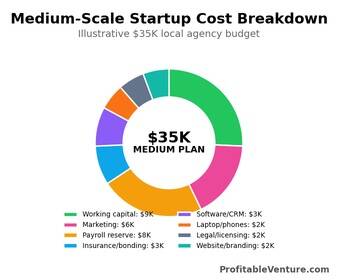
This is the financial model used later in the article.
Large Personal Assistance Agency – Approximately $90,000
- Payroll reserve – $35,000
- Marketing and customer acquisition – $15,000
- Scheduling, CRM, communication, and workforce software – $8,000
- Computers, phones, and operating equipment – $7,000
- Insurance and bonding – $7,000
- Small office and occupancy setup – $5,000
- Recruiting and background screening – $4,000
- Legal, licensing, and professional fees – $4,000
- Additional working capital – $5,000
- Estimated Total – $90,000.
Notice that payroll and working capital become much more important as the business grows.
You may have to pay employees before some business clients pay your invoices.
c. What Factors Determine the Cost of Starting a Personal Assistance Business?
- Whether you work alone or hire assistants
- Number of employees
- Insurance requirements
- Background screening
- Service territory
- Vehicle use
- Marketing budget
- Technology
- Office requirements
- Licensing
- Type of clients served
- Working capital.
d. Do You Need to Build a Facility? If YES, How Much Will It Cost?
No. A physical commercial facility is generally unnecessary for a small personal assistance business.
You can operate the administrative side of the company from a home office if local regulations allow it.
Most work takes place either at the client’s location, around the community, or online.
As you expand, a small administrative office may become useful for interviewing employees, training, storing supplies, and coordinating schedules.
Do not rent an expensive office simply to make the business appear more established. Clients care much more about reliability and professionalism.
e. What are the Ongoing Expenses of a Personal Assistance Business?
- Employee wages
- Payroll taxes
- Workers’ compensation where required
- General liability insurance
- Professional liability insurance
- Bonding or employee dishonesty coverage
- Commercial or hired/non-owned auto coverage where appropriate
- Mileage reimbursements
- Fuel
- Scheduling software
- CRM software
- Phone service
- Cloud storage
- Bookkeeping software
- Background checks
- Advertising
- Website expenses
- Accounting
- Legal expenses
- Office supplies
- Training
- Payment-processing fees.
f. What is the Average Salary of Your Staff?
Personal-assistant pay varies considerably by city, experience, service complexity, and whether work is performed locally or virtually. A growing agency may employ:
- General Manager
- Client Services Manager
- Executive Personal Assistants
- Personal Concierges
- Errand Assistants
- Virtual Assistants
- Household Coordinators
- Scheduling Coordinator
- Recruiter
- Bookkeeper
- Administrative Assistant.
Research current wages in your local market rather than relying on one national figure.
Remember that the true cost of an employee may include payroll taxes, workers’ compensation, mileage, training, paid time, software, and recruiting costs in addition to hourly wages.
g. How Do You Get Funding to Start a Personal Assistance Business?
- Personal savings
- Small-business loans
- Business lines of credit
- Credit cards used cautiously
- Family financing
- Business partners
- Private investors for larger expansion
- Starting solo and reinvesting profits
- Prepaid monthly concierge memberships.
This is one business where starting lean often makes sense. You can prove that customers are willing to pay before hiring a large team.
-
Write a Business Plan
a. Executive Summary
RightHand Personal Assistance, LLC is a proposed non-medical personal assistance and concierge company based in Dallas, Texas.
The company will help busy professionals, executives, entrepreneurs, families, and independent older adults manage time-consuming everyday responsibilities.
Services will include errand running, grocery shopping, package returns, personal shopping, reservation coordination, travel planning assistance, appointment scheduling, calendar management, household-vendor coordination, basic organization, research, and virtual administrative support.
The company will not provide medical care, hands-on personal care, medication administration, childcare, legal advice, financial advice, or other services requiring professional licenses unless appropriately qualified and separately authorized.
The business will launch as a medium-scale local agency using approximately $35,000 in startup capital.
RightHand Personal Assistance will initially employ a small team of carefully screened assistants.
Customers will be able to purchase assistance hourly, in prepaid service blocks, or through recurring monthly concierge plans.
Management will emphasize reliability, confidentiality, communication, accurate expense documentation, client retention, and geographic scheduling efficiency.
The long-term objective is to build a trusted local concierge brand and expand through recurring household accounts, executive clients, virtual assistance, and employer-sponsored concierge programs.
b. Products and Services
RightHand Personal Assistance, LLC will offer:
- Errand running
- Grocery shopping
- Personal shopping
- Package returns
- Dry-cleaning pickup and delivery
- Appointment scheduling
- Calendar organization
- Reservation coordination
- Travel research and itinerary assistance
- Household vendor scheduling
- Waiting for repair technicians
- Gift purchasing and coordination
- Home organization assistance
- Relocation assistance
- Vacation-home checks and coordination where appropriate
- Research assignments
- Email and administrative organization
- Executive assistance
- Virtual personal assistance
- Monthly concierge memberships.
c. Mission Statement
“At RightHand Personal Assistance, LLC, our mission is to give clients more control over their time by handling everyday personal and administrative responsibilities with reliability, discretion, organization, and exceptional service.”
Vision Statement
“Our vision is to become a trusted personal assistance brand known for dependable people, thoughtful service, strong client relationships, and making busy lives easier to manage.”
d. Goals and Objectives
The company’s first objective is to build a profitable base of recurring clients.
Management will prioritize customers who purchase weekly or monthly assistance rather than relying entirely on one-time errands. The company will also create clear service standards.
Assistants will be expected to acknowledge client requests quickly, arrive on time, keep receipts, protect confidential information, communicate problems before they become emergencies, and document completed tasks.
Another goal is to develop geographic density. Clients located close together will be grouped whenever practical so assistants spend more time performing billable work and less time driving across the city.
Long-term goals may include executive concierge packages, employer-sponsored assistance programs, a virtual assistant division, household-management services, and expansion into neighboring cities.
e. Organizational Structure
- Owner/General Manager
- Client Services Manager
- Personal Assistants
- Executive Assistants
- Errand Concierges
- Virtual Assistants
- Scheduling Coordinator
- Recruiting/HR Coordinator
- Marketing Assistant
- Bookkeeper/Accountant.
Marketing Plan
a. SWOT Analysis
Strengths
The business requires relatively little physical infrastructure. Services can also be customized to individual clients. Recurring weekly and monthly customers can provide predictable revenue.
A good assistant can become extremely valuable to a client because the assistant learns personal preferences and routines over time.
Weaknesses
The business depends heavily on people. An unreliable employee can damage a client relationship quickly.
Scheduling can also become complicated when several customers request urgent assistance at the same time. Travel between clients can reduce productivity and profit.
Opportunities
Opportunities include executive concierge services, senior non-medical concierge assistance, virtual personal assistance, household management, corporate employee concierge programs, travel coordination, relocation services, and monthly memberships.
A company that earns strong trust may receive significant referral business.
Threats
Competition comes from independent assistants, gig platforms, virtual assistant companies, delivery services, and specialized apps.
Other threats include employee theft, confidentiality breaches, vehicle accidents, worker misclassification, poor reviews, employee turnover, and clients requesting services outside the company’s legal scope.
b. How Do Personal Assistance Businesses Make Money?
The simplest revenue model is hourly billing. However, the company can generate income in several ways:
- Hourly personal assistance
- Prepaid blocks of hours
- Monthly concierge memberships
- Executive assistance retainers
- Virtual assistant packages
- Errand services
- Travel coordination fees
- Relocation assistance packages
- Household-management retainers
- Corporate concierge contracts
- After-hours or urgent-service premiums where appropriate.
Recurring plans are particularly valuable. A client who prepays for 20 assistance hours each month provides more predictable revenue than a customer who only calls when an emergency arises.
c. Payment Options
- Credit cards
- Debit cards
- ACH transfers
- Online invoices
- Recurring subscription billing
- Corporate invoices
- Prepaid service packages.
Whenever an assistant spends a client’s money, use clear authorization procedures. Keep receipts and separate client purchases from your service charges.
Avoid casual arrangements where employees use personal funds repeatedly and try to reconstruct expenses later.
d. Sales and Advertising Strategies
- Create a professional website
- Set up a Google Business Profile
- Network with executive coaches and business owners
- Build referral relationships with real estate agents
- Partner with professional organizers
- Network with relocation companies
- Contact luxury apartment communities
- Build relationships with senior communities for non-medical concierge needs
- Use LinkedIn to target executives and entrepreneurs
- Create monthly concierge memberships
- Offer referral credits
- Ask satisfied customers for reviews
- Use neighborhood marketing in affluent service areas
- Partner with estate managers and household professionals
- Market virtual assistance to entrepreneurs
- Develop corporate employee-concierge packages.
Referral marketing can be particularly powerful because customers may hesitate to trust an unknown person with personal errands.
A recommendation from someone they already trust removes part of that uncertainty.
Financial Projection
a. How Much Should You Charge for Personal Assistance Services?
Pricing should reflect the cost of labor, travel, insurance, administration, and the level of responsibility involved.
Do not price your services by looking only at the hourly wage you want to earn. Your business has other expenses. A useful formula is:
Minimum Billable Rate = Direct Labor Cost + Payroll Burden + Travel Allocation + Overhead Allocation + Desired Profit.
As an illustrative pricing structure, a company might test:
- Basic local errands and assistance: approximately $35 to $55 per billable hour
- Executive or higher-responsibility assistance: approximately $50 to $75 per hour
- Premium executive or lifestyle management: $75 to $100 or more per hour where the market supports it
- Monthly concierge plans: priced according to included hours, response time, and service level.
These are planning examples, not required industry prices. Your local market may support lower or higher pricing.
Consider establishing a minimum booking period for local errands so you do not spend 45 minutes traveling to complete a 10-minute task that produces very little revenue.
b. How Much Revenue Can a Personal Assistance Business Generate?
Revenue depends primarily on billable hours, number of assistants, pricing, recurring customers, and employee utilization. For planning purposes:
- Solo personal assistant: approximately $50,000 to $100,000 in annual gross revenue
- Small local agency: approximately $175,000 to $350,000
- Larger multi-assistant agency: approximately $450,000 to $1 million or more.
These are illustrative planning ranges rather than guaranteed industry averages.
For the detailed financial model below, we will use the $35,000 medium-scale local agency.
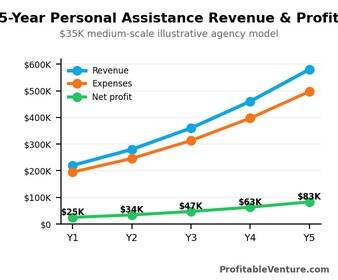
The agency is projected to generate approximately $220,000 in first-year revenue.
c. Five-Year Revenue and Profit Projection
The projection assumes the company gradually develops recurring clients, adds assistants as demand justifies it, improves scheduling efficiency, and increases the proportion of monthly concierge accounts.
| Fiscal Year | Revenue | Total Expenses | Net Profit | Net Margin |
|---|---|---|---|---|
| Year 1 | $220,000 | $195,000 | $25,000 | 11.4% |
| Year 2 | $280,000 | $246,000 | $34,000 | 12.1% |
| Year 3 | $360,000 | $313,000 | $47,000 | 13.1% |
| Year 4 | $460,000 | $397,000 | $63,000 | 13.7% |
| Year 5 | $580,000 | $497,000 | $83,000 | 14.3% |
Under this example, cumulative five-year revenue would reach approximately $1.9 million, while cumulative projected net profit would be approximately $252,000.
d. Sample Five-Year Profit and Loss Projection
| Item | Year 1 | Year 2 | Year 3 | Year 4 | Year 5 |
|---|---|---|---|---|---|
| Revenue | $220,000 | $280,000 | $360,000 | $460,000 | $580,000 |
| Assistant Wages and Payroll | $110,000 | $138,000 | $180,000 | $235,000 | $300,000 |
| Travel and Mileage | $15,000 | $18,000 | $23,000 | $29,000 | $36,000 |
| Insurance and Bonding | $6,000 | $7,000 | $8,000 | $9,000 | $10,000 |
| Software, Phones and Technology | $8,000 | $10,000 | $12,000 | $15,000 | $18,000 |
| Marketing and Customer Acquisition | $16,000 | $18,000 | $22,000 | $25,000 | $30,000 |
| Recruiting and Background Screening | $7,000 | $8,000 | $10,000 | $12,000 | $15,000 |
| Office and Administration | $12,000 | $14,000 | $16,000 | $19,000 | $22,000 |
| Licensing and Professional Fees | $5,000 | $5,000 | $6,000 | $6,000 | $7,000 |
| Payment Processing | $6,000 | $8,000 | $10,000 | $13,000 | $16,000 |
| Other Operating Expenses | $10,000 | $20,000 | $26,000 | $34,000 | $43,000 |
| Total Expenses | $195,000 | $246,000 | $313,000 | $397,000 | $497,000 |
| Projected Net Profit | $25,000 | $34,000 | $47,000 | $63,000 | $83,000 |
e. How Much Profit Do Personal Assistance Business Owners Make a Year?
There is no single amount that applies to every owner. A solo assistant with very little overhead may keep a relatively large percentage of revenue but is limited by the number of hours one person can work.
An agency can generate much greater revenue but must pay employees and support additional administration.
Using the medium-scale model above, projected business profit begins at approximately $25,000 in Year 1 and grows toward approximately $83,000 in Year 5.
The owner’s actual personal income depends on whether the owner also performs billable work, receives a salary, takes distributions, and reinvests money into expansion.
f. What Factors Determine the Amount of Profit to Be Made?
- Hourly billing rate
- Number of assistants
- Billable hours per assistant
- Employee wages
- Payroll burden
- Travel time
- Service-area size
- Recurring customers
- Monthly memberships
- Executive clients
- Customer retention
- Insurance
- Marketing costs
- Scheduling efficiency
- Employee turnover
- Amount of non-billable administrative work.
g. What is the Profit Margin of a Personal Assistance Business?
Net margins vary depending on whether the owner works alone or runs an employee-based agency.
Calculate your own margin using:
Net Profit Margin = Net Profit ÷ Total Revenue × 100.
The medium-scale agency model in this article begins at approximately 11% and gradually improves toward approximately 14%. This is an illustrative planning target rather than an industry guarantee.
h. What is the Sales Forecast?
- First Fiscal Year: $220,000
- Second Fiscal Year: $280,000
- Third Fiscal Year: $360,000
- Fourth Fiscal Year: $460,000
- Fifth Fiscal Year: $580,000.
-
Set Up Your Office and Service Operation
a. How Do You Choose a Perfect Location for a Personal Assistance Business?
You usually do not need a storefront. Your service territory matters much more than your office address.
Look for an area with enough prospective customers who value time and can afford recurring assistance. Consider:
- Concentration of professionals and executives
- Household income
- Number of small-business owners
- Senior population
- Luxury apartment and condominium communities
- Traffic congestion
- Travel time between neighborhoods
- Parking availability
- Proximity to shopping and service districts
- Competition.
A compact territory can be extremely valuable. If one assistant can serve several clients inside the same neighborhood, you reduce mileage and wasted travel time.
b. What State and City is Best to Start a Personal Assistance Business?
There is no universally best city. Markets with large professional populations, busy households, growing numbers of entrepreneurs, and higher-income neighborhoods may be worth researching. Examples include:
- Dallas, Texas
- Austin, Texas
- Atlanta, Georgia
- Charlotte, North Carolina
- Nashville, Tennessee
- Miami, Florida
- Denver, Colorado
- Phoenix, Arizona
- Boston, Massachusetts
- Seattle, Washington.
The right neighborhood is more important than appearing in a famous city.
c. What Equipment is Needed to Operate a Personal Assistance Business?
- Laptop computers
- Smartphones
- Reliable internet connection
- Printer/scanner where needed
- Scheduling software
- CRM system
- Secure cloud storage
- Password manager
- Bookkeeping software
- Expense-management software
- Online payment system
- Business phone system
- Reliable vehicle where local errands are offered
- Vehicle phone mount
- Portable charger
- Lockable document case where appropriate
- Basic office supplies.
Security deserves particular attention. Assistants may have access to client addresses, schedules, gate codes, travel dates, phone numbers, and personal documents.
Do not store sensitive information casually in text messages, notebooks left inside cars, or personal email accounts.
-
Hire Employees
Hiring is one of the most important parts of scaling this business. You are not merely hiring someone to complete tasks.
You are giving that person access to relationships built on trust. Screen candidates carefully. Depending on the position and applicable law, your process may include:
- Structured interviews
- Reference checks
- Background screening
- Driving-record checks for driving positions
- Identity verification
- Skills tests
- Confidentiality agreements
- Trial or supervised assignments.
Train employees on how you expect clients to be treated. Topics should include confidentiality, expense handling, receipts, entering homes, key management, scheduling, late arrivals, emergency procedures, client communication, personal boundaries, and situations they are not authorized to handle.
You should also make it clear that an assistant is never required to perform something illegal, unsafe, or outside the company’s approved service scope simply because a client requests it.
Another major issue is reliability. If an assistant cancels at the last minute, the client does not care that the employee disappointed you.
The client sees your company as the one that failed. Develop backup staffing as soon as your customer base becomes large enough to justify it.
-
Launch the Business Proper
You do not need an expensive grand opening. A service business is better launched by acquiring several manageable clients and perfecting the operating system.
Begin with customers whose needs fit your intended service model. Document every recurring preference.
- Which grocery store does the client prefer?
- How should receipts be delivered?
- Who is authorized to enter the house?
- Which appointments require confirmation?
- What should the assistant do if a purchase exceeds the agreed budget?
Creating these procedures early reduces confusion later. Ask initial clients for feedback and reviews after you have demonstrated consistent service. Referrals can then become an important source of new customers.
a. What Makes a Personal Assistance Business Successful?
- Reliability – Do what you promised when you promised it.
- Trust – Clients must feel safe giving you access to their personal lives.
- Discretion – Do not discuss clients casually.
- Strong communication – Confirm requests and report problems quickly.
- Good employees – One poor assistant can damage several client relationships.
- Clear boundaries – Know which services you will and will not perform.
- Accurate expense records – Clients should always understand how their money was spent.
- Scheduling efficiency – Reduce unnecessary travel between clients.
- Recurring customers – Weekly and monthly clients create stability.
- Professionalism – Appearance, communication, invoicing, and documentation matter.
- Security – Protect customer information and property carefully.
b. What Happens During a Typical Day at a Personal Assistance Business?
A typical day may begin by reviewing client requests and confirming the assistant schedule.
One assistant may start by collecting groceries for a family before delivering them to the client’s home.
Another may pick up dry cleaning, return several packages, and wait at a property for a repair technician.
A virtual assistant may be managing an executive’s calendar, researching travel options, and confirming restaurant reservations.
Throughout the day, assistants update the scheduling system as tasks are completed.
Receipts are photographed or uploaded immediately. Unexpected issues are communicated to the client.
For example, if an item is unavailable, the assistant should know whether to purchase a substitute or ask first.
The office may also receive new requests and assign them according to location and availability.
At the end of the day, the manager reviews incomplete tasks, expenses, mileage, upcoming appointments, customer messages, and the next day’s schedule.
The owner may still need to recruit employees, issue invoices, review client profitability, market the business, and follow up with prospects.
c. What Skills and Experience Do You Need to Build a Personal Assistance Business?
- Organization – You may manage many unrelated tasks simultaneously.
- Time management – Clients are paying you partly because their own time is valuable.
- Communication – Clear confirmations prevent mistakes.
- Discretion – Personal information should remain private.
- Problem solving – Tasks rarely go exactly as planned.
- Customer service – Clients expect calm, professional assistance.
- Technology skills – Calendars, booking platforms, email, CRM, and expense systems are part of the work.
- Driving and navigation – Important for local concierge work.
- Financial management – You need to distinguish billable work from expensive unproductive time.
- Employee management – Essential when scaling beyond yourself.
- Sales – Trust-based service still has to be marketed.
- Judgment – You need to know when to act independently and when to ask the client.
You do not need years of experience as an executive assistant before starting this type of business.
However, you do need to be the kind of person others can depend on. Start by handling a manageable number of clients.
- Learn how long different errands actually take.
- Track mileage.
- Document client preferences.
- Build checklists.
- Create clear expense procedures.
- Protect passwords and personal information.
Learn to say no when a client requests something outside your service scope.
Most importantly, understand that this business is not really about running errands.
It is about becoming trustworthy enough that someone is willing to hand you part of his or her life and believe that you will manage it responsibly.
If you can build that level of trust while maintaining strong scheduling, clear service boundaries, good employees, disciplined pricing, and professional systems, you can build a successful personal assistance business even if you started with no previous industry experience.