
A personal shopper business helps clients choose, purchase, return, exchange, and sometimes deliver products they either do not have the time, confidence, mobility, or desire to shop for themselves.
The service can be as simple as buying groceries for a busy family or as specialized as helping an executive build a professional wardrobe, sourcing gifts for corporate clients, finding furniture for a new home, purchasing products for an older adult, or tracking down a hard-to-find luxury item.
What the customer is really buying from you is a combination of time, judgment, convenience, and trust. That distinction matters.

If a client gives you a shopping list and a budget and pays you to purchase the products on his or her behalf, you are primarily operating a service business.
If you start buying merchandise with your own money, holding inventory, marking it up, and reselling it to customers, you are moving toward a retail business.
The second model can create additional sales-tax, inventory, return, and product-liability considerations.

For the purpose of this guide, we will concentrate mainly on a service-based personal shopper business.
You can specialize in groceries, clothing, luxury products, gifts, household supplies, furniture, baby items, corporate purchasing, or several categories.
A personal shopper can make money through hourly fees, flat shopping packages, monthly retainers, wardrobe consultations, gift-sourcing fees, delivery charges, rush fees, corporate shopping accounts, and recurring household shopping arrangements.
The business is attractive for a beginner because you do not necessarily need a storefront, expensive equipment, or large inventory.
A reliable vehicle, smartphone, laptop, professional insurance, good organizational skills, and enough working capital may be sufficient to get started.
However, trust is extremely important. You may be handling customer credit cards, budgets, addresses, clothing sizes, family information, shopping preferences, access codes, expensive merchandise, or confidential gift purchases.
A customer may also rely on you to make judgment calls when a requested product is unavailable. The strongest personal shoppers therefore do more than buy things.
They learn what their clients like, understand budgets, communicate clearly, keep receipts, protect customer information, and become consistently reliable.
Steps on How to Start a Personal Shopper Business
-
Conduct Market Research
Before deciding that you will shop for everybody, identify the customers who are most likely to pay you repeatedly. There are several completely different personal-shopping markets.
A grocery shopper serving busy families is operating a different business from a luxury fashion shopper serving executives. The grocery shopper may compete mainly on convenience and speed.
The fashion shopper may compete on taste, style knowledge, relationships with stores, wardrobe planning, and discretion.
Begin by listing three or four customer groups in your area. Examples might include:
- Busy professionals
- High-income households
- Older adults
- Working parents
- Executives
- People who dislike shopping
- Fashion-conscious clients
- Corporate organizations.
Then speak with people who fit those groups. Ask what types of shopping consume their time.
A busy parent may want weekly groceries, household supplies, school items, birthday gifts, and returns handled.
An executive may want clothing selected before business trips, gifts purchased for family members, and household shopping completed.
An older client may want help buying groceries, household goods, clothing, and gifts without relying on family members every week. You should also study how these people solve the problem today.
They may use grocery-delivery apps, department-store stylists, family members, household assistants, delivery services, or online shopping.
Your opportunity may be to provide more personalized service than an app can offer.
For example, a good independent shopper can remember that a customer dislikes under-ripe avocados, prefers a particular coffee brand, wears a certain trouser cut, avoids certain fabrics, or wants gifts that do not look generic.
That accumulated knowledge can become difficult for a competitor to replace.
Geography also matters. If you spend 90 minutes driving between two clients, that time must somehow be paid for.
A profitable local shopping route might involve four households located within the same affluent neighborhood.
A poor route may involve four households scattered across an entire metropolitan area. Map your service territory before creating your prices.
a. Who is the Target Market for a Personal Shopper Business?
- Busy professionals
- Executives
- Entrepreneurs
- High-income households
- Working parents
- Older adults who need non-medical shopping assistance
- People with limited mobility
- Frequent business travelers
- Fashion-conscious consumers
- People preparing for weddings or special occasions
- New parents
- People relocating to a new home
- Real estate professionals purchasing client gifts
- Corporate organizations
- Hotels and hospitality companies
- Busy small-business owners
- People who need gifts sourced and delivered.
b. Is a Personal Shopper Business Profitable?
Yes, a personal shopper business can be profitable because the initial investment can be relatively small.
A solo operator may work from home and avoid paying commercial rent. The business can also produce recurring revenue.
A client who hires you every Thursday to shop for groceries and household products may produce income throughout the year. A fashion client may hire you several times each season.
A business customer may use you monthly to source employee gifts, executive gifts, event items, or customer appreciation packages. Profitability depends heavily on how much of your working day is billable.
If you charge $50 per hour but spend three unpaid hours each day driving, preparing lists, handling returns, and doing administration, your real earning rate may be much lower than it appears.
You therefore need to price travel, research, returns, delivery, waiting time, and other work appropriately.
c. Are There Existing Niches in the Industry?
Yes. Personal shopping can be divided into several profitable niches.
- Grocery personal shopping
- Fashion personal shopping
- Executive wardrobe shopping
- Luxury personal shopping
- Gift shopping
- Corporate gift sourcing
- Wedding shopping
- Baby and maternity shopping
- Senior personal shopping
- Household shopping
- Furniture and home décor sourcing
- Beauty and cosmetics shopping
- Holiday shopping
- Travel wardrobe shopping
- Special-event outfit shopping
- Online personal shopping
- Hard-to-find product sourcing
- Closet refresh and wardrobe shopping.
A clear niche can help you charge more because customers are paying for specialized knowledge rather than simply transportation.
d. Who are the Major Competitors?
Your competition depends on the niche you select. Competitors can include:
- Instacart
- Shipt
- Taskrabbit
- Department-store personal stylists
- Nordstrom personal styling services
- Independent fashion stylists
- Concierge businesses
- Personal assistant companies
- Grocery delivery companies
- Luxury concierge services
- Online retailers
- Corporate gifting companies.
Large shopping platforms can offer speed and convenience. Your advantage is personalization. You can learn the client rather than simply completing the order.
e. Are There County, State, or Federal Regulations for a Personal Shopper Business in the United States?
Yes, although an ordinary personal shopper business is generally regulated as a service business rather than through one nationwide personal-shopper license.
Requirements depend on your state, county, city, business location, and exactly what you sell or do.
You may need a general business license, local registration, assumed-name registration, tax registration, and home-occupation approval if operating from home.
The distinction between shopping for a client and reselling merchandise is important.
If the client owns the merchandise immediately and you are simply reimbursed for purchases plus your service fee, your business model may differ from a company that buys goods into its own inventory and later resells them.
If you operate as a retailer, sales-tax and resale rules may apply. You should therefore explain your transaction structure clearly to your accountant.
Vehicle insurance is another important issue. If you routinely use your personal vehicle for paid shopping and delivery work, do not automatically assume an ordinary personal auto policy covers every business activity.
Discuss your use with an insurance professional. Be especially cautious with regulated products.
Alcohol, tobacco, firearms, prescription products, controlled substances, and similar purchases can involve age restrictions, licensing, delivery restrictions, or other laws.
A new personal shopper business can simply exclude regulated products from its service list until it has confirmed what is legally allowed. Another important issue appears when you start hiring other shoppers.
Do not automatically label them independent contractors simply because they use their own cars. Worker classification depends on the real working relationship.
If your company controls schedules, assigns customers, establishes how the service is performed, supervises workers, and makes personal shopping a central part of the business, obtain proper accounting or legal advice about whether those workers should be treated as employees.
f. Is There a Franchise for a Personal Shopper Business?
Pure personal-shopping franchises are less common than independently owned shopping, concierge, delivery, and personal-assistance businesses.
You may find franchises in related categories such as senior concierge services, errand services, lifestyle management, delivery, and personal assistance.
However, the low startup cost makes independent ownership practical. An independent personal shopper can develop his or her own niche, price structure, customer experience, and local brand without paying franchise royalties. If you consider a franchise, review:
- Initial franchise fee
- Royalty fees
- Territory protection
- Required software
- Marketing fees
- Service restrictions
- Required insurance
- Pricing restrictions
- Contract length
- Renewal requirements.
g. What Do You Need to Start a Personal Shopper Business?
- A defined personal-shopping niche
- A target customer
- Business registration
- Required local licenses
- Business insurance
- Reliable vehicle if providing local shopping
- Smartphone
- Laptop
- Scheduling software
- Payment-processing system
- Expense-management system
- Professional service agreement
- Customer purchase authorization
- Receipt-management system
- Website
- Professional email
- Marketing materials
- Working capital.
-
Choose a Memorable Business Name
Your business name should communicate convenience, taste, trust, or personal attention.
If you plan to serve fashion clients, the brand may need to sound more premium.
If you plan to focus on groceries and household errands, a friendly and practical name may work better. Some personal shopper business name ideas are:
- Picked for You Personal Shopping, LLC
- Personal Cart Shopping Services, LLC
- Right Choice Personal Shopper, LLC
- Shop & Serve Concierge, LLC
- Curated Cart Personal Shopping, LLC
- Perfect Pick Shopping Co., LLC
- My Shopper Concierge, LLC
- Handpicked Personal Shopping, LLC
- Priority Shopper Services, LLC
- Personal Choice Shopping Co., LLC
- The Shopping Hand, LLC
- Style & Cart Personal Shopping, LLC
- Simply Selected Shopping, LLC
- Trusted Shopper Concierge, LLC
- Picked Right Personal Shopping, LLC
- Premier Personal Shopper, LLC
- Daily Cart Concierge, LLC
- Signature Shopping Services, LLC
- Curated Life Shopper, LLC
- ShopRight Personal Concierge, LLC.
Search your state’s business database and investigate potential trademark conflicts before investing in your brand.
-
Register Your Business
a. What Type of Business Structure is Best for a Personal Shopper Business?
Many independent personal shoppers choose a limited liability company. An LLC can separate personal and business affairs while remaining relatively straightforward to operate.
This can be useful when you are handling customer funds, expensive products, deliveries, vehicles, and employees.
However, an LLC does not replace insurance, accurate accounting, good customer agreements, or responsible handling of client money.
b. Steps to Form an LLC
- Choose an available business name
- File LLC formation documents with your state
- Select a registered agent
- Create an operating agreement
- Obtain an EIN where appropriate
- Register for state and local taxes
- Open a business bank account
- Obtain required licenses
- Purchase business insurance
- Maintain required annual filings.
c. What Type of License is Needed to Start a Personal Shopper Business?
Depending on your location and business model, you may need:
- General business license
- Local business registration
- Home occupation permit
- DBA or fictitious-name registration
- Sales-tax registration if reselling taxable merchandise
- Resale certificate if purchasing merchandise for resale
- Employer registrations if hiring workers
- Commercial vehicle documentation where applicable
- Additional licenses if you provide separately regulated services.
d. What Type of Certification is Needed to Start a Personal Shopper Business?
There is no universal personal-shopper certification required throughout the United States. Useful training can include:
- Personal styling
- Fashion merchandising
- Color analysis
- Wardrobe planning
- Customer service
- Luxury retail training
- Professional organizing
- Defensive driving
- Cybersecurity and customer-privacy awareness
- First aid and CPR.
Certification may improve credibility in a specialized niche, but reliability and customer results are usually more important than collecting unnecessary certificates.
e. What Documents are Needed to Start a Personal Shopper Business?
- Business formation documents
- EIN where applicable
- Business license
- Insurance policies
- Client service agreement
- Purchase authorization form
- Expense reimbursement policy
- Return and exchange policy
- Client preference profile
- Confidentiality agreement
- Employee agreements
- Background-check authorizations
- Vehicle records where applicable
- Receipts
- Customer invoices
- Sales-tax records where applicable
- Employee payroll records.
f. Do You Need a Trademark, Copyright, or Patent?
You normally do not need a patent. A trademark may protect your business name, logo, slogan, or branded service package.
Copyright can protect original website copy, photographs, styling guides, shopping guides, videos, checklists, and marketing materials.
If you become known for fashion shopping, your brand and customer list may eventually be far more valuable than your physical equipment.
-
Cost Analysis and Budgeting
a. How Much Does It Cost to Start a Personal Shopper Business?
A personal shopper business can be started relatively inexpensively. A solo shopper working from home and using an existing vehicle may require approximately $2,500 to $8,000.
A medium-scale local agency with several shoppers, background screening, stronger marketing, software, payroll reserves, and broader insurance may require approximately $15,000 to $40,000.
A larger multi-shopper agency serving executives, households, fashion clients, and corporate accounts may require approximately $50,000 to $100,000 or more.
For this guide, we will use:
- Small solo personal shopper business: approximately $5,000
- Medium personal shopping agency: approximately $25,000
- Large multi-shopper agency: approximately $75,000.
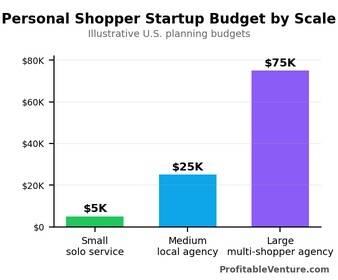
These figures are planning estimates rather than fixed industry costs.
b. What are the Costs Involved in Starting a Personal Shopper Business?
Small Solo Personal Shopper Business – Approximately $5,000
- Business registration and licensing – $400
- Insurance – $700
- Smartphone and basic technology – $500
- Website and branding – $600
- Scheduling and bookkeeping software – $300
- Initial marketing – $800
- Vehicle/business-use setup and supplies – $500
- Working capital – $1,200
- Estimated Total – $5,000.
Medium Personal Shopping Agency – Approximately $25,000
- Working capital reserve – $6,000
- Initial payroll reserve – $5,000
- Marketing and customer acquisition – $4,000
- Insurance and bonding – $2,000
- Website and branding – $2,000
- Scheduling, CRM, expense, and payment software – $2,000
- Laptops and business phones – $2,000
- Transportation setup, legal, licensing, and background checks – $2,000
- Estimated Total – $25,000.
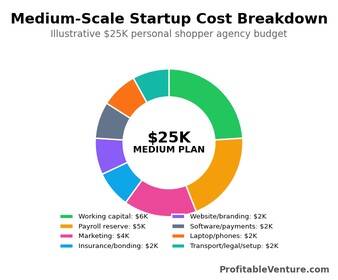
This is the model used for the detailed financial projection.
Large Multi-Shopper Agency – Approximately $75,000
- Payroll reserve – $25,000
- Marketing and sales – $12,000
- Working capital – $10,000
- Insurance and bonding – $6,000
- Software and technology – $5,000
- Phones and computers – $5,000
- Recruiting and background screening – $4,000
- Legal, licensing, and accounting setup – $3,000
- Transportation and operating equipment – $3,000
- Office setup – $2,000
- Estimated Total – $75,000.
c. What Factors Determine the Cost of Starting a Personal Shopper Business?
- Whether you work alone
- Number of shoppers
- Type of clients served
- Insurance requirements
- Vehicle use
- Service territory
- Background screening
- Technology
- Marketing budget
- Office requirements
- Working capital
- Whether you hold merchandise for resale.
d. Do You Need to Build a Facility? If YES, How Much Will It Cost?
No. A solo personal shopper generally does not need a storefront or commercial office.
You can manage scheduling, customer profiles, invoices, receipts, and marketing from a home office if local rules permit.
Most of your work takes place inside stores, online, at customer homes, or while traveling between locations.
A small office can become useful once you hire several shoppers, but do not rent one simply to look established.
e. What are the Ongoing Expenses of a Personal Shopper Business?
- Shopper wages
- Payroll taxes
- Workers’ compensation where required
- Mileage reimbursements
- Fuel
- Vehicle expenses
- Business insurance
- Commercial or appropriate business-use auto coverage
- Bonding where used
- Scheduling software
- CRM software
- Expense-management software
- Payment-processing fees
- Phone service
- Website expenses
- Advertising
- Background screening
- Accounting
- Legal fees
- Office expenses.
f. What is the Average Salary of Your Staff?
Pay varies by location, experience, and shopping specialty. A growing agency may employ:
- General Manager
- Client Services Manager
- Personal Shoppers
- Fashion Personal Shoppers
- Luxury Shoppers
- Grocery and Household Shoppers
- Corporate Gift Shoppers
- Scheduling Coordinator
- Customer Service Representative
- Bookkeeper.
Use current wage rates in your city when preparing your payroll plan. Remember that your true employee cost can exceed the hourly wage once payroll taxes, insurance, mileage, recruiting, training, and non-billable time are included.
g. How Do You Get Funding to Start a Personal Shopper Business?
- Personal savings
- Small-business loans
- Business credit
- Business lines of credit
- Family financing
- Business partners
- Starting solo and reinvesting profit
- Prepaid shopping packages
- Monthly client retainers.
Because the startup cost is relatively low, proving the concept as a solo shopper before borrowing heavily is often a sensible approach.
a. Executive Summary
Picked for You Personal Shopping, LLC is a proposed personal shopping and purchasing service based in Dallas, Texas.
The company will help busy professionals, executives, families, older adults, fashion clients, and corporate organizations save time by handling selected shopping responsibilities.
Services will include grocery and household shopping, clothing and wardrobe shopping, gift sourcing, returns and exchanges, special-event shopping, travel wardrobe preparation, home-product sourcing, and corporate gift purchasing.
The business will launch as a medium-scale local agency with approximately $25,000 in startup capital.
Customers will be able to purchase services hourly, through flat-rate shopping packages, or through monthly retainers.
Picked for You will not routinely purchase or deliver regulated products such as alcohol, tobacco, controlled substances, or other restricted items unless management has confirmed all licensing and legal requirements.
Management will emphasize trust, accurate receipts, communication, careful product selection, customer preference records, geographic scheduling efficiency, and recurring client relationships.
The long-term objective is to build a team of professional shoppers serving both household and corporate clients while developing a premium fashion and executive-shopping division.
b. Products and Services
Picked for You Personal Shopping, LLC will offer:
- Grocery shopping
- Household supply shopping
- Clothing shopping
- Wardrobe shopping
- Personal styling support
- Gift shopping
- Corporate gift sourcing
- Baby product shopping
- Holiday shopping
- Wedding and special-event shopping
- Travel wardrobe preparation
- Returns and exchanges
- Home décor sourcing
- Furniture research and shopping
- Online product research
- Hard-to-find product sourcing
- Local delivery
- Monthly personal-shopping memberships.
c. Mission Statement
“At Picked for You Personal Shopping, LLC, our mission is to save clients time and make buying decisions easier by providing dependable, thoughtful, personalized shopping services built around each customer’s budget, preferences, and lifestyle.”
Vision Statement
“Our vision is to build Picked for You into a trusted local personal-shopping brand known for dependable shoppers, excellent judgment, strong customer relationships, and exceptional attention to detail.”
d. Goals and Objectives
The first objective is to develop a base of recurring customers rather than depending entirely on one-time shopping assignments.
Management will encourage qualified customers to use weekly, biweekly, seasonal, or monthly shopping arrangements.
Another objective is to maintain detailed customer preference profiles. For example, a profile may document:
- Preferred clothing brands
- Sizes
- Colors
- Budget limits
- Favorite grocery brands
- Substitution preferences
- Gift preferences
- Stores to avoid
- Delivery instructions.
This information allows the shopper to become more useful over time. The company will also develop strong expense-control procedures so clients always receive receipts and understand exactly what they purchased.
Long-term goals include corporate shopping accounts, executive wardrobe retainers, seasonal fashion services, virtual personal shopping, and expansion into neighboring markets.
e. Organizational Structure
- Owner/General Manager
- Client Services Manager
- Personal Shoppers
- Fashion Shopper/Stylist
- Household Shoppers
- Corporate Gift Shopper
- Scheduling Coordinator
- Marketing Coordinator
- Customer Service Representative
- Bookkeeper/Accountant.
Marketing Plan
a. SWOT Analysis
Strengths
The business requires relatively little physical infrastructure. Personalized service can also create strong customer loyalty.
A shopper who understands a customer’s tastes can become difficult to replace.
Recurring household and executive accounts provide opportunities for predictable revenue.
Weaknesses
The business is labor-intensive. One shopper can only handle a limited number of assignments at once. Travel can also consume billable time.
A poor purchase can damage customer trust, particularly when the client hired you specifically for your judgment.
Opportunities
Opportunities include fashion shopping, executive services, older-adult shopping assistance, corporate gifts, relocation shopping, luxury sourcing, virtual shopping, subscription services, and monthly household retainers.
Threats
Competition includes delivery apps, large retailers, department-store stylists, online shopping, and gig platforms.
Other risks include customer payment disputes, accidents, merchandise theft, employee dishonesty, confidential information leaks, worker-classification mistakes, and increasing vehicle costs.
b. How Do Personal Shopper Businesses Make Money?
- Hourly shopping fees
- Minimum booking fees
- Flat-rate shopping packages
- Monthly retainers
- Fashion and wardrobe consultations
- Gift-sourcing packages
- Corporate shopping accounts
- Rush-service charges
- After-hours shopping
- Delivery fees
- Returns and exchange services
- Travel-shopping packages.
You can also charge for product research. If a client asks you to spend two hours locating the perfect dining table online, that research is part of the service even if you never physically enter a store.
c. Payment Options
- Credit cards
- Debit cards
- ACH transfers
- Online invoices
- Recurring billing
- Corporate invoices
- Prepaid service packages.
Create clear procedures for purchases made with client funds. Do not casually mix customer purchase money with your normal service revenue. Receipts should be retained and provided promptly.
d. Sales and Advertising Strategies
- Create a professional website
- Create a Google Business Profile
- Use LinkedIn to reach executives
- Partner with executive assistants
- Network with personal concierges
- Partner with professional organizers
- Build relationships with real estate agents
- Work with relocation specialists
- Market to luxury apartment communities
- Offer fashion-shopping consultations
- Create holiday gift-shopping packages
- Target busy parents
- Offer referral credits
- Ask satisfied customers for reviews
- Create monthly memberships
- Partner with senior communities for non-medical shopping assistance
- Develop corporate gift-shopping packages.
Trust-based referrals can be extremely valuable. A wealthy customer may be much more comfortable hiring you after receiving a recommendation from an accountant, real estate agent, executive assistant, household manager, or existing client.
Financial Projection
a. How Much Should You Charge for Personal Shopping Services?
Pricing depends on the type of shopping. Buying groceries from one supermarket generally requires less specialized judgment than assembling a complete executive wardrobe. For planning purposes, you might test pricing such as:
- Everyday local shopping: approximately $35 to $55 per hour
- Fashion and specialized shopping: approximately $50 to $90 per hour
- Premium executive or luxury shopping: approximately $75 to $125 or more per hour where the market supports it
- Monthly retainer packages: based on included hours, priority scheduling, and service level.
These are illustrative planning ranges rather than required industry rates. Consider using a minimum booking period.
If you drive 25 minutes to a store and 25 minutes back, a customer should not be able to purchase only 15 minutes of your time.
A two-hour minimum or a flat local-shopping package may protect your economics. You should also decide how mileage and delivery are handled.
Some businesses include local travel within a defined radius and charge additional mileage outside it.
Whatever structure you choose, make it simple enough for customers to understand before they book.
b. How Much Revenue Can a Personal Shopper Business Generate?
Revenue depends on pricing, billable hours, number of shoppers, client retention, and specialization.
For planning purposes:
- Solo personal shopper: approximately $40,000 to $90,000 in annual gross revenue
- Small personal shopping agency: approximately $140,000 to $300,000
- Larger multi-shopper agency: approximately $350,000 to $800,000 or more.
These are illustrative planning ranges rather than guaranteed results.
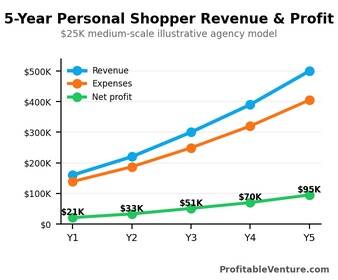
For the detailed projection below, we will use the $25,000 medium-scale agency model.
The agency is projected to generate approximately $160,000 in first-year revenue.
c. Five-Year Revenue and Profit Projection
| Fiscal Year | Revenue | Total Expenses | Net Profit | Net Margin |
|---|---|---|---|---|
| Year 1 | $160,000 | $139,000 | $21,000 | 13.1% |
| Year 2 | $220,000 | $187,000 | $33,000 | 15.0% |
| Year 3 | $300,000 | $249,000 | $51,000 | 17.0% |
| Year 4 | $390,000 | $320,000 | $70,000 | 17.9% |
| Year 5 | $500,000 | $405,000 | $95,000 | 19.0% |
Under this illustrative model, cumulative five-year revenue would be approximately $1.57 million, while cumulative projected net profit would be approximately $270,000.
d. Sample Five-Year Profit and Loss Projection
| Item | Year 1 | Year 2 | Year 3 | Year 4 | Year 5 |
|---|---|---|---|---|---|
| Revenue | $160,000 | $220,000 | $300,000 | $390,000 | $500,000 |
| Shopper Wages and Payroll | $80,000 | $110,000 | $150,000 | $198,000 | $255,000 |
| Mileage, Fuel and Delivery | $14,000 | $18,000 | $23,000 | $29,000 | $36,000 |
| Insurance and Bonding | $5,000 | $6,000 | $7,000 | $8,000 | $10,000 |
| Marketing and Customer Acquisition | $12,000 | $15,000 | $18,000 | $22,000 | $26,000 |
| Software and Payment Processing | $6,000 | $8,000 | $10,000 | $13,000 | $16,000 |
| Phones and Office Expenses | $5,000 | $6,000 | $8,000 | $10,000 | $12,000 |
| Recruiting, Background Checks and Training | $4,000 | $5,000 | $7,000 | $9,000 | $11,000 |
| Legal, Licensing and Accounting | $4,000 | $5,000 | $6,000 | $7,000 | $8,000 |
| Administration and Other Operating Expenses | $9,000 | $14,000 | $20,000 | $24,000 | $31,000 |
| Total Expenses | $139,000 | $187,000 | $249,000 | $320,000 | $405,000 |
| Projected Net Profit | $21,000 | $33,000 | $51,000 | $70,000 | $95,000 |
e. How Much Profit Do Personal Shopper Business Owners Make a Year?
There is no single income level. A solo personal shopper may keep a relatively large percentage of revenue because there are few employees, but one person has a natural limit on the number of billable hours available.
An agency can generate considerably more revenue but has much larger payroll and management expenses.
Using the medium-scale model above, projected business profit begins at approximately $21,000 in Year 1 and increases toward approximately $95,000 in Year 5.
The owner’s personal income may also include compensation for shopping or managing the business, depending on the company’s structure.
f. What Factors Determine the Amount of Profit to Be Made?
- Hourly service rate
- Number of shoppers
- Billable hours
- Average client spend
- Recurring customers
- Monthly retainers
- Travel time
- Service-area size
- Employee wages
- Vehicle expenses
- Customer acquisition cost
- Fashion and premium-shopping revenue
- Corporate accounts
- Shopper productivity
- Customer retention.
g. What is the Profit Margin of a Personal Shopper Business?
Margins depend heavily on labor and travel. Calculate your actual margin using:
Net Profit Margin = Net Profit ÷ Total Revenue × 100.
The medium-scale agency projection in this guide starts at approximately 13% and increases toward approximately 19%.
This is an illustrative financial target rather than a guaranteed industry margin.
h. What is the Sales Forecast?
- First Fiscal Year: $160,000
- Second Fiscal Year: $220,000
- Third Fiscal Year: $300,000
- Fourth Fiscal Year: $390,000
- Fifth Fiscal Year: $500,000.
-
Set Up Your Office and Shopping Operation
a. How Do You Choose a Perfect Location for a Personal Shopper Business?
Your service territory matters much more than having a storefront. Look for areas with customers who value convenience and can afford recurring assistance. Useful characteristics can include:
- High concentration of professionals
- Affluent neighborhoods
- Executive employment centers
- Senior communities
- Luxury apartment buildings
- Strong retail districts
- Good grocery-store access
- Shopping malls and fashion retailers
- Reasonable travel distances
- Convenient parking.
A smaller service radius can dramatically improve profitability. If you can shop for several clients during one trip to the same retail center, your productive time improves.
b. What State and City is Best to Start a Personal Shopper Business?
There is no universally best city. Markets with large professional populations, affluent households, strong retail sectors, corporate employment, and growing senior populations can be worth researching. Examples include:
- Dallas, Texas
- Austin, Texas
- Atlanta, Georgia
- Miami, Florida
- Charlotte, North Carolina
- Scottsdale, Arizona
- Nashville, Tennessee
- Denver, Colorado
- Seattle, Washington
- Boston, Massachusetts.
A wealthy, compact neighborhood in an ordinary metropolitan area may be better than trying to serve an entire famous city.
c. What Equipment is Needed to Operate a Personal Shopper Business?
- Reliable smartphone
- Laptop computer
- Reliable vehicle where local shopping is offered
- Phone mount
- Portable charger
- Insulated grocery bags where needed
- Reusable shopping bags
- Garment bags for fashion shopping
- Scheduling software
- CRM system
- Expense-management software
- Online payment platform
- Business phone number
- Secure cloud storage
- Password manager
- Bookkeeping software.
-
Hire Employees
Do not hire simply because customer demand begins increasing. Hire when you have enough recurring work to support another shopper or when you are regularly turning away profitable assignments.
Your shoppers represent your judgment and reputation. Depending on the position and applicable law, your screening process may include:
- Structured interviews
- Reference checks
- Background screening
- Driving-record checks for driving positions
- Shopping or styling exercises
- Customer-service tests
- Confidentiality agreements
- Supervised trial assignments.
Train shoppers on:
- Receipt handling
- Customer budgets
- Product substitutions
- Returns and exchanges
- Confidentiality
- Customer communication
- Client credit-card procedures
- Expense documentation
- Delivery
- Vehicle safety
- Handling expensive products
- Service boundaries.
One of the most important training areas is substitutions. If the client’s preferred product is unavailable, should the shopper choose an alternative automatically or ask first? The answer may differ between customers. Document those preferences.
-
Launch the Business Proper
You do not need a traditional grand opening. Begin with several carefully selected clients and use those assignments to develop your operating procedures. Before your first job, decide:
- How the client sends a shopping request
- How budgets are approved
- Who pays for merchandise
- How receipts are provided
- What happens when products are unavailable
- How returns are handled
- How travel is charged
- What happens if a customer cancels
- How quickly urgent requests are accepted.
After several assignments, review your actual profitability. You may discover that grocery shopping is profitable when customers live close together but unprofitable when each assignment involves a long drive.
You may discover that gift shopping produces excellent margins because customers value your research and judgment. Use actual results to decide where you should specialize.
a. What Makes a Personal Shopper Business Successful?
- Trust – Customers are giving you responsibility for their money and purchases.
- Good judgment – Especially important in fashion, gifts, and luxury shopping.
- Reliability – Complete assignments when promised.
- Clear communication – Ask before making expensive assumptions.
- Accurate receipts – Customers should understand every purchase.
- Strong client profiles – Remember preferences.
- Efficient routes – Reduce unproductive travel.
- Recurring clients – Predictable work creates stability.
- Professionalism – Treat customer information discreetly.
- Good employees – One careless shopper can damage the brand.
- Profitable pricing – Charge for the entire value of the service.
b. What Happens During a Typical Day at a Personal Shopper Business?
A typical day may begin by reviewing shopping requests and customer budgets.
One shopper may be assigned to three household customers in the same neighborhood.
The shopper visits a grocery store, selects products according to each customer’s preferences, communicates about unavailable items, pays using the approved method, and stores each order separately.
Another shopper may meet a client at a department store to build a wardrobe for an upcoming business trip.
A third employee may be researching anniversary gifts online for a corporate executive.
As purchases are completed, receipts are uploaded immediately. Local deliveries are organized by route.
Returns from previous assignments may also be handled during the same shopping trip.
Back at the office, the scheduling coordinator answers new requests, prepares invoices, updates customer profiles, and assigns work.
The owner may be speaking with prospective executive clients, reviewing shopper utilization, monitoring mileage, checking customer feedback, recruiting staff, and developing partnerships.
c. What Skills and Experience Do You Need to Build a Personal Shopper Business?
- Customer service – You need to understand what people actually want.
- Organization – Mixing up two customers’ purchases is unacceptable.
- Time management – Efficient shopping determines profitability.
- Communication – Product substitutions need clear decisions.
- Product knowledge – More important in specialized shopping niches.
- Fashion sense – Essential if offering wardrobe shopping.
- Budget management – Respect the client’s spending limits.
- Discretion – High-profile or wealthy clients may value privacy greatly.
- Technology – Scheduling, receipts, payments, and customer profiles need systems.
- Driving and navigation – Important in local shopping.
- Sales – You need to attract recurring clients.
- Financial management – Understand what each assignment actually earns.
You do not need previous retail experience to start a personal shopper business.
However, you should test the service before trying to build a large agency. Take several real assignments.
- Time yourself from the moment you leave until the final delivery is completed.
- Track mileage.
- Record how much time substitutions take.
- Measure how long returns require.
- Calculate your real hourly profit.
- Then improve the system.
- Create customer profiles.
- Group clients geographically.
- Introduce minimum bookings.
- Build recurring packages.
- Develop a clear system for receipts and purchasing.
Most importantly, understand that anyone can walk into a store and buy something.
A professional personal shopper is paid because the customer trusts that the right product will be selected, the budget will be respected, the task will be completed properly, and the client will get several hours of life back.
If you can provide that level of convenience consistently while maintaining strong customer relationships, efficient routes, good financial controls, and trustworthy employees, you can build a successful personal shopper business even if you started with no previous industry experience.