

A physical therapy practice is an outpatient healthcare business that helps patients recover movement, reduce pain, rebuild strength, improve balance, regain function after surgery or injury, and manage physical limitations caused by illness, aging, neurological conditions, or musculoskeletal problems.
Your practice may treat patients recovering from:
- Back and neck pain
- Knee injuries
- Shoulder injuries
- Hip replacement
- Knee replacement
- Sports injuries
- Car accidents
- Workplace injuries
- Stroke
- Neurological disorders
- Balance problems
- Chronic pain
- Post-surgical weakness
- Pelvic-floor conditions
- Age-related mobility problems.

The business can be attractive because physical therapy is usually delivered over multiple visits rather than one appointment.
A patient recovering from knee surgery, for example, may attend therapy two or three times per week for several weeks.
This creates recurring revenue while allowing your clinical team to develop long-term relationships with patients.
However, opening a physical therapy practice is different from starting an ordinary service business.
You are operating a healthcare practice. That means you need to pay attention to:
- Professional licensure
- State practice laws
- Practice ownership rules
- Patient privacy
- Clinical documentation
- Medicare requirements
- Insurance credentialing
- Billing and coding
- Medical necessity
- Professional liability
- Employee supervision.
You cannot provide physical therapy simply because you own the clinic.
Every clinician providing physical therapy must have the appropriate professional license.
In addition, some states restrict who may own a professional healthcare practice or require practices to use a professional corporation, professional LLC, or another specific structure.
Before forming the company, determine whether your state permits non-physical-therapist ownership and what type of entity the licensing board allows.
The good news is that you do not need to start with an enormous rehabilitation center.
A well-designed outpatient practice occupying approximately 1,800 to 2,500 square feet can accommodate treatment tables, private evaluation space, exercise equipment, reception, staff work areas, and a reasonably sized rehabilitation gym.
Your first goal should be to build a clinic that consistently produces excellent patient outcomes and fills therapists’ schedules—not a huge facility with expensive equipment sitting unused.
Steps on How to Start a Physical Therapy Practice
-
Conduct Market Research
Your market research should begin with patients rather than equipment. Before signing a lease, determine who is likely to use the clinic.
Study the population within approximately a 10- to 15-minute driving radius. Look for:
- Population size
- Age distribution
- Income levels
- Insurance coverage
- Hospitals
- Orthopedic practices
- Primary-care physicians
- Urgent-care centers
- Sports facilities
- Schools
- Gyms
- Senior communities
- Large employers.
Then identify existing physical therapy clinics. Do not simply count them. Research what each one does. For example:
- Do they specialize in sports?
- Do they treat neurological patients?
- Do they offer pelvic-floor therapy?
- Do they accept Medicare?
- Do they accept major commercial insurers?
- Do they offer cash-pay treatment?
- How many therapists work there?
- What are their opening hours?
- How quickly can a new patient get an appointment?
- What do patients complain about in reviews?
If every clinic in your market has a two-week waiting list, that may indicate unmet demand.
If seven clinics within three miles are competing for the same orthopedic patients, you need a clearer differentiation strategy.
a. Who is the Target Market?
Your patients may include:
- Adults recovering from surgery
- People with back and neck pain
- Athletes
- Children
- Older adults
- People recovering from stroke
- Patients with neurological disorders
- People with balance disorders
- Workers injured on the job
- Accident victims
- Pregnant and postpartum patients
- People managing chronic pain
- Patients seeking performance or mobility services.
Your referral and payer markets may also include:
- Orthopedic surgeons
- Primary-care physicians
- Neurologists
- Pain-management physicians
- Sports-medicine doctors
- Workers’ compensation networks
- Employers
- Schools
- Sports organizations
- Medicare
- Commercial insurance companies.
b. Is a Physical Therapy Practice Profitable?
Yes, a properly managed outpatient physical therapy practice can be profitable.
However, profitability depends heavily on therapist productivity and reimbursement. A therapist can treat only a limited number of patients each day.
This means labor is both your most important resource and one of your largest costs.
Suppose your clinic collects an average of $115 per completed patient visit.
If two therapists together complete 20 visits per day and work 240 clinical days per year:
20 visits × $115 × 240 days = $552,000 in annual collected revenue.
That is before considering cancellations, credentialing delays, unpaid claims, administrative days, or additional services. Your profit depends on what remains after paying:
- Therapist salaries
- PTA salaries
- Front-office payroll
- Rent
- Billing costs
- Equipment
- Insurance
- Software
- Marketing
- Medical supplies
- Taxes and professional expenses.
One of your most important metrics will therefore be: Collected Revenue per Clinical Hour. You should also monitor:
- Visits per therapist per day
- Cancellation/no-show percentage
- Average collected revenue per visit
- New patient evaluations per week
- Visits per episode of care
- Accounts receivable days
- Denial rate
- Patient retention
- Referral-source concentration.
c. What Niches Exist in Physical Therapy?
Possible niches include:
- General orthopedic physical therapy
- Sports rehabilitation
- Pediatric physical therapy
- Geriatric physical therapy
- Neurological rehabilitation
- Vestibular rehabilitation
- Pelvic-health physical therapy
- Post-surgical rehabilitation
- Hand rehabilitation
- Chronic-pain rehabilitation
- Balance and fall-prevention programs
- Industrial/workplace rehabilitation
- Cash-pay sports performance
- Home-based physical therapy
- Mobile physical therapy.
The most profitable niche is not automatically the one charging the highest price.
Choose a niche where you have enough potential patients, suitable clinicians, good referral opportunities, and reimbursement that supports your operating costs.
d. Who are the Major Competitors?
Your competitors may include:
- Independent outpatient physical therapy practices
- Hospital-owned outpatient rehabilitation centers
- Physician-owned therapy practices where allowed
- Large regional physical therapy groups
- National rehabilitation companies
- Sports-performance facilities
- Home-health providers
- Cash-pay mobile therapists.
You do not need to compete only on price. A smaller clinic can compete through:
- Faster scheduling
- Longer individual treatment time
- Specialized therapists
- Better communication
- Early-morning appointments
- Evening appointments
- Low cancellation rates
- Strong patient education
- Better measured outcomes
- Convenient location.
e. Are There State and Federal Regulations?
Yes. Physical therapy is regulated at the state level. Every therapist should hold the license required in the state where the patient is treated. State rules can govern:
- Scope of physical therapy practice
- Direct access
- Use of physical therapist assistants
- Professional ownership
- Supervision
- Documentation
- Continuing education
- Specific procedures.
Every state now permits some form of direct patient access to physical therapy, but the conditions are not identical.
Some states allow broad direct access, while others impose conditions such as treatment-duration limits or requirements that the therapist refer the patient to another healthcare professional in particular circumstances.
Insurance companies can also maintain their own authorization, referral, or network requirements even when state law permits direct access. This means you should never assume:
“State law says direct access, therefore every insurer must pay the claim.”
Those are two different questions.
Medicare
If you intend to treat Medicare patients and bill Medicare directly, your clinicians and organization need to complete the appropriate enrollment process.
Medicare physical therapy also comes with detailed requirements involving:
- Evaluations
- Plans of care
- Plan certification where applicable
- Progress documentation
- Treatment notes
- Medical necessity
- Coding
- Annual therapy billing thresholds.
Documentation is not a minor administrative task. A clinic can perform excellent treatment and still lose reimbursement because documentation does not support the claim.
HIPAA and Patient Privacy
If your practice qualifies as a HIPAA-covered entity, you need appropriate privacy and security controls. This can include:
- HIPAA privacy policies
- Security procedures
- Employee training
- Notice of Privacy Practices
- Secure patient records
- Business associate agreements
- Secure email and communications
- Access controls
- Data backup
- Breach-response procedures.
f. Is There a Franchise for a Physical Therapy Practice?
Yes. Physical therapy and rehabilitation franchise opportunities exist. A franchise can provide:
- Brand recognition
- Operating procedures
- Marketing systems
- Billing support
- Recruitment assistance
- Site-selection support
- Training.
The disadvantages can include:
- Initial franchise fees
- Royalty payments
- Marketing fees
- Territory restrictions
- Reduced flexibility.
You can review our physical therapy franchise opportunities if you want to compare the franchise route with starting independently.
g. What Do You Need to Start?
- Licensed physical therapists
- Legal business entity
- Professional/entity approvals where required
- NPI numbers
- Business bank account
- Professional liability insurance
- General liability insurance
- Workers’ compensation
- Clinic facility
- Treatment tables
- Exercise equipment
- EMR system
- Billing system
- HIPAA-compliant technology
- Insurance credentialing
- Patient forms
- Clinical documentation procedures
- Employees
- Working capital.
-
Choose a Memorable Business Name
A strong practice name should sound professional, trustworthy, and suitable for future expansion. Some ideas include:
- MotionBridge Physical Therapy, PLLC
- RestorePoint Physical Therapy, PLLC
- Peak Motion Rehabilitation, PLLC
- MoveWell Physical Therapy, PLLC
- ActivePath Rehabilitation, PLLC
- CoreMotion Physical Therapy, PLLC
- Revive Physical Therapy & Rehab, PLLC
- Mobility Works Physical Therapy, PLLC
- Forward Motion Rehabilitation, PLLC
- Renew Physical Therapy Center, PLLC
- MotionFirst Physical Therapy, PLLC
- Better Movement Rehab, PLLC
- Restore Mobility Physical Therapy, PLLC
- Peak Recovery Physical Therapy, PLLC
- TrueMotion Rehabilitation, PLLC
- NextStep Physical Therapy, PLLC
- Stronger Steps Rehabilitation, PLLC
- ActiveLife Physical Therapy, PLLC
- MotionCare Rehabilitation, PLLC
- Performance Path Physical Therapy, PLLC.
The PLLC designation is only illustrative. Your state may require or permit a PLLC, professional corporation, ordinary LLC, or another structure.
Check the professional-board and business-entity requirements before registering the name.
-
Register Your Physical Therapy Practice
a. What Business Structure is Best?
This is one area where you should not automatically create a standard LLC before checking professional-practice law. Depending on the state, your practice may operate as:
- Sole proprietorship
- Professional LLC
- Professional corporation
- Partnership
- Other permitted professional entity.
Some states also restrict ownership to licensed professionals. Others permit different arrangements.
If an ordinary LLC is permitted and suitable for your circumstances, here’s how to form an LLC in the United States.
b. Typical Business Formation Steps
- Confirm professional ownership requirements
- Choose the permitted entity structure
- Register the practice
- Obtain an EIN
- Apply for organizational and individual NPIs where applicable
- Open the business bank account
- Purchase insurance
- Apply for local business permits
- Enroll with Medicare if appropriate
- Credential with commercial payers
- Set up billing and compliance systems.
c. What Licenses and Registrations are Needed?
Depending on your state and business model:
- Physical therapist licenses
- PTA licenses where applicable
- Professional entity registration
- General business license
- Certificate of occupancy
- Local zoning approval
- NPI registration
- Medicare enrollment
- Medicaid enrollment where applicable
- Commercial insurance credentialing
- Workers’ compensation provider enrollment where appropriate.
d. What Certifications are Useful?
Clinical certifications are not substitutes for state licensure, but specialized credentials can support your niche. Examples may include expertise in:
- Orthopedics
- Sports
- Neurology
- Geriatrics
- Pediatrics
- Cardiovascular and pulmonary therapy
- Women’s/pelvic health
- Wound management
- Clinical electrophysiology.
e. What Documents Do You Need?
- Business formation documents
- EIN
- NPI information
- Professional licenses
- Lease agreement
- Insurance policies
- Medicare enrollment documents
- Payer contracts
- Credentialing files
- Patient intake forms
- Consent forms
- HIPAA Notice of Privacy Practices
- Financial policy
- Cancellation policy
- Plan-of-care documentation
- Evaluation templates
- Progress-note templates
- Discharge documentation
- Employee records
- Compliance policies.
f. What Insurance Should You Carry?
Potential coverage includes:
- Professional liability/malpractice insurance
- General liability
- Commercial property
- Workers’ compensation
- Cyber liability
- Business interruption
- Employment-practices coverage.
-
Cost Analysis and Budgeting
a. How Much Does It Cost to Start a Physical Therapy Practice?
Your startup cost depends heavily on whether you operate as a mobile/cash practice or build a fully equipped outpatient clinic.
For planning purposes:
- Small mobile or lean cash-pay practice: approximately $15,000 – $60,000
- Medium outpatient clinic: approximately $100,000 – $250,000
- Large multi-therapist rehabilitation practice: approximately $350,000 – $750,000+.
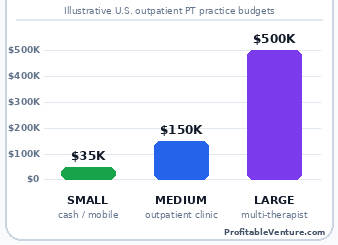
For this guide, we will model:
- Small: $35,000
- Medium: $150,000
- Large: $500,000.
You can compare this model with our separate breakdown of the cost of opening a physical therapy business.
b. Small Cash-Pay or Mobile Practice – Approximately $35,000
- Portable clinical equipment – $6,000
- EMR, billing, website, and technology – $5,000
- Professional/legal/licensing costs – $4,000
- Insurance – $3,000
- Vehicle/travel setup – $4,000
- Marketing – $4,000
- Supplies – $2,000
- Working capital – $7,000
- Total – $35,000.
c. Medium Outpatient Clinic – Approximately $150,000
- Working capital and payroll reserve – $35,000
- Lease deposit and clinic buildout – $35,000
- Clinical and exercise equipment – $30,000
- EMR, billing, computers, and technology – $10,000
- Professional liability, general insurance, licensing, and legal setup – $10,000
- Launch marketing – $10,000
- Reception, office furniture, and patient seating – $8,000
- Credentialing, initial supplies, training, and miscellaneous startup costs – $12,000
- Total – $150,000
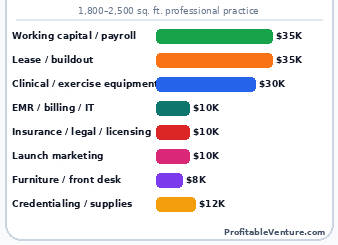
This is the business model used in the financial projections below.
d. Large Multi-Therapist Practice – Approximately $500,000
- Large clinic buildout and lease reserve – $120,000
- Clinical and rehabilitation equipment – $100,000
- Payroll and working capital – $120,000
- Technology and billing systems – $30,000
- Insurance, legal, compliance, and credentialing – $30,000
- Furniture and reception – $25,000
- Marketing – $30,000
- Supplies and specialized equipment – $25,000
- Contingency reserve – $20,000
- Total – $500,000.
e. What Determines Startup Cost?
- Clinic square footage
- Number of therapists
- Rent
- Buildout
- Exercise equipment
- Specialized treatment equipment
- Technology
- Insurance
- Credentialing
- Payroll reserve
- Marketing.
f. What are the Ongoing Expenses?
- Clinical salaries
- Administrative payroll
- Rent
- Utilities
- EMR
- Billing
- Card-processing fees
- Insurance
- Medical supplies
- Equipment maintenance
- Credentialing
- Continuing education
- Marketing
- Accounting
- Compliance
- Cleaning.
g. What Salaries Should You Budget?
Actual compensation varies substantially by region and experience. For planning purposes, reasonable budgeting ranges may include:
- Physical Therapist: approximately $90,000 – $130,000+
- Clinic Director: approximately $105,000 – $150,000+
- Physical Therapist Assistant: approximately $55,000 – $80,000
- Physical Therapy Aide: approximately $32,000 – $48,000
- Front Desk/Patient Coordinator: approximately $35,000 – $50,000
- Billing Specialist: approximately $42,000 – $65,000.
Use local wage data when building your actual budget.
h. How Do You Fund the Practice?
- Personal savings
- SBA-backed loan
- Bank loan
- Business line of credit
- Equipment financing
- Business partner
- Private investor where legally appropriate
- Starting cash-pay/mobile and reinvesting profits.
Remember that insurance credentialing and reimbursement can take time. A clinic may have payroll due this Friday while an insurer does not pay the corresponding claims for several more weeks. Do not underestimate working capital.
-
Write a Business Plan
a. Executive Summary
MotionBridge Physical Therapy & Rehabilitation, PLLC is a proposed outpatient physical therapy practice in Columbus, Ohio.
The clinic will operate from approximately 2,200 square feet of leased medical/retail space. MotionBridge will initially focus on:
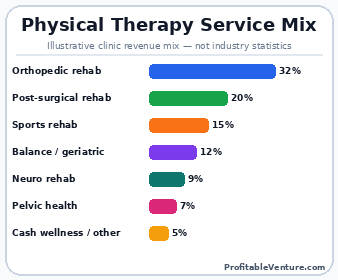
- Orthopedic rehabilitation
- Post-surgical therapy
- Sports injuries
- Back and neck pain
- Balance and fall prevention
- Geriatric rehabilitation.
The clinic will use a mixed-payer model consisting of commercial insurance, Medicare, workers’ compensation where appropriate, and selected cash-pay services.
MotionBridge will launch with approximately $150,000 in startup capital.
The clinic will differentiate itself through fast new-patient scheduling, measurable outcomes, individualized treatment, strong communication with referring providers, evening appointment availability, and efficient insurance administration.
b. Products and Services
MotionBridge will provide:
- Physical therapy evaluations
- Therapeutic exercise
- Functional training
- Gait training
- Balance training
- Neuromuscular re-education
- Manual therapy where clinically appropriate
- Post-operative rehabilitation
- Sports rehabilitation
- Fall-prevention programs
- Home exercise programs
- Patient education
- Cash-pay wellness and mobility services within scope.
c. Mission Statement
“At MotionBridge Physical Therapy & Rehabilitation, our mission is to help patients regain movement, confidence, strength, and independence through evidence-informed physical therapy, individualized treatment, measurable outcomes, compassionate care, and clear communication.”
Vision Statement
“Our vision is to become one of the most trusted outpatient rehabilitation practices in our community, known for excellent clinical outcomes, convenient access, responsible healthcare management, and patients who confidently recommend us to their families and friends.”
d. Goals and Objectives
The first goal is to fill therapist schedules without sacrificing clinical quality. The practice will monitor:
- New evaluations per week
- Completed visits
- Visits per clinician
- Cancellation rate
- Patient outcomes
- Patient satisfaction
- Average reimbursement per visit
- Insurance denial rate
- Accounts receivable days
- Referral sources.
A second objective is to prevent dependence on one referral source. If one orthopedic group provides 50% of your patients and later opens its own therapy department, your clinic could lose half its pipeline. Build multiple referral and direct-access channels.
e. Organizational Structure
- Owner/Managing Physical Therapist
- Clinic Director
- Staff Physical Therapists
- Physical Therapist Assistants
- Physical Therapy Aides where appropriate
- Patient Care Coordinator
- Billing/Credentialing Specialist
- Bookkeeper/Accountant.
Marketing Plan
a. SWOT Analysis
Strengths
Physical therapy serves patients who often require multiple visits, which supports recurring revenue.
Strong outcomes can also generate physician referrals, patient referrals, and repeat episodes of care.
Weaknesses
Revenue is labor intensive. A therapist has a limited number of productive treatment hours.
Insurance reimbursement and administrative requirements can also place pressure on margins.
Opportunities
Opportunities include:
- Direct-access patients
- Sports partnerships
- Pelvic health
- Balance/fall prevention
- Employer contracts
- Cash-pay wellness
- Home visits
- Additional clinic locations.
Threats
Threats include:
- Insurance reimbursement reductions
- Therapist shortages
- Hospital competition
- Large rehabilitation chains
- Rising payroll
- Payer audits
- Documentation problems
- High denial rates.
b. How Does a Physical Therapy Practice Make Money?
Revenue can come from:
- Commercial health insurance
- Medicare
- Medicaid where enrolled
- Workers’ compensation
- Auto insurance where applicable
- Cash-pay physical therapy
- Cash wellness programs
- Sports-performance services within permitted scope
- Employer contracts.
c. Payment Options
- Insurance billing
- Credit cards
- Debit cards
- HSA/FSA payments where eligible
- Cash
- Online payment portal
- Employer contracts.
d. How Do You Market a Physical Therapy Practice?
Your marketing strategy can include:
- Google Business Profile
- Local search optimization
- Patient reviews
- Educational website content
- Orthopedic referral relationships
- Primary-care outreach
- Sports-club relationships
- Gym relationships
- Senior-community education
- Employer injury-prevention programs
- Community workshops
- Direct-access advertising
- Patient referral campaigns that comply with applicable laws.
Do not pay healthcare professionals for patient referrals in arrangements that violate healthcare fraud-and-abuse laws.
Build referral relationships around service quality, communication, access, and outcomes.
Communicate With Referring Providers
A physician who refers a patient should not wonder what happened to that patient.
With appropriate authorization and privacy controls, provide clinically useful updates when appropriate. Make it easy for referral offices to:
- Send records
- Schedule patients
- Receive updates
- Contact your clinical team.
Financial Projection
a. How Much Should You Charge?
If you operate a cash-pay practice, illustrative price ranges may include:
- Initial physical therapy evaluation: $150 – $250
- Follow-up treatment: $100 – $175
- Specialized sports/performance session: $125 – $225
- Wellness/mobility session: $100 – $200.
Pricing varies by market, specialization, session length, and clinician expertise.
Insurance-based practices work differently. Your listed charge is not necessarily what you collect.
If your standard charge is $180 and your contracted payer allows $112 for the service, your revenue is based primarily on the contracted allowed amount and applicable patient responsibility—not the $180 sticker price.
This is why your financial model should use expected collected revenue, not your fee schedule.
b. How Much Revenue Can a Physical Therapy Practice Generate?
For planning purposes:
- Solo/mobile practice: approximately $100,000 – $250,000 annually
- Small outpatient clinic: approximately $300,000 – $700,000
- Established multi-therapist clinic: approximately $700,000 – $2 million+
- Multi-location operation: potentially several million dollars.
These are planning ranges rather than guaranteed industry averages.
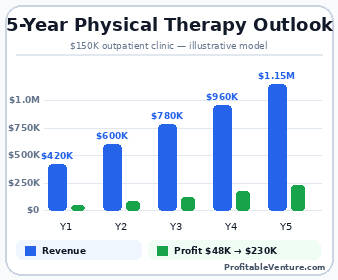
c. Five-Year Revenue and Profit Projection
| Fiscal Year | Revenue | Operating Expenses | Net Profit | Net Margin |
|---|---|---|---|---|
| Year 1 | $420,000 | $372,000 | $48,000 | 11.4% |
| Year 2 | $600,000 | $516,000 | $84,000 | 14.0% |
| Year 3 | $780,000 | $655,000 | $125,000 | 16.0% |
| Year 4 | $960,000 | $787,000 | $173,000 | 18.0% |
| Year 5 | $1,150,000 | $920,000 | $230,000 | 20.0% |
Under this model, cumulative five-year revenue would be approximately $3.91 million. Cumulative projected net profit would be approximately $660,000.
d. Sample Five-Year Profit and Loss Projection
| Item | Year 1 | Year 2 | Year 3 | Year 4 | Year 5 |
|---|---|---|---|---|---|
| Revenue | $420,000 | $600,000 | $780,000 | $960,000 | $1,150,000 |
| Clinical Payroll | $175,000 | $260,000 | $340,000 | $420,000 | $510,000 |
| Rent and Occupancy | $48,000 | $50,000 | $52,000 | $54,000 | $56,000 |
| Billing, Collections and Payment Processing | $32,000 | $45,000 | $58,000 | $70,000 | $82,000 |
| Equipment and Maintenance | $18,000 | $20,000 | $24,000 | $28,000 | $32,000 |
| Insurance, Licensing and Compliance | $12,000 | $13,000 | $15,000 | $17,000 | $19,000 |
| EMR, IT and Communications | $9,000 | $10,000 | $12,000 | $14,000 | $16,000 |
| Marketing and Referral Development | $18,000 | $22,000 | $26,000 | $30,000 | $34,000 |
| Medical and Clinic Supplies | $14,000 | $18,000 | $22,000 | $26,000 | $30,000 |
| Administrative Payroll | $28,000 | $36,000 | $44,000 | $54,000 | $64,000 |
| Management, Accounting and Other Operating Costs | $18,000 | $42,000 | $62,000 | $74,000 | $77,000 |
| Total Expenses | $372,000 | $516,000 | $655,000 | $787,000 | $920,000 |
| Projected Net Profit | $48,000 | $84,000 | $125,000 | $173,000 | $230,000 |
e. How Much Profit Can a Physical Therapy Practice Make?
There is no fixed amount. A solo owner who treats patients personally may earn both a clinical salary and business profit.
A larger practice may generate significantly more revenue but also support several clinicians and administrative employees.
Under this model, annual business profit increases from approximately $48,000 in Year 1 to approximately $230,000 in Year 5.
f. What Determines Profit?
- Completed patient visits
- Collected revenue per visit
- Therapist productivity
- Payer mix
- Cash-pay percentage
- Payroll
- Rent
- Denial rate
- No-show rate
- Documentation quality
- Referral volume
- Billing efficiency.
g. What is the Profit Margin?
Use:
Net Profit Margin = Net Profit ÷ Collected Revenue × 100.
The illustrative practice starts at approximately 11.4% and improves toward 20% as therapist schedules fill, administrative systems become more efficient, and overhead is spread across more visits.
-
Set Up Your Physical Therapy Clinic
a. How Do You Choose the Right Location?
Your patients may arrive with crutches, walkers, wheelchairs, painful knees, or poor balance. Accessibility should therefore be a major consideration. Look for:
- Ground-floor access
- Accessible parking
- ADA-compatible entrance
- Wide doorways
- Accessible restroom
- Good visibility
- Easy road access
- Nearby residential population
- Proximity to physicians and hospitals.
A cheaper second-floor clinic without an elevator is not a bargain if many of your patients cannot comfortably reach it.
b. How Much Space Do You Need?
A medium clinic might occupy approximately 1,800 to 2,500 square feet. The layout can include:
- Reception
- Waiting area
- Private evaluation room
- Treatment tables
- Open exercise area
- Storage
- Staff workspace
- Accessible restroom
- Small office.
c. What Equipment Do You Need?
- Adjustable treatment tables
- Exercise tables
- Stationary bikes
- Treadmill
- Resistance bands
- Free weights
- Kettlebells
- Balance equipment
- Exercise balls
- Foam rollers
- Steps
- Parallel bars where appropriate
- Gait-training equipment
- Blood-pressure equipment
- Clinical measurement tools
- Hot/cold therapy equipment
- Computers/tablets
- Printers/scanners
- Secure networking equipment.
Do not buy every rehabilitation machine in a catalog. Buy equipment your therapists will actually use.
A $15,000 machine occupying a corner and producing three treatments per month is poor capital allocation.
-
Hire and Train Employees
Clinical quality is the core of your practice. Do not hire physical therapists based solely on how quickly they can see patients. Evaluate:
- Clinical reasoning
- Communication
- Documentation
- Patient education
- Professionalism
- Teamwork
- Outcome measurement.
Train employees on:
- HIPAA
- Emergency procedures
- Documentation standards
- Billing compliance
- Scheduling
- Patient complaints
- Incident reporting
- Infection control
- Equipment safety.
Do Not Build the Clinic Around Excessive Patient Volume
There is a point where scheduling more patients stops improving profitability.
If therapists become so overloaded that they cannot document properly, communicate with patients, or deliver appropriate treatment, you may experience:
- Burnout
- Employee turnover
- Patient complaints
- Poor outcomes
- Billing problems
- Payer audits.
Build productivity standards around your treatment model rather than copying another clinic’s schedule.
-
Launch the Practice Properly
Do not wait until opening day to discover that your insurance credentialing is incomplete.
Start payer enrollment early. Before your first patient arrives, test the entire workflow.
Step 1 – Scheduling
- The patient calls or books online.
- Your staff verifies basic information and payer requirements.
Step 2 – Insurance Verification
Where applicable, verify:
- Active coverage
- Copay
- Deductible
- Coinsurance
- Authorization
- Referral requirement
- Visit limitations.
Step 3 – Evaluation
The licensed therapist performs and documents the clinical evaluation.
Step 4 – Plan of Care
Create clinically appropriate goals, frequency, duration, and interventions.
Step 5 – Treatment
Deliver care and document every visit.
Step 6 – Billing
Submit accurate claims promptly.
Step 7 – Follow Accounts Receivable
Do not simply submit a claim and hope it gets paid.
Track:
- Claims submitted
- Claims accepted
- Claims denied
- Patient balances
- Aging accounts.
Step 8 – Measure Outcomes
Track whether patients actually improve. Strong outcomes are useful clinically and commercially.
a. What Makes a Physical Therapy Practice Successful?
- Excellent clinicians – Clinical results drive reputation.
- Efficient scheduling – Empty therapist hours cannot generate revenue.
- Low no-show rates – Lost appointments are expensive.
- Good documentation – Treatment must be supported properly.
- Strong billing – Revenue is not real until it is collected.
- Diversified referrals – Do not depend on one physician.
- Direct-access marketing – Educate patients where permitted.
- Outcome measurement – Demonstrate improvement.
- Patient experience – Patients remember how the clinic treated them.
- Staff retention – Constant therapist turnover is expensive.
b. What Happens During a Typical Day?
- The clinic may open at 7:00 a.m. so patients can attend before work.
- The first therapist reviews the day’s schedule and outstanding documentation.
- A post-surgical knee patient arrives for a 7:15 appointment.
- At the same time, the front desk verifies insurance benefits for a new patient scheduled later in the morning.
- An 8:00 a.m. patient receives treatment for lower-back pain.
- A therapist then performs an evaluation for a runner with persistent knee pain.
Throughout the day, clinicians document:
- Patient status
- Interventions
- Response to treatment
- Objective progress
- Plan for the next visit.
The billing team reviews rejected claims. One claim is missing an authorization number.
- Another requires documentation.
- The patient coordinator calls patients who have not scheduled follow-up appointments.
- A clinic director reviews referral numbers and notices that one orthopedic practice has sent five new patients this month.
- Later, a local senior community contacts the practice about a fall-prevention workshop.
At the end of the day, management reviews:
- Completed visits
- Cancellations
- New evaluations
- Collections
- Claims submitted
- Staffing
- Outstanding documentation.
c. What Skills and Experience Do You Need?
- Clinical leadership – Someone must oversee quality of care.
- Healthcare compliance – Therapy is regulated healthcare.
- Billing knowledge – Revenue depends on clean claims and collections.
- Employee management – Therapists are your major productive asset.
- Patient service – Patients may be in pain or frustrated.
- Financial management – Know the economics of every clinician and payer.
- Marketing – Patients need to know the clinic exists.
- Referral development – Professional relationships matter.
You do not personally need to know how to perform every physical therapy technique to own or manage a practice where state law permits your ownership structure.
But the practice absolutely needs qualified licensed clinicians and competent clinical leadership.
If you are a physical therapist starting your first clinic, do not assume clinical expertise automatically makes you a good business owner.
- Learn reimbursement.
- Learn cash flow.
- Learn scheduling.
- Learn staffing.
- Learn credentialing.
- Learn billing.
- Learn marketing.
And if you are a non-clinical entrepreneur, learn enough about healthcare operations to understand why clinical decisions cannot simply be overridden because they increase revenue.
The strongest physical therapy practices balance both sides. They deliver excellent care while maintaining disciplined scheduling, billing, staffing, compliance, marketing, and financial management.
If you can combine strong clinicians, efficient operations, good documentation, diversified patient acquisition, responsible reimbursement practices, measurable outcomes, and enough working capital to survive the early months, you can build a profitable physical therapy practice even if you have never previously owned a healthcare business.