
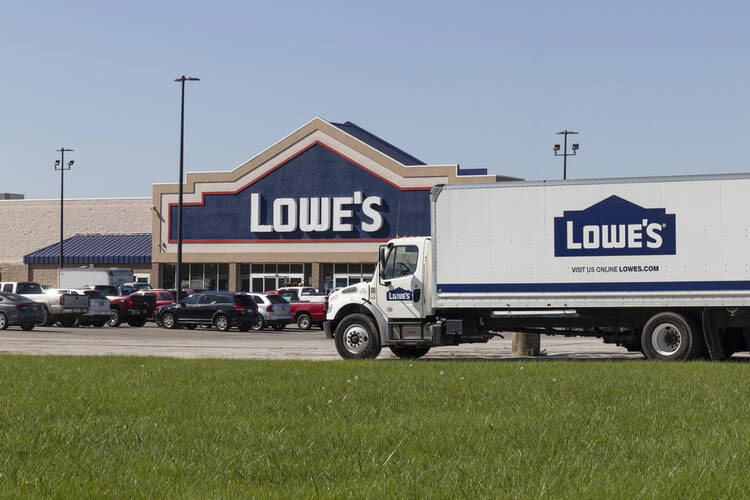
Can you get a trucking contract with Lowe’s as an independent driver or the owner of a delivery company?
Yes, there are opportunities to provide delivery services connected to Lowe’s, but getting one is not necessarily as straightforward as filling out a driver application and waiting for approval.
Lowe’s uses a combination of delivery arrangements to transport products from stores, warehouses, and distribution facilities to customers.
Some deliveries involve small home improvement products, while others require box trucks, flatbed trucks, specialized equipment, or two-person crews capable of handling heavy appliances.
For example, a customer purchasing a refrigerator may need a delivery team that can transport the appliance, move it safely into the home, and perform an approved installation or haul-away service.
A construction contractor ordering building materials, on the other hand, may require a flatbed truck or another suitable commercial vehicle.
These are different delivery services, and they do not necessarily use the same contracting process.
One important distinction is that Lowe’s has an Independent Service PROvider program primarily designed for installation contractors.
That program should not be confused with a general application for independent trucking or home delivery contracts.
For transportation work, you may need to register your business as a prospective supplier or apply through a third-party logistics company that manages deliveries for retailers.
For example, Lowe’s publicly identified OneRail as a nationwide same-day delivery partner, and OneRail maintains a carrier application program for independent delivery businesses.
Other last-mile logistics companies, including RXO, recruit independent motor carriers for bulky-item delivery and installation work.
However, acceptance into a logistics provider’s carrier network does not guarantee that you will receive Lowe’s delivery assignments.
In this article, we will examine the practical ways to pursue Lowe’s-related trucking contracts, the documents you may need, the types of vehicles commonly used, and how to evaluate the financial terms before accepting delivery work.
Important: This article was reviewed in November for the United States. Carrier recruitment procedures, available routes, contract requirements, and delivery partnerships may change.
Lowe’s does not publicly provide a universal application procedure, approval timeline, or payment rate for every independent delivery driver.
Confirm the current requirements with the company or logistics provider offering the contract.
Can You Get a Lowe’s Trucking Contract as an Independent Driver?
Yes, but your opportunities depend on whether you are an individual driver, an owner-operator with your own commercial vehicle, or an established transportation company.
These distinctions matter because major retailers frequently obtain delivery services through transportation companies rather than contracting with every individual driver directly.
For example, an independent motor carrier may own several box trucks and employ delivery crews.
That carrier can enter into a service agreement with a third-party logistics company responsible for organizing deliveries for retailers.
The logistics company then assigns approved delivery work under the terms of its agreements.
In other cases, a qualified courier company may join a technology-enabled delivery network and receive available local delivery assignments.
However, an individual who simply owns a pickup truck should not assume that the vehicle automatically qualifies for every delivery opportunity.
The business must meet the applicable vehicle, insurance, safety, legal, and contract requirements.
3 Main Ways to Pursue Lowe’s Trucking and Delivery Contracts
1. Apply Through OneRail’s Carrier Network
OneRail is a last-mile delivery and fulfillment company that works with retailers, distributors, manufacturers, and independent delivery businesses.
In July 2023, Lowe’s announced a nationwide expansion of its same-day delivery service in partnership with OneRail.
The arrangement was designed to support deliveries of eligible products ordered through Lowe’s website and mobile app.
OneRail maintains a network of courier companies and other delivery partners that can provide local delivery services.
For an independent delivery company, joining this network is one practical route to investigate.
How to apply:
- Locate OneRail’s official Become a Carrier Partner application.
- Submit your business and contact information.
- Discuss your capabilities with its business development team if contacted.
- Complete the carrier profile and application requirements.
- Review the service agreement.
- Provide the required certificate of insurance.
- Submit the requested tax and payment information.
- Complete applicable training and technology integration.
- Begin accepting eligible assignments if your business is approved and work becomes available.
OneRail’s published carrier onboarding process includes an initial meeting, carrier profile, service agreement, insurance documentation, electronic W-9, ACH information, and onboarding.
These steps are more specific than a general recommendation to create a Lowe’s driver account.
What you should consider: Applying to OneRail does not mean you are applying exclusively for Lowe’s deliveries.
The company serves multiple businesses, and available assignments depend on its contracts, your location, vehicle capabilities, and other requirements.
Ask which types of loads are available in your service area before purchasing additional vehicles.
2. Register Your Transportation Company Through Lowe’s Supplier Program
Another route is Lowe’s supplier registration program. Lowe’s allows businesses to register their capabilities for potential supplier and service opportunities.
Its supplier registration process distinguishes companies supplying retail merchandise from businesses providing indirect goods and services.
If you operate a transportation company, the relevant category to investigate is the program for indirect goods and services rather than the portal intended for companies selling merchandise on Lowe’s shelves.
How to proceed:
- Visit Lowe’s official Suppliers page.
- Review its supplier registration instructions.
- Select the appropriate registration route for your business.
- Provide accurate company and contact information.
- Describe your transportation services and operating territory.
- Provide relevant qualifications and business capabilities when requested.
- Keep your profile current and monitor communications from the procurement team.
However, Lowe’s expressly states that supplier registration does not guarantee a request for proposal, bid invitation, or contract.
It also explains that procurement opportunities may arise when existing contracts expire or new business initiatives require additional suppliers.
This means that registering your company is a potential first step toward consideration, not a direct route to immediate delivery assignments.
What you should consider: This route may be more appropriate for an established delivery or trucking company that can demonstrate its capacity to provide transportation services at a commercial scale.
Prepare a professional company profile showing your vehicles, service areas, insurance, safety practices, and operational capabilities.
3. Apply to Third-Party Last-Mile Logistics Providers
Lowe’s also uses third-party delivery providers for certain categories of deliveries, including major appliances.
For example, its appliance delivery information states that third-party delivery vendors are used for specified delivery, installation, and connection services.
One company worth investigating is RXO, a major last-mile logistics provider that contracts with independent motor carriers.
Historical court records identify Lowe’s among the retailers for which RXO’s last-mile business coordinated deliveries.
However, that historical relationship does not establish that RXO is currently recruiting carriers specifically for Lowe’s routes in every market.
RXO’s current independent motor carrier program does provide a clear application process for qualifying delivery companies.
RXO’s published carrier requirements include:
- An active registered business.
- Federal Employer Identification Number.
- Required motor carrier and USDOT registrations.
- Applicable Unified Carrier Registration.
- Commercial general liability insurance.
- Commercial auto insurance.
- Cargo insurance.
- Workers’ compensation coverage where required by the program.
- Applicable unemployment insurance for employees.
- Compliance with customer screening and driving record requirements.
- Relevant experience in appliance, furniture, or other bulky-item delivery.
Depending on the assignment, the company may also require installation experience or specialized equipment.
How to apply: Locate RXO’s official Contract Motor Carriers application and submit your business details, delivery experience, location, and vehicle capabilities.
What you should consider: RXO is a potential route into large-item home delivery, but completing its application does not guarantee Lowe’s work, a particular number of routes, or a specified income.
Lowe’s Trucking Contract Application Options Compared
The following table explains the differences between the three application routes.
| Application Route | Suitable Business | How to Apply | Important Limitation |
|---|---|---|---|
| OneRail | Local courier and last-mile delivery companies | Carrier Partner application | No guarantee of Lowe’s assignments or delivery volume |
| Lowe’s Supplier Registration | Established trucking and transportation service businesses | Relevant supplier registration category | Registration does not guarantee a bid or contract |
| RXO Last Mile | Independent motor carriers with bulky-item delivery capabilities | Contract Motor Carriers application | Current Lowe’s route availability must be verified |
Note: These routes serve different parts of the delivery market. None guarantees that an applicant will obtain a direct contract with Lowe’s or be assigned a particular number of deliveries.
9 Steps to Get Lowe’s Trucking Contracts Successfully
1. Decide Which Delivery Service You Want to Provide
Before applying for contracts, determine the type of work your business can handle.
For example, delivering small home improvement products is different from transporting refrigerators, washing machines, lumber, or construction supplies.
Your options may include:
- Local same-day deliveries.
- Box truck home deliveries.
- Major appliance transportation.
- Two-person bulky-item deliveries.
- Building material transportation.
- Flatbed trucking.
- Other commercial freight services.
Choosing a particular service allows you to identify the relevant transportation providers and prepare for their requirements.
If you have a cargo van, focus on opportunities compatible with its legal payload and cargo dimensions.
If you operate box trucks or flatbeds, investigate contracts that require those types of vehicles.
2. Register and Prepare Your Delivery Business
Major delivery networks generally want to work with businesses that can demonstrate they are legally established and capable of providing the requested services.
You may need to provide:
- Your registered business name.
- Business address and contact information.
- Employer Identification Number or appropriate tax documentation.
- Required business licenses.
- Vehicle information.
- Insurance documentation.
- Motor carrier registrations, where applicable.
- Relevant operational experience.
Some logistics providers also require applicants to operate as an LLC or corporation.
However, that is a contractual qualification set by the particular provider, not a universal federal requirement that every delivery driver must form an LLC.
If you are starting with a single commercial vehicle, this guide on how to start a box truck business can help you understand the broader business planning process.
3. Obtain the Required Motor Carrier Registration and Driver Qualifications
Commercial transportation businesses must comply with applicable federal and state motor carrier regulations.
For example, a USDOT number is generally required for qualifying commercial vehicles operating in interstate commerce with a gross vehicle weight rating, gross combination weight rating, or actual qualifying weight of 10,001 pounds or more.
Some states also require USDOT registration for certain intrastate operations.
Separately, businesses transporting federally regulated property owned by others for compensation in interstate commerce generally require appropriate FMCSA operating authority unless an exemption applies.
Do not assume that holding a USDOT number automatically authorizes every type of for-hire trucking activity.
Also, commercial driver’s license requirements depend on the vehicle configuration and applicable weight thresholds.
For example, a Class B CDL is generally required for qualifying single vehicles weighing 26,001 pounds or more, subject to the applicable licensing rules.
Some smaller box trucks do not require a CDL, but the operator may still need to comply with other commercial vehicle rules.
Determine the requirements for your exact vehicle and business activity.
4. Arrange Appropriate Commercial Insurance
Do not assume that personal auto insurance is sufficient for transporting customers’ merchandise commercially.
Depending on the contract, you may need:
- Commercial auto liability insurance.
- Motor truck cargo insurance.
- Commercial general liability insurance.
- Workers’ compensation insurance.
- Additional insured endorsements.
- Other coverage required by the logistics provider.
Federal insurance minimums and individual contract requirements are not always the same.
For example, FMCSA’s financial responsibility rules establish certain minimum public liability amounts for interstate for-hire property carriers, but a private delivery company may require higher limits or additional cargo coverage.
Ask the contracting company for its insurance requirements before purchasing a policy specifically for the opportunity.
5. Prepare Your Vehicles and Delivery Equipment
The condition and capabilities of your vehicles will influence which deliveries you can accept.
For example, a business transporting large appliances may need an appropriate box truck, liftgate, appliance dolly, straps, protective blankets, and other handling equipment.
A building materials delivery business may require a flatbed or other suitable vehicle.
Prepare a current inventory of your equipment and confirm that each truck is properly maintained, registered, and insured.
Some providers may require vehicle inspections, photographs, documentation, or other verification before approving a carrier.
However, you should not assume Lowe’s itself physically inspects every independent driver’s vehicle as part of a single nationwide application procedure.
6. Apply Through the Relevant Carrier or Supplier Program
Once your business is ready, choose the application route that matches the service you provide.
For local last-mile work, investigate OneRail’s carrier network. For larger appliance and bulky-item delivery operations, review the carrier opportunities offered by last-mile logistics companies such as RXO.
For an established transportation business seeking direct commercial opportunities with Lowe’s, investigate the company’s supplier registration process.
Provide accurate information about your business. Do not claim to have trucks, insurance coverage, specialized equipment, or service capabilities that you do not actually possess.
7. Complete Screening and Qualification Requirements
If a company is interested in your services, it may require additional screening. Depending on the logistics provider and the type of work, this can include:
- Verification of motor carrier authority.
- Insurance review.
- Driver record checks.
- Background screening.
- Drug testing where required.
- Evaluation of equipment and delivery experience.
- Review of business references.
- Confirmation of staffing capabilities.
For example, RXO states that carrier personnel must satisfy applicable customer requirements involving background checks, motor vehicle records, and drug screening.
These requirements should not be automatically attributed to every delivery contract offered by Lowe’s.
Follow the specific procedures communicated by the company evaluating your application.
8. Review the Contract and Payment Structure
Before accepting a contract, examine how you will be paid. Some delivery arrangements use a fixed daily rate, while others pay per completed stop, load, route, or another agreed measure.
Additional compensation may apply for particular services, such as difficult deliveries, haul-away, installation, or extended travel, depending on the contract.
Ask about:
- The amount paid per delivery or route.
- Minimum daily payment, if any.
- Fuel surcharges and adjustments.
- Payment frequency and invoicing procedures.
- Cancellation or failed-delivery compensation.
- Responsibility for damaged merchandise.
- Deductibles and insurance claims.
- Customer complaints and chargebacks.
- Required delivery equipment.
- Contract termination provisions.
The original claim that Lowe’s guarantees timely payments to every independent trucking contractor is not supported by a universal trucking contract policy.
Lowe’s installation service provider materials do describe timely payments as a program benefit, but that statement should not automatically be applied to independent transportation contracts.
Your actual payment rights and obligations depend on the agreement you sign.
9. Complete Onboarding and Begin Delivering
If your business is approved and a contract is executed, you may need to complete operational onboarding before receiving delivery assignments.
This can include training on delivery procedures, customer communication, scheduling systems, shipment tracking, and proof-of-delivery requirements.
Some providers may require electronic confirmation of deliveries, photographs, signatures, or other documentation.
Make sure you understand who to contact when there is a damaged product, inaccessible property, missed appointment, or customer complaint.
Maintain accurate records of completed assignments, expenses, and payments so you can determine whether the contract is financially worthwhile.
What Type of Truck Do You Need for Lowe’s Deliveries?
The appropriate vehicle depends on the products being transported and the delivery contract.
For example, small hardware items may fit inside a suitable cargo van, while appliances and bulky merchandise often require larger vehicles and specialized handling equipment.
| Vehicle Type | Potential Delivery Work | Important Considerations |
|---|---|---|
| Cargo Van | Qualifying smaller retail and home improvement products | Cargo dimensions, payload, and courier network eligibility |
| Pickup Truck | Selected local building materials and appropriately secured loads | Load securement, weather protection, and contract acceptance |
| Box Truck | Appliances, bulky goods, and larger home deliveries | Liftgate, cargo handling equipment, crew size, and safety compliance |
| Flatbed Truck | Certain lumber, construction materials, and jobsite deliveries | Securement, unloading equipment, payload, and driver qualifications |
Important: These are examples of potential vehicle uses, not a list of vehicles officially approved for all Lowe’s delivery contracts. Each carrier network or service agreement establishes its own requirements.
How Much Can You Earn From Lowe’s Delivery Contracts?
There is no reliable single nationwide rate that every independent Lowe’s delivery contractor receives.
Payment depends on the company holding the delivery contract, the services provided, the market, and the specific agreement.
For example, a two-person appliance delivery crew may have a different compensation structure from a courier transporting smaller products.
You also need to distinguish gross revenue from the amount your business retains after expenses.
Suppose your company completes ten deliveries in one day at an illustrative rate of $55 per completed stop.
Your gross revenue would be:
10 completed deliveries × $55 = $550.
However, you may need to pay a driver, helper, fuel expenses, insurance, vehicle costs, and other business expenses.
The following hypothetical example demonstrates the calculation.
Illustrative Daily Earnings for a Two-Person Delivery Crew
| Revenue or Expense | Illustrative Daily Amount |
|---|---|
| 10 Completed Deliveries at $55 Each | $550 |
| Driver Compensation | $170 |
| Delivery Helper Compensation | $140 |
| Fuel | $60 |
| Vehicle Ownership, Maintenance, and Tires | $65 |
| Allocated Insurance Costs | $35 |
| Administration and Other Overhead | $35 |
| Total Illustrative Expenses | $505 |
| Balance Before Taxes and Unbudgeted Costs | $45 |
Important: This is a hypothetical financial illustration, not a published Lowe’s contractor payment schedule or a verified industry-average delivery rate. Actual route payments and expenses may differ significantly.
The calculation excludes any unbudgeted damage claims, unusually expensive repairs, additional employee costs, and other unexpected expenses.
Notice that a business generating $550 in daily revenue might retain a relatively small amount after compensating its crew and paying operating costs.
Also, ten stops may be unrealistic for some bulky-item delivery routes involving complex access, installation, or long travel distances.
Before accepting a contract, calculate the expected revenue and cost per route using the actual terms offered.