
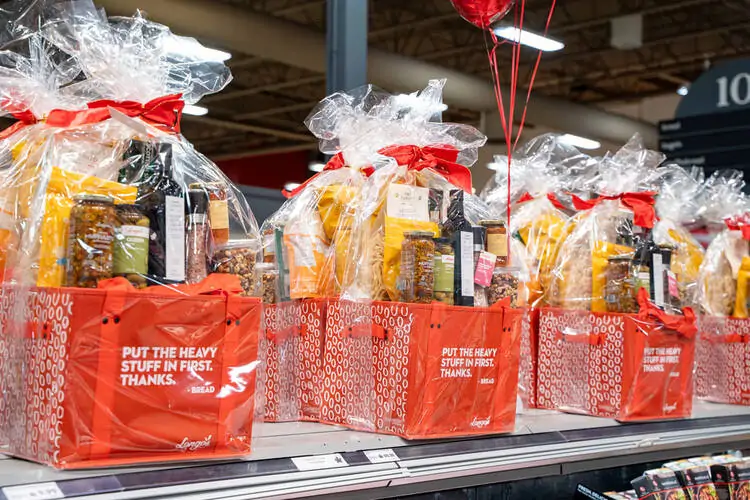
A gift basket business creates and sells carefully arranged collections of products that customers give to other people for birthdays, holidays, weddings, new babies, corporate appreciation, housewarmings, sympathy, congratulations, employee recognition, and many other occasions.
The products do not always have to come in a traditional wicker basket. You can use:
Gift boxes, wooden crates, reusable totes, trays, buckets, decorative containers, coolers, baby storage bins, picnic boxes, or branded corporate boxes.

A gourmet basket might contain chocolates, crackers, nuts, coffee, cookies, cheese, preserves, and snacks.
A spa basket might contain bath salts, candles, lotions, robes, soaps, and skincare products.
A new-parent basket might include baby clothes, blankets, toys, wipes, and practical newborn supplies.
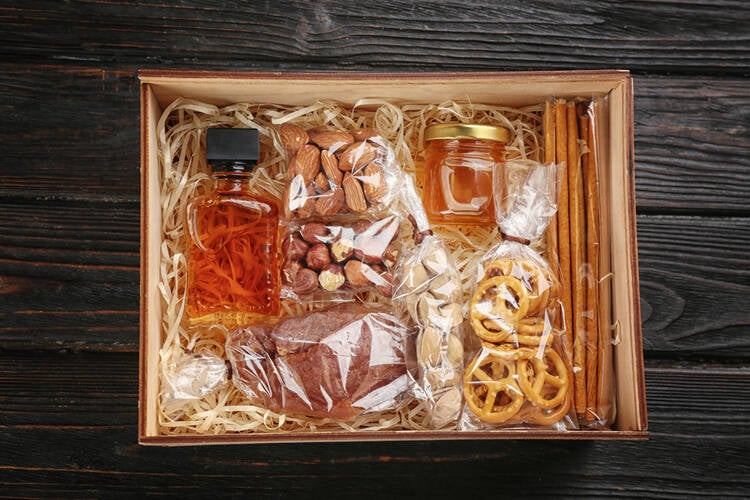
A real estate closing basket might contain local foods, coffee, candles, a cutting board, and personalized items for a new homeowner.
The reason customers buy from a gift basket company rather than purchasing every item themselves is convenience and presentation.
You are doing the shopping, product matching, wrapping, arranging, personalization, and delivery for them.
This means you are not simply selling products. You are selling a ready-made gifting solution. One of the biggest attractions of this business is that you can start small.
You do not necessarily need a retail store, expensive equipment, or a warehouse on your first day.
A beginner can operate from a properly approved home office or small studio, build gift baskets to order, sell online, make local deliveries, and gradually add corporate accounts.
However, the business becomes difficult when you purchase too much inventory before knowing what customers want.
It is very easy to spend thousands of dollars buying mugs, candles, chocolates, baskets, ribbons, baby items, spa products, and gourmet foods that look attractive but rarely appear in actual orders.
Your goal should therefore be to build a relatively small number of gift concepts that you can produce repeatedly and profitably.
Once customers show you which baskets they genuinely want to buy, you can expand.
Steps on How to Start a Gift Basket Business
-
Conduct Market Research
Market research will help you decide whether your gift basket business should focus on individual consumers, corporate clients, weddings, real estate, holiday gifting, gourmet foods, babies, luxury gifts, or another niche.
You can start by studying the businesses already serving your area. Look at florists, gourmet gift companies, chocolate shops, bakeries, online gift stores, corporate gifting companies, local artisans, and independent Etsy-style sellers.
Pay attention to the occasions they target. Some businesses may generate most of their sales during Christmas and Valentine’s Day.
Others may have year-round demand because they work with real estate agents, law firms, hotels, property managers, employers, and corporate clients.
Corporate gifting deserves special attention because one business customer can potentially place dozens or hundreds of orders.
For example, a real estate company might need closing gifts throughout the year.
A financial services company might purchase holiday gifts for important clients.
A technology company might send onboarding boxes to new employees. A hotel might provide VIP guest baskets.
These accounts can be much more valuable than constantly finding one customer at a time.
You should also research price points. Look at what customers receive for $40, $75, $100, $150, and $250. Do not compare prices without comparing contents.
A $100 gift basket containing $25 worth of products is very different from a $100 basket containing $60 worth of merchandise.
You need enough margin to pay for packaging, labor, card-processing fees, marketing, delivery, shipping materials, damaged goods, and profit. Talk directly to potential customers.
- Ask employers how they currently handle employee gifts.
- Ask real estate agents what they give clients at closing.
- Ask wedding planners whether couples request welcome gifts for guests.
- Ask customers what they dislike about ordering gift baskets online.
You may hear complaints such as:
- The basket looked much smaller than the photograph
- The products felt generic
- Shipping was too expensive
- The basket arrived late
- The recipient could not tell who sent it
- Items were damaged
- The gift felt impersonal
- Customizing the basket was difficult.
Each complaint gives you an opportunity to build a better service.
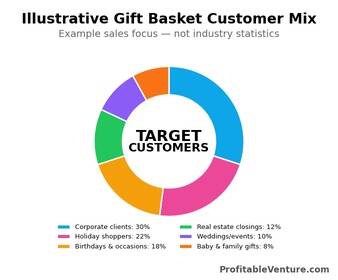
a. Who is the Target Market for a Gift Basket Business?
- Corporate organizations
- Human resources departments
- Business owners
- Real estate agents
- Mortgage companies
- Law firms
- Financial advisers
- Hotels
- Property managers
- Wedding planners
- Engaged couples
- New parents
- Families
- Birthday shoppers
- Holiday shoppers
- People sending sympathy gifts
- People sending thank-you gifts
- Schools and universities
- Nonprofit organizations
- Event organizers.
b. Is a Gift Basket Business Profitable?
Yes, a gift basket business can be profitable when the owner controls product costs, packaging, labor, shipping, and customer acquisition.
The business can be especially attractive because products can be combined into something customers perceive as more valuable than the individual items purchased separately.
However, do not confuse markup with net profit. If you purchase $30 worth of products and sell a finished basket for $75, you have not necessarily made $45 in profit. You may still have:
- $8 in basket and packaging materials
- $6 in labor
- $3 in card-processing and e-commerce costs
- $5 in advertising expense
- Delivery or shipping costs
- Business overhead.
Inventory management also matters. If you purchase products with long shelf lives and use them across several gift designs, your inventory can be efficient.
If every basket requires completely different products, you can end up with dozens of partial cases and unused items sitting on shelves. A strong operator therefore designs baskets with overlapping components.
For example, the same premium chocolates, coffee, cookies, nuts, tissue paper, ribbon, and gift box might be used across birthday, thank-you, holiday, and corporate gifts.
c. Are There Existing Niches in the Industry?
Yes. Some of the most practical gift basket niches include:
- Corporate gift baskets
- Employee appreciation gifts
- Client appreciation gifts
- Real estate closing gifts
- New homeowner baskets
- Wedding welcome boxes
- Bridesmaid gift boxes
- Groomsmen gifts
- Baby gift baskets
- New mother gift baskets
- Spa and wellness baskets
- Gourmet food baskets
- Coffee and tea baskets
- Chocolate gift baskets
- Snack boxes
- Holiday gift baskets
- Birthday gifts
- Sympathy gifts
- Get-well gift baskets
- Luxury gift boxes
- Locally sourced gift baskets
- Subscription gift boxes.
You can eventually serve several niches, but starting with two or three clear customer groups often makes marketing easier.
d. Who are the Major Competitors?
Your competitors may include:
- Harry & David
- GourmetGiftBaskets.com
- National flower and gift delivery businesses
- Local florists
- Chocolate companies
- Specialty food stores
- Online marketplaces
- Independent gift-box sellers
- Corporate gifting companies
- Local bakeries
- Gift shops
- Department stores.
Large national companies can offer enormous product selections and sophisticated shipping systems.
Your advantage as a smaller business may be customization.
You can work directly with customers, include locally sourced products, offer small corporate runs, personalize packaging, make local same-day deliveries, and create baskets around specific budgets.
e. Are There County, State, or Federal Regulations for a Gift Basket Business in the United States?
Yes, but the requirements depend on what you place inside the baskets and how you operate.
A basic gift basket company purchasing finished retail products and arranging them into gift boxes is primarily a retail business.
You may need a general business license, sales-tax registration, resale documentation, local registration, and home-occupation approval if operating from home.
State and local requirements vary considerably. Food baskets require additional care.
The simplest model for a beginner is to use commercially packaged foods from established manufacturers and leave the original labels intact.
Those labels already provide ingredients, allergen information, net contents, and other required information.
If you start opening bulk food packages and repackaging cookies, candy, nuts, popcorn, baked goods, dried fruit, or other foods under your own packaging, your responsibilities can change.
You may become subject to additional food-business, labeling, sanitation, and processing requirements.
Packaged foods generally need appropriate ingredient and allergen labeling.
Major allergens can include milk, eggs, fish, crustacean shellfish, tree nuts, peanuts, wheat, soybeans, and sesame.
Do not make casual claims such as “allergy safe” or “nut free” unless your production procedures genuinely support them.
If you bake cookies or produce other foods yourself, check state and local food rules before selling them.
A cottage food law may permit some shelf-stable products in one state while another state may require a commercial kitchen.
Alcohol is another major issue. You should not assume that you can simply purchase a bottle of wine from a retail store, place it inside a basket, and ship it anywhere in the country.
Alcohol sales and shipping are regulated, and rules vary between states. Shipping carriers also impose their own requirements.
A beginner who wants to offer wine or spirits should obtain appropriate legal guidance and licensing before selling those baskets.
An easier alternative is to partner with an appropriately licensed alcohol retailer or fulfillment company. Shipping restrictions can also affect non-food gift baskets.
For example, perfumes and certain alcohol-based cosmetics may be considered flammable materials for shipping purposes and can face carrier restrictions.
Before offering national shipping, investigate the shipping requirements for every product category you intend to include.
f. Is There a Franchise for a Gift Basket Business?
Gift and specialty gifting franchise opportunities do exist, although many gift basket businesses are independently owned.
The relatively low startup cost makes independent operation attractive because you can create your own product range, suppliers, branding, packaging, and pricing.
A franchise may offer established branding, product designs, suppliers, software, training, and marketing support.
In exchange, you may pay an initial franchise fee, royalties, advertising fees, and other required expenses. If you consider a franchise, examine:
- Required products
- Approved suppliers
- Required inventory
- Franchise fees
- Royalty fees
- Territory protection
- Shipping systems
- Online-order ownership
- Corporate account rules
- Renewal requirements.
g. What Do You Need to Start a Gift Basket Business?
- A clearly defined target customer
- Business registration
- Required retail licenses
- Sales-tax registration where applicable
- Wholesale suppliers
- Gift products
- Gift boxes and baskets
- Ribbon and tissue paper
- Cellophane or other wrapping materials
- Shipping cartons
- Labels and gift cards
- Worktables
- Storage shelves
- Computer
- Printer
- E-commerce website
- Payment processing
- Business insurance
- Reliable local delivery arrangement
- Working capital.
-
Choose a Memorable Business Name
The name should sound appropriate for gifting, celebration, appreciation, or premium presentation.
Try not to choose something that limits you to one occasion unless you are intentionally specializing.
For example, a name built entirely around Christmas may become restrictive if corporate appreciation eventually becomes your largest source of revenue. Some catchy gift basket business names are:
- Thoughtful Box Gifts, LLC
- Wrapped With Joy, LLC
- Golden Ribbon Gifts, LLC
- Gifted Moments, LLC
- Perfectly Packed Gifts, LLC
- Box & Bow Gift Co., LLC
- Bright Basket Gifts, LLC
- The Giving Box, LLC
- Curated Joy Gifts, LLC
- Celebration Basket Co., LLC
- Thoughtful Touch Gifts, LLC
- Ribbon House Gifts, LLC
- Premier Basket Co., LLC
- Gift & Gather, LLC
- Kindly Curated Gifts, LLC
- Joyful Parcel Gifts, LLC
- Signature Basket Co., LLC
- Golden Parcel Gifts, LLC
- Perfect Present Co., LLC
- Wrapped Wishes Gift Co., LLC.
Before ordering packaging or creating a website, search your state’s business database and investigate possible trademark conflicts.
-
Register Your Business
a. What Type of Business Structure is Best for a Gift Basket Business?
Many independent gift basket companies choose a limited liability company.
An LLC can provide separation between the owner’s personal affairs and the business while remaining relatively straightforward to operate.
This can be useful when you are handling customer payments, shipping products, employing staff, operating vehicles, and selling food or other consumer products.
An LLC does not replace appropriate insurance or compliance with product, food, alcohol, and shipping rules.
b. Steps to Form an LLC
- Choose an available business name
- File formation documents with your state
- Choose a registered agent
- Create an operating agreement
- Obtain an EIN where appropriate
- Register for state and local taxes
- Obtain sales-tax or seller registration where required
- Open a business bank account
- Obtain required local licenses
- Purchase appropriate insurance
- Maintain required annual filings.
c. What Type of License is Needed to Start a Gift Basket Business?
Your exact requirements depend on your location and products. You may need:
- General business license
- Retail business license
- Sales-tax or seller’s permit
- Resale certificate
- Home occupation permit if operating from home
- Certificate of occupancy if using commercial premises
- Food establishment or food-processing approval if producing or repackaging food
- Alcohol retailer licensing if selling alcohol
- Additional alcohol shipping approvals where applicable
- Employer registrations if hiring staff.
d. What Type of Certification is Needed to Start a Gift Basket Business?
There is no universal gift basket certification required across the United States. Useful training can include:
- Gift design and basket arrangement
- Retail merchandising
- Food safety training
- Food allergen awareness
- E-commerce training
- Shipping and packaging training
- Corporate sales training
- Customer service training
- First aid and CPR.
e. What Documents are Needed to Start a Gift Basket Business?
- Business formation documents
- EIN where applicable
- Business license
- Sales-tax registration
- Resale certificate
- Commercial lease or home-business approval
- Insurance policies
- Supplier agreements
- Wholesale invoices
- Product ingredient information where relevant
- Allergen information
- Customer invoices
- Corporate gift agreements
- Shipping records
- Employee records
- Return and refund policy
- Privacy policy for online customers
- Alcohol-related licenses where applicable.
f. Do You Need a Trademark, Copyright, or Patent?
You normally do not need a patent. A trademark can protect your business name, logo, slogan, or branded gift collection.
Copyright can protect original product photography, website text, printed cards, graphics, catalogs, and marketing materials.
Your visual presentation can become an important part of your brand, so use original product photography whenever possible.
-
Cost Analysis and Budgeting
a. How Much Does It Cost to Start a Gift Basket Business?
A small owner-operated business working from home and producing baskets mainly after receiving orders may require approximately $4,000 to $12,000.
A medium-scale business with a small studio, larger product inventory, professional e-commerce website, corporate sales capability, packaging supplies, and stronger working capital may require approximately $20,000 to $45,000.
A larger operation with a warehouse, employees, commercial fulfillment equipment, significant corporate inventory, and national shipping capability may require approximately $75,000 to $150,000 or more.
For this guide, we will use:
- Small home-based gift basket business: approximately $8,000
- Medium gift basket business: approximately $30,000
- Large fulfillment operation: approximately $100,000.
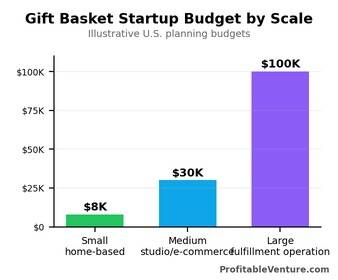
These are illustrative planning budgets rather than fixed industry prices.
b. What are the Costs Involved in Starting a Gift Basket Business?
Small Home-Based Gift Basket Business – Approximately $8,000
- Opening gift product inventory – $2,500
- Baskets, boxes, ribbon, wrapping, and packaging – $1,000
- Website, domain, and basic branding – $1,000
- Worktable, shelving, printer, and small equipment – $800
- Licenses and initial insurance – $700
- Launch marketing – $700
- Working capital – $1,300
- Estimated Total – $8,000.
This model works best when baskets are largely made to order so you are not storing huge quantities of finished inventory.
Medium Gift Basket Business – Approximately $30,000
- Opening gift and product inventory – $8,000
- Gift boxes, baskets, wrapping, ribbon, and shipping materials – $4,000
- E-commerce website, photography, and branding – $4,000
- Workstations, shelving, printers, and production equipment – $3,000
- Licensing, insurance, and professional fees – $2,000
- Initial marketing and corporate sales – $3,000
- Shipping and local-delivery setup – $2,000
- Working capital reserve – $4,000
- Estimated Total – $30,000.
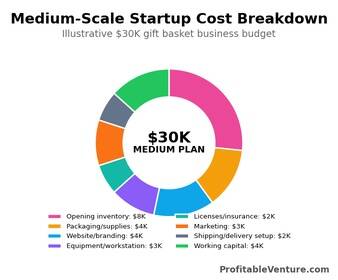
This is the financial model used later in this article.
Large Gift Basket Fulfillment Business – Approximately $100,000
- Opening inventory – $22,000
- Warehouse/studio setup and storage – $15,000
- Payroll reserve – $15,000
- Working capital – $15,000
- Packaging and shipping materials – $8,000
- Production and fulfillment equipment – $6,000
- E-commerce, order-management software, and technology – $5,000
- Delivery and shipping setup – $5,000
- Marketing and corporate-sales development – $6,000
- Licensing and insurance – $3,000
- Estimated Total – $100,000.
c. What Factors Determine the Cost of Starting a Gift Basket Business?
- Number of basket designs
- Product quality
- Opening inventory
- Packaging quality
- Whether you operate from home
- Warehouse or studio rent
- E-commerce technology
- Photography
- Local delivery
- National shipping
- Employee count
- Food-related licensing
- Alcohol-related licensing
- Marketing
- Working capital.
d. Do You Need to Build a Facility? If YES, How Much Will It Cost?
No. A beginner can operate from a home office or approved residential workspace if local zoning and business rules allow it.
You mainly need clean, organized storage and enough room to assemble products.
As orders increase, a small commercial studio or warehouse can become useful. You may need designated areas for:
- Product storage
- Gift basket assembly
- Packaging inventory
- Finished orders
- Shipping
- Corporate customization
- Photography.
A gift basket company generally does not benefit from expensive storefront rent unless walk-in retail forms an important part of the business.
e. What are the Ongoing Expenses of a Gift Basket Business?
- Gift products
- Packaging
- Gift boxes and baskets
- Ribbon
- Tissue paper
- Shipping cartons
- Labels
- Employee wages
- Rent or storage
- Website fees
- E-commerce software
- Payment-processing fees
- Shipping
- Local delivery
- Insurance
- Advertising
- Photography
- Printing
- Damaged products
- Expired food inventory
- Accounting and bookkeeping.
f. What is the Average Salary of Your Staff?
Wages depend on your city and employee responsibilities. A small company may begin with the owner and temporary holiday help. A larger operation may employ:
- General Manager
- Corporate Sales Representative
- Gift Designer
- Basket Assembly Staff
- Inventory Associate
- Shipping and Fulfillment Staff
- Customer Service Representative
- Delivery Driver
- Marketing Coordinator
- Bookkeeper.
Holiday staffing deserves special attention. A business may need twice or three times its normal workforce during November and December while requiring far fewer employees in January.
Temporary and seasonal labor should therefore be built into your financial planning.
g. How Do You Get Funding to Start a Gift Basket Business?
- Personal savings
- Small-business loans
- Business credit
- Family financing
- Business partners
- Corporate preorder deposits
- Equipment financing for larger operations
- Starting from home and reinvesting profits
- Launching with made-to-order baskets rather than large inventory.
This is a business where starting lean can be extremely useful. You can learn what customers buy before committing large amounts of money to inventory.
a. Executive Summary
Golden Ribbon Gifts, LLC is a proposed gift basket and corporate gifting company based in Atlanta, Georgia.
The company will create attractive gift baskets, boxes, and curated gift packages for individuals, companies, real estate professionals, wedding clients, and other organizations.
Products will include gourmet food gifts, coffee and tea boxes, spa gifts, baby gifts, housewarming baskets, birthday packages, holiday baskets, real estate closing gifts, employee gifts, and corporate appreciation boxes.
The business will operate through an e-commerce website and local delivery rather than relying on expensive walk-in retail space.
Golden Ribbon Gifts will launch using approximately $30,000 in startup capital.
The business will initially maintain approximately 12 to 15 core gift designs at several price points.
Customers will also be able to request customized baskets for larger corporate orders.
Management will prioritize reusable product components, disciplined inventory purchasing, attractive presentation, professional photography, reliable delivery, and corporate customer acquisition.
The company will avoid selling or shipping alcoholic beverages until all licensing and carrier requirements have been properly established.
The long-term objective is to develop a strong corporate gifting division capable of producing recurring client, employee, and holiday orders throughout the year.
b. Products and Services
Golden Ribbon Gifts, LLC will offer:
- Birthday gift baskets
- Corporate gift baskets
- Employee appreciation boxes
- Client appreciation gifts
- Real estate closing gifts
- Housewarming baskets
- Baby gift baskets
- New mother gifts
- Spa gift boxes
- Gourmet food baskets
- Coffee and tea gifts
- Chocolate baskets
- Snack boxes
- Sympathy baskets
- Get-well gifts
- Wedding welcome boxes
- Holiday baskets
- Custom corporate branding
- Local delivery
- Nationwide shipping for eligible products.
c. Mission Statement
“At Golden Ribbon Gifts, LLC, our mission is to make thoughtful gifting easier by creating beautifully presented, carefully selected gifts that help individuals and businesses celebrate, appreciate, comfort, and connect with the people who matter to them.”
Vision Statement
“Our vision is to build Golden Ribbon Gifts into a trusted gifting brand known for thoughtful products, beautiful presentation, dependable delivery, creative customization, and exceptional corporate service.”
d. Goals and Objectives
The company’s first goal is to develop a profitable core collection. Each basket will be tracked by sales volume, product cost, labor time, customer reviews, and overall margin.
Low-performing designs will be removed rather than maintained indefinitely.
Another objective is to build recurring corporate accounts. Management will target businesses that regularly need:
- Employee recognition gifts
- Client thank-you gifts
- New hire gifts
- Holiday gifts
- Real estate closing gifts
- Event gifts
- Referral gifts.
The company will also improve operational efficiency by standardizing packaging and reusing popular products across several gift collections.
Long-term goals include a dedicated fulfillment studio, larger corporate accounts, personalized branded products, subscription gifting, and seasonal fulfillment contracts.
e. Organizational Structure
- Owner/General Manager
- Corporate Sales Manager
- Gift Designers
- Basket Assembly Staff
- Inventory/Fulfillment Associate
- Customer Service Representative
- Shipping Coordinator
- Delivery Drivers
- Marketing Coordinator
- Bookkeeper/Accountant.
Marketing Plan
a. SWOT Analysis
Strengths
The business can be started with relatively modest capital and operated without a retail storefront.
Products can also be customized for many occasions. Corporate customers can generate large orders and repeat business.
A strong local operator can offer customization that larger national competitors may not provide economically on small orders.
Weaknesses
The business can be highly seasonal. Inventory can also become difficult to manage because products may have different shelf lives and customer demand changes by occasion. Shipping fragile or perishable products can create additional complexity.
Opportunities
Corporate gifting, employee onboarding, real estate closing gifts, weddings, local artisan products, subscription gifting, luxury gift boxes, and personalized packaging provide growth opportunities.
Businesses increasingly need gifts that can be sent to employees and customers in different locations.
Threats
The company faces competition from national gifting brands, online marketplaces, florists, retailers, and customers who build gifts themselves.
Other threats include shipping increases, damaged deliveries, food expiration, alcohol restrictions, holiday labor shortages, supplier problems, and rapidly changing customer tastes.
b. How Do Gift Basket Businesses Make Money?
- Individual gift basket sales
- Gift boxes
- Premium customization
- Corporate gift orders
- Employee appreciation programs
- Real estate closing gifts
- Holiday gifting
- Wedding welcome boxes
- Local delivery fees
- Personalization charges
- Subscription gifts
- Bulk event orders
- Shipping and handling charges where appropriate.
c. Payment Options
- Credit cards
- Debit cards
- Apple Pay
- Google Pay
- ACH transfers
- Online invoices
- Corporate invoices
- Gift cards.
Large customized orders should normally require a deposit before you purchase special inventory.
d. Sales and Advertising Strategies
- Create a professional e-commerce website
- Use high-quality product photography
- Set up a Google Business Profile for local delivery
- Target real estate agents
- Contact property-management companies
- Develop corporate gift catalogs
- Contact human resource departments
- Use LinkedIn for corporate prospecting
- Create holiday preorder campaigns
- Partner with wedding planners
- Partner with hotels
- Work with local artisans
- Offer personalized corporate cards
- Create volume discounts carefully
- Use email marketing
- Develop referral incentives
- Ask satisfied recipients and buyers for reviews
- Create seasonal social media campaigns.
Do not wait until December to contact corporate customers about Christmas gifting. Large business buyers may start planning months earlier.
Financial Projection
a. How Much Should You Charge for Gift Baskets?
Price each basket using its complete cost. Include:
- Products inside the basket
- Basket or gift box
- Tissue paper
- Filler
- Ribbon
- Greeting card
- Custom label
- Labor
- Payment-processing fees
- Expected product loss
- Shipping box where applicable.
A useful formula is:
Gross Margin = (Selling Price – Direct Product and Packaging Cost) ÷ Selling Price × 100.
Suppose the gift products and packaging cost $38 and you sell the finished basket for $85. The $47 difference is not necessarily your final profit.
You still need to cover marketing, website expenses, labor, insurance, rent, delivery, and administration.
Do not forget labor. A highly customized basket that takes an employee 45 minutes to build should not be priced as though the basket assembled itself.
b. How Much Revenue Can a Gift Basket Business Generate?
Revenue depends on customer volume, average order size, corporate contracts, holiday sales, and whether you ship nationally. For planning purposes:
- Small owner-operated business: approximately $50,000 to $120,000 in annual gross revenue
- Medium gift basket business: approximately $150,000 to $300,000
- Large corporate and fulfillment operation: approximately $400,000 to $1 million or more.
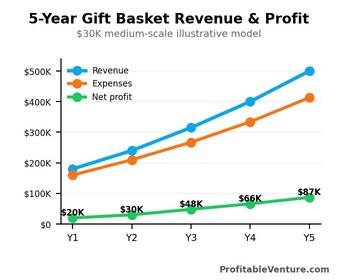
These are planning estimates rather than guaranteed results. For the detailed model below, we will use the $30,000 medium-scale business. Year 1 is projected at approximately $180,000 in gross revenue.
c. Five-Year Revenue and Profit Projection
| Fiscal Year | Revenue | Total Expenses | Net Profit | Net Margin |
|---|---|---|---|---|
| Year 1 | $180,000 | $160,000 | $20,000 | 11.1% |
| Year 2 | $240,000 | $210,000 | $30,000 | 12.5% |
| Year 3 | $315,000 | $267,000 | $48,000 | 15.2% |
| Year 4 | $400,000 | $334,000 | $66,000 | 16.5% |
| Year 5 | $500,000 | $413,000 | $87,000 | 17.4% |
Under this model, cumulative five-year revenue would be approximately $1.635 million, while cumulative projected net profit would be approximately $251,000.
d. Sample Five-Year Profit and Loss Projection
| Item | Year 1 | Year 2 | Year 3 | Year 4 | Year 5 |
|---|---|---|---|---|---|
| Revenue | $180,000 | $240,000 | $315,000 | $400,000 | $500,000 |
| Gift Products and Merchandise | $70,000 | $90,000 | $112,000 | $138,000 | $168,000 |
| Packaging Materials | $15,000 | $19,000 | $24,000 | $30,000 | $36,000 |
| Labor and Payroll | $30,000 | $42,000 | $56,000 | $72,000 | $90,000 |
| Shipping and Delivery | $12,000 | $17,000 | $22,000 | $29,000 | $38,000 |
| Studio, Rent and Storage | $9,000 | $10,000 | $12,000 | $14,000 | $16,000 |
| Marketing and Customer Acquisition | $8,000 | $10,000 | $13,000 | $16,000 | $20,000 |
| E-commerce, Software and Payment Processing | $6,000 | $8,000 | $10,000 | $12,000 | $15,000 |
| Insurance and Licensing | $3,000 | $3,000 | $4,000 | $4,000 | $5,000 |
| Administration and Other Operating Expenses | $7,000 | $11,000 | $14,000 | $19,000 | $25,000 |
| Total Expenses | $160,000 | $210,000 | $267,000 | $334,000 | $413,000 |
| Projected Net Profit | $20,000 | $30,000 | $48,000 | $66,000 | $87,000 |
e. How Much Profit Do Gift Basket Business Owners Make a Year?
There is no fixed amount. A home-based operator may generate lower revenue but have very little rent or payroll.
A larger operation may produce hundreds of thousands of dollars in sales while supporting employees, warehouse costs, shipping expenses, and marketing.
Using the medium-scale model in this guide, projected business profit begins at approximately $20,000 in Year 1 and increases toward approximately $87,000 in Year 5.
The owner’s actual personal income depends on salary, distributions, taxes, debt, and reinvestment.
f. What Factors Determine the Amount of Profit to Be Made?
- Average order value
- Product cost
- Packaging cost
- Corporate accounts
- Holiday sales
- Labor efficiency
- Shipping cost
- Local delivery cost
- Inventory waste
- Product expiration
- Advertising costs
- Customer retention
- Repeat corporate orders
- Amount of customization
- Pricing discipline.
g. What is the Profit Margin of a Gift Basket Business?
Net margins vary depending on the products, packaging, labor, and sales channel. Calculate your margin using:
Net Profit Margin = Net Profit ÷ Total Revenue × 100.
The medium-scale financial model in this guide begins at approximately 11% and gradually improves toward approximately 17%.
This is an illustrative planning target rather than a guaranteed industry margin.
h. What is the Sales Forecast?
- First Fiscal Year: $180,000
- Second Fiscal Year: $240,000
- Third Fiscal Year: $315,000
- Fourth Fiscal Year: $400,000
- Fifth Fiscal Year: $500,000.
-
Set Up Your Office and Fulfillment Area
a. How Do You Choose a Perfect Location for a Gift Basket Business?
You do not necessarily need a retail storefront. If most orders come through your website or corporate clients, an affordable studio or light-industrial space can be more useful. Look for:
- Affordable rent
- Easy delivery access
- Reliable climate control
- Secure product storage
- Room for packing tables
- Courier access
- Parking
- Good shipping-carrier access
- Space for future expansion.
If you operate from home, make sure your inventory remains organized and separate from ordinary household use.
Food products should be stored appropriately and protected from pests, heat, moisture, pets, and contamination.
b. What State and City is Best to Start a Gift Basket Business?
There is no universally best city because a strong e-commerce operation can serve customers well beyond its immediate location.
However, markets with large corporate populations, active real estate industries, tourism, weddings, and higher-income households can be worth researching. Examples include:
- Atlanta, Georgia
- Dallas-Fort Worth, Texas
- Charlotte, North Carolina
- Austin, Texas
- Nashville, Tennessee
- Orlando, Florida
- Phoenix, Arizona
- Denver, Colorado
- Raleigh, North Carolina
- Columbus, Ohio.
Your ability to reach corporate customers and ship efficiently may matter more than having an expensive retail address.
c. What Equipment is Needed to Operate a Gift Basket Business?
- Large worktables
- Storage shelves
- Inventory bins
- Ribbon dispensers
- Scissors
- Tape dispensers
- Heat sealer where appropriate
- Cellophane cutter
- Label printer
- Shipping printer
- Shipping scale
- Computer
- Smartphone
- Barcode scanner for larger operations
- Inventory software
- E-commerce platform
- Photography equipment or professional photographer
- Shipping cartons
- Packing materials
- Gift baskets and boxes
- Ribbon and tissue paper.
-
Hire Employees
A new gift basket company may begin with the owner handling design, purchasing, marketing, and fulfillment.
As orders increase, your first hires may be basket assemblers and fulfillment assistants. Train employees on:
- Product placement
- Packaging standards
- Gift card accuracy
- Inventory control
- Food allergen awareness
- Order verification
- Shipping procedures
- Customer privacy
- Corporate customization
- Quality control.
Accuracy is extremely important. If a company orders 100 gifts for clients, every box must contain the correct products, branding, and greeting card.
A simple mistake repeated 100 times becomes an expensive mistake. During busy holiday periods, use checklists and batch-production systems.
One employee can assemble boxes, another can insert products, another can add cards, and another can perform final quality control.
-
Launch the Business Proper
Do not launch with 50 gift basket designs. Start with a carefully selected collection that you can photograph beautifully and produce consistently. For example, you might begin with:
- $49 thank-you box
- $69 birthday basket
- $79 gourmet snack box
- $89 spa basket
- $99 housewarming basket
- $125 premium corporate basket
- $175 luxury gift box.
This gives customers clear price points without overwhelming them. Before formally launching nationwide shipping, send test orders to several addresses.
See whether the baskets arrive intact. Open them after several days and check whether the presentation still looks attractive.
Products can move inside the shipping carton even when the basket looked perfect on your assembly table. You should also test your local delivery process.
- Can someone leave a basket at an apartment?
- What happens if the recipient is not home?
- Do you leave it outside?
- Do you call?
- What happens with food products during extremely hot weather?
These procedures should be decided before problems occur.
a. What Makes a Gift Basket Business Successful?
- Beautiful presentation – The gift needs to look valuable when opened.
- Good products – Attractive packaging cannot save disappointing contents.
- Clear price points – Customers should find something that fits their budget quickly.
- Reliable delivery – Occasion gifts often have deadlines.
- Corporate accounts – Recurring business can improve revenue stability.
- Strong photographs – Customers are buying what they see online.
- Inventory control – Avoid excessive stock and expired food.
- Consistent packaging – Every order should represent the brand well.
- Accurate personalization – Names and messages must be correct.
- Profitable pricing – Include labor and packaging in your calculations.
- Good customer service – Customers need confidence that important gifts will arrive correctly.
b. What Happens During a Typical Day at a Gift Basket Business?
A typical day may begin by reviewing orders and delivery deadlines.
- Employees print packing lists and organize orders according to product type and shipping date.
- Inventory is collected from storage and placed at assembly stations.
- A gift designer may begin by positioning products inside boxes or baskets.
- Tissue paper, filler, ribbon, gift cards, and branding are added.
- Completed gifts go through quality control.
The employee checks:
- Correct products
- Correct customer name
- Correct recipient
- Correct greeting message
- Correct shipping address
- Correct branding.
Orders being shipped are packed inside protective outer cartons. Shipping labels are printed and packages are organized for carrier pickup. Local deliveries may be arranged by route.
Meanwhile, the owner may be answering corporate inquiries, purchasing inventory, creating new gift designs, photographing products, managing social media, invoicing clients, and checking stock levels.
During the holiday season, the production area may look completely different.
Hundreds of boxes may be assembled in batches, and inventory purchasing may happen weeks in advance.
c. What Skills and Experience Do You Need to Build a Gift Basket Business?
- Creativity – Presentation matters.
- Inventory management – Too much stock can consume cash.
- Product sourcing – Good wholesale purchasing improves margins.
- Customer service – Gifts are often emotionally important purchases.
- Corporate sales – Business accounts can transform revenue.
- E-commerce – Many customers will order without seeing the product physically.
- Photography – Strong images help customers understand value.
- Shipping knowledge – Products must survive transportation.
- Financial management – Product cost is only one part of the real cost.
- Organization – Multiple recipients and customized messages create room for errors.
- Marketing – Customers need to find you before important occasions.
- Time management – Holiday deadlines are unforgiving.
You do not need previous experience in the gifting industry to start. However, begin small enough that you can learn without expensive mistakes.
- Create five or ten sample baskets.
- Cost every item.
- Time how long each one takes to assemble.
- Package one for shipping and send it across the country.
- Give the others to people and ask whether they believe the selling price matches the perceived value.
Then start selling. Track which gifts people actually purchase rather than which designs receive the most compliments.
Most importantly, remember that customers usually come to you because they want to make someone else feel appreciated. Your job is to make that process easy.
If you combine attractive presentation, good products, reliable delivery, disciplined inventory purchasing, profitable pricing, and strong corporate relationships, you can build a successful gift basket business even if you started with no previous industry experience.