An Amazon FBA private-label business involves finding a product with proven demand, having a manufacturer produce that product under your own brand, creating your own packaging and listing, and then using Amazon’s Fulfillment by Amazon service to store inventory and fulfill customer orders.
This is very different from retail arbitrage. You are not walking into Walmart, buying discounted products, and reselling them.
You are also not simply buying an existing branded product from a wholesaler.
With private label, you are trying to build an asset that belongs to you. For example, suppose you discover that silicone food-storage containers sell well on Amazon.
Instead of selling another company’s containers, you find a manufacturer capable of producing them according to your specifications. You might:
- Change the color combination
- Improve the lid
- Add better measurements
- Increase the thickness
- Create improved packaging
- Add your own instruction guide
- Place your own brand on the product.
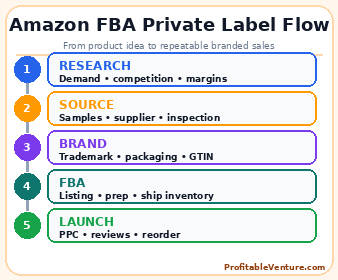
You then create an Amazon listing under your brand and send inventory into Amazon’s fulfillment network.
When customers order, Amazon can pick, pack, and ship the product while also handling much of the customer-service and returns process associated with FBA orders.
This can make the business attractive because you do not necessarily need to pack 100 customer orders inside your house every day.
However, FBA does not mean Amazon runs your business for you. You are still responsible for:
- Choosing the product
- Finding suppliers
- Negotiating manufacturing prices
- Product quality
- Compliance
- Importing
- Branding
- Inventory forecasting
- Listings
- Advertising
- Profit margins
- Reordering.
The biggest mistake beginners make is assuming Amazon FBA is mainly about finding a cheap product in China and putting a logo on it.
That worked much better when competition was lower. Today, a successful private-label product needs a reason to exist.
You should be able to explain why someone should buy your version instead of the 20 competing products already appearing on page one.
Your advantage might be better design, better packaging, better sizing, improved materials, a bundle, easier instructions, stronger branding, or a feature that competitors repeatedly receive complaints about.
If you get product selection right, Amazon FBA can help you scale quickly. If you get it wrong, you can end up with $15,000 worth of inventory sitting inside fulfillment centers while storage costs continue accumulating.
That is why this business should begin with research, not inventory.
Steps on How to Start an Amazon FBA Private Label Business
-
Conduct Product and Market Research
Your first objective is to find a product that customers already want but where you can still create a compelling offer. You are not necessarily trying to invent something completely new.
Inventing a new product can create patent, engineering, tooling, and customer-education costs that a beginner may not need.
A practical private-label strategy is often to find an existing product category and make a meaningful improvement. Start by researching Amazon. Look at:
- Best Sellers
- New Releases
- Search suggestions
- Competitor listings
- Customer reviews
- Frequently returned complaints
- Price ranges
- Number of competing reviews
- Product sizes
- Variations
- Sponsored listings.
Reviews can be extremely useful. Do not read only five-star reviews. Read the one-, two-, and three-star reviews. You may repeatedly see complaints such as:
- “The handle breaks.”
- “It is too small.”
- “The instructions are terrible.”
- “The zipper fails.”
- “The container leaks.”
- “The packaging arrived damaged.”
- “The material feels cheap.”
Those complaints can become your product-development brief. If 200 customers complain that a competitor’s zipper fails, ask your manufacturer whether a stronger zipper can be used.
You are no longer simply copying a product. You are using customer feedback to improve it.
a. What Makes a Good Beginner Private-Label Product?
There is no perfect formula, but beginner-friendly products often share several characteristics. You may prefer a product that is:
- Small
- Lightweight
- Durable
- Easy to understand
- Not highly seasonal
- Not extremely fragile
- Not electrically complicated
- Not dependent on many sizes
- Not dominated by one famous brand
- Priced high enough to absorb Amazon fees.
A selling price somewhere around $20 to $50 can be a practical area for product research because you may have enough selling price to cover product cost, freight, Amazon fees, advertising, returns, and profit.
That does not mean products outside that range cannot work. It simply gives a beginner a useful starting point.
b. What Products Should Beginners Be Careful With?
You should be particularly cautious with products involving complicated regulatory or liability requirements. Examples can include:
- Dietary supplements
- Medical products
- Baby products
- Children’s products
- Cosmetics
- Food
- Products making health claims
- Electronics
- Battery-powered products
- Pesticide products
- Chemicals
- Products involving flames or heat
- Products designed to support significant weight.
These categories are not automatically bad businesses. They can simply require more testing, documentation, insurance, certifications, labeling, or Amazon approval. A beginner may find it easier to learn Amazon with a simpler product first.
c. How Do You Know Whether a Product Can Be Profitable?
Never look only at the supplier’s manufacturing price. Your true cost includes:
- Manufacturing
- Packaging
- Product inspection
- International freight
- Import duties
- Customs brokerage
- Domestic delivery
- Amazon inbound costs
- Referral fees
- FBA fulfillment fees
- Storage
- Advertising
- Returns
- Damaged inventory.
Suppose you sell a product for $32.99. Your simplified unit economics might look like this:
| Item | Per Unit |
|---|---|
| Selling Price | $32.99 |
| Manufacturing Cost | $7.50 |
| Freight, Duties and Prep | $2.20 |
| Estimated Amazon Referral Fee | $4.95 |
| Illustrative FBA Fulfillment | $5.50 |
| Storage, Inbound and Returns Allowance | $1.20 |
| Advertising Allowance | $4.00 |
| Illustrative Contribution Remaining | $7.64 |
This is only an illustration. Your exact Amazon fulfillment cost depends on the product’s dimensions, weight, category, inventory profile, and current fee structure.
Use Amazon’s fee estimator for the actual product before placing your inventory order.
d. Who are Your Major Competitors?
Private-label competition depends entirely on your product. If you sell kitchen organizers, your competitors will be kitchen-organizer brands.
If you sell dog accessories, you compete with pet brands. You may also compete with:
- Amazon Basics
- National consumer brands
- Chinese direct-to-consumer brands
- Other Amazon private-label sellers
- Walmart marketplace sellers
- Temu sellers
- Independent Shopify brands.
Do not choose a product merely because one competitor appears to be making large sales.
If the first page consists almost entirely of listings with 20,000 to 100,000 reviews, you may need an exceptional product or large advertising budget to compete.
e. Are There Federal, State, or Amazon Regulations?
Yes. Your private-label brand is responsible for more than Amazon’s marketplace rules.
You may also need to comply with U.S. laws applying to the actual product. Depending on what you sell, regulatory authorities can include:
- Consumer Product Safety Commission
- Food and Drug Administration
- Federal Communications Commission
- Environmental Protection Agency
- Federal Trade Commission
- U.S. Customs and Border Protection
- State regulatory agencies.
Amazon also restricts certain products and may request compliance documentation, laboratory reports, certificates, invoices, photographs, or other evidence before permitting a product to be listed.
Check compliance before manufacturing thousands of units. Finding out after production that Amazon will not accept your product can be extremely expensive.
f. What Does Amazon FBA Actually Do?
With FBA, you send your inventory into Amazon’s fulfillment network. Amazon can then:
- Store the inventory
- Pick products after customers order
- Pack orders
- Ship orders
- Provide FBA customer service
- Process qualifying returns.
You pay Amazon for these services. FBA costs can include fulfillment, storage, inventory-related charges, inbound costs, removal/disposal costs where applicable, and other fees depending on the situation.
You should therefore think of FBA as a logistics partner rather than free warehousing.
g. What is Amazon Brand Registry?
Brand Registry is especially important for private-label sellers because it provides additional brand-building and intellectual-property tools.
To enroll an eligible brand, you generally need a qualifying pending or registered trademark and branding that is permanently affixed to your product or packaging.
Brand Registry can provide access to tools such as:
- A+ Content
- Brand Stores
- Brand Analytics
- Brand protection tools
- Amazon Vine eligibility for qualifying products
- Additional advertising capabilities.
You do not need to wait until your business is huge before thinking about trademarks. With private label, your brand is part of what you are building.
h. What Do You Need to Start?
- Business entity
- Amazon seller account
- Business bank account
- Credit or debit card accepted by Amazon
- Government-issued identification
- Tax information
- Brand name
- Trademark strategy
- Product research
- Supplier
- Product samples
- Packaging
- UPC/GTIN or applicable exemption
- Product testing where required
- Product inspection
- Freight forwarder or shipping arrangement
- Product photographs
- Amazon listing
- Advertising budget
- Working capital.
-
Choose Your Brand Name and Product
The business name and product brand do not necessarily need to be identical.
Your LLC could be called Summit Commerce LLC while your consumer brand is called EverHaven.
This can give you flexibility to launch several brands later. Your private-label brand name should be:
- Easy to pronounce
- Easy to spell
- Broad enough for future products
- Distinctive
- Suitable for a trademark
- Available as a domain where practical.
Avoid a name tied so tightly to one product that expansion becomes awkward.
If your first product is a garlic press, “GarlicPressKing” may become a poor brand name when you later want to sell mixing bowls or pantry organizers.
Sample Private Label Brand Names
- EverHaven
- NorthPeak Living
- Oakmere
- Velora Home
- BrightTrail
- Novaro
- CasaVerve
- PeakNest
- Solmira
- ArdenVale
- CoreHaven
- NexaLiving
- TrueHarbor
- Bellaro
- TerraNest
- BrightCove Goods
- NorthVale
- Alora Living
- Verdena
- HomeCrafta.
These are examples only. Check trademarks and marketplace use before adopting any name.
-
Register Your Business and Amazon Seller Account
a. What Business Structure is Best?
An LLC is commonly suitable for a new U.S. private-label ecommerce business.
It gives you a formal business entity for contracts, banking, suppliers, Amazon registration, and accounting.
As the brand grows, discuss tax elections and corporate structures with a qualified accountant.
b. Steps to Form an LLC
- Choose the LLC name
- File formation documents
- Select a registered agent
- Create an operating agreement
- Obtain an EIN
- Open a business bank account
- Set up bookkeeping
- Obtain required state registrations
- Purchase appropriate insurance
- Maintain annual filings.
c. Set Up an Amazon Seller Account
Amazon currently offers Individual and Professional selling plans. A private-label seller planning to advertise, build a brand, use advanced tools, and sell substantial volume will normally find the Professional plan more practical.
The Professional selling plan currently costs $39.99 per month plus applicable selling fees. Amazon may ask for information including:
- Government-issued ID
- Business details
- Residential/business address documentation
- Chargeable credit card
- Bank information
- Tax information
- Product information
- Brand/manufacturer information.
Make sure names and addresses are consistent across your documents.
d. Do You Need a Trademark?
You can potentially begin selling without completing a trademark registration, but a serious private-label brand should strongly consider trademark protection.
A qualifying pending or registered trademark can also help you become eligible for Amazon Brand Registry.
Do not manufacture branded packaging before confirming that your chosen name is reasonably available.
e. Do You Need a UPC?
Amazon commonly uses GTINs such as UPCs to identify products. Some products may qualify for GTIN exemptions, but private-label sellers frequently obtain their own identifiers.
If you need UPCs, obtain legitimate codes associated with your business rather than purchasing questionable recycled barcode numbers.
f. What Documents Should You Keep?
- LLC documents
- EIN
- Bank statements
- Supplier contracts
- Purchase invoices
- Product specifications
- Inspection reports
- Testing reports
- Freight documents
- Customs records
- Trademark records
- Insurance policies
- Product photographs
- Packaging files
- Compliance certificates
- Amazon shipment records.
-
Find a Manufacturer and Develop the Product
You may source products domestically or internationally. Private-label manufacturers can be found in countries such as:
- United States
- China
- India
- Vietnam
- Mexico
- Turkey
- Pakistan
Other manufacturing regions depending on product type. The cheapest supplier is not automatically the best supplier. Ask manufacturers about:
- Minimum order quantity
- Unit price
- Sample cost
- Lead time
- Packaging options
- Private labeling
- Customization
- Quality systems
- Testing
- Export experience
- Production capacity
- Payment terms.
Order Samples First
Never place a large first order based only on supplier photographs. Order samples from several suppliers. Compare:
- Materials
- Finish
- Weight
- Dimensions
- Durability
- Packaging
- Smell
- Color
- Functionality.
Try to damage the sample.
- Drop it.
- Wash it if it is washable.
- Open and close it repeatedly.
- Use it the way an impatient customer would.
Your product needs to survive real customers, not just look good in a photograph.
Use Pre-Shipment Inspection
A third-party inspection before the balance is paid and the shipment leaves the factory can help identify issues while the supplier can still correct them.
Inspection can include:
- Quantity verification
- Product dimensions
- Function tests
- Packaging
- Logo placement
- Barcode accuracy
- Carton markings
- Visible defects.
Inspection does not replace product compliance testing where laboratory testing is legally required.
-
Cost Analysis and Budgeting
a. How Much Does It Cost to Start an Amazon FBA Private Label Business?
You can technically test private label with a modest budget, but undercapitalization creates problems.
A small initial order can sell out before your replacement shipment arrives. A weak advertising budget can prevent the listing from gaining useful data.
No reserve means you may have to choose between reordering inventory and paying advertising bills. For planning purposes:
- Lean one-product launch: approximately $7,500 to $15,000
- Well-funded one- to two-product launch: approximately $20,000 to $40,000
- Multi-SKU brand launch: approximately $60,000 to $150,000+.
For this guide, we will use:
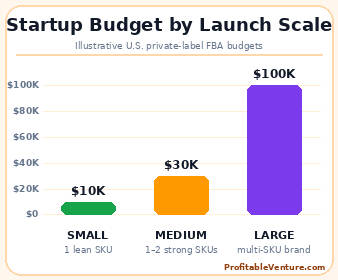
- Small launch: $10,000
- Medium launch: $30,000
- Large launch: $100,000.
b. What are the Startup Costs?
Small Private-Label Launch – Approximately $10,000
- Product samples and development – $700
- Branding and trademark preparation – $700
- First inventory order – $4,000
- Freight, duties, and preparation – $1,300
- Photography and listing content – $500
- Launch advertising – $1,500
- Inspection, software, and administration – $500
- Working-capital reserve – $800
- Estimated Total – $10,000.
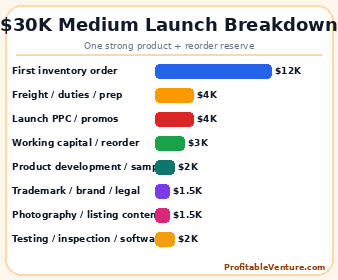
Medium Private-Label Launch – Approximately $30,000
- First inventory order – $12,000
- Freight, duties, preparation, and inbound costs – $4,000
- Launch PPC and promotions – $4,000
- Working capital and reorder reserve – $3,000
- Product development and samples – $2,000
- Trademark, branding, and legal setup – $1,500
- Professional photography and listing content – $1,500
- Testing, inspection, software, and administration – $2,000
- Estimated Total – $30,000.
This is the model used in the financial projection.
Large Multi-SKU Launch – Approximately $100,000
- Initial inventory – $45,000
- International freight and duties – $12,000
- Launch advertising – $15,000
- Working-capital and reorder reserve – $11,000
- Product development and tooling – $5,000
- Trademark, compliance, and legal expenses – $4,000
- Photography, video, and listing assets – $3,000
- Testing and inspections – $3,000
- Software and administration – $2,000
- Estimated Total – $100,000.
c. What Determines Startup Cost?
- Minimum order quantity
- Unit manufacturing cost
- Number of SKUs
- Product size and weight
- Tooling
- Packaging
- Testing
- Freight
- Tariffs and duties
- Amazon fees
- Advertising budget
- Trademark expenses
- Working-capital requirements.
d. Do You Need an Office or Warehouse?
Not necessarily. A major benefit of FBA is that Amazon can store and fulfill inventory.
You can operate administration from a home office if local regulations allow.
As the business grows, you may eventually use a third-party logistics warehouse to:
- Receive imports
- Inspect shipments
- Store overflow inventory
- Apply labels
- Prepare Amazon shipments
- Supply other sales channels.
Do not automatically send an entire year’s inventory into Amazon fulfillment centers. Excess inventory can create storage and aged-inventory costs.
e. What are the Ongoing Expenses?
- Inventory manufacturing
- Freight
- Import duties
- Amazon referral fees
- FBA fulfillment costs
- Storage costs
- Inbound shipment costs
- Amazon advertising
- Returns
- Product inspection
- Software
- Trademark renewals
- Insurance
- Accounting
- Photography and creative work
- 3PL fees where applicable.
f. How Do You Fund the Business?
- Personal savings
- Business credit
- Business line of credit
- Bank loan
- SBA-backed financing
- Private investors
- Business partners
- Supplier payment terms
- Reinvesting Amazon proceeds.
Inventory businesses consume cash.
You may need to reorder your product months before the current inventory sells out because manufacturing and international shipping take time.
That means a business can appear profitable on paper while experiencing serious cash-flow pressure.
-
Write a Business Plan
a. Executive Summary
EverHaven Products, LLC is a proposed private-label ecommerce company that will develop consumer household products and sell them primarily through Amazon using Fulfillment by Amazon.
The business will begin with one carefully researched home-organization product priced at approximately $32.99.
The product will be manufactured according to EverHaven specifications, packaged under the EverHaven brand, inspected before shipment, and sent into Amazon’s fulfillment network.
The company will launch with approximately $30,000 in capital.
Management will focus on product quality, customer feedback, listing conversion, Amazon advertising, inventory availability, contribution margin, and disciplined reordering.
The long-term goal is to develop several complementary products under the same brand rather than continually launching unrelated products.
b. Products and Services
The initial product line may include:
- Home organization products
- Kitchen organization accessories
- Storage products
- Complementary household accessories.
The business will initially avoid high-risk regulated categories until management develops greater compliance expertise.
c. Mission Statement
“At EverHaven Products, LLC, our mission is to develop thoughtfully improved everyday products that solve common household frustrations through practical design, dependable quality, clear instructions, and responsive customer service.”
Vision Statement
“Our vision is to build EverHaven into a trusted ecommerce brand with a focused family of useful products, strong customer reviews, repeatable product-development systems, and diversified online sales.”
d. Goals and Objectives
The first objective is to validate one profitable product before expanding aggressively. Management will track:
- Sessions
- Conversion rate
- Units sold
- Average selling price
- Advertising cost
- Advertising sales
- Total advertising cost of sales
- Refund rate
- Review rating
- Contribution margin
- Inventory days remaining.
The second objective is to avoid stockouts. Management will estimate:
- Manufacturing lead time
- Inspection time
- Freight time
- Amazon receiving time
- Safety-stock requirements.
A product selling 20 units per day that takes 90 days to reorder may require thousands of units in the supply pipeline.
The long-term objective is to develop complementary products that can be cross-promoted to existing customers.
e. Organizational Structure
A small FBA private-label company can remain lean.
- Owner/General Manager
- Virtual Assistant
- Product Sourcing Specialist
- Graphic Designer
- Photographer
- Advertising Specialist
- Bookkeeper
- Freight Forwarder
- Inspection Company
- Third-Party Logistics Provider where required.
Many of these positions can initially be contractors rather than employees.
Marketing Plan
a. SWOT Analysis
Strengths
FBA gives a small brand access to Amazon’s fulfillment infrastructure without building its own national warehouse operation. A successful private-label listing can generate sales around the clock.
The company also owns the brand rather than depending entirely on reselling someone else’s product.
Weaknesses
The company depends heavily on Amazon. Fees, policies, advertising costs, competition, and account requirements can change. Cash is also tied up in inventory for weeks or months.
Opportunities
Opportunities include additional SKUs, bundles, improved packaging, Amazon Brand Store development, international marketplaces, Walmart Marketplace, Shopify, wholesale sales, and direct-to-consumer sales.
Threats
Threats include copycat products, rising PPC costs, manufacturing problems, shipping delays, tariffs, negative reviews, account suspensions, intellectual-property disputes, price competition, product recalls, and excess inventory.
b. How Does an Amazon FBA Private Label Business Make Money?
The primary revenue source is the sale of branded products. Long-term revenue can also come from:
- Additional private-label products
- Product bundles
- Amazon international marketplaces
- Walmart Marketplace
- Shopify
- Wholesale accounts
- Corporate sales.
c. Advertising and Sales Strategies
- Amazon Sponsored Products
- Sponsored Brands when eligible
- Sponsored Display where appropriate
- Amazon Vine for eligible launches
- A+ Content
- Brand Store
- Coupons
- Promotions
- Listing SEO
- Professional product photography
- Video
- External social media where profitable
- Email marketing for off-Amazon customers where applicable.
Do Not Buy Fake Reviews
Do not build the business around fake reviews, paid positive reviews, review manipulation, or attempting to pressure customers into leaving only positive feedback.
A sustainable brand needs legitimate customer feedback. Programs such as Amazon Vine can help eligible products obtain independent reviews within Amazon’s rules.
Financial Projection
a. How Much Should You Charge?
- Do not select the selling price before understanding your costs.
- Start with the customer and competition, then work backward.
- Suppose competitors sell between $24.99 and $39.99.
- If your product is substantially better, $32.99 may be reasonable.
Your price needs to absorb:
- Amazon referral fee
- FBA fulfillment
- Product cost
- Freight
- Advertising
- Returns
- Storage
- Overhead
- Profit.
A product that looks attractive at $29.99 may become unprofitable after Amazon fees and advertising.
b. How Much Revenue Can an Amazon FBA Private Label Business Generate?
The range is enormous. A failed product might generate only a few thousand dollars.
A good one-product brand may generate hundreds of thousands of dollars annually. A multi-SKU brand can generate millions. For planning purposes:
- Small one-product seller: approximately $50,000 to $200,000 annual sales
- Developing private-label brand: approximately $150,000 to $750,000
- Established multi-SKU brand: approximately $750,000 to several million dollars or more.
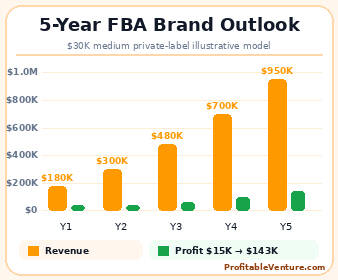
The model below assumes EverHaven generates approximately $180,000 in Year 1 sales.
c. Five-Year Revenue and Profit Projection
| Fiscal Year | Revenue | Total Expenses | Net Profit | Net Margin |
|---|---|---|---|---|
| Year 1 | $180,000 | $165,000 | $15,000 | 8.3% |
| Year 2 | $300,000 | $267,000 | $33,000 | 11.0% |
| Year 3 | $480,000 | $420,000 | $60,000 | 12.5% |
| Year 4 | $700,000 | $603,000 | $97,000 | 13.9% |
| Year 5 | $950,000 | $807,000 | $143,000 | 15.1% |
Under this model, cumulative five-year revenue would be approximately $2.61 million. Cumulative projected net profit would be approximately $348,000.
d. Sample Five-Year Profit and Loss Projection
| Item | Year 1 | Year 2 | Year 3 | Year 4 | Year 5 |
|---|---|---|---|---|---|
| Revenue | $180,000 | $300,000 | $480,000 | $700,000 | $950,000 |
| Product Manufacturing | $45,000 | $78,000 | $120,000 | $171,000 | $228,000 |
| Freight, Duties and Inspection | $14,000 | $24,000 | $36,000 | $52,000 | $68,000 |
| Amazon Referral, FBA, Storage and Related Fees | $54,000 | $90,000 | $142,000 | $205,000 | $276,000 |
| Amazon Advertising and Promotions | $30,000 | $45,000 | $68,000 | $91,000 | $114,000 |
| Seller Software and Professional Plan | $4,000 | $5,000 | $6,000 | $8,000 | $10,000 |
| Creative, Photography and Brand Development | $5,000 | $4,000 | $6,000 | $8,000 | $10,000 |
| Returns, Refunds and Damaged Inventory | $4,000 | $7,000 | $10,000 | $14,000 | $19,000 |
| Administration, Legal and Accounting | $6,000 | $9,000 | $18,000 | $28,000 | $42,000 |
| Other Operating Costs | $3,000 | $5,000 | $14,000 | $26,000 | $40,000 |
| Total Expenses | $165,000 | $267,000 | $420,000 | $603,000 | $807,000 |
| Projected Net Profit | $15,000 | $33,000 | $60,000 | $97,000 | $143,000 |
e. How Much Profit Can an Amazon FBA Private Label Seller Make?
There is no standard amount. A single unsuccessful product can lose money. A well-developed product can generate substantial income.
Under this medium-scale model, projected annual profit grows from approximately $15,000 in Year 1 to approximately $143,000 by Year 5.
This assumes the brand gradually introduces additional complementary products and becomes more efficient with advertising and procurement.
f. What Determines Profit?
- Selling price
- Manufacturing cost
- Amazon fees
- FBA size tier
- Advertising cost
- Conversion rate
- Freight
- Import duties
- Return rate
- Supplier pricing
- Inventory turnover
- Review rating
- Stock availability
- Competition.
g. What Profit Margin Should You Expect?
Calculate net profit using:
Net Profit Margin = Net Profit ÷ Revenue × 100.
The illustrative business in this guide begins around 8.3% net margin and grows toward approximately 15.1%.
A product with a 30% margin before advertising is not necessarily producing a 30% business profit. Look at the entire P&L.
h. What is the Sales Forecast?
- Year 1: $180,000
- Year 2: $300,000
- Year 3: $480,000
- Year 4: $700,000
- Year 5: $950,000.
-
Create Your Amazon Listing and Send Inventory to FBA
Your listing is your salesperson. Customers cannot pick up your product, open the package, or speak to a store employee.
The images and listing need to answer their questions. A strong listing can include:
- Clear product title
- Main white-background product image
- Feature images
- Size/dimension graphics
- Lifestyle images
- Comparison graphics
- Benefit-oriented bullet points
- Accurate description
- Video where available
- A+ Content for eligible brands.
Do not make claims the product cannot support. Do not Photoshop features into an image that the product does not have.
Prepare Inventory Correctly
Amazon has packaging, labeling, and preparation requirements for FBA inventory.
Your units need to arrive ready for Amazon’s fulfillment system. Requirements can involve:
- Correct barcodes
- Secure packaging
- Poly bags where applicable
- Warning labels where required
- Carton labeling
- Shipment labels
- Proper case quantities
- Product-specific preparation.
Confirm the requirements for your exact product before the factory ships it.
Having the manufacturer apply required unit labels correctly can be cheaper than fixing thousands of units after arrival in the United States.
-
Launch and Manage the Business Properly
A private-label product launch is not finished when the listing becomes active. That is when the real work begins. During the first weeks, watch:
- Impressions
- Clicks
- Cost per click
- Conversion rate
- Search terms
- Organic ranking
- Advertising sales
- Refunds
- Customer questions
- Reviews.
If customers click but do not buy, the problem may be:
- Price
- Images
- Reviews
- Product positioning
- Weak perceived value.
If nobody clicks, your keyword targeting, main image, title, price, or advertising strategy may need work.
a. What Makes an Amazon Private-Label Business Successful?
- Good product selection – Poor products are difficult to advertise profitably.
- Real differentiation – A logo alone is not a competitive advantage.
- Strong unit economics – Calculate every meaningful cost.
- Quality control – One defective batch can damage the listing.
- Professional images – Customers buy with their eyes.
- Inventory management – Running out can damage momentum.
- Advertising discipline – Revenue generated by unprofitable ads is not success.
- Brand protection – Trademark and Brand Registry can become valuable.
- Customer feedback – Reviews show you how to improve the next production run.
- Cash-flow management – Reordering requires cash before inventory sells out.
b. What Happens During a Typical Day?
An FBA seller does not normally spend the morning packing individual Amazon orders. Instead, the day may begin by checking Seller Central.
- You review yesterday’s sales.
- You check advertising.
One campaign may have spent $120 and generated $600 of attributed sales. Another may have spent $80 and generated only $95.
- You adjust bids and negative keywords.
- You then look at inventory.
Your hero product has 2,200 units available and is selling 24 units per day. At that rate, you have roughly 92 days of inventory before considering inbound stock and changes in sales velocity.
- Your manufacturer needs 35 days for production.
- Ocean freight and receiving may require several more weeks.
- You may already need to reorder.
Next, you respond to your supplier about an upcoming production run. Customer reviews suggest the packaging should be stronger, so you ask the manufacturer to change the inner insert.
- Your photographer is preparing images for a new variation.
- Your bookkeeper reconciles Amazon settlements.
- Your freight forwarder provides an updated shipping quote.
- The afternoon may be spent researching the next complementary product.
This is what the business gradually becomes: product development, marketing, inventory, finance, and supply-chain management.
c. What Skills and Experience Do You Need?
- Product research – You need to recognize viable opportunities.
- Financial analysis – Revenue alone can be misleading.
- Supplier negotiation – Small price reductions matter at scale.
- Quality control – Your brand takes the blame for defects.
- Advertising – Amazon PPC can consume margins quickly.
- Inventory forecasting – Stockouts and overstock are both expensive.
- Copywriting – Listings need to communicate benefits clearly.
- Branding – Private label should become more than a generic product.
- Cash-flow management – Inventory often must be paid for before revenue arrives.
- Compliance – The product must be legal and eligible for sale.
You do not need previous ecommerce experience to start an Amazon FBA private-label business.
But do not make your education unnecessarily expensive. Your first goal should not be to launch five products. Learn how to launch one properly.
- Spend time researching.
- Order samples.
- Calculate the real landed cost.
- Estimate Amazon fees before manufacturing.
- Check patents and trademarks.
- Confirm product compliance.
- Inspect inventory.
- Build professional listing assets.
Launch with enough advertising money to collect useful data. Then watch the numbers rather than becoming emotionally attached to the product.
- If the product works, reorder before you run out.
- If customers identify a genuine problem, improve the next production run.
If the product clearly does not work after sensible testing, do not keep pouring money into it simply because you spent six months developing it. Most importantly, think beyond one Amazon listing.
The real opportunity in private label is to build a brand with products customers recognize, intellectual property you control, supplier relationships you have developed, and sales channels that can eventually extend beyond Amazon.
If you can combine careful product selection, genuine differentiation, quality manufacturing, strong unit economics, professional listings, disciplined advertising, inventory planning, and good cash-flow management, you can build a successful Amazon FBA private-label business even if you started with no previous ecommerce experience.