A glass recycling business collects discarded glass, sorts it, removes contaminants, crushes and processes it into reusable material known as cullet, and sells the processed glass to manufacturers and other industrial customers.
Your raw material may come from:
- Municipal recycling programs
- Material recovery facilities
- Bars and restaurants
- Hotels
- Breweries
- Wineries
- Food manufacturers
- Supermarkets
- Bottle redemption centers
- Waste-hauling companies
- Commercial glass collection programs.
Your finished product may be sold for use in:
- New glass bottles and jars
- Fiberglass insulation
- Glass abrasives
- Filtration media
- Highway marking beads
- Tile and terrazzo
- Construction aggregate
- Landscaping materials
- Specialty glass products.
The important thing to understand is that all recycled glass is not equal. A glass-container manufacturer needs clean, specification-compliant cullet.
That usually means bottles and jars have been separated from contaminants such as ceramics, stones, metals, plastics, caps, paper, and incompatible glass types.
Window glass, mirrors, drinking glasses, cookware, laboratory glass, ceramics, and heat-resistant glass can have different chemical compositions from ordinary food and beverage container glass.
If you mix unsuitable materials into container-grade cullet, you can ruin an otherwise valuable load.
This is why the business is not simply about buying a crusher and breaking bottles. You are creating an industrial raw material with a customer specification.
The cleaner and more consistent your output, the more useful it becomes to higher-value buyers. There is another important reality you should understand before starting.
Glass is heavy.
This makes transportation one of the most important parts of the business model.
You might find thousands of tons of unwanted glass 300 miles away, but transporting that material to your facility and then transporting processed cullet another 300 miles to a buyer can destroy the economics.
For that reason, your ideal location is not simply where rent is cheap. You need to be reasonably close to both your glass supply and your end markets.
A successful glass recycling company therefore makes money from a combination of material processing, logistics, contamination control, volume, and reliable industrial buyers.
Steps on How to Start a Glass Recycling Business
-
Conduct Market Research
Do not begin by buying recycling machinery. Begin by finding out who will buy your processed glass.
This is one of the most important pieces of advice in this entire guide. Contact potential buyers and ask what specifications they require. For example, a bottle manufacturer may want:
- Container glass only
- Specific colors
- Maximum particle size
- Very low ceramic contamination
- Very low metal contamination
- Very low organic contamination
- Consistent moisture levels.
A construction-material company may accept glass that would never satisfy a bottle manufacturer. Those are completely different products.
Once you understand what buyers need, work backward and determine what processing equipment is required. Next, investigate glass supply. You need to talk to:
- Municipal recycling departments
- Material recovery facilities
- Waste-hauling companies
- Bars
- Restaurants
- Hotels
- Breweries
- Wineries
- Beverage distributors
- Bottle redemption businesses
- Food-processing facilities.
Ask:
- How many tons of glass do they generate?
- How is it currently disposed of?
- Is the glass color separated?
- How contaminated is it?
- Who currently pays for transportation?
- Are they paying a disposal or processing fee?
- Would they sign a multi-year supply agreement?
You should know where at least a substantial portion of your feedstock will come from before financing a $1 million processing line.
a. Who is the Target Market?
Your business actually has two target markets. The first consists of organizations supplying discarded glass. They can include:
- Municipalities
- Material recovery facilities
- Recycling centers
- Waste-management companies
- Bottle redemption centers
- Restaurants
- Hotels
- Breweries
- Wineries
- Supermarkets
- Food and beverage manufacturers.
The second market consists of companies purchasing processed glass. Potential buyers include:
- Glass-container manufacturers
- Fiberglass manufacturers
- Aggregate companies
- Concrete-product companies
- Tile manufacturers
- Abrasive manufacturers
- Filtration-media companies
- Highway-bead manufacturers
- Landscaping-material suppliers
- Specialty glass manufacturers.
b. Is a Glass Recycling Business Profitable?
Yes, but the business can be difficult if you depend only on selling crushed glass.
A more resilient model can earn revenue from several sources. For example:
- Municipality pays you a processing fee
- Commercial customer pays a collection fee
- You sell clean cullet
- You sell lower-grade processed glass into construction applications
- You provide dedicated glass pickup services.
This matters because commodity values fluctuate. Suppose you receive one ton of commercial glass and earn $25 from a collection or processing agreement.
After sorting and cleaning, you recover saleable cullet that generates additional revenue.
The same ton may therefore generate income at both the inbound and outbound ends of your operation.
That can be much stronger than relying solely on whatever a manufacturer happens to pay for cullet that month. Profitability is heavily influenced by:
- Volume
- Contamination level
- Transportation distance
- Processing yield
- Electricity
- Labor
- Equipment uptime
- Disposal cost for contaminants
- Buyer specifications
- Sale price of processed glass.
c. What Niches Exist in Glass Recycling?
You can specialize in:
- Container glass recycling
- Commercial bottle collection
- Color-sorted cullet
- Mixed-color cullet
- Fiberglass feedstock
- Glass aggregate
- Recycled glass sand
- Glass abrasive media
- Filtration media
- Terrazzo and decorative glass
- Construction applications
- Bottle-deposit processing
- Specialty industrial glass processing.
Container-grade cullet can be attractive because glass manufacturers can remelt it into new containers, but quality requirements can be demanding.
Lower-grade recovered glass may still have value in secondary applications.
A smart processor develops more than one outlet so that material that misses one buyer’s specification does not automatically become landfill waste.
d. Who are the Major Competitors?
Your competitors can include:
- Strategic Materials
- Regional glass beneficiation companies
- Material recovery facilities
- Waste-management companies with glass-processing operations
- Municipal recycling operations
- Independent aggregate processors
- Container-deposit processors.
You are not necessarily competing with a national processor for every account.
A regional business may have an advantage when transportation costs make it uneconomical for distant processors to collect local glass. You can also compete by offering:
- Dedicated glass collection
- Cleaner source-separated material
- Fast commercial pickups
- Reliable container service
- Customized cullet specifications
- Regional delivery.
e. Are There County, State, or Federal Regulations?
Yes. A glass recycling facility can be subject to several layers of regulation depending on its location and activities. You may need to address:
- Industrial zoning
- Solid-waste or recycling facility permits
- Stormwater requirements
- Air-quality or dust-control permits
- Wastewater permits if washing glass
- Building permits
- Fire-code requirements
- Truck and commercial vehicle regulations
- Noise restrictions
- Worker-safety requirements.
Ordinary beverage-container glass is not automatically hazardous waste. However, you need procedures preventing unsuitable hazardous or contaminated materials from being mixed into your incoming stream.
If your business accepts other industrial wastes or contaminated materials, additional environmental regulations may apply.
Worker Safety
Glass recycling presents obvious and less obvious hazards. Workers may be exposed to:
- Sharp glass
- Moving conveyors
- Crushers
- Forklifts
- Loaders
- Falling materials
- Dust
- Noise
- Unexpected equipment startup.
Your facility should have procedures covering machine guarding, lockout/tagout, forklift traffic, hearing protection where required, eye protection, gloves, protective footwear, dust control, and safe equipment maintenance.
Nobody should reach into a jammed crusher or conveyor while machinery is capable of starting.
f. Is There a Franchise for a Glass Recycling Business?
Glass recycling is not primarily a franchise industry. Most businesses are independent processors, municipal contractors, waste companies, materials companies, or regional recycling operators.
A better approach is often to develop:
- Municipal contracts
- MRF supply agreements
- Commercial collection contracts
- Offtake agreements with manufacturers.
g. What Do You Need to Start?
- Reliable glass supply
- Confirmed end markets
- Industrial site
- Receiving area
- Storage bunkers
- Conveyors
- Glass crusher
- Screens
- Magnetic separation
- Contaminant-removal equipment
- Optical sorting for larger operations
- Dust control
- Loader
- Forklift
- Bins
- Truck scale or weighing system
- Collection trucks where applicable
- Permits
- Insurance
- Employees
- Working capital.
h. How Does the Glass Recycling Process Work?
A typical operation may follow these stages:
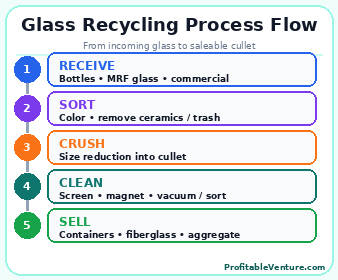
Step 1 – Receive the Glass
- Incoming glass is weighed and recorded.
- The operator identifies its source and inspects contamination.
Step 2 – Remove Large Contaminants
Plastic bags, cardboard, large metal objects, trash, and incompatible materials are removed.
Step 3 – Separate the Glass
Depending on the target market, glass may need to be separated into:
- Clear/flint
- Amber/brown
- Green
- Mixed color.
Step 4 – Crush the Glass
A crusher reduces containers into manageable cullet.
Step 5 – Screen the Material
Screens classify the material by size.
Step 6 – Remove Metals
Magnetic and other separation equipment can remove caps and metallic contaminants.
Step 7 – Remove Remaining Contaminants
Depending on the plant, this may involve:
- Air separation
- Vacuum systems
- Optical sorters
- Manual quality control
- Additional screening.
Step 8 – Test and Store Finished Cullet
Processed glass is stored by grade or color until enough material is available for shipment.
Step 9 – Deliver to the Buyer
The finished product is loaded in bulk for shipment to the customer.
-
Choose a Memorable Business Name
Some glass recycling business name ideas are:
- ClearCycle Glass Recovery, LLC
- GreenGlass Recycling, LLC
- PureCullet Processing, LLC
- SecondLife Glass, LLC
- GlassLoop Recycling, LLC
- ClearPath Recycling, LLC
- EcoCullet Materials, LLC
- GlassWorks Recovery, LLC
- RenewGlass Processing, LLC
- CircleGlass Materials, LLC
- EverClear Recycling, LLC
- ReGlass Materials, LLC
- GreenBottle Recovery, LLC
- ClearEarth Glass, LLC
- Urban Cullet Recycling, LLC
- GlassCycle Materials, LLC
- NextGlass Recovery, LLC
- CleanCullet Recycling, LLC
- Reclaim Glass Works, LLC
- Infinite Glass Recovery, LLC.
Check state business records and potential trademark conflicts before adopting a name.
-
Register Your Business
a. What Business Structure is Best?
An LLC can be suitable for a smaller independent glass recycling company. A larger operation with outside investors may eventually use a corporation.
This is an industrial business with meaningful liability exposure, so you should combine your legal structure with appropriate insurance and strong operating procedures.
b. Steps to Form an LLC
- Choose an available business name
- File Articles of Organization
- Select a registered agent
- Create an operating agreement
- Obtain an EIN
- Register for applicable taxes
- Open a business bank account
- Secure the industrial site
- Obtain environmental and operating permits
- Purchase insurance
- Maintain annual filings.
c. What Licenses and Permits are Needed?
Potential requirements include:
- General business license
- Solid-waste/recycling facility permit
- Zoning approval
- Certificate of occupancy
- Industrial stormwater coverage
- Air-quality permit where applicable
- Dust-control approval
- Wastewater/discharge permit where applicable
- Building permit
- Fire inspection
- Commercial vehicle registration
- Truck-weight permits where applicable.
Permit requirements can differ dramatically between states.
Speak with the relevant environmental agency before signing a long-term lease for the site.
d. What Certifications are Needed?
There is no single national certification required to own a glass recycling company. Useful training can include:
- OSHA safety training
- Forklift certification
- Lockout/tagout training
- Heavy-equipment operation
- First aid and CPR
- Environmental compliance training
- Quality-control training.
e. What Documents are Needed?
- Formation documents
- EIN
- Business license
- Environmental permits
- Stormwater documents
- Site plan
- Lease or deed
- Equipment specifications
- Insurance policies
- Employee safety procedures
- Lockout/tagout procedures
- Training records
- Incoming material records
- Weight tickets
- Customer specifications
- Quality-control records
- Maintenance logs
- Supplier contracts
- Offtake agreements.
f. Do You Need a Trademark, Copyright, or Patent?
You normally do not need a patent to operate a conventional recycling plant. A trademark can protect your company name and brand.
Copyright can protect original website content, marketing materials, photographs, and technical documentation.
A patent may become relevant only if your company develops genuinely novel processing or sorting technology.
-
Cost Analysis and Budgeting
a. How Much Does It Cost to Start a Glass Recycling Business?
Glass recycling ranges from relatively simple collection and crushing operations to sophisticated beneficiation plants using optical sorting and automated contamination removal.
For planning purposes:
- Small collection/crushing operation: approximately $150,000 – $400,000
- Medium regional cullet processor: approximately $750,000 – $1.75 million
- Large automated processing plant: approximately $2.5 million – $8 million+.
For this guide, we will model:
- Small: $250,000
- Medium: $1.2 million
- Large: $4 million.
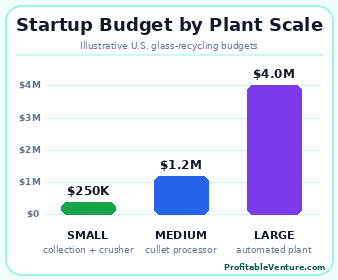
These figures exclude land purchase.
b. What are the Costs Involved?
Small Glass Recycling Operation – Approximately $250,000
- Used crusher, screens, and conveyors – $80,000
- Loader, forklift, and bins – $40,000
- Facility deposit and site improvements – $35,000
- Truck/trailer equipment – $30,000
- Dust control and safety equipment – $15,000
- Permits and engineering – $10,000
- Scale, testing, office, and administration – $10,000
- Working capital – $30,000
- Estimated Total – $250,000.
Medium Glass Recycling Plant – Approximately $1.2 Million
- Sorting, conveying, crushing, and screening line – $360,000
- Facility improvements and site buildout – $180,000
- Loader, forklift, bins, and material handling – $140,000
- Truck and collection equipment – $120,000
- Dust-control and safety systems – $80,000
- Electrical and utility upgrades – $80,000
- Permits, engineering, and professional expenses – $60,000
- Working capital – $180,000
- Estimated Total – $1,200,000.
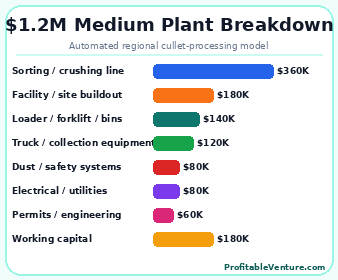
This is the model used in the financial projection.
Large Automated Glass Processing Plant – Approximately $4 Million
- Automated crushing, screening, and optical sorting line – $1,300,000
- Building and site improvements – $700,000
- Loaders, forklifts, trucks, and mobile equipment – $500,000
- Dust collection, cleaning, and safety systems – $300,000
- Electrical and utility infrastructure – $350,000
- Storage bunkers, silos, and bins – $250,000
- Laboratory, scales, controls, and automation – $150,000
- Engineering, permitting, and professional fees – $150,000
- Working capital – $300,000
- Estimated Total – $4,000,000.
c. What Factors Determine Startup Cost?
- Tons processed per hour
- Glass contamination
- Manual versus optical sorting
- Number of colors separated
- Equipment automation
- Facility size
- Electrical requirements
- Dust control
- Truck fleet
- Land and yard requirements
- Permitting
- Working capital.
d. Do You Need to Build a Facility?
No. A suitable industrial warehouse and yard can significantly reduce startup costs. Look for:
- Industrial zoning
- Concrete floors
- Truck access
- High ceilings
- Three-phase power
- Outdoor storage approval
- Loading space
- Good drainage
- Enough distance from noise-sensitive neighbors
- Room for expansion.
e. What are the Ongoing Expenses?
- Feedstock purchasing where applicable
- Collection expenses
- Payroll
- Truck fuel
- Equipment fuel
- Electricity
- Facility rent
- Equipment maintenance
- Crusher wear parts
- Conveyor belts
- Dust-control filters
- Insurance
- Waste disposal
- Environmental compliance
- Laboratory testing
- Transportation to buyers.
f. What Employees are Needed?
A medium plant may employ:
- General Manager
- Plant Manager
- Operations Supervisor
- Equipment Operators
- Sorting-Line Employees
- Loader Operators
- Forklift Operators
- Maintenance Technician
- Truck Drivers
- Quality-Control Technician
- Sales/Procurement Manager
- Administrative Staff.
Illustrative annual compensation ranges might include:
- Plant Manager: $70,000 – $110,000+
- Maintenance Technician: $50,000 – $80,000
- Heavy Equipment Operator: $42,000 – $65,000
- Commercial Driver: $45,000 – $70,000
- Quality-Control Technician: $40,000 – $60,000
- Sorting/Production Employee: $32,000 – $48,000.
g. How Do You Fund the Business?
- Personal equity
- Commercial bank loans
- SBA-backed financing
- Equipment financing
- Equipment leasing
- Private investors
- Business partners
- Municipal contracts
- Economic-development financing
- Recycling/environmental grants where available.
A signed supply contract and a credible buyer agreement can make your financing proposal much stronger than simply telling a lender that recycling is growing.
-
Write a Business Plan
a. Executive Summary
ClearCycle Glass Recovery, LLC is a proposed regional glass recycling and cullet-processing business serving the greater St. Louis industrial market.
The company will receive post-consumer and commercial container glass from municipalities, material recovery facilities, hospitality businesses, waste haulers, and commercial collection programs.
Glass will be inspected, sorted, crushed, screened, cleaned, and processed into marketable cullet. The company will focus primarily on:
- Container-grade cullet
- Fiberglass feedstock
- Secondary glass aggregate.
ClearCycle will launch with approximately $1.2 million in capital. The plant will be designed as a regional operation capable of increasing throughput as supply agreements develop.
The company’s strategy is built around four principles:
- Secure glass supply before adding capacity
- Maintain multiple end markets
- Control contamination
- Keep transportation distances economical.
b. Products and Services
ClearCycle Glass Recovery will offer:
- Commercial glass collection
- Municipal glass processing
- MRF glass processing
- Color-sorted cullet
- Mixed cullet
- Fiberglass feedstock
- Processed glass aggregate
- Custom crushing and screening
- Bulk recycled glass supply.
c. Mission Statement
“At ClearCycle Glass Recovery, LLC, our mission is to turn discarded glass into reliable industrial raw material through efficient collection, careful processing, contamination control, responsible operations, and dependable customer service.”
Vision Statement
“Our vision is to become a leading regional glass recovery company that keeps usable glass out of landfills while supplying manufacturers and construction markets with consistent recycled material.”
d. Goals and Objectives
The first objective is to achieve dependable plant throughput. Management will track:
- Inbound tons
- Processed tons
- Saleable yield
- Contaminant percentage
- Processing cost per ton
- Transportation cost per ton
- Equipment downtime
- Electricity per ton
- Average revenue per ton.
The second objective is to develop several end markets. The business should not become dependent on one bottle manufacturer.
ClearCycle will maintain relationships with container manufacturers, fiberglass producers, construction-material companies, and secondary glass users.
The third objective is to improve material quality. Better contamination removal can allow the company to move glass from a low-value outlet into a higher-value specification.
e. Organizational Structure
- Owner/General Manager
- Plant Manager
- Operations Supervisor
- Maintenance Technician
- Quality-Control Technician
- Loader/Forklift Operators
- Sorting-Line Employees
- Commercial Drivers
- Supply and Sales Manager
- Administrative/Accounting Staff.
Marketing and Sales Plan
a. SWOT Analysis
Strengths
Glass can be repeatedly recycled when properly separated and processed. A regional processor can also solve a logistical problem for municipalities and businesses that do not have economical access to distant glass processors.
Weaknesses
Glass is heavy and relatively inexpensive per ton, making transportation expensive. Processing machinery also requires substantial capital and maintenance.
Opportunities
Opportunities include municipal contracts, commercial bottle collection, fiberglass markets, recycled aggregate, dedicated glass drop-off systems, bottle-deposit material, and higher-purity cullet.
Threats
Threats include fuel-price increases, contamination, machinery failures, loss of a large buyer, changes in municipal recycling programs, low commodity prices, environmental violations, and competition from large waste-management companies.
b. How Does a Glass Recycling Business Make Money?
- Processing fees
- Tipping fees
- Municipal recycling contracts
- Commercial collection fees
- Cullet sales
- Fiberglass-grade material sales
- Glass aggregate sales
- Abrasive-media feedstock
- Specialty processed glass.
c. Payment Methods
- ACH
- Wire transfer
- Commercial invoice
- Municipal contract payment
- Purchase orders
- Approved customer credit terms.
d. Sales Strategies
- Contact municipal recycling departments
- Approach MRF operators
- Target breweries and wineries
- Develop hotel and restaurant collection routes
- Contact bottle manufacturers
- Contact fiberglass manufacturers
- Approach aggregate suppliers
- Develop construction-industry outlets
- Offer contamination reporting to suppliers
- Negotiate multi-year supply contracts
- Negotiate buyer specifications before production.
Financial Projection
a. How Should You Price Glass Recycling Services?
There is no single price per ton that works everywhere. You should calculate each account using:
Collection Cost + Processing Cost + Contaminant Disposal + Transportation + Overhead + Desired Margin.
Then subtract expected material-sale value where appropriate.
A customer delivering clean, source-separated bottles directly to your plant can be significantly more valuable than a customer requiring a 100-mile pickup for highly contaminated mixed glass.
Do not offer both customers the same deal simply because they deliver the same number of tons.
b. How Much Revenue Can a Glass Recycling Plant Generate?
A small regional processor may generate several hundred thousand dollars annually.
A larger facility processing tens of thousands of tons can generate several million dollars.
For planning purposes:
- Small operation: approximately $300,000 – $900,000 annually
- Medium regional plant: approximately $750,000 – $3 million
- Large automated processor: several million dollars annually depending on throughput and contracts.
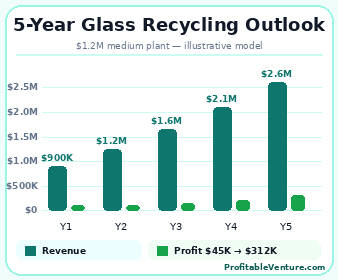
The medium-scale model below assumes approximately $900,000 in Year 1 revenue from combined material sales, processing fees, and collection services.
c. Five-Year Revenue and Profit Projection
| Fiscal Year | Revenue | Total Expenses | Net Profit | Net Margin |
|---|---|---|---|---|
| Year 1 | $900,000 | $855,000 | $45,000 | 5.0% |
| Year 2 | $1,250,000 | $1,162,000 | $88,000 | 7.0% |
| Year 3 | $1,650,000 | $1,505,000 | $145,000 | 8.8% |
| Year 4 | $2,100,000 | $1,880,000 | $220,000 | 10.5% |
| Year 5 | $2,600,000 | $2,288,000 | $312,000 | 12.0% |
Under this illustrative model, cumulative five-year revenue would be approximately $8.5 million. Cumulative projected net profit would be approximately $810,000.
d. Sample Five-Year Profit and Loss Projection
| Item | Year 1 | Year 2 | Year 3 | Year 4 | Year 5 |
|---|---|---|---|---|---|
| Revenue | $900,000 | $1,250,000 | $1,650,000 | $2,100,000 | $2,600,000 |
| Feedstock / Collection Costs | $180,000 | $255,000 | $340,000 | $430,000 | $520,000 |
| Payroll and Employee Costs | $240,000 | $320,000 | $400,000 | $490,000 | $590,000 |
| Hauling, Fuel and Transportation | $120,000 | $160,000 | $205,000 | $255,000 | $315,000 |
| Facility Rent and Occupancy | $96,000 | $100,000 | $104,000 | $108,000 | $112,000 |
| Electricity and Utilities | $45,000 | $60,000 | $75,000 | $90,000 | $105,000 |
| Maintenance and Wear Parts | $55,000 | $70,000 | $90,000 | $110,000 | $135,000 |
| Residual Disposal | $25,000 | $35,000 | $45,000 | $55,000 | $65,000 |
| Insurance and Environmental Compliance | $25,000 | $30,000 | $35,000 | $40,000 | $45,000 |
| Administration, Sales and Marketing | $35,000 | $45,000 | $60,000 | $75,000 | $90,000 |
| Depreciation, Financing and Other Costs | $34,000 | $87,000 | $151,000 | $227,000 | $311,000 |
| Total Expenses | $855,000 | $1,162,000 | $1,505,000 | $1,880,000 | $2,288,000 |
| Projected Net Profit | $45,000 | $88,000 | $145,000 | $220,000 | $312,000 |
e. How Much Profit Can a Glass Recycling Business Make?
There is no fixed amount. A processor operating below capacity can struggle because machinery, management, insurance, rent, and maintenance continue whether the plant processes 30 tons or 200 tons that day.
Under this medium-scale model, annual projected net profit increases from approximately $45,000 in Year 1 to approximately $312,000 in Year 5.
f. What Factors Determine Profit?
- Inbound tons
- Processing fee per ton
- Cullet selling price
- Contamination
- Saleable recovery rate
- Transportation distance
- Fuel prices
- Electricity
- Labor
- Equipment downtime
- Maintenance
- Residual disposal cost
- Customer specifications.
g. What is the Profit Margin?
Use:
Net Profit Margin = Net Profit ÷ Revenue × 100.
The illustrative model begins at approximately 5% and improves toward approximately 12% as throughput, yield, buyer relationships, and equipment utilization improve.
h. What is the Sales Forecast?
- Year 1: $900,000
- Year 2: $1,250,000
- Year 3: $1,650,000
- Year 4: $2,100,000
- Year 5: $2,600,000.
-
Set Up Your Glass Recycling Plant
a. How Do You Choose the Perfect Location?
A good glass recycling location needs industrial infrastructure more than consumer visibility. Look for:
- Industrial zoning
- Highway access
- Rail access where useful
- Heavy truck access
- Three-phase electricity
- Low-cost industrial space
- Room for outdoor containers
- Distance from residential neighborhoods
- Reliable drainage
- Space for future expansion.
Then calculate transportation. Map your major glass suppliers and likely buyers.
A slightly more expensive facility located between both sides of the supply chain may be cheaper overall than an inexpensive property requiring excessive truck mileage.
b. What Equipment is Needed?
- Receiving hoppers
- Feeders
- Conveyors
- Glass crusher
- Vibrating screens
- Trommel screens where appropriate
- Magnetic separators
- Air separation equipment
- Vacuum systems
- Optical sorter for advanced operations
- Dust-control system
- Loader
- Forklift
- Skid steer
- Storage bunkers
- Roll-off containers
- Truck scale
- Collection trucks
- Quality-control equipment.
c. Do Not Design the Plant Without the Buyer Specification
This deserves repeating. Suppose you purchase a processing line that produces mixed-color cullet at a particular size.
You later discover that your best prospective customer wants clear glass separated from amber and green.
You may now need expensive additional sorting equipment. Ask potential buyers for specifications before finalizing equipment.
-
Hire and Train Employees
Recycling equipment can be dangerous when employees become casual around it. Train workers on:
- PPE
- Eye protection
- Cut-resistant gloves
- Hearing protection where required
- Machine guarding
- Lockout/tagout
- Forklift safety
- Loader safety
- Traffic separation
- Dust control
- Material inspection
- Emergency procedures.
Create designated pedestrian and heavy-equipment routes. A sorting employee should not routinely walk through the same uncontrolled path used by loaders and dump trucks.
Quality-Control Training
Employees also need to recognize contamination. Train them to identify:
- Ceramics
- Stones
- Metal
- Plastic
- Mirrors
- Heat-resistant cookware
- Window glass
- Other incompatible materials.
A small amount of the wrong material can reduce the value of an entire shipment.
-
Launch the Business Properly
Do not begin by accepting every truckload offered to you. Commission the plant slowly. Run known material through the system. Measure:
- Input weight
- Finished cullet weight
- Residual waste
- Processing time
- Energy use
- Contamination level
- Equipment downtime.
Then send test loads to prospective buyers. Ask for feedback. If the customer says your ceramic contamination is too high, solve that before processing thousands of tons.
a. What Makes a Glass Recycling Business Successful?
- Reliable feedstock – Machinery needs glass to process.
- Reliable buyers – A mountain of cullet is not cash.
- Low contamination – Quality determines marketability.
- High processing yield – More saleable output per inbound ton improves economics.
- Short transportation distances – Glass is heavy.
- Equipment uptime – Idle machinery still costs money.
- Preventive maintenance – Crushers and conveyors experience substantial wear.
- Multiple end markets – Avoid dependence on one buyer.
- Safe operations – Industrial accidents can be devastating.
- Strong contracts – Predictable supply and demand support financing and growth.
b. What Happens During a Typical Day?
The plant begins with a safety and production meeting. Operators inspect conveyors, guards, emergency stops, loaders, and crushers before startup.
- The first inbound truck arrives from a municipal recycling program.
- The truck is weighed.
- The load is inspected and assigned to the appropriate receiving area.
- A loader moves glass into the feed hopper.
The processing line begins separating contamination and reducing glass to specification.
Employees monitor:
- Feed rate
- Crusher performance
- Screening
- Contaminant levels
- Dust-control equipment
- Conveyor operation.
A second truck arrives from a brewery collection program.
- This material is considerably cleaner because it was separated at the source.
- Management records the difference in recovery yield.
Later in the day, a finished cullet shipment is loaded for an industrial customer. The shipment is weighed and accompanied by the appropriate records.
The maintenance technician uses a scheduled shutdown period to inspect bearings, belts, crusher wear components, and dust-control equipment.
At the end of the shift, management reviews:
- Inbound tons
- Finished tons
- Residual waste
- Downtime
- Maintenance issues
- Outbound shipments.
Over time, those numbers tell you which suppliers provide profitable glass and which ones are sending you expensive contamination.
c. What Skills and Experience Do You Need?
- Recycling operations – You need to understand material flow.
- Industrial equipment management – The plant depends on machinery.
- Quality control – Buyer specifications matter.
- Logistics – Transportation can make or break the economics.
- Environmental compliance – Recycling plants still require responsible environmental management.
- Workplace safety – Crushers, conveyors, glass, trucks, and loaders create serious hazards.
- Contract negotiation – You need both supply and buyer agreements.
- Financial management – Calculate profit per ton, not merely total revenue.
- Maintenance planning – Wear components need preventive replacement.
You do not need previous ownership experience in recycling to start a glass recycling company.
However, you should not attempt to design and operate an industrial processing plant entirely by yourself if you have never worked with recycling machinery.
- Hire experienced engineering and operations people.
- Visit existing recycling facilities.
- Talk to equipment manufacturers.
- Obtain actual buyer specifications.
- Get real trucking quotes.
- Get real utility requirements.
- Investigate permits before leasing property.
Most importantly, secure both sides of the business before making the largest investment. You need glass coming in and customers taking processed glass out.
If you can combine dependable feedstock, good contamination control, efficient processing, short transportation distances, strong industrial buyers, preventive maintenance, and disciplined cost-per-ton management, you can build a successful glass recycling business even if you started with no previous recycling-business experience.