

A food truck business is a mobile food-service operation that prepares and sells meals, snacks, beverages, desserts, or specialty foods from a vehicle equipped with a commercial kitchen.
Unlike a traditional restaurant, a food truck can move to where customers are.
You might serve office workers during lunch, attend festivals on weekends, park near breweries in the evening, cater weddings and corporate events, or build a regular schedule around several profitable locations. This mobility is one of the biggest attractions of the business.

Instead of committing immediately to an expensive restaurant lease, dining room, large staff, and extensive interior buildout, you can concentrate your investment on a truck, kitchen equipment, permits, ingredients, branding, and finding locations where customers already gather.
Food trucks make money primarily from food and beverage sales, but a well-run operation can develop several additional income streams.
These may include private catering, corporate lunches, weddings, festivals, school events, sports tournaments, delivery orders, branded merchandise, packaged sauces, and partnerships with breweries, offices, event organizers, and entertainment venues.

You do not need to be a professional chef to start a food truck business, but you must understand that selling delicious food is only part of the job.
You will also need to control food costs, manage inventory, comply with health regulations, hire dependable workers, maintain your vehicle, choose profitable locations, create a menu that can be prepared quickly, market the business, and keep customers coming back.
If you have no experience, one of the smartest things you can do is start with a simple concept rather than trying to offer a restaurant-sized menu from a small truck.

A food truck with six excellent items that customers can receive quickly will usually be easier to operate than one trying to prepare 30 completely different dishes in a cramped kitchen.
Steps on How to Start a Food Truck Business
-
Conduct Market Research
Your market research should come before you purchase a food truck. A common mistake beginners make is to fall in love with the idea of owning a beautiful truck, spending heavily on the vehicle and kitchen, and only afterward asking where the customers will come from.
You should start by studying the food scene in the city where you intend to operate.
Visit food truck parks, office districts, universities, breweries, farmers’ markets, festivals, industrial areas, tourist attractions, sports venues, and other places where mobile food vendors operate.
Observe which trucks have lines and which ones do not. Pay attention to what customers are buying, how much they are paying, how long they are willing to wait, and what types of food appear to be missing from the market.
Your concept should solve a simple problem. Perhaps office workers need fast lunches that can be served in less than five minutes.
Maybe a nightlife district has plenty of burgers but very few late-night tacos.
Perhaps breweries in your city want rotating food vendors because they do not operate kitchens.
You should also research your competitors’ menus. Do not look only at their prices.
Study portion sizes, packaging, online reviews, customer complaints, service speed, branding, social media activity, and where they park.
A truck selling a $15 meal is not necessarily more profitable than one selling a $10 meal if the expensive meal costs too much to produce or takes too long to prepare.
Talk directly to potential customers whenever possible. Ask office workers what they normally spend on lunch. Speak with event organizers about what they expect from food vendors.
Talk to brewery managers about vendor arrangements. Ask college students what foods they wish were available near campus.
The objective is not to hear that people “like your idea.” The objective is to find out whether enough people are likely to pay for it regularly.
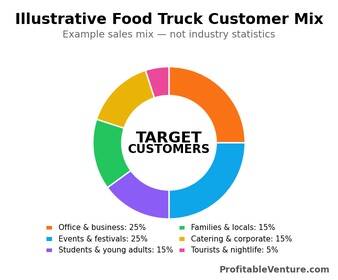
a. Who is the Target Market for a Food Truck Business?

- Office workers looking for quick lunches
- Students and university communities
- Young professionals
- Families attending community events
- Tourists
- Festival and concert attendees
- Customers at breweries and entertainment venues
- Construction and industrial workers
- Nightlife customers
- Wedding and party organizers
- Corporate organizations
- Schools and colleges
- Sports-event organizers
- Farmers’ market customers
- People looking for specialty or ethnic foods.
b. Is a Food Truck Business Profitable?
Yes, a food truck business can be profitable, but there is an important difference between having strong sales and actually making money.
A truck can have customers lined up every afternoon and still perform poorly financially if food waste is high, ingredients are expensive, employees are overstaffed, event fees are excessive, or the owner does not price the menu correctly.
Your profitability will depend largely on your food-cost percentage, labor costs, average order value, number of customers served per shift, location fees, commissary expenses, fuel, insurance, maintenance, and the number of profitable operating days you achieve.
A simple menu with high-margin products and fast preparation can be extremely valuable.
For example, selling 150 meals during a busy lunch period means very little if every customer has to wait 20 minutes because the kitchen cannot keep up.
Speed, consistency, portion control, and food cost matter just as much as taste.
c. Are There Existing Niches in the Industry?
Yes. Food trucks can specialize in almost any cuisine that can be prepared safely and efficiently in a mobile kitchen. Popular niches include:

- Taco and Mexican food trucks
- Burger trucks
- Barbecue trucks
- Pizza trucks
- Seafood trucks
- Chicken and wings trucks
- Breakfast and brunch trucks
- Sandwich and grilled-cheese trucks
- Vegan and vegetarian food trucks
- Healthy bowls and salad trucks
- African food trucks
- Caribbean food trucks
- Asian street-food trucks
- Mediterranean food trucks
- Dessert trucks
- Ice cream trucks
- Coffee and beverage trucks
- Juice and smoothie trucks
- Gourmet specialty-food trucks
- Event and catering-focused food trucks.

A niche does not have to be unusual to succeed. A familiar product prepared extremely well, served quickly, and presented under a memorable brand can be more successful than a concept customers have difficulty understanding.
d. Who are the Major Competitors?
Your strongest competitors will usually be local rather than national. A food truck competes not only against other food trucks but against almost every convenient food option surrounding its customers. Your competitors may include:

- Other food trucks serving similar cuisines
- Quick-service restaurants
- Fast-casual restaurants
- Takeout restaurants
- Street-food vendors
- Food carts
- Convenience stores selling prepared foods
- Delivery-only kitchens
- Supermarket prepared-food departments
- Catering companies
- Restaurants operating booths at festivals and events.
This is why you should avoid assuming that having no other food truck nearby means you have no competition.
If a customer can purchase a quick lunch from a nearby restaurant for the same amount of money, that restaurant is competing for the same customer.
e. Are There County, State, or Federal Regulations for Food Truck Businesses in the United States?

Yes. Food trucks are regulated, but the specific rules vary considerably from one state, county, and city to another.
Retail food trucks are generally regulated primarily through state and local authorities rather than through one single nationwide food-truck licensing system.
Your local health department is likely to play one of the most important roles in approving the business.
Depending on your location, the truck may have to pass plan review before construction or modification, undergo health inspections, provide approved handwashing and ware-washing facilities, maintain safe hot and cold food temperatures, use food-grade water tanks, provide wastewater storage, and comply with rules covering food storage and sanitation.
Many jurisdictions base at least part of their food-safety regulations on principles contained in the FDA Food Code.
You may also have to comply with fire department requirements, particularly if your truck uses propane, fryers, grills, generators, ventilation hoods, or fire-suppression systems.
Parking rules are another major consideration. A food truck permit does not necessarily mean you can park and sell food anywhere you want.
Cities may restrict how close food trucks can operate to intersections, restaurants, schools, residential properties, hydrants, or particular public spaces. Private property usually requires permission from the owner.
Some jurisdictions also require food trucks to operate from an approved commissary or commercial kitchen for food preparation, storage, cleaning, water servicing, or waste disposal.
Always speak with your city or county health department before purchasing or converting a truck.
It is much cheaper to design a truck around the regulations than to purchase one and later discover that expensive modifications are required before it can pass inspection.
f. Is There a Franchise for a Food Truck Business?

Yes, food-truck franchise opportunities exist, although independent businesses are far more common.
One example is Cousins Maine Lobster, which operates both food trucks and restaurants through its franchise system.
A franchise can give a beginner an established brand, recipes, operating procedures, suppliers, marketing systems, and training. However, that support comes at a price.
You may have to pay a franchise fee, ongoing royalties, advertising contributions, and comply with restrictions involving suppliers, menu items, equipment, branding, and operating procedures.
Before purchasing any franchise, review the Franchise Disclosure Document carefully and consult a qualified franchise attorney or accountant.
g. What Do You Need to Start a Food Truck Business?
- A clear food concept
- A tested menu
- A suitable food truck or mobile kitchen
- Commercial cooking and refrigeration equipment
- Business registration
- Local business licenses
- Mobile food vendor permit
- Health department approval
- Food safety certification where required
- Fire inspection and approval where applicable
- Commercial vehicle insurance
- General liability insurance
- Workers’ compensation coverage where required
- Commissary or commercial kitchen access where required
- Food suppliers
- POS and payment-processing equipment
- Initial inventory
- Packaging and disposable supplies
- Working capital
- A reliable location and event strategy.
-
Choose a Memorable Business Name

A food truck name has to work harder than the name of many other businesses.
Your truck itself is a moving billboard, and customers may see the name for only a few seconds while driving past.
Choose something easy to read, easy to pronounce, and easy to remember.
The name should ideally give customers some idea of your personality or the type of food you serve without making future expansion unnecessarily difficult.
Before spending money on a truck wrap, check your state’s business-name database, search the internet, check social media usernames, and investigate potential trademark conflicts.
Some catchy food truck business name ideas are:
- Rolling Fork Kitchen, LLC
- Street Feast Food Truck, LLC
- Urban Bite Kitchen, LLC
- Flavor Wagon, LLC
- Fork & Wheel Food Company, LLC
- Hungry Road Kitchen, LLC
- Fire & Flavor Food Truck, LLC
- Rolling Plate Kitchen, LLC
- Street Spoon Foods, LLC
- City Bite Food Truck, LLC
- Roadside Feast, LLC
- Nomad Kitchen, LLC
- Quick Fork Mobile Kitchen, LLC
- Flavor Route Foods, LLC
- Rolling Table Food Truck, LLC
- Street Cravings Kitchen, LLC
- Fresh Lane Foods, LLC
- The Hungry Wheel, LLC
- Urban Flame Food Truck, LLC
- Road Chef Kitchen, LLC.
-
Register Your Business
a. What Type of Business Structure is Best for a Food Truck Business?
The appropriate business structure depends on factors such as the number of owners, taxes, financing plans, and the level of liability protection you want. Many independent food truck owners choose a limited liability company.
An LLC provides separation between the business and its owner while remaining relatively straightforward to operate compared with more complex corporate structures.
Food service involves meaningful risks. Customers could become injured, food could allegedly cause illness, an employee could be hurt, or the truck could be involved in a vehicle accident.
An LLC is not a replacement for insurance, safe operating procedures, or food-safety compliance, but it can be part of a sensible business structure.
b. Steps to Form an LLC
- Choose an available business name
- File your LLC formation documents with the state
- Choose a registered agent
- Create an operating agreement
- Obtain an Employer Identification Number when needed
- Register for applicable state and local taxes
- Open a separate business bank account
- Obtain required licenses and permits
- Maintain required state reports and filings.
c. What Type of License is Needed to Start a Food Truck Business?
The exact licenses vary by location, but you may need:
- General business license
- Mobile food vendor permit
- Health department permit
- Food establishment permit
- Food handler permit or card
- Certified food protection manager qualification where required
- Fire department permit or inspection
- Commercial vehicle registration
- Sales tax or seller’s permit
- Parking or vending permit
- Commissary agreement where required
- Event-specific vendor permits
- Signage approval where applicable
- Special permits if selling alcoholic beverages.
Do not rely on a permit list from another city. A truck legally operating in one county may need additional licenses before selling in another jurisdiction.
d. What Type of Certification is Needed to Start a Food Truck Business?
Requirements differ by location and menu, but useful or required certifications may include:
- Food handler certification
- Certified food protection manager certification
- Food safety training
- Allergen awareness training
- First aid and CPR training
- Fire extinguisher and propane safety training
- Alcohol-service certification if applicable.
The owner does not necessarily have to personally hold every qualification, but someone responsible for the operation may be required to meet local food-safety requirements.
e. What Documents are Needed to Start a Food Truck Business?
- Business formation documents
- Employer Identification Number where applicable
- Business license
- Mobile food vendor permit
- Health department permit
- Approved food truck plans where required
- Food handler certificates
- Food protection manager certificate where required
- Fire inspection documentation
- Vehicle registration
- Commercial auto insurance
- General liability insurance
- Workers’ compensation policy where required
- Commissary agreement where required
- Supplier records and invoices
- Employee records
- Sales-tax registration where applicable
- Event permits
- Equipment inspection and maintenance records.
f. Do You Need a Trademark, Copyright, or Patent?
You do not normally need a patent to start a food truck. A trademark may become valuable because your name, logo, slogan, and truck design can become recognizable brand assets.
Copyright may protect original photographs, videos, website content, menu artwork, and marketing materials.
Recipes are more complicated from an intellectual-property perspective and should not automatically be assumed to receive the same type of protection as a trademarked brand.
For most beginners, the immediate priorities should be legal business formation, permits, insurance, food safety, a good truck, and customers.
-
Cost Analysis and Budgeting
a. How Much Does It Cost to Start a Food Truck Business?
The cost of opening a food truck in the United States can vary dramatically.
A beginner buying a modest used truck with an existing kitchen is in a completely different financial position from an entrepreneur ordering a brand-new custom vehicle with premium cooking equipment.
A practical planning range is approximately $60,000 to $100,000 for a small operation, $120,000 to $180,000 for a professionally equipped medium-scale operation, and $250,000 to $400,000 or more for a larger multi-truck operation.
For this guide, we will use three illustrative startup budgets:
- Small-scale food truck business: approximately $75,000
- Medium-scale food truck business: approximately $150,000
- Large-scale food truck business: approximately $325,000.
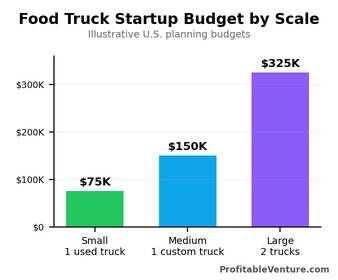
These are planning estimates rather than guaranteed prices. The actual amount you spend will depend on your city, cuisine, truck condition, kitchen equipment, permits, insurance, commissary requirements, and how much working capital you keep available.
b. What are the Costs Involved in Starting a Food Truck Business?
Small-Scale Food Truck Business – Approximately $75,000
- Used food truck – $40,000
- Kitchen repairs, equipment, and modifications – $12,000
- Licenses, permits, inspections, and registrations – $2,000
- Commercial vehicle and liability insurance – $4,000
- POS system, branding, signage, and basic truck graphics – $3,000
- Initial food inventory, packaging, and smallwares – $3,000
- Commissary and parking deposits – $3,000
- Initial working capital reserve – $8,000
- Estimated Total – $75,000.
This setup is suitable for an owner-operated truck with a relatively simple menu and limited staff.
Medium-Scale Food Truck Business – Approximately $150,000
- Newer or professionally built food truck – $85,000
- Kitchen equipment, ventilation, refrigeration, and upgrades – $20,000
- Licenses, permits, plan review, inspections, and registrations – $4,000
- Commercial vehicle, liability, and other insurance – $6,000
- Professional truck wrap, POS, website, and branding – $6,000
- Initial ingredients, packaging, utensils, and smallwares – $5,000
- Commissary and parking deposits – $4,000
- Working capital reserve – $20,000
- Estimated Total – $150,000.
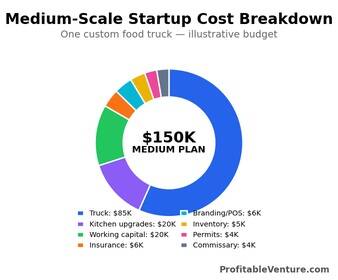
This is the financial model we will use later in the article for the five-year projection.
Large-Scale Food Truck Business – Approximately $325,000
- Two professionally built food trucks – $180,000
- Kitchen equipment and additional buildout – $40,000
- Licenses, permits, inspections, and registrations – $8,000
- Commercial vehicle and liability insurance – $14,000
- Truck wraps, POS systems, website, and branding – $12,000
- Initial food inventory, packaging, and smallwares – $10,000
- Commissary, storage, and parking deposits – $11,000
- Initial payroll, food purchases, repairs, and working capital – $50,000
- Estimated Total – $325,000.
A larger startup should have experienced management and a strong sales plan before purchasing multiple trucks.
Two beautiful food trucks sitting in a parking lot do not create twice the profit. They create twice the equipment that must be kept busy.
c. What Factors Determine the Cost of Starting a Food Truck Business?
- New versus used truck – A new custom vehicle can cost substantially more than a used truck.
- Menu – A coffee truck requires different equipment from a barbecue or fried-food operation.
- Kitchen equipment – Fryers, ovens, refrigeration, generators, hood systems, and fire suppression add to the investment.
- Local regulations – Some cities require more extensive plan reviews, commissary arrangements, or equipment modifications.
- Truck condition – An inexpensive used truck can become costly if the engine, transmission, generator, refrigeration, or plumbing constantly fails.
- Insurance – Premiums depend on location, coverage, driving history, vehicle value, payroll, and business activities.
- Branding – Professional wraps and signage cost more than basic graphics.
- Working capital – You need enough cash to operate during slow periods and handle unexpected repairs.
- Number of trucks – Expanding from one truck to several vehicles increases equipment, staffing, insurance, and inventory needs.
d. Do You Need to Build a Facility? If YES, How Much Will It Cost?
No, you usually do not need to construct a restaurant building to start a food truck business.
However, your local health department may require your truck to use an approved commissary or commercial kitchen.
A commissary can provide facilities for food preparation, ingredient storage, dishwashing, water filling, wastewater disposal, cleaning, and overnight storage.
If a commissary is required, renting approved space is generally more practical for a new operator than building a dedicated commercial kitchen.
You may eventually establish your own commissary if you expand to several trucks or begin producing large quantities of food.
e. What are the Ongoing Expenses of a Food Truck Business?
- Food ingredients
- Beverages
- Disposable packaging
- Employee wages
- Payroll taxes
- Commissary rent
- Parking fees
- Event and festival fees
- Fuel
- Propane
- Generator fuel and maintenance
- Truck repairs
- Kitchen-equipment repairs
- Commercial auto insurance
- General liability insurance
- Workers’ compensation insurance where required
- License and permit renewals
- Merchant processing fees
- POS subscriptions
- Online ordering fees
- Marketing and social media advertising
- Accounting and bookkeeping
- Cleaning products
- Pest-control services where applicable
- Waste disposal
- Phone and internet expenses.
f. What is the Average Salary of Your Staff?
Employee pay varies considerably by state and city, so a nationwide salary figure is not particularly useful for a business plan. A small truck may operate with the owner and one or two employees.
A busier operation may employ a cook, prep worker, cashier, food-truck manager, and additional event staff.
When building your budget, research the prevailing hourly wage in your city and remember that your true labor cost can include payroll taxes, workers’ compensation, overtime, training, uniforms, and employee turnover.
If you work on the truck yourself, do not pretend your labor is free. Include reasonable compensation for your work when deciding whether the business is truly profitable.
g. How Do You Get Funding to Start a Food Truck Business?
- Personal savings
- Small-business loans
- Equipment financing
- Commercial vehicle financing
- Investors or business partners
- Family financing
- Crowdfunding
- Local small-business programs where available
- Leasing a food truck
- Starting with a food trailer or cart before upgrading to a truck
- Reinvesting profits into future expansion.
Do not spend every available dollar on the truck. A food truck with a $100,000 kitchen and no money left for inventory, payroll, marketing, repairs, or slow weeks is not properly funded.
-
Write a Business Plan
a. Executive Summary
Urban Bite Kitchen, LLC is a proposed mobile food business based in Austin, Texas.
The company will operate a professionally equipped food truck serving freshly prepared street-food meals designed for quick service and convenient takeaway.
The primary target markets will include office workers, university communities, brewery customers, festival attendees, families, tourists, and corporate clients.
The business will operate from a carefully planned weekly schedule consisting of regular lunch locations, evening partnerships, weekend events, and private catering opportunities.
Rather than competing through an oversized menu, Urban Bite Kitchen will focus on a limited selection of signature dishes that share ingredients and can be produced consistently and quickly.
The business will generate income from walk-up food sales, catering, festivals, corporate lunches, private events, and selected online orders.
Management will emphasize food safety, portion control, low food waste, fast customer service, location profitability, and strong social media communication.
The long-term objective is to establish a recognizable local brand before considering a second truck, permanent restaurant, commissary kitchen, or packaged food products.
b. Products and Services
Urban Bite Kitchen, LLC may offer:
- Freshly prepared street-food meals
- Signature sandwiches or wraps
- Rice or grain bowls
- Side dishes
- Vegetarian options
- Cold beverages
- Desserts
- Corporate lunch service
- Wedding catering
- Private party catering
- Festival vending
- School and university events
- Brewery and entertainment-venue partnerships
- Preordered group meals.
c. Mission Statement
“At Urban Bite Kitchen, LLC, our mission is to serve fresh, flavorful, and memorable food in a convenient mobile format while delivering friendly service, consistent quality, and responsible food-safety standards wherever our customers gather.”
Vision Statement
“Our vision is to build Urban Bite Kitchen into a recognizable mobile food brand known for great food, fast service, creative locations, and loyal customers, with the potential to expand into additional trucks, catering services, and permanent food-service locations.”
d. Goals and Objectives
The first objective should be to prove that one food truck can operate profitably.
This means identifying profitable locations, developing a menu customers regularly reorder, controlling food costs, reducing waste, maintaining reasonable labor expenses, and building enough demand to support consistent operating hours.
The company should develop several revenue sources rather than relying entirely on street sales.
Private catering and corporate events can help fill days when normal foot traffic is weaker.
Festivals may generate large sales volumes, although vendor fees and staffing costs must be evaluated carefully.
Another major objective is building a customer database and social media following.
Unlike a restaurant, your location may change every day. Customers therefore need an easy way to find you.
Long-term goals may include adding another truck, developing a central commissary, launching packaged sauces, offering franchise opportunities, opening a permanent restaurant, or creating a catering division.
e. Organizational Structure
- Owner/General Manager
- Food Truck Manager
- Head Cook
- Prep Cook
- Cashier/Customer Service Staff
- Event Staff
- Bookkeeper/Accountant
- Marketing and Social Media Assistant.
A new one-truck operation does not need all these employees. The owner can perform several roles and outsource areas such as accounting, payroll, graphic design, and specialized marketing.
Marketing Plan
a. SWOT Analysis
Strengths
A food truck has the ability to move closer to customers instead of waiting for customers to visit a fixed restaurant.
The business can test different neighborhoods, office parks, breweries, and events before committing to permanent locations.
A focused menu also allows a food truck to build a strong identity around a few recognizable dishes.
Lower seating and dining-room requirements can make the operation more flexible than a traditional full-service restaurant.
Weaknesses
Kitchen space is extremely limited. Storage, refrigeration, food preparation, and service must all happen within a small area.
Bad weather can reduce walk-up customers. A truck breakdown can stop both transportation and food sales at the same time.
The business may also depend heavily on permits, parking availability, event schedules, and local vending rules.
Opportunities
Food trucks can pursue opportunities beyond ordinary roadside sales. Corporate catering, weddings, birthdays, sports tournaments, breweries, festivals, school events, apartment communities, and private venues can provide additional income.
A popular truck can also use the mobile business to test concepts before opening a restaurant.
Successful menu items may eventually become packaged products, sauces, frozen foods, or retail merchandise.
Threats
Food inflation, labor shortages, vehicle breakdowns, increased permit costs, bad weather, new competitors, food-safety incidents, poor customer reviews, theft, and changes in local vending regulations can affect the business.
One of the biggest threats is uncontrolled food cost. If ingredient prices rise while menu prices remain unchanged, the truck can become less profitable even when customer traffic remains strong.
b. How Do Food Truck Businesses Make Money?
The main revenue source is direct food and beverage sales. However, relying on walk-up customers alone can make income unpredictable. A food truck can also earn money through:
- Corporate catering
- Private parties
- Weddings
- Festivals
- Concerts
- School events
- Sporting events
- Delivery and preorder services
- Meal packages
- Branded merchandise
- Bottled sauces or packaged products where legally permitted
- Partnerships with breweries and entertainment venues.
The best revenue stream is not always the one producing the biggest sales number.
A large festival may generate impressive revenue but also involve a high vendor fee, additional workers, large inventory purchases, travel expenses, and significant waste.
Evaluate every opportunity based on expected profit rather than sales alone.
c. Payment Options
- Credit cards
- Debit cards
- Cash
- Apple Pay
- Google Pay
- Online ordering
- Gift cards
- Corporate invoicing for approved catering clients.
Fast payment processing is especially important during busy service periods.
If every transaction takes too long, the payment system becomes a bottleneck that limits how many customers the truck can serve.
d. Sales and Advertising Strategies
- Post your daily location on Instagram, Facebook, and TikTok
- Create a simple website with your menu and schedule
- Maintain an accurate Google Business Profile where appropriate
- Use high-quality food photographs
- Partner with breweries and bars
- Target office parks during lunch hours
- Contact corporate event planners
- Attend carefully selected festivals and community events
- Offer catering packages
- Create loyalty rewards
- Collect customer email addresses
- Encourage satisfied customers to post reviews
- Partner with apartment communities
- Offer limited-time menu items
- Use your truck wrap as mobile advertising
- Create referral relationships with wedding and event planners.
Food is extremely visual. A photograph of a great-looking meal can sometimes sell your product more effectively than a paragraph describing it.
Your marketing should therefore show the food, the truck, happy customers, and exactly where people can find you.
Financial Projection
a. How Much Should You Charge for Your Food?
Do not price your menu simply by looking at what another food truck charges.
Calculate what each item actually costs you to produce. Include the ingredients, sauces, toppings, packaging, napkins, utensils, payment-processing fees, and a reasonable allowance for waste.
Then consider labor and overhead. A useful starting formula is:
Selling Price = Food and Packaging Cost ÷ Target Food-Cost Percentage.
However, the final price must also make sense to customers in your market.
If your calculated profitable price is dramatically higher than customers are willing to pay, you may need to redesign the recipe, portion size, supplier arrangement, or entire menu item. Do not keep an unprofitable product merely because customers like it.
b. How Much Revenue Can a Food Truck Business Generate?
Revenue varies widely depending on location, operating days, menu prices, catering activity, events, weather, and customer traffic. For planning purposes, you can use the following ranges:
- Small owner-operated truck: approximately $180,000 to $240,000 in annual gross revenue
- Medium professionally operated truck: approximately $280,000 to $380,000 in annual gross revenue
- Larger two-truck operation: approximately $600,000 to $850,000 in annual gross revenue.
These figures are not guarantees. A food truck operating only a few days each week in a seasonal market may earn substantially less.
For the financial projection in this guide, we will use the $150,000 medium-scale startup model.
The truck is assumed to generate approximately $300,000 in gross revenue during its first full year.
c. Five-Year Revenue and Profit Projection
The projection assumes the food truck gradually improves its locations, builds repeat customers, increases catering sales, improves menu pricing, and controls food waste.
| Fiscal Year | Revenue | Total Expenses | Net Profit | Net Margin |
|---|---|---|---|---|
| Year 1 | $300,000 | $285,000 | $15,000 | 5.0% |
| Year 2 | $340,000 | $320,000 | $20,000 | 5.9% |
| Year 3 | $390,000 | $362,000 | $28,000 | 7.2% |
| Year 4 | $450,000 | $414,000 | $36,000 | 8.0% |
| Year 5 | $520,000 | $474,000 | $46,000 | 8.8% |
Under this example, cumulative five-year revenue would reach approximately $2 million, while cumulative net profit would be approximately $145,000.
The profit figures assume that labor expenses include reasonable compensation for the people actually working in the business.
That distinction matters because an owner who works full-time on the truck should not treat his or her own labor as having no value simply to make the profit figure look larger.
d. Sample Five-Year Profit and Loss Projection
| Item | Year 1 | Year 2 | Year 3 | Year 4 | Year 5 |
|---|---|---|---|---|---|
| Revenue | $300,000 | $340,000 | $390,000 | $450,000 | $520,000 |
| Food and Beverage Cost | $90,000 | $99,000 | $113,000 | $128,000 | $145,000 |
| Labor | $75,000 | $85,000 | $98,000 | $114,000 | $132,000 |
| Commissary and Parking | $18,000 | $19,000 | $20,000 | $22,000 | $24,000 |
| Fuel and Utilities | $14,000 | $15,000 | $17,000 | $19,000 | $21,000 |
| Insurance, Licenses and Permits | $12,000 | $13,000 | $14,000 | $15,000 | $16,000 |
| Vehicle and Equipment Maintenance | $10,000 | $11,000 | $14,000 | $17,000 | $19,000 |
| Payment Processing and Technology | $12,000 | $13,000 | $15,000 | $17,000 | $20,000 |
| Marketing | $9,000 | $10,000 | $12,000 | $14,000 | $16,000 |
| Truck Financing / Depreciation | $25,000 | $25,000 | $25,000 | $25,000 | $25,000 |
| Other Operating and Administrative Expenses | $20,000 | $30,000 | $34,000 | $43,000 | $56,000 |
| Total Expenses | $285,000 | $320,000 | $362,000 | $414,000 | $474,000 |
| Projected Net Profit | $15,000 | $20,000 | $28,000 | $36,000 | $46,000 |
This projection is deliberately conservative. A highly successful truck with excellent locations, strong catering income, a high-margin menu, and disciplined costs could perform better.
A poorly managed operation could lose money despite producing significant sales.
e. How Much Profit Do Food Truck Owners Make a Year?
There is no single reliable income figure that applies to every food truck owner.
Someone operating a paid-off truck personally can have a very different financial result from someone with a large loan, several employees, high event fees, and expensive ingredients.
Using the medium-scale projection in this guide, net business profit begins at approximately $15,000 in Year 1 and grows toward approximately $46,000 in Year 5.
Remember that this projection already includes labor expense. An owner actively working on the truck may therefore receive compensation for his or her labor in addition to the remaining business profit, depending on how the business is structured.
f. What Factors Determine the Amount of Profit to Be Made?
- Number of customers served
- Average customer order value
- Menu pricing
- Food cost
- Food waste
- Portion control
- Labor expenses
- Location quality
- Number of operating days
- Weather
- Event fees
- Commissary expenses
- Vehicle repairs
- Catering income
- Customer service speed
- Social media following
- Repeat business
- Competition.
g. What is the Profit Margin of a Food Truck Business?
Profit margins vary considerably.
Instead of relying on a headline industry percentage, calculate your own net margin every month. Use this formula:
Net Profit Margin = Net Profit ÷ Total Revenue × 100.
The medium-scale model used in this article begins with a projected net margin of approximately 5% and gradually improves toward approximately 9%.
The improvement assumes better purchasing, stronger locations, more catering work, lower waste, repeat customers, and improved operating efficiency.
h. What is the Sales Forecast?
Based on the medium-scale food truck used in our example, the sales forecast is:
- First Fiscal Year: $300,000
- Second Fiscal Year: $340,000
- Third Fiscal Year: $390,000
- Fourth Fiscal Year: $450,000
- Fifth Fiscal Year: $520,000.
The business should not assume sales will automatically increase every year.
Growth will depend on adding profitable locations, catering contracts, better customer retention, efficient menu pricing, and stronger brand awareness.
-
Set Up Your Office
a. How Do You Choose a Perfect Location for a Food Truck Business?
For a food truck, location can change from day to day, which is both an advantage and a challenge. The best location is not necessarily the place with the most people.
It is the place with enough suitable customers, legal permission to operate, convenient parking, reasonable competition, and enough sales potential to justify your time. Consider:
- Office districts with lunch traffic
- Universities and colleges
- Breweries
- Business parks
- Industrial areas
- Tourist destinations
- Food truck parks
- Farmers’ markets
- Apartment communities
- Festivals
- Concert venues
- Sporting events
- Private corporate campuses
- Nightlife districts where vending is permitted.
Test locations before making long-term commitments whenever possible. A location that looks busy may produce poor sales because customers are simply passing through.
b. What State and City is Best to Start a Food Truck Business?
No city is automatically the best. You need a combination of customer demand, favorable weather, reasonable operating costs, manageable regulations, event opportunities, and access to profitable locations.
Markets worth researching include:
- Austin, Texas
- Houston, Texas
- Dallas, Texas
- Portland, Oregon
- Los Angeles, California
- San Diego, California
- Denver, Colorado
- Phoenix, Arizona
- Nashville, Tennessee
- Orlando, Florida.
However, do not choose a city because it appears on a list of “best food truck cities.”
Research local permits, vending restrictions, parking, commissary costs, weather, competition, event opportunities, and customer spending before investing.
c. What Equipment is Needed to Operate a Food Truck Business?
The exact equipment depends on the menu, but you may need:
- Commercial food truck
- Refrigerator
- Freezer
- Prep refrigerator
- Grill
- Flat-top griddle
- Fryer
- Commercial oven
- Microwave where appropriate
- Ventilation hood
- Fire suppression system
- Generator or approved electrical system
- Propane system where applicable
- Fresh-water tank
- Wastewater tank
- Handwashing sink
- Ware-washing sinks
- Food-preparation tables
- Hot-holding equipment
- Food-storage containers
- Shelving
- Knives and utensils
- Thermometers
- POS terminal
- Receipt printer
- Cash drawer
- Fire extinguishers
- First aid kit
- Cleaning and sanitation supplies.
Do not buy equipment before finalizing your menu and speaking with the authority that will inspect your truck.
Every piece of equipment consumes money, electricity, propane, space, cleaning time, and maintenance.
-
Hire Employees
A small food truck can often start with two or three people, including the owner.
One person may handle cooking while another handles assembly, orders, and payments.
During busy events, you may need additional workers for prep, customer service, restocking, and cleanup.
Hire for reliability as much as cooking ability.
A talented employee who regularly arrives late can destroy a food truck’s service schedule.
All employees should be trained in handwashing, avoiding cross-contamination, food temperatures, allergen awareness, sanitation, cleaning procedures, portion control, customer service, and emergency procedures.
Your staff should also learn the menu well enough to work quickly in a small space without constantly getting in one another’s way.
Cross-training is especially valuable.
If your cashier can help assemble orders and your cook understands the POS system, the operation becomes more resilient when someone is absent.
-
Launch the Business Proper
You do not need an extravagant grand opening. In fact, a soft launch is often better for a new food truck.
Invite a manageable number of customers or operate at a smaller event so your team can test the kitchen under real conditions. Watch how long each order takes.
Identify where employees collide with one another, which ingredients run out first, which menu items slow down service, and whether the POS and generator can handle peak demand.
Fix those problems before promoting a massive opening event. Once the operation is running smoothly, announce your regular schedule through social media, your website, email, local partnerships, and event listings.
Your truck’s first customers can become some of your best marketers if they receive great food and friendly service.
a. What Makes a Food Truck Business Successful?
- Great food – Customers must genuinely want to eat your food again.
- Simple menu – A focused menu helps control inventory and improve service speed.
- Fast service – Long waits can destroy lunch-period sales.
- Profitable pricing – Every menu item must contribute toward overhead and profit.
- Good locations – The truck needs to operate where paying customers actually gather.
- Food safety – One serious incident can damage the business permanently.
- Strong branding – Customers should recognize the truck immediately.
- Consistent schedule – Regular customers need to know where to find you.
- Social media communication – Location changes must be communicated clearly.
- Multiple revenue streams – Catering and events reduce dependence on ordinary street traffic.
- Cost control – Food waste and overstaffing can quickly consume profit.
b. What Happens During a Typical Day at a Food Truck Business?
A typical day often begins several hours before the first customer places an order.
The team receives or collects ingredients, prepares sauces and vegetables, portions proteins, stocks beverages, checks refrigeration, loads supplies, fills water tanks, and verifies that the truck is clean and ready.
The driver then moves the truck to its approved location. Before service begins, equipment is turned on, food temperatures are checked, the POS system is prepared, menu boards are displayed, and employees organize their workstations.
When customers arrive, speed becomes extremely important. Orders are taken, payments processed, food prepared, meals assembled, and orders handed to customers while the kitchen constantly restocks ingredients.
During slower periods, workers clean surfaces, replenish supplies, check temperatures, prepare additional ingredients, and update social media.
After service, the team closes the kitchen, stores or disposes of food correctly, cleans equipment, removes waste, records inventory, and returns the truck to its commissary or approved parking location.
The owner may still have bookkeeping, payroll, supplier orders, event applications, social media posts, catering inquiries, menu costing, repairs, and scheduling to handle.
This is why a food truck is not simply “cooking inside a vehicle.” It is a restaurant, delivery vehicle, marketing platform, catering operation, and small business squeezed into one mobile unit.
c. What Skills and Experience Do You Need to Build a Food Truck Business?
- Basic cooking knowledge – You need to understand how your menu is prepared consistently.
- Food safety knowledge – Safe storage, cooking, cooling, reheating, and sanitation are essential.
- Customer service skills – Friendly service encourages reviews and repeat business.
- Financial management – You must understand sales, food cost, labor, cash flow, and profit.
- Inventory management – Too much inventory creates waste while too little causes lost sales.
- Time management – Preparation, travel, service, cleaning, and events must be carefully scheduled.
- Marketing skills – Customers need to know where your truck is and why they should visit it.
- Leadership – A small kitchen requires cooperation and clear direction.
- Menu-development skills – Great food must also be practical to prepare inside the truck.
- Basic vehicle awareness – Mechanical breakdowns can shut down the entire business.
- Negotiation skills – You may negotiate with suppliers, venues, event organizers, and catering clients.
- Adaptability – Weather, events, customer traffic, equipment problems, and ingredient availability can change quickly.
If you have never operated a restaurant or food truck before, lack of experience does not automatically prevent you from succeeding.
What matters is whether you are willing to learn before risking a large amount of money.
Work in a food truck or commercial kitchen if you can. Take food-safety training. Cost your recipes.
Test your menu at small events. Talk to local food truck operators. Visit the health department before buying your vehicle.
Most importantly, learn to think of your menu as a business rather than simply a collection of foods you enjoy cooking.
Every item has to earn its place.
It should be something customers want, something your kitchen can produce efficiently, and something you can sell at a price that leaves enough money to pay your bills and generate a profit.
If you can combine those three things with good locations, strong customer service, careful cost control, and consistent marketing, you can build a food truck business even if you started with no previous industry experience.